
Best Brokers in The US
After extensive tests, we have pinpointed the best brokers for traders in the US – regulated by financial bodies like the CFTC, SEC, NFA or FINRA, and catering to local citizens with domestic markets and accounts based in US dollars.
 Written By
Royston Wild
Royston is a seasoned investor and financial writer with over a decade of experience analyzing brokers and investment markets. With a background in stocks, commodities, and forex reporting - he brings a fresh perspective to broker evaluations.
Royston Wild Profile Page Fact Checked By
Tobias Robinson
Tobias is committed to helping traders find the right brokerage for their needs. He has tested 200+ brokers, spent 2,600+ hours using different platforms, and placed 2,100+ trades.
Tobias Robinson Profile Page Edited By
James Barra
James is an experienced broker analyst with a background in financial services. He has spent 2,500+ hours testing brokers, used 35+ different platforms and apps, audited 120+ broker T&Cs, and verified 300+ regulatory licenses.
James Barra Profile PageApril 1, 2026
-
1Interactive Brokers (IBKR) is a leading brokerage offering access to over 170 markets in 40 countries and a range of investment services. With 40+ years in the industry, this Nasdaq-listed company follows strict regulations by the SEC, FCA, CIRO, and SFC, making it a trusted global trading broker.
-
2NinjaTrader is a US-based brokerage regulated for trading futures. It offers three different pricing plans for varied needs and budgets, along with extremely low margins on popular contracts. The company's renowned charting software and trading platform provides extensive customization options and excellent technical analysis features.
-
3eToro is a platform for social investing that provides options for both short and long-term trading on stocks, ETFs, options, and crypto. The platform is recognized for its easy-to-use, community-oriented interface and reasonable fees. With oversight from FINRA and SIPC, and used by millions globally, eToro is a reputed name in the industry. Trading on eToro is facilitated by eToro USA Securities, Inc.
-
4Plus500US, a broker since 2021 in the US, is authorized by the CFTC and NFA. It offers futures trading in forex, indices, commodities, cryptocurrencies, and interest rates. Sign-up takes 10 minutes with a $100 minimum deposit ($200 by wire transfer). The web platform is simple, enhancing its services for US traders.
-
5OANDA is a well-known broker that excels in quick trade executions, a low deposit requirement, and impressive charting and trading platform functions. The highly-regarded brand has over 25 years of expertise and is overseen by reliable authorities like the NFA/CFTC. It provides 24/7 support for traders and offers flexible contract sizes with automated trade executions.
US Trading Suitability Comparison
See how our top firms cater specifically to traders in the US:
| Broker |  |
USD Account |
CFTC Regulated |
SEC Regulated |
NFA Regulated |
FINRA Regulated |
Extended Hours On US Markets |
|---|---|---|---|---|---|---|---|
 |
✓ | ✓ | ✓ | ✓ | ✓ | ✓ | |
 |
✓ | ✓ | ✗ | ✓ | ✗ | ✗ | |
 |
✓ | ✗ | ✓ | ✗ | ✓ | ✓ | |
 |
✓ | ✓ | ✗ | ✓ | ✗ | ✗ | |
 |
✓ | ✓ | ✗ | ✓ | ✗ | ✗ | |
| Broker | |
USD Account |
CFTC Regulated |
SEC Regulated |
NFA Regulated |
FINRA Regulated |
Extended Hours On US Markets |
Broker Details Comparison
| Broker | Demo Account |
Minimum Deposit |
Minimum Trade |
Leverage |
Assets |
Platforms |
|---|---|---|---|---|---|---|
|
✓ | $0 | $100 | 1:50 (major forex pairs), 1:2-1:4 (equities) | Stocks, Options, Futures, Forex, Funds, Bonds, ETFs, Mutual Funds, Cryptocurrencies, CFDs Stocks, Options, Futures, Forex, Funds, Bonds, ETFs, Mutual Funds, Cryptocurrencies | Trader Workstation (TWS), IBKR Desktop, GlobalTrader, Mobile, Client Portal, AlgoTrader, OmniTrader, TradingView, eSignal, TradingCentral, ProRealTime, Quantower |
|
✓ | $0 (live trades must meet intraday margin minimums, e.g., $50 to trade micro contracts) | 0.01 Lots | $50 intraday margins for Micro contracts and $500 for popular E-mini contracts | Futures, Forex, Stocks, Options, Commodities, Futures, Crypto (non-futures depend on provider) | NinjaTrader Desktop, Web & Mobile, eSignal |
|
✓ | $100 | $10 | ✗ | Stocks, Options, ETFs, Crypto | eToro Trading Platform & CopyTrader |
|
✓ | $100 | Variable | Variable | Futures on Cryptocurrencies, Metals, Agriculture, Forex, Interest rates, Energy, Equity Index future contracts | WebTrader, App |
|
✓ | $0 | 0.01 Lots | 1:50 | Forex, Crypto with Paxos (Cryptocurrencies are offered through Paxos. Paxos is a separate legal entity from OANDA) | OANDA Trade, MT4, TradingView, AutoChartist |
| Broker | Demo Account |
Minimum Deposit |
Minimum Trade |
Leverage |
Assets |
Platforms |
How Safe Are The Top Brokers In The US?
While US regulators are amongst the strictest in the world, it's still important to consider the account-level safeguards available:
| Broker | Trust Rating |
Guaranteed Stop Loss |
Negative Balance Protection |
Segregated Accounts |
|---|---|---|---|---|
|
✗ | ✓ | ✓ | |
|
✗ | ✗ | ✓ | |
|
✗ | ✗ | ✓ | |
|
✗ | ✗ | ✓ | |
|
✗ | ✗ | ✗ | |
| Broker | Trust Rating |
Guaranteed Stop Loss |
Negative Balance Protection |
Segregated Accounts |
Mobile Trading Comparison
Traders in the US, like the rest of the world, are increasingly trading stocks and other securities from their palms - here's how our top providers perform on the go:
| Broker | Mobile Apps |
iOS Rating |
Android Rating |
Smart Watch App |
|---|---|---|---|---|
|
iOS & Android | ✓ | ||
|
iOS & Android | ✗ | ||
|
iOS & Android | ✗ | ||
|
iOS & Android | ✗ | ||
|
iOS & Android | ✗ | ||
| Broker | Mobile Apps |
iOS Rating |
Android Rating |
Smart Watch App |
Comparison for Beginners
Compare how suitable the Best Brokers in The US are for beginners.
| Broker | Demo Account |
Minimum Deposit |
Minimum Trade |
Education Rating |
Support Rating |
Fractional Shares |
Demo Competitions |
|---|---|---|---|---|---|---|---|
|
✓ | $0 | $100 | ✓ | ✗ | ||
|
✓ | $0 (live trades must meet intraday margin minimums, e.g., $50 to trade micro contracts) | 0.01 Lots | ✗ | ✗ | ||
|
✓ | $100 | $10 | ✓ | ✗ | ||
|
✓ | $100 | Variable | ✗ | ✗ | ||
|
✓ | $0 | 0.01 Lots | ✗ | ✗ | ||
| Broker | Demo Account |
Minimum Deposit |
Minimum Trade |
Education Rating |
Support Rating |
Fractional Shares |
Demo Competitions |
Comparison for Advanced Traders
Compare how suitable the Best Brokers in The US are for advanced or professional traders.
| Broker | Automated Trading |
VPS |
API |
AI |
Pro Account |
Leverage |
Low Latency |
Extended Hours |
|---|---|---|---|---|---|---|---|---|
|
Capitalise.ai, TWS API | ✗ | ✗ | ✓ | ✗ | 1:50 (major forex pairs), 1:2-1:4 (equities) | ✓ | ✓ |
|
NinjaScript or via Automated Trading Interface | ✗ | ✗ | ✗ | ✗ | $50 intraday margins for Micro contracts and $500 for popular E-mini contracts | ✓ | ✗ |
|
✗ | ✗ | ✗ | ✗ | ✗ | ✗ | ✓ | ✓ |
|
✗ | ✗ | ✗ | ✗ | ✗ | Variable | ✓ | ✗ |
|
Expert Advisors (EAs) on MetaTrader | ✗ | ✗ | ✓ | ✗ | 1:50 | ✓ | ✗ |
| Broker | Automated Trading |
VPS |
API |
AI |
Pro Account |
Leverage |
Low Latency |
Extended Hours |
Accounts Comparison
Compare the trading accounts offered by Best Brokers in The US.
| Broker | Demo Account |
Interest on Cash |
Islamic Account |
Joint Account |
Managed Account |
PAMM |
MAM |
LAMM |
Pro Account |
|---|---|---|---|---|---|---|---|---|---|
|
✓ | USD: 3.14%, GBP: 3.24% | ✗ | ✓ | ✓ | ✗ | ✓ | ✗ | ✗ |
|
✓ | ✗ | ✗ | ✓ | ✗ | ✗ | ✗ | ✗ | ✗ |
|
✓ | USD: 4.05% | ✗ | ✗ | ✓ | ✗ | ✗ | ✗ | ✗ |
|
✓ | ✗ | ✗ | ✗ | ✗ | ✗ | ✗ | ✗ | ✗ |
|
✓ | ✗ | ✗ | ✗ | ✗ | ✗ | ✗ | ✗ | ✗ |
| Broker | Demo Account |
Interest on Cash |
Islamic Account |
Joint Account |
Managed Account |
PAMM |
MAM |
LAMM |
Pro Account |
Compare The Ratings Of Our Top US Trading Brokers
See how our best brokers for US traders scored in each core area following our hands-on tests:
| Broker | Trust |
Platforms |
Assets |
Mobile |
Fees |
Accounts |
Research |
Education |
Support |
|---|---|---|---|---|---|---|---|---|---|
|
|||||||||
|
|||||||||
|
|||||||||
|
|||||||||
|
|||||||||
| Broker | Trust |
Platforms |
Assets |
Mobile |
Fees |
Accounts |
Research |
Education |
Support |
Fee and Cost Comparison
Compare the cost of trading with the Best Brokers in The US.
| Broker | Cost Rating |
Fixed Spreads |
Inactivity Fee |
EUR/USD Spread |
Crypto Spread |
|---|---|---|---|---|---|
|
✗ | $0 | 0.08-0.20 bps x trade value | 0.12%-0.18% | |
|
✗ | $35 | 1.3 | Floating | |
|
✓ | $10 | ✗ | BTC 0.75% | |
|
✗ | $0 | 0.75 | ✗ | |
|
✗ | $0 | 1.6 | $100 | |
| Broker | Cost Rating |
Fixed Spreads |
Inactivity Fee |
EUR/USD Spread |
Crypto Spread |
Broker Popularity
US traders are often drawn to brokerage firms with a large client base as a sign of reliability. Here's how many traders our top firms have:
| Broker | Popularity |
|---|---|
| Plus500US |
|
| Interactive Brokers |
|
| eToro USA |
|
| NinjaTrader |
|
Why Trade With Interactive Brokers?
Interactive Brokers is ideal for seasoned traders due to its robust charting platforms, updated data, and adaptability, especially with the IBKR Desktop application. Its exceptional pricing and advanced order features appeal to traders, and its variety of stocks remains unmatched in the market.
Pros
- The new IBKR Desktop platform combines the advantages of TWS and adds unique tools like Option Lattice and Screeners with MultiSort to make trading accessible and impressive for traders of all levels.
- The TWS platform is designed for intermediate to advanced traders. It includes over 100 order types and a dependable real-time market data feed that rarely experiences downtime.
- There's a large selection of free or paid research subscriptions available to all traders. If you subscribe to Toggle AI, you will also receive commission refunds from IBKR.
Cons
- Customer service may take time to respond, and there may be delays in fixing problems based on tests. It could be difficult to reach the customer service promptly.
- Only one active session per account is allowed, which means you can't run the desktop version and mobile app at the same time. This can sometimes lead to a frustrating trading experience.
- In 2025, IBKR was fined $11.8 million by the US OFAC for offering services in restricted areas. It also faced a $125,000 fine from FINRA in 2025 for failing to disclose municipal bond information.
Why Trade With NinjaTrader?
NinjaTrader consistently satisfies active futures traders with its low-cost service and high-quality analysis tools. It offers superior charting features, including hundreds of indicators and over 10 chart types.
Pros
- Nano contracts, which are one-hundredth the size of standard contracts, let traders adjust positions precisely and manage risks on a smaller scale. This is beneficial for those who build positions gradually.
- The market replay feature lets you download tick-by-tick historical data, go back to any date, and interact with it as if trading live. It's useful for strategy testing and real-world practice.
's ecosystem offers traders access to thousands of add-ons and applications from developers in over 150 countries. These include indicators, strategies, and custom tools that extend the platform's native features.
Cons
- Intraday margin requirements can increase up to four times in the 15 minutes before major economic news releases and may remain high for several minutes after volatility decreases. This can surprise unprepared traders at critical times.
- Traders who need fundamental data research must find other sources, as the platform mainly focuses on technical analysis and lacks information on company or macro fundamentals.
- NinjaTrader was bought by Kraken in May 2025. Although it still operates independently, traders concerned about long-term stability may worry about changes in the platform's direction and pricing under new ownership.
Why Trade With eToro USA?
eToro is a top choice for traders due to its top-notch social investing and copy trading services. The broker caters well to new traders with its low deposit requirement, commission-free trading, and user-friendly platform.
Pros
- Traders can use Smart Portfolios for a simpler approach, covering multiple sectors and markets like renewable energy and artificial intelligence.
- eToro USA Securities is a reliable broker that's regulated by the SEC, part of FINRA, and a member of SIPC.
- A free demo account enables new users and potential traders to test the broker without risk.
Cons
- There are fewer trading options available, including only stocks, ETFs, and cryptos, compared to competitors.
- Average fees can reduce the profits of traders.
- Traders used to third-party charting tools won't find MetaTrader 4 platform integration.
Why Trade With Plus500US?
Plus500US is a great option for beginners with its easy-to-use platform and access to the Futures Academy to improve trading skills. It received second place in DayTrading.com's 'Best US Broker' award for its strong tools and dependable service.
Pros
- The account setup, pricing structure, and web platform make futures trading simpler than competitors like NinjaTrader.
- Plus500 is a reputable publicly traded company with over 24 million traders and sponsors the Chicago Bulls.
- Plus500 included prediction markets in its 'Plus500 Futures' platform in February 2026. This addition offers event-based trades in 10 categories, such as financials and politics, and includes short-term intraday contracts expiring in 15 minutes.
Cons
- Plus500US is expanding its investment options, but it currently only offers around 50+ futures and no stocks.
- Plus500US offers competitive pricing but does not have a discount program for high-volume traders, unlike brokers like Interactive Brokers.
- The private trading platform is easy to use, but doesn't have the advanced analysis tools that platforms like MetaTrader 4 do.
Why Trade With OANDA US?
OANDA is a reputable broker for US traders. It offers user-friendly tools for analysis and a simple sign-up process. It is very trustworthy due to heavy regulation.
Pros
- Experienced traders can use top-notch tools like an MT4 premium upgrade and advanced charting from MotiveWave.
- The OANDA web platform offers an exceptional charting environment with over 65 technical indicators provided by TradingView.
- There's a robust selection of 68 currency pairs for committed forex traders focusing on short-term trades.
Cons
- In 2025, the NFA fined OANDA $600,000 for compliance issues.
- Few payment options are available and e-wallets are not supported.
- The trading markets are limited to only forex and cryptocurrencies.
Filters
How We Chose The Best Brokers For Traders In The US
To earn a place in our list of leading trading providers for US traders:
- Brokers had to be authorized by a US regulator like the CFTC, SEC, NFA, or FINRA. This was a non-negotiable to ensure we only show trusted providers that should follow US rules designed, in part, to protect market participants, including retail investors. We confirmed the regulatory credentials of every broker listed above on the respective regulator’s database.
- Brokers had to offer a trading account based in US dollars (USD). This makes deposits, withdrawals and account management smoother for US citizens. We confirmed this was the case by either going through the account opening process or confirming directly with brokers’ support teams. That said, US traders may still need to pay a foreign exchange conversion fee if they buy and sell foreign securities.
- Brokers had to offer US-related financial markets. These could be access to stocks on domestic exchanges and indices like the Nasdaq, New York Stock Exchange, or S&P 500, currency pairs containing the US dollar, or US bonds like Treasury Bills. We fired up brokers’ platforms to check they offer domestic US markets. Most brokerages listed also provides access to global financial markets.
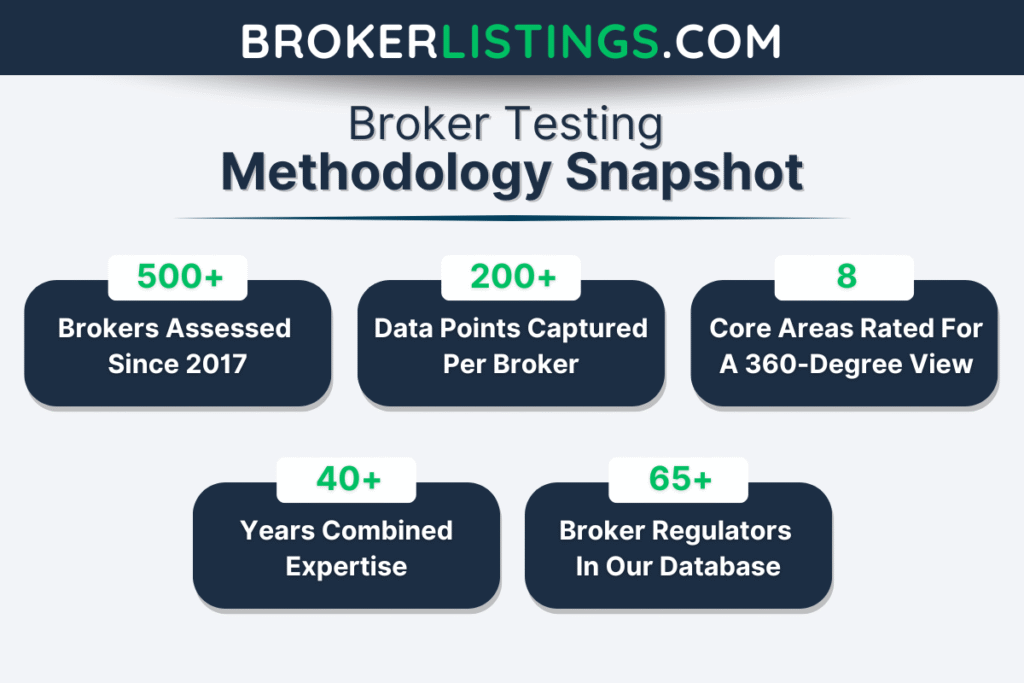
- We applied our rigorous testing methodology – with our experienced traders and brokerage experts running tests across 8 core areas, recording over 200 data points per provider, and documenting their hands-on observations, which all feed into our brokers’ overall ratings, which firms were ultimately ranked by.
What To Look For In A Brokerage As A US Trader
US citizens are some of the most active investors on the planet. According to Gallup, around 62% of Americans invest in the stock market by owning shares directly, through a stock mutual fund, or in a self-directed 401 (k) or Individual Retirement Account (IRA).
As a result of this high participation, there’s been a boom in the number of investment and trading platforms in recent years. In some ways this is good – giving traders more choice, but taking time to select the right broker for you is critical.
We’ve learned through our tests that market access and the quality of trading tools, size of fees, and more, can vary significantly among companies. This can impact not only your bottom line, but your satisfaction and enjoyment.
To help you find the right broker, we’ve boiled it down to several questions:
Can I Trust The Broker?
Knowing that you can trust the company you’re considering with your money and your personal information is paramount. The growth of online trading has led to an explosion in the number of bad actors in operation alongside established, reputable firms.
As a consequence, it’s critical to check that the brokerage is licensed by a reputable US regulator, such as:
- The Commodity Futures Trading Commission (CFTC)
- The Securities and Exchange Commission (SEC)
- The National Futures Association (NFA)
- The Financial Industry Regulatory Authority (FINRA)
BrokerListings.com’s Regulator Ranking System grades the world’s major watchdogs according to the safeguards they provide investors, ranked from Category A to C. All of the US regulators listed above are classed as ‘Category A’.
Choosing a brokerage authorized by one of these bodies cannot only help protect you against fraud, but also means you can expect a good level of service and protection if the operator goes bust. For example, with securities brokerage accounts at some SEC-authorized firms (depending on membership and product), US retail investors can have a form of ‘compensation’ if their broker fails, known as SIPC protection. If a SIPC-member broker-dealer goes bankrupt and customer assets are missing, SIPC works to return customer securities and cash, and can return funds of up to $500,000 per customer, including up to $250,000 for cash. Cash held for commodity trades aren’t protected.
You can also check any brokerage you’re planning on using has not been flagged by regulators for soliciting US citizens without appropriate authorization. You can turn to the CFTC Red List for this, which contains hundreds of such firms.
Pro tip: Start with small deposits when using a new broker and test their withdrawals process and support before depositing large sums.
Top broker for trustworthiness: OANDA US is sits amongst out most trusted brokers for traders in the United States having been operating since 1996, earning the trust of our team during testing, and in the US is CFTC-registered and a member of the NFA (ID 0325821).
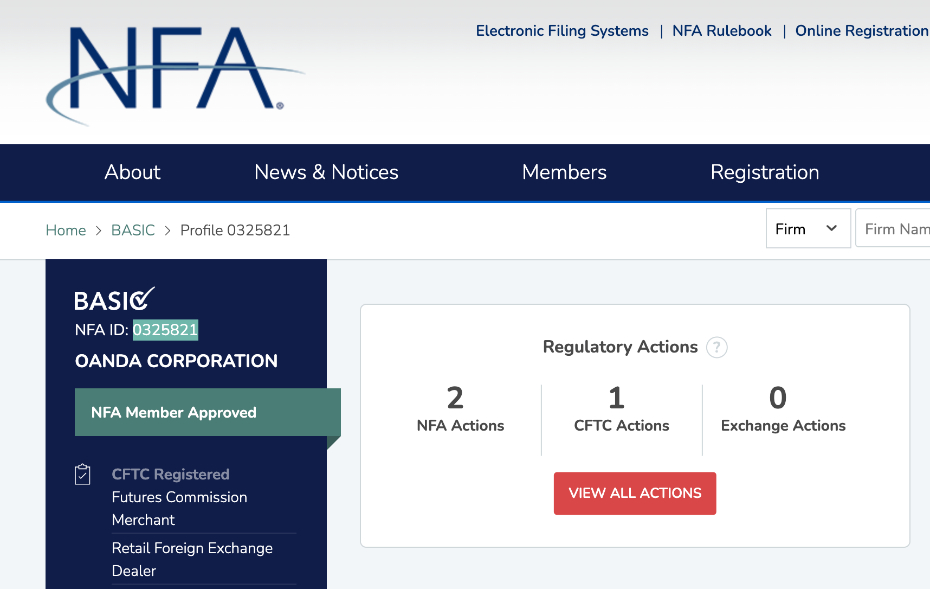
OANDA Corporation on the NFA database
Which Markets Can I Invest In?
Most reputable brokerages we’ve tested offer trading of US shares on exchanges like the New York Stock Exchange and Nasdaq, as well as major currency pairings involving the US dollar like the EUR/USD and GBP/USD.
Many top brokers also offer a comprehensive suite of global shares and other forex pairs, alongside other financial securities like commodities, cryptocurrencies and exchange-traded funds (ETFs) – providing opportunities to diversify portfolios beyond US markets.
In addition, derivative instruments – like futures and options, where investors open a position without owning any underlying asset – can be used to trade certain markets, and are available at some US firms.
Interest in prediction markets has also picked up in the US – providing options on financial markets but also a broader set of events, from sports and elections to entertainment. The number of prediction markets websites is growing.
Top broker for range of markets: Interactive Brokers excels in this department, offering access to more than 10,000 US shares and ETFs, along with fractional shares allowing investors on tight budgets to build diversified portfolios with less capital. Interactive Brokers also offers a huge range of stocks from global exchanges, as well as a large selection of currency pairings, commodities, funds, bonds, cryptocurrencies and derivatives, plus prediction markets through its ForecastTrader.
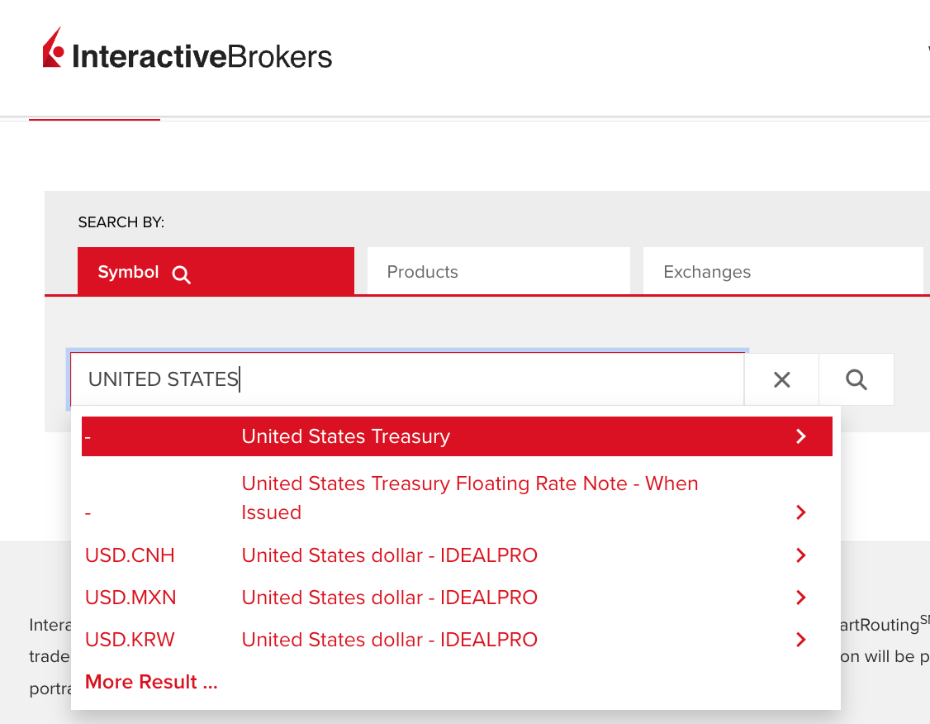
Interactive Brokers has a user-friendly product search function for finding US and global assets
What Are The Trading Costs?
The cost of investing among different brokers can also be vast. Some companies offer a more extensive service than others, providing additional features like educational resources, premium trading platforms, and richer market data. For investors who value these extras, the larger costs may be worthwhile.
That said, the market is ultra-competitive from a cost perspective. What’s more, even brokerages with lower charges can still offer a great service, or one better than some of the more premium operators. So it pays to shop around. This is especially true for short-term trading styles like day trading, where higher, frequent costs can erode returns.
There’s also been a trend towards commission-free brokerages in the US, which remove some transaction costs, keeping pricing transparent and attractive for newer traders especially.
Important costs to consider include:
- Transaction charges
- Account management fees
- Deposit and withdrawal charges
- Inactivity fees
Regulatory charges may also be passed onto to traders by brokers, such as the FINRA Trading Activity Fee (TAF) on sales, and historically the SEC Section 31 fee on covered sales, though in May 2025 this was effectively lowered to $0.00.
Be mindful that some brokers may offer lower headline charges like those above, but make up for it with wider bid (buy) and ask (sell) spreads. That said, larger spreads are unlikely to be a major problem for long-term investors.
Pro tip: Top brokers offer investing accounts that are denominated in US dollars. These can have substantial advantages for investors, including protection from currency conversion costs and simplifying the buying and selling of US-listed assets.
Top broker for trading costs: eToro USA has a super transparent pricing structure, with zero commission on transactions involving US equities. Spreads and other charges are also highly competitive, including no deposit charges, though there is a $10 inactivity fee after 12 months.
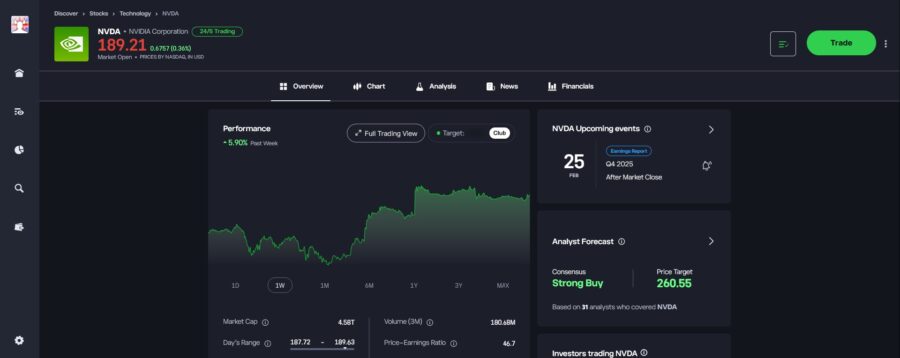
eToro Platform With US Tech Stock
How Good Are The Trading Tools?
Most brokers today offer sophisticated and responsive trading platforms that appeal to both novice and experienced investors. However, the best one for you will depend on personal taste – such as how much you want to customize menus, and what color schemes and fonts you like – and what resources you need. Does the software offer advanced charting tools, for instance?
No dealing platform is the same, so it could be worth testing it via a demo trading account before committing (most US brokers we’ve tested offer free demo accounts). Be aware that firms often only allow investors to road test for a limited period of time.
Important questions to ask when considering a company’s trading platform include:
- How easy is it to place trades and monitor my portfolio?
- Are dashboards showing information like holdings, portfolio performance, dividends easy to access and understand?
- Is the platform stable, especially during busy trading periods?
- Does the platform offer AI trading tools like pattern recognition features?
- Can I access a wide range of research materials, including market news, analyst reports and investment guides?
- Does the platform offer alerts for price changes, dividends, shareholder actions and so on?
- Can I build customizable watchlists and use stock screeners to track and identify potential investments?
- Does the system offer strong security features like two-factor authentication for signing in, and account activity monitoring?
- Is there a mobile trading app so I can track markets, place trades, and manage my portfolio on the go?
Top broker for trading platform: Plus500 USA offers an excellent proprietary system for US citizens of different levels of experience, notably those interested in futures trading. It offers real-time market data, sophisticated charting tools, analyst insights and on a platform that’s fast, easy to navigate and highly customizable. Plus500 also offers trading on a dedicated mobile app.
Bottom Line
The online brokerage account marketplace is extremely competitive, which works to the advantage of US investors and traders. Take the time to find the best broker that works for you based on items like investing costs, trading platform, and the range of available securities.
And most importantly, take time to check that the brokerage is reputable using the online company database of one or more respected global regulators, like the CFTC, SEC, NFA or FINRA.
FAQ
Who Regulates Trading Brokerages In The US?
There are several chief regulators that oversee retail brokerages:
- Commodity Futures Trading Commission (CFTC): Regulates derivatives markets, especially futures, swaps, and retail forex, and the firms that offer them (e.g., FCMs, RFEDs, IBs). CFTC focuses on market integrity, leverage/margin rules, and customer protections like segregation for futures.
- National Futures Association (NFA): The industry self-regulator for the CFTC-regulated side of the market, i.e. futures and forex. It sets day-to-day compliance standards for members, audits and enforces conduct, and runs the public NFA BASIC database with firm registration status and disciplinary history.
- Securities and Exchange Commission (SEC): Regulates securities markets and firms that offer stocks, ETFs, bonds, options, and mutual funds. SEC sets and enforces the core federal rules for broker-dealers and investor disclosures.
- Financial Industry Regulatory Authority (FINRA): The main front-line supervisor for retail broker-dealers (a self-regulatory organization overseen by the SEC). It handles broker licensing, conduct rules, sales and marketing enforcement, and provides the public BrokerCheck database.
What Trading Account Do I Need?
US brokers offer different types of accounts depending on what you want to trade, how much risk you’re taking, and whether you want tax advantages.
- Individual taxable brokerage account: Best for most people who want maximum flexibility to trade and invest in stocks, ETFs, options, bonds, with no contribution limits, although you may owe taxes on dividends and interest and realized gains.
- Cash account: Best for beginners and long-term investors who don’t want leverage as you trade only with settled funds, though it can be slower for frequent trading.
- Margin account: Best for experienced stock and options traders who want to borrow against their portfolio for leverage and short selling, but it’s higher risk and subject to margin requirements and possible forced liquidation.
- Joint account: Best for two people (e.g., spouses) who want shared ownership and management of investments, it’s usually taxable like a standard brokerage account.
- Custodial account: Best for investing for a child whereby an adult controls it until the child reaches the age of majority, and the assets legally become the child’s.
- Managed account: Best if you want hands-off investing – you’re paying for portfolio management which can be a human advisor or increasingly automated through a roboadvisor, usually focused on long-term goals.
- IRA (Traditional/Roth): Best for long-term investors focused on retirement with tax advantages like deduction or tax-free growth depending on type, though withdrawals have rules and you generally can’t use high-risk features like margin in the same way.