
Best Brokers For Regulation And Safety 2026
Explore our list of the top brokers that ensure trader safety, selected for their regulatory licenses, transparency, fund protection, and trustworthy environments.
 Written By
Royston Wild
Royston is a seasoned investor and financial writer with over a decade of experience analyzing brokers and investment markets. With a background in stocks, commodities, and forex reporting - he brings a fresh perspective to broker evaluations.
Royston Wild Profile Page Fact Checked By
Tobias Robinson
Tobias is committed to helping traders find the right brokerage for their needs. He has tested 200+ brokers, spent 2,600+ hours using different platforms, and placed 2,100+ trades.
Tobias Robinson Profile Page Edited By
James Barra
James is an experienced broker analyst with a background in financial services. He has spent 2,500+ hours testing brokers, used 35+ different platforms and apps, audited 120+ broker T&Cs, and verified 300+ regulatory licenses. James has also been on US and UK TV, and been a guest on finance podcasts, discussing reports conducted by BrokerListings.com and sharing his expertise.
James Barra Profile PageAugust 18, 2026
-
1Founded in 2001, FOREX.com is part of StoneX, a global financial services firm with over a million customers. Regulated in the US, UK, EU, Australia, and other regions, it offers thousands of markets, not just forex, with competitive pricing on advanced platforms.
-
2Interactive Brokers (IBKR) is a leading brokerage offering access to over 170 markets in 40 countries and a range of investment services. With 40+ years in the industry, this Nasdaq-listed company follows strict regulations by the SEC, FCA, CIRO, and SFC, making it a trusted global trading broker.
Read More
-
3Firstrade is a US-based discount broker-dealer authorized by the SEC and a member of FINRA/SIPC. It offers welcome bonuses, advanced tools and apps, and commission-free trading. Firstrade Securities is a popular top online brokerage, and opening a new account is fast and simple.
-
4Moomoo is a regulated trading platform overseen by trusted regulators like the SEC. It provides a simple, cost-effective method to trade in stocks, ETFs, and various assets from China, Hong Kong, Singapore, the US, and Australia. They provide the option for margin trading, along with no minimum deposit requirement, and several bonus options.
Read More
-
5NinjaTrader is a US-based brokerage regulated for trading futures. It offers three different pricing plans for varied needs and budgets, along with extremely low margins on popular contracts. The company's renowned charting software and trading platform provides extensive customization options and excellent technical analysis features.
Most Trusted Brokers Compared
| Broker |  |
USD Account |
Demo Account |
Minimum Deposit |
Minimum Trade |
Leverage |
Copy Trading |
Regulator |
Instruments |
Platforms |
Account Currencies |
Automated Trading |
AI |
Guaranteed Stop Loss |
|---|---|---|---|---|---|---|---|---|---|---|---|---|---|---|
 |
✓ | ✓ | $100 | 0.01 Lots | 1:50 | ✗ | NFA, CFTC | Forex, Futures and Options on Metals, Energies, Commodities, Indices, Bonds Forex, CFDs, Stock CFDs, Indices, Commodities, Futures, Options, Crypto | WebTrader, Mobile, MT4, MT5, TradingView | USD, EUR, GBP, CAD, AUD, JPY, CHF, PLN | Expert Advisors (EAs) on MetaTrader | ✓ | ✗ | |
 |
✓ | ✓ | $0 | $1 | 1:50 (major forex pairs), 1:2-1:4 (equities) | ✗ | SEC, FINRA, CFTC, NFA, CIRO, FCA, CBI, ASIC, SFC, SEBI, JFSA, MAS | Stocks, Options, Futures, Forex, Funds, Bonds, ETFs, Mutual Funds, Cryptocurrencies, CFDs Stocks, Options, Futures, Forex, Funds, Bonds, ETFs, Mutual Funds, Cryptocurrencies | Trader Workstation (TWS), IBKR Desktop, GlobalTrader, Mobile, Client Portal, AlgoTrader, OmniTrader, TradingView, eSignal, TradingCentral, ProRealTime, Quantower | USD, EUR, GBP, CAD, AUD, INR, JPY, SEK, NOK, DKK, CHF, AED, HUF | TWS API | ✓ | ✗ | |
 |
✓ | ✗ | $0 | $5 | 1:2 | ✗ | SEC, FINRA | Stocks, ETFs, Options, Mutual Funds, Bonds, Fixed | Firstrade Invest 3.0, TradingCentral | USD | ✗ | ✓ | ✗ | |
 |
✓ | ✓ | $0 | $0 | 1:2 | ✗ | SEC, FINRA, SIPC, MAS, SFC, ASIC, FMA, CIRO, CIPF, JFSA, SC | Stocks, Options, ETFs, ADRs, OTCs ,Futures | Desktop Platform, Mobile App | USD, CAD, AUD, JPY, MYR, HKD, SGD, CNY | Moomoo OpenAPI | ✓ | ✗ | |
 |
✓ | ✓ | $0 (live trades must meet intraday margin minimums, e.g., $50 to trade micro contracts) | 1 contract | $50 intraday margins for Micro contracts and $500 for popular E-mini contracts | ✗ | NFA, CFTC, CySEC | Futures, Forex, Stocks, Options, Commodities, Futures, Crypto (non-futures depend on provider) | NinjaTrader Desktop, Web & Mobile, eSignal | USD, EUR, GBP, CAD, AUD | NinjaScript or via Automated Trading Interface | ✗ | ✗ | |
| Broker | |
USD Account |
Demo Account |
Minimum Deposit |
Minimum Trade |
Leverage |
Copy Trading |
Regulator |
Instruments |
Platforms |
Account Currencies |
Automated Trading |
AI |
Guaranteed Stop Loss |
How Do The Top Brokers For Safety Protect Your Funds?
Explore the investor protections and fund safeguards of the most well-regulated brokers:
| Broker | Trust Rating |
Guaranteed Stop Loss |
Negative Balance Protection |
Segregated Accounts |
|---|---|---|---|---|
|
✗ | ✗ | ✓ | |
|
✗ | ✗ | ✓ | |
|
✗ | ✗ | ✓ | |
|
✗ | ✗ | ✓ | |
|
✗ | ✗ | ✓ | |
| Broker | Trust Rating |
Guaranteed Stop Loss |
Negative Balance Protection |
Segregated Accounts |
Mobile App Trading Compared
We ran hands-on tests of the mobile platforms from leading brokers for safety and security:
| Broker | Mobile Apps |
iOS Rating |
Android Rating |
Smart Watch App |
|---|---|---|---|---|
|
iOS & Android | ✗ | ||
|
iOS & Android | ✓ | ||
|
iOS & Android | ✗ | ||
|
Yes (iOS & Android) | ✗ | ||
|
iOS & Android | ✗ | ||
| Broker | Mobile Apps |
iOS Rating |
Android Rating |
Smart Watch App |
Are The Safest Trading Platforms Suitable For Beginners?
Strong regulation and safety can mean a smoother, secure start. Discover what beginner traders can expect from top platforms:
| Broker | Demo Account |
Minimum Deposit |
Minimum Trade |
Education Rating |
Support Rating |
Fractional Shares |
Demo Competitions |
|---|---|---|---|---|---|---|---|
|
✓ | $100 | 0.01 Lots | ✗ | ✗ | ||
|
✓ | $0 | $1 | ✓ | ✗ | ||
|
✗ | $0 | $5 | ✓ | ✗ | ||
|
✓ | $0 | $0 | ✓ | ✗ | ||
|
✓ | $0 (live trades must meet intraday margin minimums, e.g., $50 to trade micro contracts) | 1 contract | ✗ | ✗ | ||
| Broker | Demo Account |
Minimum Deposit |
Minimum Trade |
Education Rating |
Support Rating |
Fractional Shares |
Demo Competitions |
Are The Top Trading Platforms For Safety Suitable For Advanced Traders?
Professionals often rely on highly trusted, regulated brokers for capital protection and assurance. Here’s how the top brokers serve experienced users:
| Broker | Automated Trading |
VPS |
API |
AI |
Pro Account |
Leverage |
Low Latency |
Extended Hours |
|---|---|---|---|---|---|---|---|---|
|
Expert Advisors (EAs) on MetaTrader | ✓ | ✓ | ✓ | ✗ | 1:50 | ✓ | ✗ |
|
TWS API | ✗ | ✓ | ✓ | ✗ | 1:50 (major forex pairs), 1:2-1:4 (equities) | ✓ | ✓ |
|
✗ | ✗ | ✗ | ✓ | ✗ | 1:2 | ✗ | ✓ |
|
Moomoo OpenAPI | ✗ | ✓ | ✓ | ✗ | 1:2 | ✓ | ✓ |
|
NinjaScript or via Automated Trading Interface | ✗ | ✗ | ✗ | ✗ | $50 intraday margins for Micro contracts and $500 for popular E-mini contracts | ✓ | ✗ |
| Broker | Automated Trading |
VPS |
API |
AI |
Pro Account |
Leverage |
Low Latency |
Extended Hours |
Accounts Comparison
Compare the trading accounts offered by Best Brokers For Regulation And Safety 2026.
| Broker | Demo Account |
Interest on Cash |
Islamic Account |
Joint Account |
Managed Account |
PAMM |
MAM |
LAMM |
Pro Account |
|---|---|---|---|---|---|---|---|---|---|
|
✓ | ✗ | ✓ | ✗ | ✗ | ✗ | ✗ | ✗ | ✗ |
|
✓ | USD: 3.14%, GBP: 3.24% | ✗ | ✓ | ✓ | ✗ | ✓ | ✗ | ✗ |
|
✗ | ✗ | ✗ | ✓ | ✗ | ✗ | ✗ | ✗ | ✗ |
|
✓ | USD: 3.35% | ✗ | ✗ | ✗ | ✗ | ✗ | ✗ | ✗ |
|
✓ | ✗ | ✗ | ✓ | ✗ | ✗ | ✗ | ✗ | ✗ |
| Broker | Demo Account |
Interest on Cash |
Islamic Account |
Joint Account |
Managed Account |
PAMM |
MAM |
LAMM |
Pro Account |
Compare Detailed Ratings Of The Most Trusted Brokers
See how brokers with top-tier regulation scored in every category during our testing process:
| Broker | Trust |
Platforms |
Assets |
Mobile |
Fees |
Accounts |
Research |
Education |
Support |
|---|---|---|---|---|---|---|---|---|---|
|
|||||||||
|
|||||||||
|
|||||||||
|
|||||||||
|
|||||||||
| Broker | Trust |
Platforms |
Assets |
Mobile |
Fees |
Accounts |
Research |
Education |
Support |
Fees & Transparency: How The Safest Brokers Compare
Licensed brokers must meet standards on fee transparency. Compare costs among transparent, trusted platforms:
| Broker | Cost Rating |
Fixed Spreads |
Inactivity Fee |
EUR/USD Spread |
Crypto Spread |
|---|---|---|---|---|---|
|
✗ | $15 | 1.2 | BTC 1.4%, ETH 2% | |
|
✗ | $0 | 0.08-0.20 bps x trade value | 0.12%-0.18% | |
|
✗ | $0 | ✗ | Variable | |
|
✗ | $0 | ✗ | 0.49% per spot Bitcoin trade (US), 0.3% to 0.39% (Singapore) | |
|
✗ | $35 | 1.3 | Floating | |
| Broker | Cost Rating |
Fixed Spreads |
Inactivity Fee |
EUR/USD Spread |
Crypto Spread |
Customer Ratings
Compare how customers of these brokers feel about them, with real user ratings from Trustpilot, the Apple App Store and Google Play.
| Broker | Customers |
Trustpilot Score |
Trustpilot Reviews |
Android App Rating |
iOS App Rating |
|---|---|---|---|---|---|
|
450,000 | 2,514 | |||
|
4,300,000 | 5,511 | |||
|
✗ | 53 | |||
|
24,000,000 | 569 | |||
|
1,800,000 | 1,240 | |||
| Broker | Customers |
Trustpilot Score |
Trustpilot Reviews |
Android App Rating |
iOS App Rating |
Which Regulated Brokers Are Trusted By The Most Traders?
A large client base often signals strong regulatory standing and user confidence. Here's how many traders trust the top regulated brokers:
| Broker | Popularity |
|---|---|
| Moomoo |
|
| Interactive Brokers |
|
| NinjaTrader |
|
| FOREX.com |
|
Why Trade With FOREX.com?
FOREX.com is a top-tier brokerage suitable for forex traders of all skill levels. It offers more than 80 currency pairs, has small spreads starting from 0.0 pips, and features low fees. The platform provides powerful charting tools that include over 100 technical indicators and multiple research aids.
Pros
- FOREX.com provides top-tier forex pricing beginning at 0.0 pips. They also offer competitive cashback rebates up to 15% for dedicated traders.
- FOREX.com has over 20 years of experience with strong regulatory oversight, and has received multiple awards, including second place in our 'Best Forex Broker' awards. As such, FOREX.com is globally reputed as a reliable trading brokerage.
- Educational resources include tutorials, webinars, and a YouTube channel to help you learn about financial markets.
Cons
- Demo accounts have a limited time duration of 90 days, which may not be sufficient for thoroughly testing trading strategies.
- FOREX.com's MT4 platform provides around 600 instruments for trading, which is considerably less than the 5,500+ options accessible on its other platforms.
- FOREX.com’s group, GAIN Capital Group LLC, paid a $700,000 NFA fine for improperly managing some client accounts.
Why Trade With Interactive Brokers?
Interactive Brokers is ideal for seasoned traders due to its robust charting platforms, updated data, and adaptability, especially with the IBKR Desktop application. Its exceptional pricing and advanced order features appeal to traders, and its variety of stocks remains unmatched in the market.
Pros
- There's a large selection of free or paid research subscriptions available to all traders. If you subscribe to Toggle AI, you will also receive commission refunds from IBKR.
- IBKR provides a cost-effective platform for traders by offering low fees, narrow spreads, and clear pricing.
- IBKR is a highly regarded brokerage, regulated by prime authorities. This ensures the safety and reliability of your trading account.
Cons
- In 2025, IBKR was fined $11.8 million by the US OFAC for offering services in restricted areas. It also faced a $125,000 fine from FINRA in 2025 for failing to disclose municipal bond information.
- IBKR offers many research tools. However, the tools are not uniformly distributed across trading platforms and the web-based 'Account Management' page, causing confusion for the users.
- TWS is complex, and beginners might find it difficult to use and understand all its features.
Why Trade With Firstrade?
Firstrade is ideal for beginners wanting to trade US stocks without commission fees. It offers plenty of free educational resources and high-quality research, including its new FirstradeGPT tool. Users also get trading ideas from Morningstar, Briefing.com, Zacks, and Benzinga.
Pros
- Great broker for cost-conscious traders with low OTC fees
- FirstradeGPT ranks among the initial brokers to offer AI-powered analysis.
- Improved platform in 2025 with Firstrade Invest 3.0, featuring a cleaner interface and faster order entry for active traders in key areas like watchlists and options chains.
Cons
- Customer support needs improvement after testing, but 24/7 help is now available.
- Firstrade does not offer a demo or paper trading account, unlike over 90% of other options we've reviewed.
- Visa card deposits and withdrawals are not accepted.
Why Trade With Moomoo?
Moomoo is a great option for beginner and intermediate traders aiming to diversify their investment portfolio. The brokerage's app is easily navigable and the trading fees are significantly low.
Pros
- The fees for options contracts have been lowered from $0.65 to $0.
- Moomoo offers detailed analytics and insights compared to other brands.
- Moomoo is a member of FINRA and SIPC, providing added protection for clients.
Cons
- Moomoo has received several regulatory penalties lately, including fines and orders in 2026 that temporarily halted the acceptance of some Japanese and Chinese clients.
- The account options are limited compared to similar brokerages, with no managed portfolios or robo-advisor solutions.
- No negative balance protection, a standard safety feature at top-tier regulated brokers.
Why Trade With NinjaTrader?
NinjaTrader consistently satisfies active futures traders with its low-cost service and high-quality analysis tools. It offers superior charting features, including hundreds of indicators and over 10 chart types.
Pros
- In July 2026, NinjaTrader introduced CME Group Single Stock futures. This allows traders to take directional positions in major U.S. companies such as Nvidia and Amazon without using options.
- The market replay feature lets you download tick-by-tick historical data, go back to any date, and interact with it as if trading live. It's useful for strategy testing and real-world practice.
's ecosystem offers traders access to thousands of add-ons and applications from developers in over 150 countries. These include indicators, strategies, and custom tools that extend the platform's native features.
Cons
- NinjaTrader was bought by Kraken in May 2025. Although it still operates independently, traders concerned about long-term stability may worry about changes in the platform's direction and pricing under new ownership.
- Intraday margin requirements can rise up to four times in the 15 minutes before major economic news and remain high for several minutes after volatility decreases.
- NinjaTrader was fined $250,000 in 2025 for not implementing a sufficient anti-money laundering program and for supervisory failures.
Filters
How We Ranked The Safest Brokers
To rank the top brokers, we sorted providers by our proprietary Trust Score, a framework designed to assess the strength and reliability of a broker’s regulatory oversight and client safety.
This score is built around several core criteria: the quality and number of regulatory licenses held, the broker’s track record with financial authorities, the transparency of its operations, and direct input from our expert review team.
Only brokers regulated by Category A authorities (such as the SEC in the US, FCA in the UK, ASIC in Australia, or CySEC in Europe) are eligible for the highest scores.
Find The Top Brokers By Regulator
Explore the best online brokers by regulatory authority below – click a regulator to see the most trusted, licensed platforms operating under their oversight.
North America
- SEC-Regulated Brokers in the USA
- CFTC-Regulated Brokers in the USA
- FINRA-Regulated Brokers in the USA
- NFA-Regulated Brokers in the USA
- CIRO-Regulated Brokers in Canada
Europe
- FCA-Regulated Brokers in the UK
- CySEC-Regulated Brokers in Cyprus
- CBI-Regulated Brokers in Ireland
- BaFin-Regulated Brokers in Germany
- AMF-Regulated Brokers in France
- CONSOB-Regulated Brokers in Italy
- KNF-Regulated Brokers in Poland
- CNMV-Regulated Brokers in Spain
- AFM-Regulated Brokers in the Netherlands
- FINMA-Regulated Brokers in Switzerland
- ESMA-Regulated Brokers in Europe
Asia-Pacific
- ASIC-Regulated Brokers in Australia
- JFSA-Regulated Brokers in Japan
- MAS-Regulated Brokers in Singapore
- SEBI-Regulated Brokers in India
- SC-Regulated Brokers in Malaysia
- FMA-Regulated Brokers in New Zealand
- VFSC-Regulated Brokers in Vanuatu
- SFC-Regulated Brokers in Hong Kong
Middle East & Africa
- DFSA-Regulated Brokers in the Dubai
- FSCA-Regulated Brokers in South Africa
- CMA-Regulated Brokers in Kenya
Latin America
What To Look For In A Broker You Can Trust
The growth of online trading has led to an explosion in the number of fraudsters looking to make off with traders’ money and personal data.
The Australian Securities and Investment Commission (ASIC) alone took down 7,300 websites in just one year – equivalent to 20 per day – that advertised fake trading platforms and cryptocurrency investments, data shows. Elsewhere, in the UK, in the first six months of 2025 alone, investment scams – often involving the use of bogus trading platforms – cost victims a whopping £97.7 million.
Fueled by the growth of social media, and rising in both frequency and sophistication with the use of artificial intelligence (AI), it’s more important than ever to protect yourself against fraudulent activity.
These are the critical things to think about when considering how ‘safe’ a broker is:
Regulatory Status
The largest and most popular brokerages tend to be regulated by more than one authority from our investigations.
However, not all regulators are created equal, and the protection traders enjoy in different regions can differ substantially. It’s therefore important to choose a broker whose operations are authorized and supervised by a reputable authority in a territory with well-developed financial markets, such as the US, UK, Europe, and Australia.
Pro tip: Unfortunately there’s no international standard by which the rigor of different regulators is defined. However, here at BrokerListings, we use a three-tier category – from A for best protection, to C for worst – to evaluate financial regulators.
Brokerages who fall foul of respective regulators’ rules can face disciplinary action. Financial penalties, sanctions on management, and suspension and/or cancellation of licenses can be issued when regulators find proof of a rule breach.
Most regulators make the process of checking a broker’s legal status quick and simple. Searchable online databases are common, while some authorities also answer individuals’ queries by telephone or email. We’ve used dozens of databases to verify the regulatory credentials of every broker in our database.
These directories should also disclose information including:
- The activities the broker is allowed to carry out.
- Details on how long the firm has been licensed.
- The company’s point of contact and registered address.
- Information on current or previous enforcement actions (if applicable).
Pro tip: Many regulators also require that firms sign up to compensation schemes that ensure clients are not out of pocket if the company goes busts.
For example, FCA-registered brokers are automatically enrolled in the Financial Services Compensation Scheme (FSCS). This provides protection of up to £85,000 per person per brokerage.
Some top-tier watchdogs will also require companies separate client funds from their own in segregated accounts. This important protection means the broker can’t use outside funds to cover their operational costs or to pay debts.
Top broker for regulatory credentials: FOREX.com remains one of the most regulated brokers worldwide, with licenses in 10 different regions. This includes approval from several A-listed bodies including the CFTC in the US, FCA in the UK, CIRO in Canada, SFC in Hong Kong, and CySEC in Europe.
Track Record
You want a broker with a clean record, ideally free from any disciplinary action, such as fines and suspensions.
Alongside regulator databases, it’s worth checking various sources when researching a provider’s reputation, incident history, and the quality of service a trader can expect.
Again, financial websites can be a great source of information here. Brokerages that receive awards from respected financial bodies and media outlets (like DayTrading.com’s ‘Broker of the Year’ Awards) can be another good indicator of a reputable operator.
Top broker for track record: Pepperstone has scooped multiple awards down the years, including the ‘Best Overall Broker’ from DayTrading.com. It scores an average of 4+ stars out of five from 3,000+ customer reviews on TrustPilot, too. Pepperstone has also received the regulatory seal of approval from seven different bodies, including the FCA, ASIC, and the DFSA.
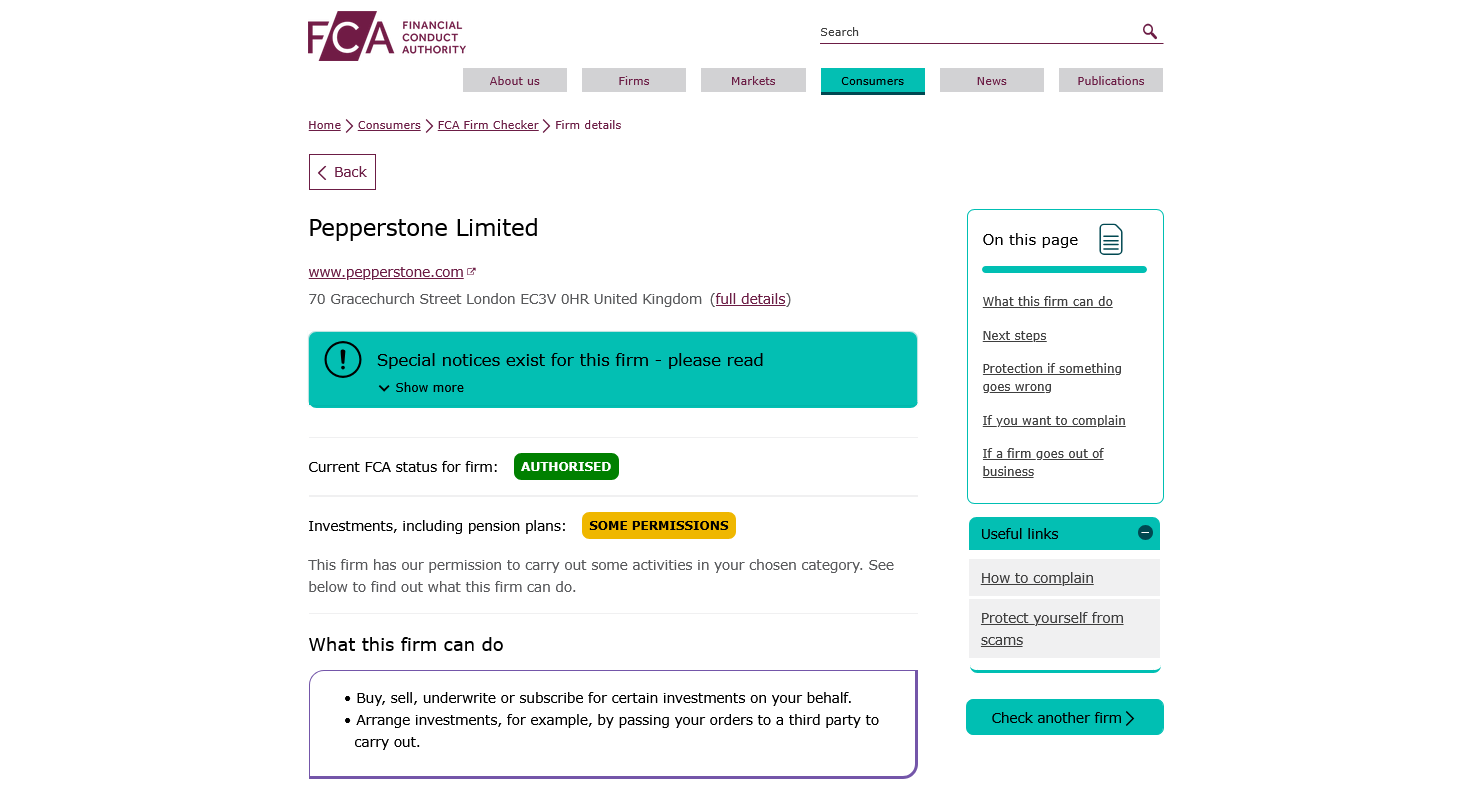
Pepperstone’s regulatory status, as shown on the FCA’s website
Length Of Service
When evaluating a broker’s standing, it’s important to think about how long it’s been in business.
On paper, a broker that’s received no regulatory fines may seem a better choice than a company with one on their record, for example. Yet context is important – a single fine issued several years ago may not be a concern if the company’s been operating for 20 years and has largely demonstrated strong compliance.
Brokerages that have been operating long-term (a decade or more) are also likely to have built robust protections for traders, developed great customer service, and demonstrated their ability to absorb market and economic shocks.
Pro tip: Be watchful of companies that may have rebranded or changed their names, particularly if done frequently. This could be a sign that the broker is trying to distance itself from past misconduct and/or poor customer reviews.
Remember that such changes aren’t necessarily a sign that the broker’s trying to escape past issues.
Top broker for length of service: Interactive Brokers has traded under various names since 1977, but has been using its current moniker since 2001. It executes roughly 3+ million trades every day across multiple markets including equities, gold, cryptocurrencies and forex. The company is regulated by multiple bodies from around the globe, including the CFTC, FCA, CIRO, and FINMA.
Stock Market Listing
Brokers whose shares trade on major stock exchanges are held to further levels of accountability. To keep a listing, businesses need to comply with tough governance rules and regularly publish audited financial statements.
But stock market listings aren’t just important for the purposes of legitimacy. Traders can also check in on a broker’s most recent updates to see how it’s performing, the strength of its financial foundations, and whether it’s facing risks that may endanger customers’ money.
Top broker for stock market listing: IG – which was founded as a gold-trading company in 1974 – has maintained a listing on the London and Frankfurt Stock Exchanges since 2005. It’s one of the largest companies on the UK’s FTSE 250 mid-cap index, while during its 50+ year existence, it’s obtained licenses from almost a dozen regulators across the world. These include multiple top-tier authorities including the FCA, ASIC, CFTC and the BaFin.
Cybersecurity
In line with regulatory requirements, licensed brokers must ensure minimum levels of online security to protect clients’ funds and personal information, and to keep their trading platforms operating securely and reliably.
However, the depth and complexity of cyber protection can differ significantly among brokers and their platforms or apps. For instance, not all require two-factor (2FA) authentication when customers sign onto the platform, while others don’t make additional verification checks when withdrawals are processed.
Top broker for cybersecurity: eToro has a variety of tools to protect itself and customers from cyber attacks. These include 2FA or biometric verification when signing in, secure sockets layer (SSL) encryption for data protection, and email alerts to inform clients when their accounts are accessed via a new device.
eToro has also obtained SOC 2 Type II Compliance Certification. This is a third-party audit that evaluates an organization’s online systems based on things like security, robustness and data protection, all according to standards drawn up by the American Institute of Certified Public Accountants (AICPA).
Pro tip: Be mindful that online security breaches can still occur regardless of such safeguards. A comprehensive and well-developed suite of tools can reduce the chances of such an occurrence, but there is no such thing as total protection.
Red Flags To Watch For
There are a number of warning signs that can reveal a potentially untrustworthy brokerage. Common ones we’ve seen include:
- Absence of regulatory approval.
- Limited and unstable trading platforms.
- Slow or inaccessible customer support.
- Poor security protocols.
- Lack of transparency on fees and charges.
- Overly ambitious claims on potential returns.
- Complex and hidden terms and conditions.
- Aggressive sales techniques, pressure to trade regularly and pushy requests for cash deposits.
- Unrealistic bonus incentives.
- Negative reviews from investing websites, trader forums and customer review platforms like Trustpilot.
Deep-Dive Regulation & Safety Reviews
We’ve built deeper guides into the legitimacy, regulation, and safety characteristics of high-profile brokers:
- Is IG Safe? A Verdict After 20 Safety Checks
- Is OKX Safe Or Not?
- Is Plus500 Legit Or Not?
- Is eToro Safe Or Not?
- Is Moomoo Legit and Safe?
- Is XM Legit and Safe?
- Is CMC Markets Legit and Safe?
- Is IC (Previously IC Markets) Legit and Safe?
- Is Interactive Brokers Safe and Legit?
- Is PU Prime Legit and Safe?
- Is Eightcap Legit?
- Is FXCC Safe, Legit, and Regulated?
- Is Fusion Markets Legit, Safe and Regulated?
- Is Exness Legit?
- Is RoboForex Legit and Safe?
Bottom Line
It’s critical to only do business with a brokerage you can trust, so take time to research the company before handing over any money or sensitive information. No broker is 100% ‘safe,’ but doing your homework can significantly reduce the risks you face.
FAQ
What Is A Regulated Broker?
These are financial intermediaries that are authorized and supervised to provide online trading services to retail investors by one or more government-recognized bodies.
Examples of major regulators include the US Securities and Exchange Commission (SEC), and the UK Financial Conduct Authority (FCA).
Why Is Using A Regulated Broker Important?
Ensuring that the broker I choose isn’t just about avoiding potential fraud. Regulated businesses must also provide good levels of customer service, a high degree of transparency, and robust client protection from events like company insolvency.
How Can I Check That A Broker Is Regulated?
Licensed brokerages generally state their regulatory status on their websites. They will provide details of the legal body with whom they’re authorized, as well as their license number.
With this information, you should be able to verify the broker’s status via the relevant regulator’s website. As well as providing searchable databases to find such information, some authorities also publish ‘warning lists’ to help traders avoid firms that are operating illicitly. The CFTC RED List is a good example, and a database we check ourselves. It shows unauthorized brokerages in the US.