 Top Lists for USA
Best Financial Sector Conduct Authority (FSCA) Regulated Brokers
We’ve personally tested and ranked the top brokers regulated by the South African Financial Sector Conduct Authority (FSCA), ensuring high standards of trust for African traders especially.
 Written By
Royston Wild
Royston is a seasoned investor and financial writer with over a decade of experience analyzing brokers and investment markets. With a background in stocks, commodities, and forex reporting - he brings a fresh perspective to broker evaluations.
Royston Wild Profile Page Fact Checked By
Tobias Robinson
Tobias is committed to helping traders find the right brokerage for their needs. He has tested 200+ brokers, spent 2,600+ hours using different platforms, and placed 2,100+ trades.
Tobias Robinson Profile Page Edited By
James Barra
James is an experienced broker analyst with a background in financial services. He has spent 2,500+ hours testing brokers, used 35+ different platforms and apps, audited 120+ broker T&Cs, and verified 300+ regulatory licenses. James has also been on US and UK TV, and been a guest on finance podcasts, discussing reports conducted by BrokerListings.com and sharing his expertise.
James Barra Profile PageOctober 13, 2026
Filters
How We Chose The Top FSCA-Regulated Brokers
Our strict evaluation process involves three steps:
- Checking the regulatory status of each broker in our database. For trading firms operating in South Africa, we verify that those claiming official approval on their website or other material are featured on the FSCA’s online directory.
- Regularly re-checking each brokerage’s inclusion in the database. The reason? The FSCA can suspend or withdraw licenses if it deems brokers have committed serious rule breaches. We also check the regulator’s website to see if the brokers have been investigated or sanctioned.
- Considering additional criteria outside the firm’s regulatory status. This may include fees and spreads, the range of financial markets on offer, and the sophistication of the trading platform. This mixes real-world testing with the hundreds of data points we collect.
What Is The FSCA?
The Financial Sector Conduct Authority (FSCA) is the body responsible for regulating South Africa’s financial markets.
Its role includes issuing licenses to brokers operating in the country; supervising their activity to detect potential rule breaches; and imposing sanctions when wrongdoing is proven.
The FSCA is a relatively new organization, having been established in 2018 to replace the Financial Services Board (FSB). Set up under the Financial Sector Regulation Act, 2017, the regulator’s stated purpose is to “enhance and support the efficiency and integrity of the financial system, and to protect financial customers.”
Under BrokerListings.com’s Regulator Rating System, the FSCA has been granted Category B status. As a result, traders and investors can expect a good level of protection against fraudulent practices and bad business practices. They can also be reasonably confident in the robustness and integrity of South Africa’s financial markets.
However, the safeguards the FSCA provides aren’t as strong or comprehensive as those individuals enjoy in some other regions (such as the US, UK, European Union and Hong Kong).
For instance, regulated brokers aren’t required to join a financial redress scheme — like the UK’s Financial Services Compensation Scheme (FSCS) — which helps traders and investors claim compensation if their broker becomes insolvent or is unable to meet its obligations.
What Powers Does FSCA Have?
Financial services regulation in South Africa is split between the FSCA, the Prudential Authority (PA) and the South African Reserve Bank (SARB). Within this trifecta, it is the FSCA’s role to supervise market conduct and enhance consumer protection across service providers, including:
- Brokers.
- Asset managers.
- Financial advisers.
- Banks.
- Insurance providers.
- Retirement funds.
- Stock exchanges (including the Johannesburg Stock Exchange).
- Crypto asset service providers.
The FSCA derives its power from the Financial Sector Regulation Act alongside other key pieces of legislation. Under its supervisory remit, it can launch investigations into companies and individuals and compel firms to surrender information.
If its investigations reveal regulatory breaches, it can invoke a range of enforcement actions, including:
- Suspending or revoking licenses.
- Imposing financial penalties.
- Restricting certain activities (like providing a particular financial product).
- Preventing individuals from operating in financial services.
- Referring more serious cases to criminal prosecutors.
The FSCA provides a comprehensive list of enforcement actions on its website. I can search by company or individual name and date for cases going all the way back to 2007.
FSCA Actions Against Brokers
In December 2025, Banxso and two of its directors were hit with a ZAR2 billion (roughly $108 million) fine after the regulator found it had:
- “Misappropriated client funds,”
- “Provided false and/or misleading information to clients and to the FSCA,”
- “Promised clients unrealistic returns,” and
- “Failed to act in the best interests of its clients.”
The FSCA also imposed fines ranging from ZAR20 million (approximately $1.1 million) to ZAR5 million (roughly $270,000) on three other individuals.
Four of these five individuals were barred from operating for 30 years, while another was prevented from operating for 10 years.
Also in December 2025, the FSCA permanently withdrew Afrimarkets Capital’s regulatory approval having suspended it the previous July when it launched an investigation into the company’s conduct.
The regulator found that the broker had:
- “Misappropriated client funds,”
- “Provided advice to clients whilst it was not authorized to do so,”
- “Provided false and/or misleading information to clients and to the FSCA,”
- “Promised clients unrealistic returns,” and
- “Failed to act in the best interests of its clients.”
What Rules Must An FSCA Broker Follow?
Service providers must adhere to a stringent set of rules to obtain and maintain their regulatory status. Key requirements include:
- Financial services are rendered “honestly, fairly, with due skill, care and diligence, and in the interests of clients and the integrity of the financial services industry.”
- Product and services information is “provided timeously so as to afford the client reasonably sufficient time to make an informed decision about the proposed transaction.”
- Advertisements are “factually correct,” “provide a balanced presentation of key information” and “not be misleading.”
- Brokers disclose “any personal interest in the relevant service, or of any circumstance which gives rise to an actual or potential conflict of interest,” and that they “take all reasonable steps to ensure fair treatment of the client.”
- Service providers handle customer complaints “in a timely and fair manner” and “maintain a record of such complaints for a period of five years.”
- Brokerages open and maintain “a separate account, designated for client funds, at a bank” and “ensure that the separate account only contains funds of clients and not those of the provider.”
How Can I Check That The Brokerage Is FSCA Approved?
Checking a broker’s regulatory status can be done swiftly using the FSCA’s online directory. Let’s say I wish to verify that Trade Nation – which offers contracts for difference (CFDs) across a range of financial markets – is licensed to trade in South Africa.
My first port of call is the broker’s website, where I obtain its Financial Service Provider (FSP) number (49846).
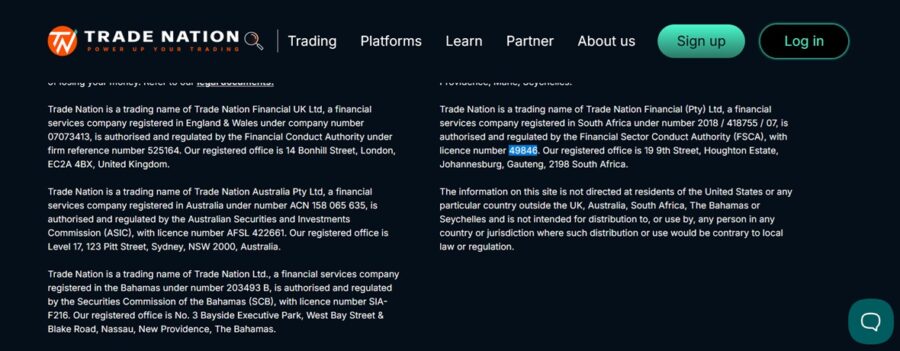
Source: Trade Nation
With this information, I bring up the regulator’s online database, type the number into the ‘Search for FSP No’ field and hit the ‘Submit’ button.
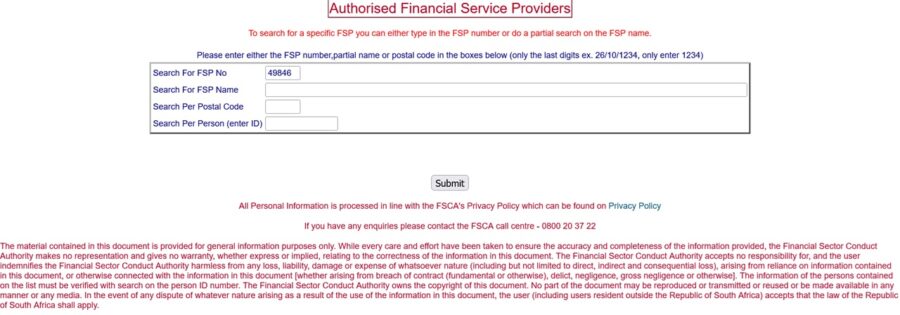
Source: FSCA
My search generates one match, confirming Trade Nation’s regulatory status. Clicking on the ‘Details’ button then brings up a raft of information on the company.

Source: FSCA
This includes:
- Date of registration.
- Registered address.
- Telephone number.
- Key individuals within the company.
- Products it’s approved to provide.
The FSCA also maintains a warnings and alerts list on its website. Here individuals can see details of companies operating outside the rules (like offering services without a license or running a fraudulent investment scheme).
Bottom Line
Using an FSCA-approved broker goes a long way to helping individuals avoid scammers and companies with poor business conduct. This is essential given the explosion in online fraud. That’s also why every single one of our best trading brokers in South Africa is authorized by the FSCA.
However, South Africa’s regulatory landscape isn’t as watertight as those in other parts of the world. For this reason, it can be a good idea to use a broker that’s approved by a Category A regulator under BrokerListings.com’s Regulator Ranking System alongside the FSCA.