
Best Brokers in Germany
After running firsthand tests, we’ve ranked the top brokers for traders in Germany. These are trading firms that cater to Germans with authorization from the BaFin and support for EUR-based accounts.
 Written By
Royston Wild
Royston is a seasoned investor and financial writer with over a decade of experience analyzing brokers and investment markets. With a background in stocks, commodities, and forex reporting - he brings a fresh perspective to broker evaluations.
Royston Wild Profile Page Fact Checked By
Tobias Robinson
Tobias is committed to helping traders find the right brokerage for their needs. He has tested 200+ brokers, spent 2,600+ hours using different platforms, and placed 2,100+ trades.
Tobias Robinson Profile Page Edited By
James Barra
James is an experienced broker analyst with a background in financial services. He has spent 2,500+ hours testing brokers, used 35+ different platforms and apps, audited 120+ broker T&Cs, and verified 300+ regulatory licenses. James has also been on US and UK TV, and been a guest on finance podcasts, discussing reports conducted by BrokerListings.com and sharing his expertise.
James Barra Profile PageJuly 2, 2026
-
1Founded in Australia in 2010, Pepperstone is a forex and CFD broker with over 830,000 clients worldwide. It offers 1,400+ instruments on MT4, MT5, cTrader, and TradingView, with low, clear fees. Pepperstone is regulated by the FCA, ASIC, and CySEC.✓ Supports EUR Accounts
-
2Founded in 1974, IG is part of IG Group Holdings Plc, a public company listed on the LSE as IGG. The brand provides access to over 17,000 markets with easy-to-use platforms and apps. For 50 years, IG has been an industry leader, excelling in all key areas for traders.✓ Supports EUR Accounts
-
3Founded in 1989, CMC Markets is a London Stock Exchange-listed broker regulated by the FCA, ASIC, and CIRO. Over 1 million traders worldwide use its award-winning services.✓ Supports EUR Accounts
-
4Launched in 2012 for buying and selling Bitcoin by bank transfer, Coinbase has grown into a major crypto company. It offers 240+ crypto assets, trading platforms for retail investors, is listed on Nasdaq, and holds licenses from multiple regulators. In May 2025, Coinbase became the first crypto company in the S&P 500, strengthening its reputation.✓ Supports EUR Accounts
Compare Brokers
| Broker |  |
EUR Account |
Demo Account |
Minimum Deposit |
Minimum Trade |
Leverage |
Copy Trading |
Regulator |
Instruments |
Platforms |
Account Currencies |
Automated Trading |
AI |
Guaranteed Stop Loss |
|---|---|---|---|---|---|---|---|---|---|---|---|---|---|---|
 |
✓ | ✓ | $0 | 0.01 Lots | 1:30 (Retail), 1:500 (Pro) | ✓ | FCA, ASIC, CySEC, BaFin, DFSA, SCA, SCB, CMA-Kenya | CFDs, Forex, Currency Indices, Stocks, Indices, Commodities, ETFs, Crypto CFDs (only Pro clients), Spread Betting | Pepperstone Trading Platform, MT4, MT5, cTrader, TradingView | USD, EUR, GBP, CAD, AUD, NZD, JPY, CHF, HKD, SGD | Expert Advisors (EAs) on MetaTrader | ✗ | ✗ | |
 |
✓ | ✓ | $0 | 0.01 Lots | 1:30 (Retail), 1:222 (Pro) | ✗ | CFTC, NFA, FCA, BaFin, ASIC, FINMA, MAS, JFSA, FMA, DFSA, BMA | CFDs (not in US), Forex, Stocks, Indices, Commodities, ETFs, Futures, Options, Crypto, Spread Betting (UK only) | Web, L2 Dealer, MT4, TradingView, AutoChartist, TradingCentral, ProRealTime | USD, EUR, GBP, CAD, AUD, JPY, ZAR, SEK, DKK, CHF, HKD, SGD | Expert Advisors (EAs) on MetaTrader, build your own on ProRealTime | ✓ | ✓ | |
 |
✓ | ✓ | $0 | 0.01 Lots | 1:30 (Retail), 1:500 (Pro) | ✗ | FCA, ASIC, MAS, CIRO, BaFin, FMA, DFSA | CFDs, Forex, Stocks, Indices, Commodities, ETFs, Treasuries, Custom Indices, Spread Betting, Certificates and Warrants (Germany and Austria) | Web, MT4, MT5, TradingView | USD, EUR, GBP, CAD, AUD, NZD, SEK, NOK, SGD, PLN | Expert Advisors (EAs) on MetaTrader | ✗ | ✓ | |
 |
✓ | ✗ | $0 | $2 | ✗ | ✗ | CSSF, CBI, CySEC, BaFin, MAS, OSC, ASIC, BMA | Crypto, Stocks, ETFs (US only), Pre-IPO Perpetual Futures (non-US) | Coinbase, Advanced Trade, Wallet, NFT, TradingView | USD, EUR | Algo trading via Coinbase Advanced API | ✓ | ✗ | |
| Broker | |
EUR Account |
Demo Account |
Minimum Deposit |
Minimum Trade |
Leverage |
Copy Trading |
Regulator |
Instruments |
Platforms |
Account Currencies |
Automated Trading |
AI |
Guaranteed Stop Loss |
How Safe Are The Best Brokers In Germany?
We examined the account protections, regulatory credentials and fund safeguards available to German clients:
| Broker | Trust Rating |
Guaranteed Stop Loss |
Negative Balance Protection |
Segregated Accounts |
|---|---|---|---|---|
|
✗ | ✓ | ✓ | |
|
✓ | ✓ | ✓ | |
|
✓ | ✓ | ✓ | |
|
✗ | ✗ | ✓ | |
| Broker | Trust Rating |
Guaranteed Stop Loss |
Negative Balance Protection |
Segregated Accounts |
Mobile Trading Comparison
For many traders in Germany, like much of Europe and the rest of the world, reliable mobile access is essential - here’s how our leading brokers perform on smartphones:
| Broker | Mobile Apps |
iOS Rating |
Android Rating |
Smart Watch App |
|---|---|---|---|---|
|
iOS & Android | ✗ | ||
|
iOS & Android | ✓ | ||
|
iOS & Android | ✗ | ||
|
iOS & Android | ✗ | ||
| Broker | Mobile Apps |
iOS Rating |
Android Rating |
Smart Watch App |
Comparison for Beginners
Compare how suitable the Best Brokers in Germany are for beginners.
| Broker | Demo Account |
Minimum Deposit |
Minimum Trade |
Education Rating |
Support Rating |
Fractional Shares |
Demo Competitions |
|---|---|---|---|---|---|---|---|
|
✓ | $0 | 0.01 Lots | ✗ | ✗ | ||
|
✓ | $0 | 0.01 Lots | ✗ | ✗ | ||
|
✓ | $0 | 0.01 Lots | ✓ | ✓ | ||
|
✗ | $0 | $2 | ✗ | ✗ | ||
| Broker | Demo Account |
Minimum Deposit |
Minimum Trade |
Education Rating |
Support Rating |
Fractional Shares |
Demo Competitions |
Comparison for Advanced Traders
Compare how suitable the Best Brokers in Germany are for advanced or professional traders.
| Broker | Automated Trading |
VPS |
API |
AI |
Pro Account |
Leverage |
Low Latency |
Extended Hours |
|---|---|---|---|---|---|---|---|---|
|
Expert Advisors (EAs) on MetaTrader | ✗ | ✓ | ✗ | ✓ | 1:30 (Retail), 1:500 (Pro) | ✓ | ✗ |
|
Expert Advisors (EAs) on MetaTrader, build your own on ProRealTime | ✓ | ✓ | ✓ | ✓ | 1:30 (Retail), 1:222 (Pro) | ✓ | ✓ |
|
Expert Advisors (EAs) on MetaTrader | ✓ | ✗ | ✗ | ✓ | 1:30 (Retail), 1:500 (Pro) | ✓ | ✓ |
|
Algo trading via Coinbase Advanced API | ✗ | ✓ | ✓ | ✗ | ✗ | ✓ | ✗ |
| Broker | Automated Trading |
VPS |
API |
AI |
Pro Account |
Leverage |
Low Latency |
Extended Hours |
Accounts Comparison
Compare the trading accounts offered by Best Brokers in Germany.
| Broker | Demo Account |
Interest on Cash |
Islamic Account |
Joint Account |
Managed Account |
PAMM |
MAM |
LAMM |
Pro Account |
|---|---|---|---|---|---|---|---|---|---|
|
✓ | ✗ | ✓ | ✗ | ✓ | ✓ | ✓ | ✗ | ✓ |
|
✓ | GBP: 3.75% | ✗ | ✓ | ✓ | ✗ | ✗ | ✗ | ✓ |
|
✓ | ✗ | ✓ | ✗ | ✗ | ✗ | ✗ | ✗ | ✓ |
|
✗ | ✗ | ✗ | ✗ | ✗ | ✗ | ✗ | ✗ | ✗ |
| Broker | Demo Account |
Interest on Cash |
Islamic Account |
Joint Account |
Managed Account |
PAMM |
MAM |
LAMM |
Pro Account |
Compare The Ratings Of Our Top Trading Brokers In Germany
See how our recommended brokers for German traders scored across the main categories in our testing:
| Broker | Trust |
Platforms |
Assets |
Mobile |
Fees |
Accounts |
Research |
Education |
Support |
|---|---|---|---|---|---|---|---|---|---|
|
|||||||||
|
|||||||||
|
|||||||||
|
|||||||||
| Broker | Trust |
Platforms |
Assets |
Mobile |
Fees |
Accounts |
Research |
Education |
Support |
Fee and Cost Comparison
Compare the cost of trading with the Best Brokers in Germany.
| Broker | Cost Rating |
Fixed Spreads |
Inactivity Fee |
CFD Stocks Spread |
EUR/USD Spread |
Crypto Spread |
|---|---|---|---|---|---|---|
|
✓ | $0 | 0.02 | 0.1 | 30 (BTC) | |
|
✗ | $12 | 0.02 | 0.86 | Variable | |
|
✗ | $15 | 0.02 | 0.7 | From 1.3 | |
|
✗ | $0 | ✗ | ✗ | 0.5% - 1% (BTC) | |
| Broker | Cost Rating |
Fixed Spreads |
Inactivity Fee |
CFD Stocks Spread |
EUR/USD Spread |
Crypto Spread |
Customer Ratings
Compare how customers of these brokers feel about them, with real user ratings from Trustpilot, the Apple App Store and Google Play.
| Broker | Customers |
Trustpilot Score |
Trustpilot Reviews |
Android App Rating |
iOS App Rating |
|---|---|---|---|---|---|
|
830,000 | 3,651 | |||
|
753,000 | 10,102 | |||
|
300,000 | 3,489 | |||
|
108,000,000 | 23,211 | |||
| Broker | Customers |
Trustpilot Score |
Trustpilot Reviews |
Android App Rating |
iOS App Rating |
Broker Popularity
Many traders in Germany prioritize brokers with a solid reputation, large user base and well-known brand. Here’s how our top-rated providers compare:
| Broker | Popularity |
|---|---|
| Coinbase |
|
| Pepperstone |
|
| IG |
|
| CMC Markets |
|
Why Trade With Pepperstone?
Pepperstone is a leading trading option, providing low spreads, quick execution, and advanced chart tools for experienced traders. It also supports new traders with no minimum deposit, thorough learning resources, and exceptional 24/5 support (18 hours on weekends). Based under ASIC regulation, Pepperstone's comprehensive service earned it the 'Best Aus Broker' award for 2025 by DayTrading.com in Australia.
Pros
- Award-winning customer support is available by phone, email, or live chat. Response times are under five minutes during testing, with friendly agents who know the products and trading tools.
- Provides a dedicated CopyTrading app for traders seeking a less active trading approach, available in select countries.
- Support for numerous top-charting platforms such as MT4, MT5, TradingView, and cTrader. These cater to different short-term trading styles, including algorithmic trading.
Cons
- Even with expanded market options, crypto CFD offerings remain limited compared to brokers like Eightcap, and investing in actual coins is not available.
- Execution might be less reliable in fast markets than headline speeds indicate. Our tests showed fast execution at expected prices, but some community feedback mentions issues like slippage, stop-loss fills, and spread-sensitive order triggers during volatility.
- Pepperstone has discontinued support for several tools that enhanced the trading experience for active retail traders, including Autochartist, Capitalise.ai, and a free VPS for eligible traders (now only available to pro traders in some countries).
Why Trade With IG?
IG offers an easy-to-use web platform, beginner education, advanced charts with TradingView, real-time data, and reliable trade execution.
Pros
- The IG app provides an excellent mobile trading experience with a clean design that earned it the Runner Up spot in our 'Best Trading App' award.
- As a reputable broker, IG follows strict regulations in various regions, ensuring strong trust.
- The proprietary web-based platform serves traders at all levels, offering advanced charting tools and real-time market data for trading. IG has also integrated TradingView.
Cons
- Beginners may find IG's fees confusing, as there are different charges for various trades and services, possibly resulting in unexpected costs.
- In the UK and EU, there is negative balance protection, but US clients do not have account protection or guaranteed stop losses.
- IG has stopped its swap-free account, making it less attractive to Islamic traders.
Why Trade With CMC Markets?
CMC Markets offers a great online platform for traders. It has advanced charting tools and a wide variety of CFDs to trade, including a large selection of currencies and customized indices. It caters to traders at all levels.
Pros
- CMC Markets introduced an AI News feature, which uses AI to highlight and summarize market stories instead of executing trades for you. This suggests the future direction of broker research tools.
- The brokerage excels by offering various useful resources. These include scanners that identify trading patterns, webinars, tutorials, updates from news outlets, and research from esteemed companies like Morningstar.
- CMC provides great pricing, with narrow spreads and low fees for trading except for stock CFDs. The Alpha and Price+ programs also give benefits to active traders, including up to 40% spread discounts.
Cons
- The CMC Markets app provides full trading services, but its design and user experience are not as good as leading competitors such as eToro.
- A $15 monthly inactivity fee starts after 12 months of no activity, which might discourage casual investors.
- While the web platform has improved, it still needs more enhancements to be as user-friendly for trading as competitor software such as IG.
Why Trade With Coinbase?
Coinbase is great for beginners who want an easy-to-use platform to buy and sell various cryptocurrencies, with strong security and regulatory compliance. However, its fees are higher than competitors in our tests, and it’s less suited for short-term traders.
Pros
- Users can automatically direct their paycheck into USDC or other cryptocurrencies, with a daily deposit limit of $200,000.
- Coinbase and Chainlink DataLink have partnered, providing on-chain access to premium exchange data like spot prices, order books, and futures data. This integration enhances DeFi pricing and risk management.
- Platforms are available for all skill levels: beginners can use the simple Coinbase app, while Advanced Trade offers lower fees and professional tools.
Cons
- Crypto fees are high based on tests, especially when compared to competitors like Kraken and BitMEX, particularly on the regular trading platform.
- Customer support is frustrating during testing because most help options require login, making it difficult for locked-out users or those without accounts to get assistance.
- Advanced Trade provides TradingView charts but lacks research tools like news feeds, economic calendars, and AI market insights.
Filters
How We Chose The Best Brokers For Traders In Germany
To build our shortlist, we assessed several key factors:
- Brokers had to be regulated by the Bundesanstalt für Finanzdienstleistungsaufsicht (BaFin). This is the German financial regulator who ensures authorized firms provide important safeguards to retail investors, including mandatory risk disclosures, caps on leverage to 1:30, and negative account balance protection.
- Brokers had to offer EUR trading accounts. The ability to deposit, withdraw or manage a trading account in euros can make funding simpler for German residents, while potentially reducing currency conversion costs. However, FX fees may still apply when trading instruments priced in another currency, such as US stocks.
- We followed our rigorous testing process. Our analysts evaluated each firm across 8 core categories, collected more than 200 individual data points per brokerage, and documented the overall trading experience. These findings fed into each broker’s rating and helped determine our final rankings.
How To Choose A Broker In Germany
Germany has the largest retail investor base in Europe by some distance. Research shows the number of people owning stocks, equity-based funds or exchange-traded funds (ETFs) has reached a record high of 14.1m.
That represents about 17% of the German population. This huge-and-steadily-growing investing community has also seen a similar upswing in the number of brokers offering access to shares, forex and other financial markets.
Unfortunately, this investing boom also means fraud is on the rise, with bad actors using increasingly sophisticated methods to scam traders out of their money and steal their personal data.
Ensuring that the brokerage you’re considering is ‘legit’ is therefore essential. However, it’s only one of several essential things to check when you’re choosing a financial services provider.
Here are some key questions to ask when selecting a broker:
Is The Broker Trustworthy?
Fake investment platforms are contributing significantly to the broader rise in online fraud.
The total number of internet scams in Germany has increased by 34% according to annual figures. Authorities also closed down more than 1,400 bogus investment platforms in October 2025.
The best way to avoid potential fraud is to use a broker licensed by the Bundesanstalt für Finanzdienstleistungsaufsicht (BaFin). This is Germany’s official regulator, providing investors with strong protections against scams and bad business practices.
Pro tip: BaFin’s self-stated objective is “ensuring a stable and fair financial system that people in Germany can trust.” Like other national watchdogs in the European Union, its regulatory framework is influenced by directives laid down by the European Securities and Markets Authority (ESMA).
As a consequence, German investors benefit from protections laid out in the Markets in Financial Instruments Directive II (MiFID II). These include:
- Negative balance protection, which limits losses to the funds an investor has in their account.
- Leverage limits (for instance, 1:30 on high-risk contracts for difference (CFD) derivative products).
- Access to a compensation scheme if the broker becomes insolvent (in Germany, this is the Entschädigungseinrichtung der Wertpapierhandelsunternehmen (EdW)).
- Fund segregation rules that keep clients’ money separate from those of the service provider.
After issuing licenses, BaFin closely supervises brokers to ensure they are meeting industry standards. If it identifies rulebreaking, it can enforce a variety of sanctions including financial penalties and license revocations or even suspensions. In 2025, BaFin issued 142 fines on institutions amounting to €80.9m.
Pro tip: Like other European regulators (including ESMA itself), BaFin has attained Category A status under BrokerListings.com’ Regulator Ranking System. This means investors can expect a high level of protection.
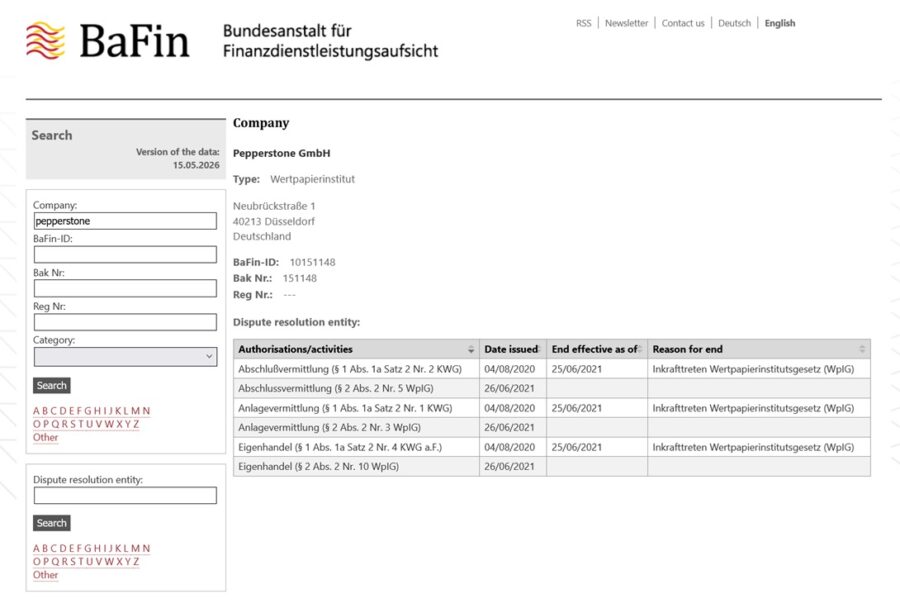
BaFin maintains an online company database that investors can use to check a broker’s regulatory status quickly and easily.
Best broker for trust: Pepperstone is licensed by several respected global regulators including BaFin.
Source: BaFin
What Markets Can I Trade?
There are seven regulated stock exchanges in Germany, the largest of which is the Frankfurt Stock Exchange (FSE). This is operated by Deutsche Börse.
Frankfurt is the third-largest equity trading venue in Europe by market capitalization – behind only the London Stock Exchange and Euronext Paris – and handles 90% of all German stock transactions. As you’d expect, then, most brokers allow clients to trade FSE-listed securities.
Traders in Germany can also deal in a wide variety of other assets including:
- Forex
- Bonds
- ETFs
- Cryptocurrencies
- Indices including the DAX 40
- Derivatives (like futures and options contracts that trade on Germany’s Eurex exchange).
Pro tip: The range of assets investors can deal in will differ among brokers. Most, for instance, offer the EUR/USD currency pairing (which pits the euro against the US dollar) and other major pairs. But you may need to hunt around if you want to trade a minor or exotic pairing like the EUR/TRY (with pairs Europe’s single currency with the Turkish lira).
Best broker for range of markets: IG offers thousands of stocks, forex pairings, bonds and cryptocurrencies from Germany and indeed across the globe. It also has a huge catalogue of derivative products, including an enormous 17,000 CFDs.
What Is The Investing Platform Like?
Germany’s fertile investing landscape means competition among brokerages is fierce. This has led companies to plough huge sums of money into their platforms so they can offer the best possible trading experience.
There are still some big differences between brokers’ trading platforms, however. Some will only offer a stripped-back offering for customers who don’t want to pay for a premium service. Ironically, some companies offer software and a level of service that matches paid-for offerings at no extra cost to standard customers.
When choosing a broker, consider things like the investing platform’s execution speeds, how customizable the interface is, which order types are available, and how up-to-date pricing information is.
You might be more flexible on other features of the platform, however. Not planning on trading on the go? Then the availability of a smartphone or smartwatch app won’t be a dealbreaker. Similarly, you might not be bothered by the trading platform offering detailed trading guides, or the broker letting you trade with third-party software like MetaTrader 5 (MT5).
Pro tip: We recommend that traders ‘road test’ brokers using a demo account if possible. That way you can get a flavor of the broker’s platform before depositing any cash. These trading simulators are also a useful tool for new traders who are looking to get up to speed with the market.
Best broker for investing platform: AvaTrade offers its own top-tier trading platform (WebTrader), though investors can also use a variety of third-party systems including MetaTrader 4 (MT4), MT5, TradingView and cTrader.
Other features include:
- Excellent charting tools
- A sophisticated demo account
- Analyst reports, including technical analysis
- Strong risk management tools, including the AvaProtect function which helps protect against volatility-related losses
- Trading via a mobile app
How Expensive Is It To Trade?
As we’ve mentioned, you might want to pay more for a more advanced trading platform or service. But what are the other cost considerations investors need to bear in mind?
There are plenty, including:
- Transaction charges
- Fund deposit and withdrawal charges
- Account inactivity fees
- Currency conversion charges
- Bid (buy) and ask (ask) spreads
Under MiFID II rules, brokers operating in Germany must clearly disclose all trading costs in a clear and aggregated format. Clients should also be supplied upon request information pertaining to one-off charges, ongoing costs, transaction fees, incidental costs and charges for ancillary services.
Pro tip: Think carefully about your investing style when considering which broker to use on cost grounds.
Let’s say you wish to place 10 or more trades a month. You’ll want to find a service provider that prides itself on offering lower transaction charges and narrow spreads. They’re likely to be far more cost effective to use than brokerages with higher account management charges.
Note that following the end of Germany’s temporary exemption from MiFIR Article 39a, which allowed certain brokers to continue receiving payment for order flow (PFOF) until 30 June, 2026, some firms may compensate for the loss of revenue with alternative charges. Conflicts of interest should be reduced, but German brokerages may look to generate revenue elsewhere, so check spreads, conversion charges, and any subscription costs.
Best broker for trading charges: CMC Markets offers low transaction fees, competitive spreads, and doesn’t charge withdrawal or deposit fees.
CMC Markets also offers trading accounts where transactions, profits and losses are recorded in a range of global currencies. Handily for German traders, this includes EUR-denominated accounts, making trading simpler and helping investors to avoid currency-related costs.
Bottom Line
Traders in Germany can trade in confidence thanks to rigorous financial market oversight from BaFin. But as is the case in all regions, online fraud is growing rapidly in the Central European territory, so traders need to stay vigilant. It’s critical to only use the services of a company that’s received regulatory approval.
It’s also important to think about the quality of the trading platform, the range of available markets, and what trading costs you can expect when selecting a broker. An expensive brokerage can take a big bite out of your trading profits over time.
FAQs
Who Regulates Brokerages In Germany?
The Bundesanstalt für Finanzdienstleistungsaufsicht (BaFin) is responsible for regulating and supervising financial markets in Germany, including online brokers and trading platforms. It has a range of tools as its disposal to penalise brokers who fall short of industry standards.
Can I Open An Account In Germany With EUR As My Base Currency?
A range of brokerages allow investors to trade using the European single currency. This protects investors from adverse exchange rate movements while making portfolio management far simpler.