Best DAX Index (Germany) Brokers 2026
Discover the best brokers with access to Germany’s DAX Index following our rigorous hands-on testing.
 Written By
Royston Wild
Royston is a seasoned investor and financial writer with over a decade of experience analyzing brokers and investment markets. With a background in stocks, commodities, and forex reporting - he brings a fresh perspective to broker evaluations.
Royston Wild Profile Page Fact Checked By
James Barra
James is an experienced broker analyst with a background in financial services. He has spent 2,500+ hours testing brokers, used 35+ different platforms and apps, audited 120+ broker T&Cs, and verified 300+ regulatory licenses. James has also been on US and UK TV, and been a guest on finance podcasts, discussing reports conducted by BrokerListings.com and sharing his expertise.
James Barra Profile Page Edited ByJames Barra
James is an experienced broker analyst with a background in financial services. He has spent 2,500+ hours testing brokers, used 35+ different platforms and apps, audited 120+ broker T&Cs, and verified 300+ regulatory licenses. James has also been on US and UK TV, and been a guest on finance podcasts, discussing reports conducted by BrokerListings.com and sharing his expertise.
James Barra Profile PageOctober 13, 2026
 Our Top Pick in USA
1
Our Top Pick in USA
1
 FOREX.com
-
Available in United States
Not available in United States
Rating breakdown
Founded in 2001, FOREX.com is part of StoneX, a global financial services firm with over a million customers. Regulated in the US, UK, EU, Australia, and other regions, it offers thousands of markets, not just forex, with competitive pricing on advanced platforms.
- Demo Account
- ✓
- Minimum Deposit
- $100
- Minimum Trade
- 0.01 Lots
- Leverage
- 1:50
- Copy Trading
- ✗
- Regulator
- NFA, CFTC
- Instruments
- Forex, Futures and Options on Metals, Energies, Commodities, Indices, Bonds Forex, CFDs, Stock CFDs, Indices, Commodities, Futures, Options, Crypto
- Platforms
- WebTrader, Mobile, MT4, MT5, TradingView
- Account Currencies
- USD, EUR, GBP, CAD, AUD, JPY, CHF, PLN
- Automated Trading
- Expert Advisors (EAs) on MetaTrader
- AI
- ✓
- Guaranteed Stop Loss
- ✗
Compare Brokers
| Broker | |
USD Account |
Demo Account |
Minimum Deposit |
Minimum Trade |
Leverage |
Copy Trading |
Regulator |
Instruments |
Platforms |
Account Currencies |
Automated Trading |
AI |
Guaranteed Stop Loss |
|---|---|---|---|---|---|---|---|---|---|---|---|---|---|---|
|
✓ | ✓ | $100 | 0.01 Lots | 1:50 | ✗ | NFA, CFTC | Forex, Futures and Options on Metals, Energies, Commodities, Indices, Bonds Forex, CFDs, Stock CFDs, Indices, Commodities, Futures, Options, Crypto | WebTrader, Mobile, MT4, MT5, TradingView | USD, EUR, GBP, CAD, AUD, JPY, CHF, PLN | Expert Advisors (EAs) on MetaTrader | ✓ | ✗ | |
| Broker | |
USD Account |
Demo Account |
Minimum Deposit |
Minimum Trade |
Leverage |
Copy Trading |
Regulator |
Instruments |
Platforms |
Account Currencies |
Automated Trading |
AI |
Guaranteed Stop Loss |
Safety Comparison
Compare how safe the Best DAX Index (Germany) Brokers 2026 are.
| Broker | Trust Rating |
Guaranteed Stop Loss |
Negative Balance Protection |
Segregated Accounts |
|---|---|---|---|---|
|
✗ | ✗ | ✓ | |
| Broker | Trust Rating |
Guaranteed Stop Loss |
Negative Balance Protection |
Segregated Accounts |
Mobile Trading Comparison
Compare the mobile trading features of the Best DAX Index (Germany) Brokers 2026.
| Broker | Mobile Apps |
iOS Rating |
Android Rating |
Smart Watch App |
|---|---|---|---|---|
|
iOS & Android | ✗ | ||
| Broker | Mobile Apps |
iOS Rating |
Android Rating |
Smart Watch App |
Comparison for Beginners
Compare how suitable the Best DAX Index (Germany) Brokers 2026 are for beginners.
| Broker | Demo Account |
Minimum Deposit |
Minimum Trade |
Education Rating |
Support Rating |
Fractional Shares |
Demo Competitions |
|---|---|---|---|---|---|---|---|
|
✓ | $100 | 0.01 Lots | ✗ | ✗ | ||
| Broker | Demo Account |
Minimum Deposit |
Minimum Trade |
Education Rating |
Support Rating |
Fractional Shares |
Demo Competitions |
Comparison for Advanced Traders
Compare how suitable the Best DAX Index (Germany) Brokers 2026 are for advanced or professional traders.
| Broker | Automated Trading |
VPS |
API |
AI |
Pro Account |
Leverage |
Low Latency |
Extended Hours |
|---|---|---|---|---|---|---|---|---|
|
Expert Advisors (EAs) on MetaTrader | ✓ | ✓ | ✓ | ✗ | 1:50 | ✓ | ✗ |
| Broker | Automated Trading |
VPS |
API |
AI |
Pro Account |
Leverage |
Low Latency |
Extended Hours |
Accounts Comparison
Compare the trading accounts offered by Best DAX Index (Germany) Brokers 2026.
| Broker | Demo Account |
Interest on Cash |
Islamic Account |
Joint Account |
Managed Account |
PAMM |
MAM |
LAMM |
Pro Account |
|---|---|---|---|---|---|---|---|---|---|
|
✓ | ✗ | ✓ | ✗ | ✗ | ✗ | ✗ | ✗ | ✗ |
| Broker | Demo Account |
Interest on Cash |
Islamic Account |
Joint Account |
Managed Account |
PAMM |
MAM |
LAMM |
Pro Account |
Detailed Rating Comparison
Compare how we rated the Best DAX Index (Germany) Brokers 2026 in key areas.
| Broker | Trust |
Platforms |
Assets |
Mobile |
Fees |
Accounts |
Research |
Education |
Support |
|---|---|---|---|---|---|---|---|---|---|
|
|||||||||
| Broker | Trust |
Platforms |
Assets |
Mobile |
Fees |
Accounts |
Research |
Education |
Support |
Fee and Cost Comparison
Compare the cost of trading with the Best DAX Index (Germany) Brokers 2026.
| Broker | Cost Rating |
Fixed Spreads |
Inactivity Fee |
EUR/USD Spread |
Crypto Spread |
|---|---|---|---|---|---|
|
✗ | $15 | 1.2 | BTC 1.4%, ETH 2% | |
| Broker | Cost Rating |
Fixed Spreads |
Inactivity Fee |
EUR/USD Spread |
Crypto Spread |
Customer Ratings
Compare how customers of these brokers feel about them, with real user ratings from Trustpilot, the Apple App Store and Google Play.
| Broker | Customers |
Trustpilot Score |
Trustpilot Reviews |
Android App Rating |
iOS App Rating |
|---|---|---|---|---|---|
|
450,000 | 2,541 | |||
| Broker | Customers |
Trustpilot Score |
Trustpilot Reviews |
Android App Rating |
iOS App Rating |
Broker Popularity
See how popular the Best DAX Index (Germany) Brokers 2026 are in terms of number of clients.
| Broker | Popularity |
|---|---|
| FOREX.com |
|
Why Trade With FOREX.com?
FOREX.com is a top-tier brokerage suitable for forex traders of all skill levels. It offers more than 80 currency pairs, has small spreads starting from 0.0 pips, and features low fees. The platform provides powerful charting tools that include over 100 technical indicators and multiple research aids.
 Christian Harris
Review Author
Pros
- The in-house Web Trader is a top platform for new traders, featuring a sleek design and over 80 technical indicators for market analysis.
- FOREX.com has over 20 years of experience with strong regulatory oversight, and has received multiple awards, including second place in our 'Best Forex Broker' awards. As such, FOREX.com is globally reputed as a reliable trading brokerage.
- FOREX.com provides top-tier forex pricing beginning at 0.0 pips. They also offer competitive cashback rebates up to 15% for dedicated traders.
Cons
- FOREX.com's MT4 platform provides around 600 instruments for trading, which is considerably less than the 5,500+ options accessible on its other platforms.
- Demo accounts have a limited time duration of 90 days, which may not be sufficient for thoroughly testing trading strategies.
- US clients do not have negative balance protection, so you can potentially owe more than your original account deposit.
Filters
How We Choose The Top DAX Brokers
Our detailed evaluation process involves the following four steps:
- Opening a trading account with each broker in our evolving database, then recording which ones provide access to the DAX.
- Verifying that each brokerage is authorized by a top-level national regulator, like Germany’s Bundesanstalt für Finanzdienstleistungsaufsicht (BaFin). Under BrokerListings.com’s proprietary ranking system, BaFin is considered to provide ‘excellent’ safeguards against fraud and bad business practices, earning it Category A status.
- Examining the strength and weaknesses of each broker and the service they provide. Fees and charges, the range of assets they provide access to, and the functionality of their online trading platform are just three things we consider.
- Regularly re-checking that each broker has retained their regulatory status. This is because financial watchdogs can temporarily or permanently withdraw a service provider’s license when misconduct is identified.
Brokers are assigned an overall rating after combining more than 200+ data points and the views of our hands-on testers, with brokers that provide access to the DAX index sorted by this ranking.
How Should I Choose A Broker To Trade The DAX?
Rising investor interest in German large-cap companies – combined with broader growth in online retail investing – has boosted trading activity in DAX shares. The boom in exchange-traded fund (ETF) investing has also boosted trading in Germany’s blue chips.
As a result, more brokers are offering exposure to DAX companies than ever before. What’s more, many companies that already provided investors with access have increased their product ranges.
Yet brokerage services can differ significantly. It’s therefore essential to take time to find a broker that best suits your needs.
But largely speaking, there are four key things every investor should consider before opening an account. Let’s take a look at them.
Trustworthiness
Investment scams are becoming more commonplace across the globe. They’re also growing in complexity as bad actors use AI to trap their victims.
Wherever you’re based, it’s therefore critical to narrow your search to include only brokers that are authorized by a reputable financial watchdog. In 2025, Germany’s BaFin published 800 warnings related to bogus financial services websites and messaging services.
Top-level regulators typically maintain online directories of authorized firms to make finding a legitimate broker easier and quicker. BaFin’s own database allows users to search by name, registration number, or to trawl through the entire alphabetically-ordered directory.
Pro tip: To make it simpler for you to find a top-tier regulator, BrokerListings.com has created a comprehensive scoring system of hundreds 0f organizations. These range from regulators offering ‘excellent’ protection (Category A) to those that should be ‘approached with caution’ (Category C).
Investors residing in Germany often plump for brokers that are BaFin approved due to the body’s strong record of supervision and enforcement. Germany’s financial markets and services sector is well regulated thanks to frameworks set out by the European Securities and Markets Authority (ESMA), as well as a raft of European Union (EU) legislation.
Yet choosing a regulator from one of the European Union’s (EU’s) other member states also offers excellent protections for traders in Germany. Under Markets in Financial Instruments Directive II (MiFID II) rules, a broker that’s licensed in one EU member state can ‘passport’ their services into another. So choosing a brokerage that’s approved by another regulator in the trading bloc is a good option to consider.
Every regulator located in the EU has received a Category A ranking under our rating system.
Pro tip: Using a broker that’s approved by an EU national regulator has other benefits. Let’s say I want to trade contracts for difference (CFDs) based on DAX-linked securities. I will automatically enjoy negative balance protection, which means I can’t lose more money than I deposit in my trading account.
Authorized brokers must also limit leverage on CFDs to 1:30 for retail traders, rules designed to stop individuals taking on excessive risk. Approved service providers must also be signatories to a local compensation scheme that seeks to protect investors in case the firm becomes insolvent.
In Germany, this is the Entschädigungseinrichtung der Wertpapierhandelsunternehmen (EdW). This particular scheme compensates investors for up to 90% of eligible claims, up to a limit of €20,000 per individual.
If you’re based outside the EU and plan to trade securities or derivatives related to the DAX, we suggest searching for top-level regulators in your jurisdiction.
Top DAX broker for trustworthiness: ActivTrades has been offering financial services since 2001 when it was founded in Switzerland. It is regulated by Portugal’s Comissão do Mercado de Valores Mobiliários (CMVM) under the name ‘ActivMarkets – Empresa de Investimento S.A.’
ActivTrades is authorized by the UK’s Financial Conduct Authority (FCA) as well, another Category A regulator.
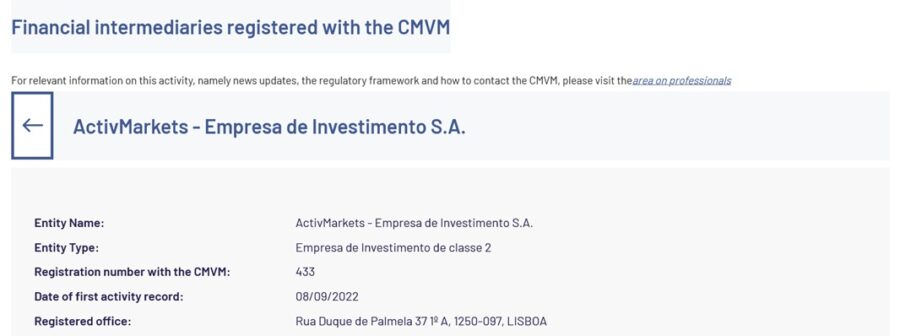
ActivTrades’ regulatory status with CMVM. Source: CMVM
Range Of Assets
There are plenty of brokers out there offering exposure to the DAX. However, not all of them provide access via the same financial instruments.
Many service providers allow traders to buy shares and ETFs outright. However, others don’t provide direct exposure and only offer access through derivatives like futures and options contracts or CFDs. Some brokerages offer both routes.
Think carefully about the securities you prefer, and whether the broker you’re considering can meet your needs. Using derivatives has advantages, like allowing traders to speculate on both rising and falling prices. But this strategy can also have drawbacks – someone holding a Deutsche Telekom-linked CFD, for instance, won’t receive the market-beating dividends the telecoms giant frequently pays.
Pro tip: If you’re into trading German large caps, don’t just restrict yourself to brokers offering DAX exposure. Also consider using one that lets you trade the MDAX index, which comprises the 50 biggest shares outside the DAX.
This index is also packed with large, high-quality companies. What’s more, DAX companies regularly drop out of the leading index and into the MDAX when periodic market reviews are conducted.
Top DAX broker for range of assets: Interactive Brokers offers a multitude of ways to trade DAX companies and the index itself. Investors can buy and sell shares, ETFs that track the large-cap index, and futures and options on derivatives exchanges like Eurex, which is also operated by Deutsche Boerse in Germany.
Depending on their jurisdiction, traders may also be able to deal in DAX-linked CFDs.
Trading Costs
Under EU rules, authorized brokers in the region are required to provide details of “all costs and associated charges relating to the investment and/or ancillary service and the financial instrument.” These must be provided in “good time” and before any services are provided.
For brokers, this means they must disclose all investment service costs including:
- Trade commissions.
- Bid (buy) and ask (sell) spreads.
- Management and account fees.
- Deposit and withdrawal charges.
- Currency conversion fees.
- Overnight financing charges (also known as swap fees) for derivatives.
- Account inactivity fees.
- Advisory fees.
The size of these fees and costs can differ significantly among service providers. Some offer really attractive features like commission-free trading. However, it’s important to carefully assess a broker’s entire cost structure before signing up. The devil is often in the detail, and not keeping a close eye on trading charges can really eat into my profits.
Let’s say I’m a high-volume trader comparing the cost structures of two brokers. I may be attracted by the idea of paying zero commission to a broker versus one that charges $5 per trade. Yet if the spreads offered by the former brokerage are markedly higher, it may be more cost effective to use the one that charges transaction fees.
Pro tip: Deutsche Boerse – operator of the Frankfurt Stock Exchange, home to the DAX – charges transaction fees to exchange participants rather than retail investors themselves. For instance, retail liquidity providers (RLPs) pay a fee of 0.8 basis points on the value of transactions on DAX-related instruments traded through Deutsche Boerse’s Xetra electronic trading platform.
Brokers may look to pass on some or all of these costs to their customers through commissions, bid-ask spreads or other charges.
If I’m investing in Germany or another eurozone country, I should also consider using a brokerage that offers euro (EUR)-denominated trading accounts.
Trading on Frankfurt’s stock exchange is conducted solely in the eurozone currency, so a EUR-based account can help me save on costly forex conversion charges. It can also make totting up my real returns and managing my portfolio simpler.
Top DAX broker for trading costs: Whether trading DAX stocks and ETFs directly, or derivatives linked to German large-cap shares, XTB’s fee structure is extremely competitive.
For German shares and ETFs, there are no commissions charged up to a monthly turnover limit of €100,000. Above this threshold, XTB charges 0.2% when positions are opened and closed (with a minimum charge of €10).
The broker’s CFD charges are a little more complicated. DAX index-based derivatives are usually free from trading charges, though those related to individual shares are not.
XTB also doesn’t charge customers for making deposits or withdrawing cash. Its spreads are also competitive. And clients can open up to four investment accounts (excluding demo accounts) – these can be based in EUR, US dollars (USD) or British pounds (GBP).
Just be mindful of an inactivity charge, which kicks in after 12 months and is set at €10 per month.
Trading Platform
At BrokerListings.com, we believe taking the broker’s software out for a ‘test drive’ is a great idea before you deposit any cash and begin trading.
This can be an especially good idea for novice traders who can try out their investment strategies before putting any money on the line. Many top brokers offer this service, and large (if not unlimited) virtual funds for you to play with.
This may not be a dealbreaker for all DAX investors. However, there are certain features we believe are essential for traders of all levels.
These include:
- Fast execution speeds
- Platform stability during busy periods (for instance, when the Statistisches Bundesamt releases German GDP data).
- Access to real-time market data, such as up-to-date pricing on DAX shares and information on trading volumes.
- High levels of customization for charts, menus and buttons.
- Watchlists that allow me to track and compare price movements of DAX constituents.
- Easy-to-reach customer service during the Frankfurt market’s opening hours.
- News feeds covering Germany’s leading listed companies, as well as key data on DAX listings (including dividend data, valuations and analyst ratings).
- Access to risk management tools, which is especially important for trading high-risk DAX-linked derivatives.
- Robust security measures, including multi-factor authentication for signing in and making account withdrawals.
Top DAX broker for trading platform: IG offers a sophisticated in-house trading platform, as well as a great mobile platform for trading ‘on the go.’ Not only that, but it’s one of the few brokers to also offer a smartwatch app.
IG’s desktop platform is fast and stable, highly customizable and comes with a large box of tools (including alerts, advanced charts, market screeners, and access to the ProRealTime advanced charting software if traders meet certain trading criteria).
However, if you prefer using a third-party system, IG’s trading infrastructure is compatible with several platforms including MetaTrader 4 (MT4) and TradingView.
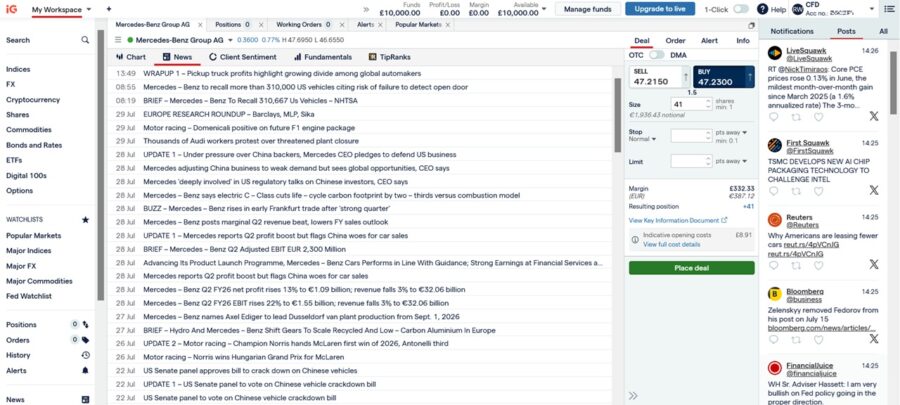
Trading Mercedes-Benz shares with IG. Source: IG
How Can I Begin Trading The DAX?
In order to start trading DAX-quoted companies, I’ll need to complete the following tasks:
1. Comparing brokers. This is the most time-consuming stage of the process, but doing it properly can significantly improve my investing experience (not to mention my returns). Regulation, trading platform, asset range and investing fees are the core four things to consider. Other things to think about will depend on my trading style and personal circumstances, and may include the availability of low minimum deposits and access to margin trading.
2. Opening an account. Once I’ve picked a broker, I’ll need to provide them with some personal information. This may include my name, date of birth, place of residence, employment status, source of funds, investing experience and objectives. Some service providers will also ask for proof of address and identification at this stage.
3. Deposit money. With my account open, I’ll be able to deposit funds to begin buying DAX stocks. Brokers typically offer a range of ways to transfer money, including bank transfer (such as from regional banks like Commerzbank), debit card, digital wallet (like Google Wallet) and payment service providers.
What Is The DAX?
The DAX – or Deutscher Aktienindex, to give it its official name – is Germany’s flagship stock market index. It is made up of the largest and most traded listed companies on the Frankfurter Wertpapierbörse (FWB, or Frankfurt Stock Exchange), owned and operated by Deutsche Boerse.
The DAX is also known informally as the DAX 40, reflecting the number of blue-chip companies it includes. It comprises roughly 80% of the entire market capitalization of stocks listed in Germany, and is home to a diverse range of industry-leading businesses with strong economic moats (or competitive advantages) and diverse revenue streams.
These include:
- Diversified engineering group Siemens.
- Pharmaceuticals manufacturer Bayer.
- Luxury carmaker Mercedes-Benz.
- Banking services provider Deutsche Bank.
- Defense contractor Rheinmetall.
- Electricity and gas supplier E.ON.
- Sportswear manufacturer Adidas.
- Consumer goods maker Henkel.
When it was launched in 1988, the index comprised just 30 shares. Listings were expanded to 40 companies in September 2021.
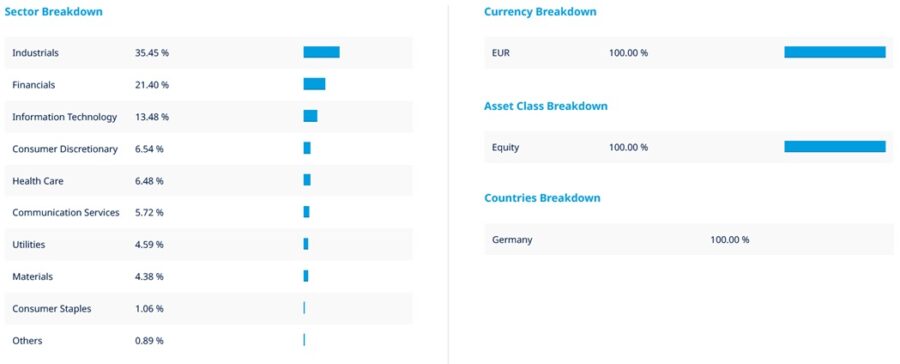
Composition of the DAX. Source: Amundi
The DAX is one of several equity indices based in Frankfurt. The list also includes:
- The MDAX, a mid-cap index comprising the 50 largest stocks outside the DAX.
- The SDAX, a small-cap index comprising the 70 biggest shares outside the MDAX.
- The TecDAX, which comprises the Frankfurt stock market’s 30 largest technology shares.
- The DAX All Cap, which combines the DAX, MDAX and SDAX.
How Can I Trade The DAX?
Investors can trade the blue-chip index in a number of ways. The simplest and most direct method is to purchase individual shares in businesses that make up the DAX.
Another way to gain exposure is to buy derivative products that track prices of DAX stocks. These can include futures, options and warrants traded on Eurex, a derivatives-focused marketplace in Germany. Many other international securities exchanges offer the same financial instruments that track DAX companies.
Certain brokers also allow traders to use CFDs and spread bets to speculate on German large-cap shares. These are traded over-the-counter (OTC) rather than on regulated exchanges.
Derivatives like these have several advantages, including the opportunity to go ‘long’ or ‘short.’ This means a trader can potentially turn a profit even when share prices fall. On the downside, investors don’t own any underlying stock, so they don’t get voting rights or the opportunity to receive dividends.
Investors can also take a more diversified approach to trading the DAX with an ETF. Products like the iShares Core DAX UCITS ETF hold shares in each of the index’s 40 companies, and therefore track broader movements in the index.
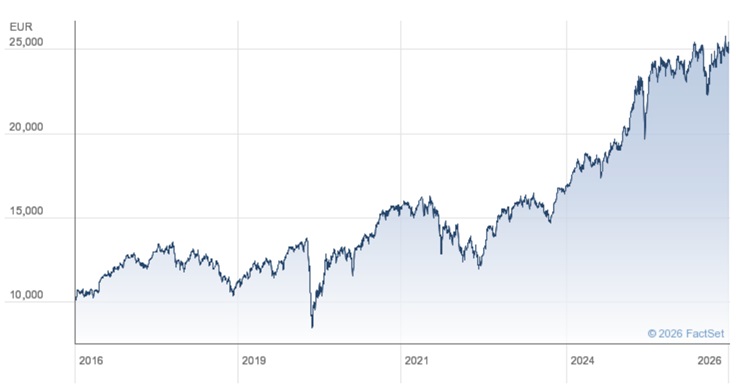
Long-term performance of the DAX. Source: Hargreaves Lansdown
These products give traders access to a variety of investment opportunities while simultaneously allowing them to spread risk. Investors can buy a distributing ETF, which pays out the dividends from DAX companies to investors, or an accumulating ETF where these cash rewards are automatically reinvested back into the fund.
It’s also possible to buy a leveraged DAX-related ETF, which carries more risk but also the potential for greater returns. The Xtrackers LevDAX Daily Swap UCITS ETF, for example, seeks to deliver double the daily return of the German index. Certain leveraged ETFs also allow investors to take a ‘short’ position on the DAX.
Just as with individual shares, traders can also buy futures, CFDs and other derivatives contracts that track the DAX index.
Pro tip: Investors can trade DAX-quoted shares and ETFs during regular stock market hours, which are Monday to Friday 9am to 5.30pm Central European Time (CET).
Bottom Line
The Frankfurt stock market’s DAX index offers a wealth of investing opportunities. If you’re thinking of trading German large-cap companies, take time to compare the services offered by different brokerages. Trading costs can differ significantly between service providers, as can the quality of their online platform and the range of assets they offer to retail traders.
Always check that the brokerage you’re considering is regulated by a top financial watchdog like BaFin. This provides strong safeguards against bad business practices and fraudsters.