

Broker Scams: Warnings, Resources & How To Protect Yourself
Broker scams are a plague, and the problem is only getting worse as improvements in technology, notably artificial intelligence, make it easier for scammers to target investors with increasingly convincing frauds, such as clones of legitimate firms. At the same time, regulators are overwhelmed, and often unable to catch unscrupulous providers, especially when working across borders.
 Written By
James Barra
James is an experienced broker analyst with a background in financial services. He has spent 2,500+ hours testing brokers, used 35+ different platforms and apps, audited 120+ broker T&Cs, and verified 300+ regulatory licenses. James has also been on US and UK TV, and been a guest on finance podcasts, discussing reports conducted by BrokerListings.com and sharing his expertise.
James Barra Profile Page Fact Checked By
Tobias Robinson
Tobias is committed to helping traders find the right brokerage for their needs. He has tested 200+ brokers, spent 2,600+ hours using different platforms, and placed 2,100+ trades.
Tobias Robinson Profile Page Edited By
William Berg
William Berg combines his expertise in law and finance to analyze trading brokers. He has checked 3,250+ regulatory licenses, investigated 2,365+ broker clones and trading scams, and placed 3,500+ trades.
William Berg Profile PageSeptember 24, 2026
We’ve built this scam hub to help try and keep traders safe. We’ve built practical resources to help users spot the warning signs of a brokerage scam, understand where to go to report a fraudulent platform, and what to do (and not to do) if they have fallen victim.
The Scale Of The Problem
To demonstrate how rapidly the volume and sophistication of investment and brokerage scam have increased, consider the following statistics in three major jurisdictions, comparing 2025 data with 2015 figures:
- United States: Reported losses from investment fraud hit a staggering $8.6 billion in 2025, according to the FBI’s Internet Crime Complaint Center (IC3) This is a massive 3,596% increase from 2015, when losses from investment fraud clocked in at $232.7 million. The sheer volume of reports has also reached unprecedented levels. In the US, the FBI received roughly 300,000 complaints in 2016, but this number has rocketed to over 1 million by 2025, a 230% jump.
- United Kingdom: Reported losses from investment scams came in at £879.8 million in 2025, according to the City of London Police. This is a surge of 1,148% compared to 2015, when losses were approximately £70.5 million. The jump is largely fueled by “recovery fraud” and AI-generated deepfakes that clone legitimate financial firms (something we unpack in more detail later).
- Australia: Reported losses from investment scams were $837.7 million in 2025, according to the ACCC’s National Anti-Scam Centre, with investment scams the primary source of financial harm for Australians. While this reflects a slight dip from 2024 due to stronger enforcement, the long-term trend aligns with the US and UK: when investment losses came in at $41.4 million in 2015, representing a 1,923% increase.
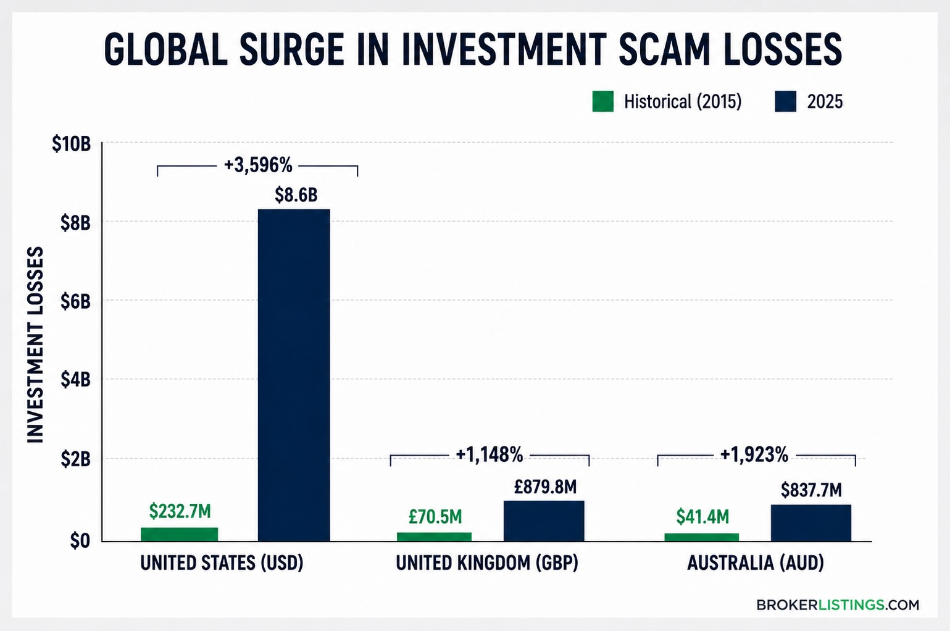
Figures are reported losses in local currencies. Reporting systems differ between jurisdiction.
It’s one thing to read the numbers, but when you see them in a chart like above, the scale at which this problem is growing becomes clear. Interestingly, it also makes it apparent that US citizens are losing considerably more to investment-related scams, including those tied to trading brokers – impersonating regulated broker dealers, manipulating trading terms, bonus traps, etc – than in the UK and Australia.
Why? Well, this could be for a mix of reasons, such as the US being more of a target for scammers owing to its many wealthy residents. However, it could also be because consumer reporting mechanisms are stronger in the US – something we found ourselves when we reported the same scam to six different regulators, including the SEC (US), FCA (UK), and ASIC (Australia), with the SEC having comfortably the easiest to use complaints system.
Types Of Broker Scams
The data above paints a picture of the wider investment scam landscape for context, but fraud related to trading brokers is its own subcategory. It involves criminals specifically targeting retail investors looking to join or use a trading broker. They take various approaches and deploy a range of tactics, including:
« Make Full Width »| Type of Brokerage Scam | How it Works | Warning Signs |
|---|---|---|
| Clones of Licenses & Brands | The scammer steals the name and regulatory number (FCA, ASIC, etc.) of a real, authorized firm, and sets up a legitimate looking domain. | The URL or registered name for the brokerage doesn’t quite match the official regulator’s register. |
| Offshore Relocation | Brokers claim to be ‘Global’ but are actually registered in unregulated or loosely regulated jurisdictions (Vanuatu, St. Vincent etc) to avoid robust oversight and having to provide strong retail safeguards. | A lack of negative balance protection, very high leverage, bonuses with unfair withdrawal conditions. |
| Price Feed Rigging | The broker uses internal software to manipulate market movements with spikes that hit your stop-loss or cause fake slippage. | Price movements on your screen don’t reflect third-party sites or data feeds like TradingView. |
| Withdrawal Blocks | Freezing your account and claiming you must pay a ‘tax’ or similar before they’ll pay a withdrawal request, or refusal to pay due to invented terms and rules. | Being asked to send funds via crypto to unlock your balance, getting stuck in a loop of delays with the support team. |
| Volume Churning | ’Account managers’ help execute hundreds of high-risk trades to generate volume and thus commissions for themselves. | Rapid-fire trades placed on your behalf that quickly drain your account equity. |
Why Scammers Are Becoming More Successful
Scammers are getting better at catching out individuals in broker-related rackets for three key reasons:
- As the figures further above show, there is a huge amount of money to be made from financial scams. Unsurprisingly, criminals are attracted by the returns and are thus getting more organised, more experienced, and much greedier.
- Technology is lowering the entry bar and effort required to quickly and easily build fake websites, copy legitimate brokers’ branding and regulatory credentials, and contact potential victims en masse. Artificial intelligence, in particular, has been rocket fuel for scammers, who can now, for example, build extremely convincing deepfake videos of celebrities as an example. In fact, we’ve run an independent study into the use of deepfake celebrity investment scams, with three case studies and details on how to spot such scams – they are alarmingly life-like.
- The advent and noise around cryptocurrencies has attracted a new wave of retail investors with scammers in tandem. For example, in major jurisdictions, cryptocurrency-linked brokerage and trading schemes are now sometimes accounting for the majority of investment losses, including over 80% in the US. And this was a category that was frankly fringe and negligible only 10 years ago.
How To Spot A Scam Broker
There are many warning signs to stay alert to. To help readers, we’re taking a two-pronged approach in our safety hub:
- We’ve built a list of 10 key red flags to watch out for. If you see any of these, be extremely careful and thoroughly investigate the trading provider before signing up or sending any funds. If you see multiple of these, run.
- We’ve gone through, step-by-step, the alarm bells we identified in a potential brokerage scam operating in 2026. This helps bring to life what we’re looking for when investigating online trading providers with real examples and screenshot evidence.
10 Red Flags To Watch Out For In A 2026 Broker Scam
Our red flags reflect how scam brokers are using the latest technologies to dupe traders:
« Make Full Width »| # | Red Flag | Overview | Example Wording/Behaviour |
|---|---|---|---|
| 1 | An AI search sends you to the wrong broker | Scammers now sometimes benefit from AI answers and brand pages they’ve copied that can surface clone domains instead of the real regulated broker. | The name and licence number look real, but the domain, email, WhatsApp number or onboarding link is probably not the one listed on the regulator’s register. |
| 2 | A real licence number appears on a fake site | Do not just verify the licence number; scammers copy genuine details about a firm and rely on victims not checking the exact website and contact details. | “We are FCA regulated” with a real FRN number, yet the official register lists a slightly different website or legal entity. |
| 3 | You are subtly directed to a broker’s weaker offshore entity | A broker may advertise its strong regulatory credentials (SEC, CFTC, FCA, ASIC, etc), then sign you up through a different branch where there’s weaker mandated safeguards, often with higher leverage and incentives. | “For your country, your account is held with our Seychelles/Belize/Vanuatu entity.” |
| 4 | Fake profits appear before real withdrawals | Scam platforms often show consistent profits, lots of winning trades, and a large account balance, but then block withdrawals with invented or vague conditions. | “Your withdrawal is pending”, “pay tax first”, “more internal checks required”. |
| 6 | Deepfake celebrity or expert endorsements | Scammers use AI-generated videos, cloned voices, made up testimonials and edited or fabricated news stories to create credibility. | A celebrity, trader or official recommends a trading platform you cannot verify independently. |
| 7 | The sales tactics begin on social media | Many scams start through TikTok, Instagram, YouTube, LinkedIn, dating apps, Telegram or WhatsApp before moving users to a scam broker. | “Join our VIP signals group”, “my analyst can onboard you today”. |
| 8 | The payment options do not match the legitimate broker | A genuine broker should not need third-party bank accounts, crypto wallets, vouchers or unrelated merchants to fund your account. | Deposit goes to a private account, crypto address, payment agent, exchange wallet or company name unrelated to the platform. |
| 9 | The “support team” asks for remote access or wallet approval | Fake brokers and recovery scammers use screen sharing, browser extensions, wallet connections and API permissions to take control of funds or accounts. | “Install AnyDesk”, “connect wallet to verify”, “share screen with compliance”. |
| 10 | A recovery firm appears after the loss | Victims are often targeted again by people claiming they can recover funds, trace crypto or work with regulators, usually for an upfront fee. | “We found your stolen crypto”, “pay the release fee”, “we work with the regulator”, “connect your wallet to recover funds”. Note that nobody can “reverse” a blockchain transaction once confirmed. |
A Real Case Study – Tickz
It’s one thing having a list of red flags, but lets bring these to life by taking you through a broker, Tickz (https://tickz.com/), that we suspect may be operating a scam, or at the very least, is a trading provider that you shouldn’t trust with your funds.
After spending 11 hours exploring the Tickz platform, reviewing everything on their website, digging into their regulatory credentials, and reading through third-party reports of the brokerage, here are 3 key warning signs we found:
1. Based And “Regulated” Offshore (MISA)
Tickz is technically a regulated broker, a claim they make on their website and marketing materials to reassure prospective clients they can be trusted. However, Tickz is regulated (via Trusteo Ltd) by the Mwali International Services Authority (MISA) – a ‘Category C’ body in our regulator classification system, meaning it does not provide strict scrutiny of licensees, nor does it mandate strict safeguards for retail investors.
The result? It is essentially regulation in name only. You won’t get protections like access to an investor compensation scheme in the event of broker insolvency or a robust recourse channel in the event of withdrawal disputes (of which there have been many).
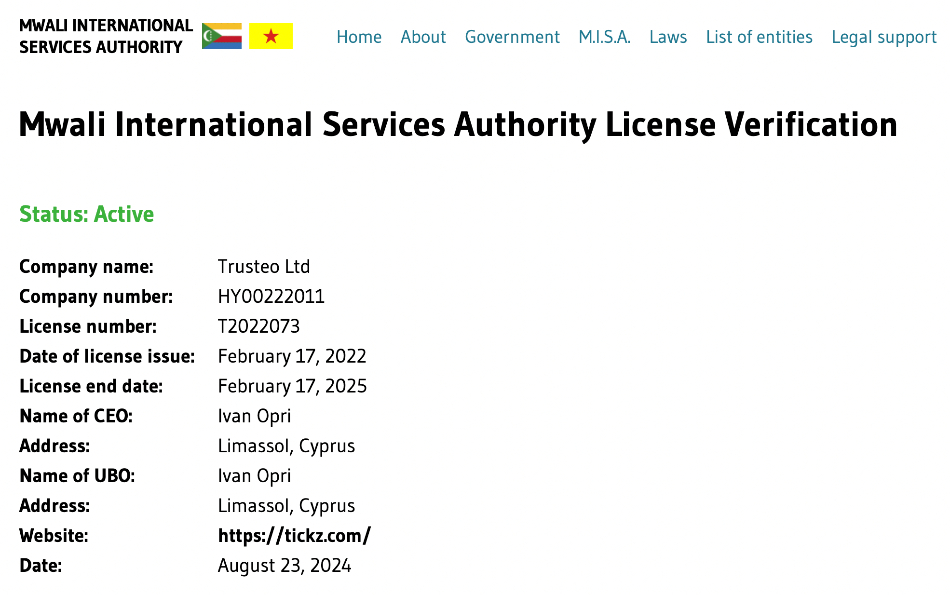
‘Regulated’ and ‘regulated by a trusted body’ are two different things
2. Offers Binary Options – An Unlicensed Product
Tickz refuses to acknowledge they offer binary options – a trading product that has been banned or heavily restricted in many regions due to the prevalence of scams and huge retail investor losses, including in the UK by the FCA, in many European countries following interventions by ESMA, and in Australia by the ASIC. Given their risks, we’ve built a dedicated guide to warn about the dangers of trading binary options.
We opened a Tickz account and spent hours placing trades on its products, including the forex pair EUR/USD, and we are highly confident they do offer binary options. Users can place up/down predictions based on the sell/buy buttons, they can choose the duration of the trade (30 seconds to 5 hours), and if they win they earn a fixed percentage of their stake which is known upfront, while if their prediction is wrong, they lose their stake. We have seen this exact product structure on other binary options platforms, thus they are essentially binaries.
Even more concerningly, and as you can see below, the support team refused to acknowledge they offer binary-like products when we challenged them on it. This is despite it being blindingly obvious to any experienced trader who has come across binary options before.
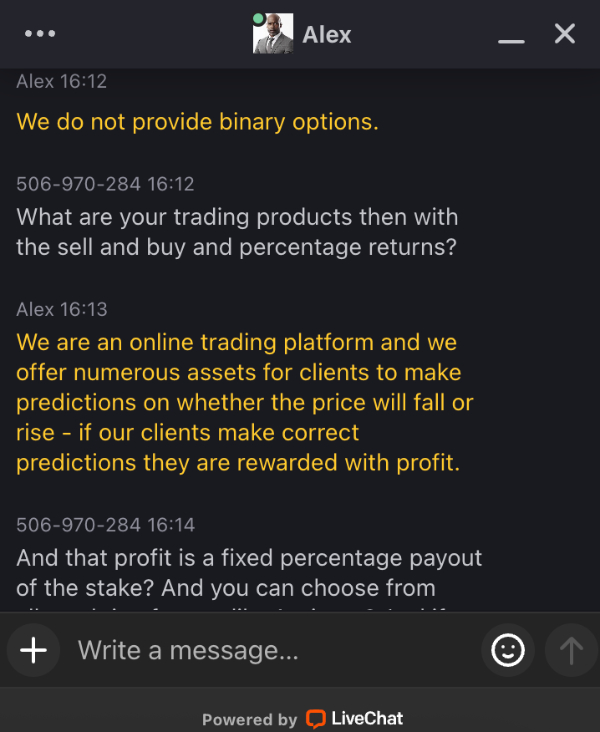
3. Withdrawal Complaints
We scoured through the around 4,400 reviews of tickz.com on the Google Play Store and found many complaints from users having issues with withdrawals. These include unexpected delays and many instances where Tickz appears to have refused to pay out withdrawals. So many complaints of this nature is extremely concerning and we would steer clear of any firm where many users report not being able to extract legitimate trading profits.
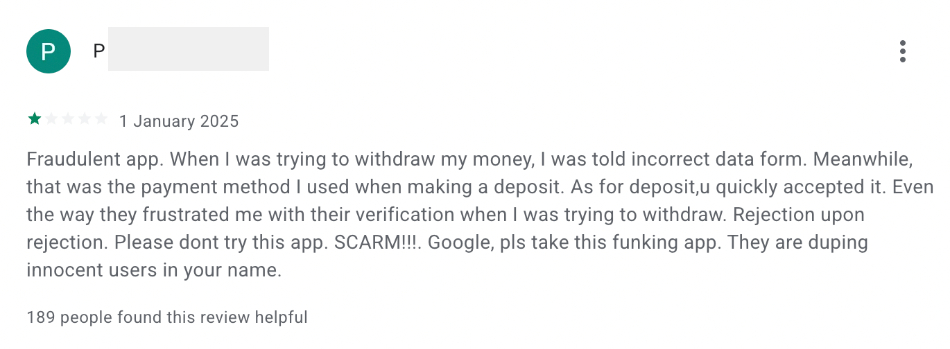
This is one of many withdrawal complaints we read, screenshotted and have saved
We also checked other third-party sites and noticed the broker’s profile on Trustpilot has been suspended, i.e. people can’t leave reviews. This is because Trustpilot have “detected suspicious features about this company” – another indication that something isn’t quite right.
Note that while we discovered significant red flags while investigating Tickz, we cannot state that this broker is a scam with 100% certainty. Still, at the very least, Tickz is not authorized by a trusted regulator (MISA does not count).
Scam Brokers To Watch
Our team actively monitor the market, tracking new brokers that crop up and staying abreast of regulatory watchlists, to stay informed about firms that we believe may be running scams.
When we identify such a provider, we add them to our blacklist of brokerage scams, which we recommend traders check before making a deposit. If a provider you were thinking about using is on there, we recommend extreme caution, further due diligence, and most importantly; to pass them over, and stick to trusted, well-regulated trading brokers.
What To Do If You’ve Been Scammed
1. Stop Engaging Immediately
If the broker, their ‘account manager’, crypto platform or a support agent asks you for more money to unlock withdrawals, pay tax, verify your account, release profits, cover gas fees or satisfy more compliance checks, stop right away.
We’ve seen scammers use fake trading dashboards to show large apparent profits to make victims believe one final payment will release their funds. However, in reality each new payment simply continues the brokerage scam and shows them that they’ve still got you on the hook.
Do not aggressively argue with them, threaten them, or explain that you know it is a scam, because that sometimes actually gives them time to delete evidence, move domains, or pass your details to a recovery-scam team.
Be wary of the long con: Some scammers build friendships or romantic relationships over many months before even mentioning the trading platform/brokerage that could “help”. People don’t think they are being ‘sold’ anything for a long time. Always have your guard up.
2. Lock Down Any Accounts They Could Exploit
If you think the scammers may have access to your sensitive personal details, you need to act. Change the password on your email first, then your bank and brokerage account. Access to email, in particular, can sometimes let scammers reset almost everything else.
We’ve seen instances where scammers who pretend to be a broker’s support team ask victims to install AnyDesk, TeamViewer, screen-sharing tools, browser extensions, or APK files, so it’s important to remove anything they told you to install from your computer, and get the device checked before logging back into accounts.
Where available, turn on two-factor authentication, revoke unknown wallet approvals, check API keys, review email forwarding rules, and sign out of all unknown sessions. It is much better to lose some time reconfiguring security settings than to sit idle and let scammers continue to access your personal data and funds.
3. Preserve Any Evidence
The website or brokerage firm could disappear (the average website lifecycle of scams is around 21 days), so make sure you save the exact URL of e.g. the web trading platform. Then take screenshots of the account dashboard, supposed balances, messages refusing withdrawals, instructions for making deposits, wallet addresses, bank account details, names of account managers (though these are often fake), phone numbers, Telegram or WhatsApp chats, social media ads, fake licence numbers and any regulator or company logos they used.
We’ve seen scam brokers rotate domains, delete dashboards, remove fake reviews, change brand names and shut down WhatsApp groups within hours of victims challenging them. That’s why acting quickly is key, and why you shouldn’t always let on that you think they are scammers immediately.
Compile all of this into a folder, so it’s easy to send to a regulator or police department and straightforward for them to review it all. We have done this ourselves when we’ve reported suspected investment scams to US, UK, European and Australian regulators, and it made the process much smoother.
4. Report The Scam
If you’ve fallen victim to a scam broker, it’s important you report it to a suitable regulator, police force, or other relevant body. This will help your chances of any legal recourse, while also giving local bodies an opportunity to issue alerts about the provider, which may help reduce the chances of more traders losing their capital to the fraud.
To help potential victims, we’ve identified the suitable regulatory body or starting point for retail traders in every country. Head to our country-by-country reporting directory for scam brokers.
You can also report the scam directly to the BrokerListings.com team, who depending on the circumstances, may be able to investigate and warn other potential victims.
5. Be Prepared For The Recovery Scam
We’ve seen this catch victims out when they are at their most vulnerable. After a trading, broker or crypto scam, assume you may be contacted again by someone claiming to recover your funds, trace the wallet, work with regulators, represent a law firm, unlock your frozen account, or negotiate with the broker.
You may be on a list compiled by the original scammers that is then sold elsewhere, such as the dark web. We say this not to scare you, but to warn you about the very real dangers posed by recovery scammers.
We’ve seen recovery scammers quote the exact amount lost, the fake broker’s name, the wallet address and the original account manager’s details, which makes them sound convincing but often suggested they are connected to the same scam network or using a victim list.
Do not pay upfront recovery fees, connect your wallet, share seed phrases, install remote-access tools, or send “tax” or “clearance” payments to release recovered funds.
Recovery scammers are hard workers – you’ll find them on trader forums, Trustpilot, comments on social media, and all over the web. I have personally (manually) read and removed as spam over 1,305 comments from recovery scammers that have tried to target our visitors with messages and comments about brokers. Not a single comment from a recovery scammer has been published on our websites.
Want to learn more? We’ve built a dedicated guide to recovery scams, including a list of suspected recovery fraudsters.