 Top Lists for USA
Binary Options: Scams, Regulatory Crackdowns & The House Edge
Binary options are one of the most controversial retail trading products of recent decades. They’re enticing for their simplicity – you bet on the direction of an underlying asset, winning a fixed payout or losing your stake. Yet they are high risk – attracting scammers, subject to restrictions in many jurisdictions, and often have a house edge that makes it challenging for traders to make money.
 Written By
James Barra
James is an experienced broker analyst with a background in financial services. He has spent 2,500+ hours testing brokers, used 35+ different platforms and apps, audited 120+ broker T&Cs, and verified 300+ regulatory licenses. James has also been on US and UK TV, and been a guest on finance podcasts, discussing reports conducted by BrokerListings.com and sharing his expertise.
James Barra Profile Page Fact Checked By
Royston Wild
Royston is a seasoned investor and financial writer with over a decade of experience analyzing brokers and investment markets. With a background in stocks, commodities, and forex reporting - he brings a fresh perspective to broker evaluations.
Royston Wild Profile PageSeptember 29, 2026
A Quick History Lesson
Binary options took off in retail circles in 2008 after US regulators allowed binary-style contracts on certain exchanges, such as Nadex (since acquired by Crypto.com). Exchange-traded binaries are priced between $0 and $100 and settle at one of those two values – $0 for an ‘out of the money’ trade and $100 for an ‘in the money’ trade.
In the next few years, beyond the US, over-the-counter (OTC) brokers started offering their own take on binary options to retail investors. With these contracts, users staked a fixed amount for a set percentage return. This model typically focuses on short-term price movements with expiry times ranging from several seconds up to a few days or weeks. Traders can access these products through stripped-back web-based platforms, placing up/down bets in a single click. Spurred on by improvements in mobile technology and low deposits of <$100 in many cases, they proved popular, especially in Europe, the Middle East and Asia.
You can see what these all-or-nothing contracts look like below. We’ve placed over 265 binary trades through live and demo accounts on 15 platforms as part of our research into this topic.
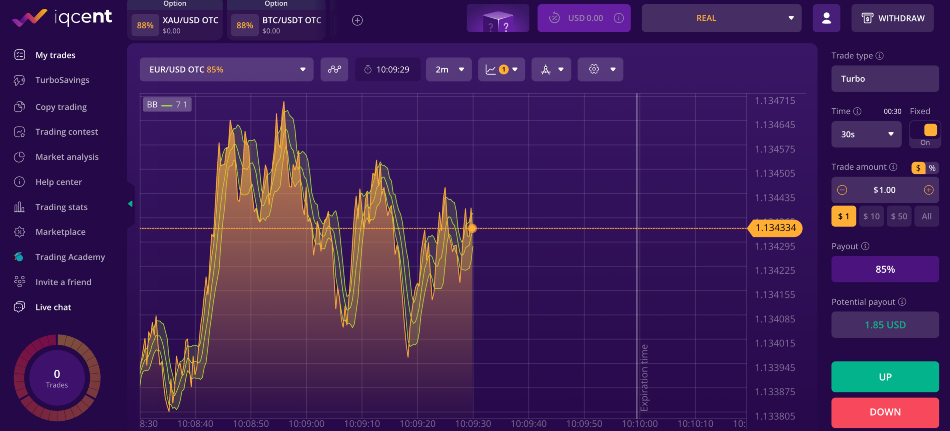
IQCent platform – an unregulated binary broker that we do not recommend
Fast forward to the mid-2010s, and their newfound popularity also coincided with a rise in complaints. Binaries were heavily pushed through social media, aggressive telephone sales operators, and often through ‘bonuses’ that came with restrictive withdrawal conditions. The US Commodity Futures Trading Commission (CFTC) and Securities and Exchange Commission (SEC) started reporting complaints involving providers blocking withdrawals, stealing users’ identities, and allegedly manipulating software to ensure clients lost trades.
By the late 2010s, some parts of the binary options industry had moved beyond ‘high risk’ to fraudulent. The SEC and FBI were issuing warnings in the US across 2016 and 2017, while the European Securities and Markets Authority (ESMA) banned binaries initially in July 2018, before national regulators later adopted their own permanent measures, including the UK’s Financial Conduct Authority (FCA) notice in 2019, saying the products were inherently risky and prone to consumer harm.
Many binary options brands disappeared, moved offshore, or rebranded. Some sites that stuck around became associated with scams and recovery fraud. Some of those still standing today are often tarnished with the stigma of years gone by, and are home to more than their fair share of regulatory warnings and user complaints.
More recently, in some regions, we’re seeing binary options evolve into or at least share similar hallmarks to event contracts and prediction markets. These contracts use the same basic yes/no payoff structure but often extend beyond financial instruments to speculating on events in sports, the wider economy, and culture. Regulators are still getting to grips with the explosion of event contracts, but in July 2026, ESMA reminded firms that products labeled as ‘prediction market contracts’ may still fall within existing restrictions on binary options in Europe.
Class over, let’s walk through three key reasons why binary options are high risk:
1. Binary Options Scams
Binary options providers have been associated with high rates of predatory behavior and broker scams. For this reason, we recommend caution if you see advertising to join a platform. We’ve run deep-dive investigations into a number of questionable providers, including issuing stark warnings about TagOption and BetaBinary.
Leveraging our research and week-on-week activities tracking suspicious brokers in the trading space, we’ve also collated a list of binary options websites that we’ve blacklisted due to safety concerns. We’ve assigned each one a safety score from 0 to 10, where 0 is the least safe, and ranked them from low to high.
Inclusion in the list does not mean these firms are necessarily scams that will steal your money, but their regulatory credentials, user reviews, and our experience testing their platforms have given us cause for concern. For example, none of the platforms listed below are authorized by a trusted financial body, i.e. a ‘Category A’ body in our regulator bandings.
Note that a firm may have a slightly higher safety score if it has fewer accusations of scam complaints and withdrawal issues from the third-party websites we checked, notably Trustpilot and Reddit.
All of these domains are still active from our latest checks, and thus require the most caution. We have excluded historical binary sites suspected of being scams.
| Broker Name | Website URL | Safety Rating | Still Active? |
|---|---|---|---|
| TagOption | tagoption.com/tagoption.ke | 0/10 | Yes |
| BetaBinary | betabinary.com/betabinary.ke | 0/10 | Yes |
| RaceOption | raceoption.com | 1/10 | Yes |
| VideForex | videforex.com | 1/10 | Yes |
| IQCent | iqcent.com | 1/10 | Yes |
| 1PrimeOptions | 1primeoptions.com | 1/10 | Yes |
| ComforTrade | comfortrade.com | 1/10 | Yes |
| Tickz | tickz.com | 1/10 | Yes |
| Zentrader | zentrader.com | 2/10 | Yes |
| Crystal Ball Markets | crystalballmarkets.com | 3/10 | Yes |
Also keep an eye out for binary options signals providers. Often operating in the shadows of Telegram, we’ve found, as was the case with Sweetex, that they can suggest their trade calls are suspiciously accurate and money can be made easily, while encouraging visitors to use offshore, high-risk binary platforms that aren’t well-regulated.
2. Regulators Have Taken A Dim View
Few retail trading products have come under quite the same scrutiny as binary options. That’s why binaries are now banned or restricted in many major trading jurisdictions.
Below, we’ve broken down the regulatory status of binaries in key regions. We’ve also collated warnings local regulators have issued, where relevant, so you can see for yourself why they’re concerned. For balance, we’ve also included rows to show key countries where binaries are still permitted.
| Jurisdiction | Regulatory Status | Local Warnings & Resources |
|---|---|---|
| United States | Legal only via a registered US exchange or designated contract market (DCM). | CFTC/SEC: Binary Options and Fraud |
| Canada | Prohibited for contract expiries under 30 days. No CIRO dealer is authorized to sell them. | CSA/CIRO: Binary Options and Prediction-Market Rules |
| UK | Banned since 2019. The FCA regularly warns about unauthorized binary firms. | FCA: Permanent Retail Binary-Options Ban |
| EU | Prohibited under measures adopted by most EU national regulators. | ESMA: Transition to National Measures, ESMA: Binary Options and Event Contracts |
| Australia | Banned until 1 October 2031. | ASIC: Ban Extended Until 2031 |
| New Zealand | No ban but treated as high-risk derivatives, and providers may require a license. | FMA: Binary Options |
| Singapore | No ban, but binaries are regulated capital markets product that require a license or exemption. | MAS: Risks of Unregulated Binary Platforms |
| Hong Kong | No ban but depending on their structure and underlying asset, providers may require a SFC license. | SFC Alert List |
| Japan | Domestic providers must be registered; unregistered foreign platforms are unauthorized. | Japan FSA: Supervision of Retail Binary Options |
| India | No SEBI-authorized providers. Offshore binary trading may breach foreign-exchange, remittance and securities rules. | SEBI: Unauthorized Virtual Trading Platforms |
| Pakistan | No SECP-regulated market. Offshore binary platforms are generally unlicensed. | State Bank of Pakistan: Offshore Trading Platforms |
| China | No authorized mainland market. Offshore solicitation falls outside the approved domestic securities framework. | CSRC Investor Warnings |
| Russia | No regulated market. Numerous binary brands appear on the Bank of Russia warning list. | Bank of Russia Warning List |
| South Africa | No blanket ban, but providers generally require FSCA authorisation. Many offshore binary sites operate without authorisation. | FSCA Warnings and Alerts |
| UAE | Not banned, but binary options may only be offered within the DFSA framework. | DFSA: Binary Options and OTC Derivatives |
| Israel | Prohibited, including by platforms serving customers overseas. | Israel Moves to Ban Binary Options |
The treatment of binary options by regulators can depend on the structure of the contract, underlying asset, expiry time, and location of the provider. This table should not be considered legal advice.
3. The House Usually Wins
Another key concern in relation to binary options is the negative expected value that’s often baked into the product structure, especially on OTC platforms.
The crux of it is that a winning trade generally pays you less than the amount risked on a losing trade. We logged into 15 platforms – virtually all traditional assets spanning forex, stocks, commodities, indices and crypto – generally have maximum payouts of up to around 95% or lower. For this example, we deliberately chose a platform offering one of the highest payouts we found on EUR/USD OTC at 95% to demonstrate that even higher potential payouts still require a consistently high win rate. The platform is Videforex (not recommended).
We risked $100 per trade, staking $1,000 in total. At a 95% payout, each winning position returned $195 ($95 profit plus the $100 stake), while each losing position cost the full $100 stake. As you can see below, in one of our test trading sessions, we finished with four winning trades and six losing trades. Our winners generated $380 in profit, while our losing trades cost $600, leaving us $220 down overall.
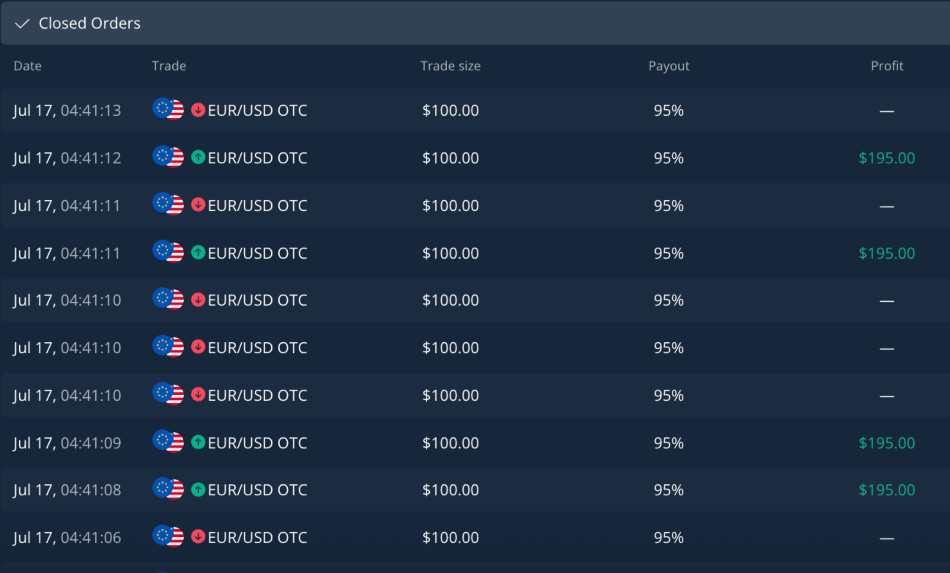
We placed 10 scalp binary options trades on EUR/USD OTC – 4/10 were winners
This structural disadvantage becomes even clearer over a larger sample, i.e. the hundreds of trades a binary trader looking to generate a meaningful amount or intending to trade for a living. At a 95% payout, a trader must consistently win more than 51.28% of trades simply to break even. If they make 100 trades, winning 55 and losing 45, 55 winning trades would generate $5,225 in profit while 45 losing trades would cost $4,500, leaving them with just $725 in net profit despite a relatively strong 55% win rate. Anything below the 51.28% break-even threshold produces a negative expected return over time.
And had we continued at the same 40% win rate over 100 trades, and granted this 10-trade session was a small sample, 40 winners would have generated $3,800 in profit while 60 losses would have cost $6,000, leaving us $2,200 down overall.
Ultimately, many retail traders struggle to maintain the required level of consistency once short-term noise, news events, platform delays, emotional decision-making, and changing market conditions are taken into account. Even skilled traders can experience extended losing streaks that quickly wipe out gains because every loss is larger than every equivalent win.
Bottom Line
For these three key reasons, binary options aren’t suitable for most retail traders. We generally recommend sticking to better-regulated trading products like forex or stocks, offered by licensed brokerages. While they still come with significant risks, they don’t have quite the same stigma; they are typically available through more established regulatory frameworks than many offshore binary options platforms.