
Best Deutsche Boerse Brokers 2026
Discover the best brokers with access to the Deutsche Boerse following our rigorous hands-on testing.
 Written By
Royston Wild
Royston is a seasoned investor and financial writer with over a decade of experience analyzing brokers and investment markets. With a background in stocks, commodities, and forex reporting - he brings a fresh perspective to broker evaluations.
Royston Wild Profile Page Fact Checked By
James Barra
James is an experienced broker analyst with a background in financial services. He has spent 2,500+ hours testing brokers, used 35+ different platforms and apps, audited 120+ broker T&Cs, and verified 300+ regulatory licenses. James has also been on US and UK TV, and been a guest on finance podcasts, discussing reports conducted by BrokerListings.com and sharing his expertise.
James Barra Profile Page Edited By
Tobias Robinson
Tobias is committed to helping traders find the right brokerage for their needs. He has tested 200+ brokers, spent 2,600+ hours using different platforms, and placed 2,100+ trades.
Tobias Robinson Profile PageAugust 5, 2026
Filters
How We Choose The Top Deutsche Boerse Brokers
Our comprehensive testing process comprises four steps:
- After opening a trading account with each broker in our expanding database, we record which ones provide access to Deutsche Boerse.
- Checking that each firm is authorized by a top-tier financial services regulator. For investors residing in Germany, we suggest using a broker that’s authorized by Bundesanstalt für Finanzdienstleistungsaufsicht (BaFin), Germany’s national regulator. Selecting a broker that’s approved by another European Union (EU) watchdog is also acceptable in our view. Under BrokerListings.com’s proprietary rating system, each of these bodies has received a Category A rating, meaning investors can expect ‘excellent’ levels of protection.
- Evaluating important aspects of the broker’s service, including their fees and charges, the quality of their online trading platform, their compatibility with third-party software, and how effectively they execute customer orders.
- Regularly re-checking each broker’s authorization. This is because regulators can suspend or withdraw a broker’s license when rules are breached.
Brokers are given an overall rating after we combine 200+ data points and the views of our hands-on evaluators. Firms that provide access to Deutsche Boerse are then sorted in order of their ranking.
How Should I Choose A Broker To Trade Financial Assets On Deutsche Boerse?
Deutsche Boerse operates one of Europe’s largest exchange groups, providing retail investors with exposure to a broad range of securities. As such, the range of brokers offering access to stocks via Xetra or Boerse Frankfurt, for instance, or derivatives through Eurex is vast.
Having said that, the number and type of securities offered among brokers can differ, and in some cases significantly. Not only that, but there may also be notable differences between the levels of service each company provides.
For these reasons, it’s important to spend time finding the broker that best suits your needs. But largely speaking, the four most important things to consider when choosing a service provider are:
Trustworthiness
Online investment fraud is booming. In 2025, an operation involving German state police and national regulator BaFin closed down 1,400 illegal internet domains that were being used to trick traders and investors.
So as you can see, the most important thing to check when choosing a broker is that it’s authorized by a reputable financial watchdog. In Germany, investors often choose firms that are BaFin licensed, and use the regulator’s online database to check a broker’s status before handing over any money or sensitive personal information.
However, investors in Germany don’t necessarily need to restrict themselves to BaFin-approved brokerages. The reason? Under the Markets in Financial Instruments Directive II (MiFID II), a broker that’s authorized in one European Union (EU) country can ‘passport’ their services into the market of any other bloc member.
Strict regulatory oversight by the European Securities and Markets Authority (ESMA), as well as each national regulator in the EU, helps investors receive strong protections from fraud and bad business practices by any officially licensed broker.
Pro tip: Under BrokerListings.com’s regulator scoring system, ESMA — along with each regulator that applies its regulatory framework — has received Category A status.
Brokers registered in other European Economic Area (EEA) countries (namely Norway, Liechtenstein and Iceland) are also permitted to passport their services to EU members. However, we would recommend avoiding brokers who are approved solely by regulators in these countries. This is due to their lower Category B or C ratings under our ranking system.
Using a broker licensed by an EU regulator has other benefits for retail investors, such as negative balance protection for trading contracts for difference (CFDs) outside Deutsche Boerse. This ensures investors can’t lose more money than is deposited in their trading account. Leverage on CFDs is also restricted to 1:30 to prevent individuals taking on unacceptable levels of risk.
Furthermore, brokers approved by BaFin or another EU financial watchdog must be signed up to a scheme that allows customers to apply for compensation if the company goes bust and cannot return their funds or securities.
In Germany this is the Entschädigungseinrichtung der Wertpapierhandelsunternehmen (EdW), which compensates investors for up to 90% of eligible claims (up to a maximum of €20,000 per individual).
Top Deutsche Boerse broker for trustworthiness: Eightcap — founded in Australia in 2015 — is authorized to operate in the EU by the Cyprus Securities and Exchange Commission (CySEC). It also holds licenses with other Category A regulators, namely the UK’s Financial Conduct Authority (FCA) and the Australian Securities and Investments Commission (ASIC).
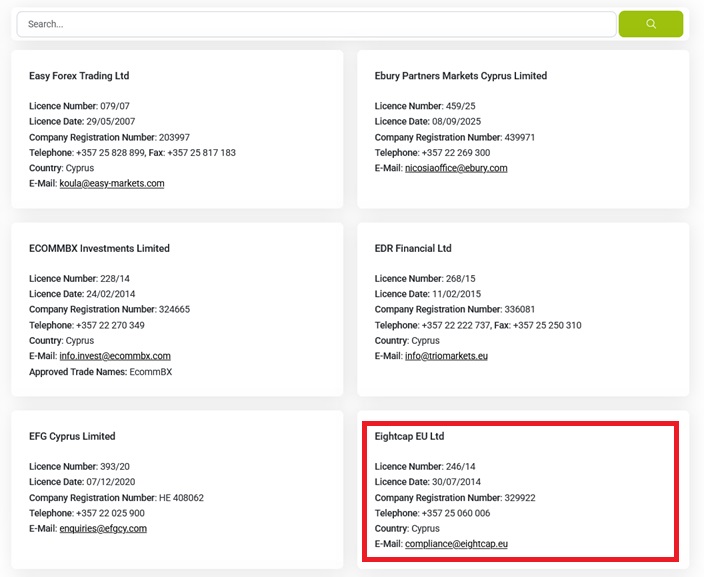
Eightcap is regulated by CySEC in the EU. Source: CySEC
Trading Costs
Regulated brokers operating in the EU must publish a comprehensive and easy-to-understand list of fees and charges investors can expect.
These include:
- Transaction fees.
- Deposit and withdrawal charges.
- Management fees and account subscription costs.
- Inactivity fees.
- Forex conversion charges.
No two brokers operate with exactly the same cost structure. So it’s important to carefully analyze the items different firms charge for and the size of their costs, and then think about which fee structure best fits your investing style.
Be mindful that some brokerages will charge more because they offer a better service. For instance, they may provide access to advanced charting tools on their platform, and superior educational resources.
Think about whether you’d be willing to pay extra for this. If you find that over time such extras don’t make a positive difference to your trading performance, consider downgrading your package if possible or switching to a cheaper broker. Unnecessary trading costs add up and can take a major bite out of your profits.
Certain brokers also offer different prices for investors depending on other factors. For instance, some firms have higher-tier accounts benefiting from lower trading commissions. Eligibility often depends on how much an investor deposits in their account, or alternatively on their trading volumes.
Pro tip: Also take a close look at the broker’s bid (buy) and ask (sell) spreads. If you’re a high-volume trader, using a service provider with wider spreads can be more costly than using one that charges trading commissions.
Deutsche Boerse doesn’t charge retail or institutional investors to buy or sell assets on Boerse Frankfurt or Eurex. Instead, it slaps fees on exchange members (such as brokers), who can then pass these costs onto their customers if they wish.
For example, the standard transaction fee on Eurex for DAX futures is €1.50 per contract for client business, such as that carried out by a retail broker. Other institutions (like market makers and proprietary traders) will pay a lower rate.
Traders in Germany and the broader eurozone may wish to consider using a broker that offers euro (EUR)-based trading accounts. This way they can avoid currency conversion fees when dealing in EUR-denominated Deutsche Boerse assets. Account administration and portfolio management can also be much simpler if you’re trading in the same currency you use every day.
Top Deutsche Boerse broker for trading costs: One thing we especially like about Trade Nation is its low fixed spreads. But there are plenty of other features that caught our eye, including zero commissions; no deposit or withdrawal fees; and a lack of charges if your account is idle for a while.
Trade Nation also offers EUR-denominated accounts. And putting the cherry on top is the broker’s ‘no minimum deposit’ policy.
Range Of Markets
All the major brokerages should offer access to stocks, exchange-traded funds (ETFs) or bonds on Xetra or Boerse Frankfurt. The same goes for derivative products on Eurex.
However, the depth of each broker’s product range can differ substantially. Want to trade a particular small cap share on the SDAX index? This may not be possible with all service providers.
Also be aware that some brokers may not allow you to hold a specific Deutsche Boerse-listed security directly. You may be able to get exposure via a futures or options contract on it through Eurex, or a CFD contract traded over-the-counter (OTC).
Products like this allow you to speculate on an asset’s price, though it can have disadvantages too. For instance, buying a Eurex futures contract on E.ON means that — unlike share investors — you’ll miss out on the energy provider’s dividends.
Top Deutsche Boerse broker for range of markets: CMC Markets is best known as a CFD trading platform. Traders have more than 12,000 contracts to choose from, providing exposure across a number of markets including equities, forex, commodities and bonds.
Investors can also buy Deutsche Boerse securities directly through its CMC Invest platform. This is available to investors spanning 15 countries in North America, Europe and Asia, including Germany.
Trading Platform
Brokers have invested heavily in technology in recent years, meaning traders can often access cutting-edge platforms without having to pay extra for the privilege. However, the quality of the service and the range of tools on offer can still differ substantially among service providers.
Key things to look out for may, depending on your investing style, include:
- Trade execution speeds.
- Real-time pricing and volume data.
- Menus, charts and buttons that are highly customizable and simple to navigate.
- Sophisticated risk management tools (like stop loss orders).
- Robust online security (like two-factor authentication when signing in and withdrawing funds).
- Advanced charting tools.
- Access to automated and algorithmic trading tools.
- The option to create watchlist for specific securities, such as DAX-listed shares.
- On-hand customer service which is contactable through multiple channels.
- Exhaustive research and education tools (like news feeds, economic calendars and analyst research).
- Compatibility with third-party trading platforms like MetaTrader 5 (MT5).
Pro tip: BrokerListings.com recommends taking a broker’s platform on a ‘road test’ before depositing any money in a trading account. This can be done with a free-to-use demo account which many service providers currently offer. These simulators have an added benefit for novice investors, too, by helping them get up to speed with the market before putting any ‘real’ cash on the line.
Top Deutsche Boerse broker for trading platform: Pepperstone doesn’t only offer its own proprietary trading system for customers to use. Its online infrastructure also supports popular third-party platforms MetaTrader 4 (MT4), MetaTrader 5 (MT5), TradingView and cTrader.
Pepperstone offers smartphone apps too for investors who like to buy, sell, and manage their portfolios on the move. There’s also a demo account available.
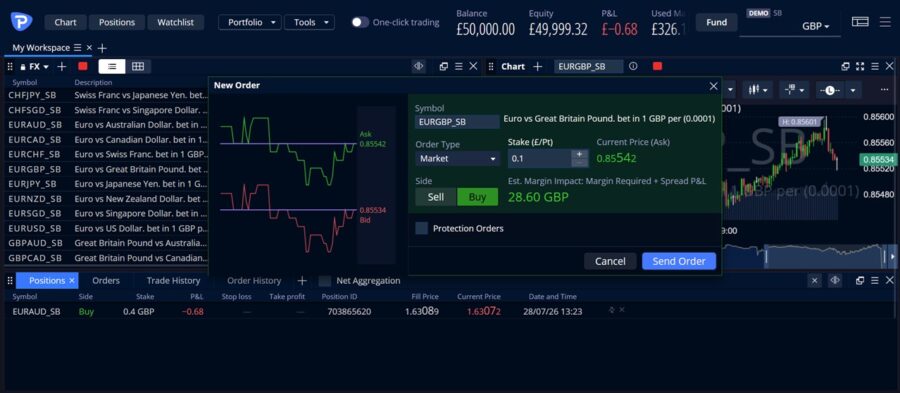
Trading using a Pepperstone demo account. Source: Pepperstone
How Can I Begin Trading On Deutsche Boerse?
Buying and selling financial assets on Frankfurt’s markets involves three key steps:
1. Comparing brokerages. The global popularity of German stocks means many service providers offer broad exposure to the Frankfurt market. Yet the range of assets I can access may differ significantly among brokers. And as I’ve shown, there are a number of other factors to consider. So I’ll take time to work out what’s best for me before registering my details.
2. Opening an account. Once I’ve chosen a broker, I’ll need to provide them with key information to process my application and comply with regulations. Before I’m able to trade, the company will need to know the basics (name, address, nationality etc.) as well as some personal investing details (like my trading experience and goals). I may also need to provide proof of identification and address before my account is up and running.
3. Deposit funds. With my account open, I’ll be ready to fund it to start trading on Deutsche Boerse. Many brokers offer a range of ways to deposit money, including bank transfer (such as from regional banks like Volksbanken Raiffeisenbanken), debit card, digital wallets (like Apple Pay) and payment service providers.
What Is Deutsche Boerse?
Deutsche Boerse Group was founded in 1992 in Frankfurt, and is one of the world’s largest securities exchange operators.
It is perhaps best known for its ownership of the Frankfurter Wertpapierbörse (FWB, or Frankfurt Stock Exchange), where the lion’s share of equities trading in Germany takes place.
The group also operates the following exchanges in Germany:
- Eurex, where derivatives (including futures and options contracts) change hands.
- The European Energy Exchange (EEX), a major energy and environmental commodities marketplace.
- 360T, where forex and money-market trading occurs.
Pro tip: 360T and the EEX are designed almost exclusively for institutional investors, while retail investors can access Deutsche Boerse’s other markets through an online broker.
As well as operating several of Germany’s major securities exchanges, Deutsche Boerse Group provides clearing, settlement, custody and market data services across the globe.
Deutsche Boerse is home to some of Europe’s largest listed companies. These include:
- Diversified technology group Siemens.
- Software developer SAP.
- Insurance provider Allianz.
- Siemens Energy, which builds power generation and transmission technology.
- Telecommunications specialist Deutsche Telekom.
- Semiconductor manufacturer Infineon.
- Munich RE, the world’s largest reinsurance provider.
- Logistics group DHL.
- Chemicals and pharmaceuticals producer Merck.
- Financial services provider Deutsche Bank.
This list illustrates the diverse range of established and industry-leading companies Deutsche Boerse provides exposure to. The exchange’s benchmark share index is the Deutscher Aktienindex, commonly referred to as the DAX, comprising 40 of Frankfurt’s biggest listed companies.
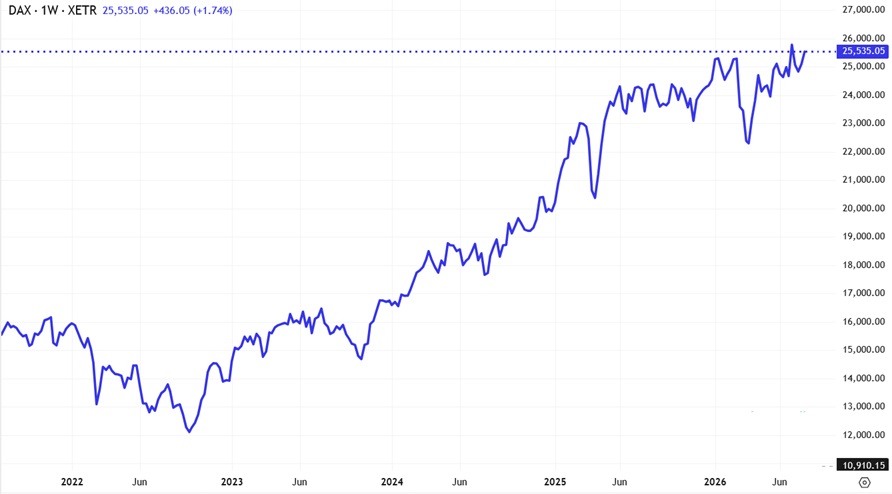
Long-term performance of the DAX index. Source: TradingView
How Can I Trade Deutsche Boerse Securities And Derivatives?
Roughly 90% of share trading in Germany occurs on Xetra, Deutsche Boerse’s electronic trading platform, though equities are also exchanged on Boerse Frankfurt. This is the Frankfurt Stock Exchange’s traditional trading venue, where specialist market makers provide liquidity.
Xetra and Boerse Frankfurt collectively offer retail investors exposure to hundreds of German and international companies. These range from the blue-chip constituents of the DAX index, to mid-sized companies on the MDAX and small cap stocks on the SDAX.
Many of these listings can also be found on the TecDAX, a specialist index of fast-growing technology companies.
Investors aren’t restricted to just stock trading, however. Boerse Frankfurt provides access to 1.5 million securities in total, a list which also includes:
- Government and corporate bonds.
- ETFs.
- Exchange-traded commodities (ETCs).
- Investment funds.
- Warrants.
- Certificates.
Traders who want to deal in futures and options can do so via Deutsche Boerse’s Eurex exchange.
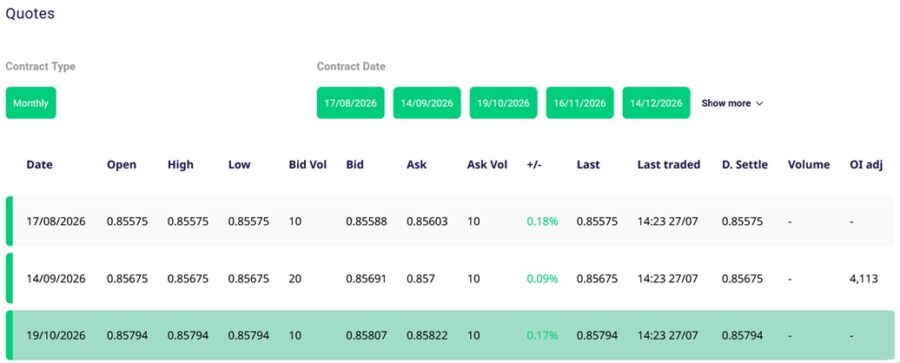
Quotes for the EUR/GBP forex pair at Eurex. Source: Eurex
Bottom Line
Deutsche Boerse offers a world of investing opportunities, as is reflected by the large number of brokers that offer access. When choosing a service provider, it’s critical to choose one that’s authorized by a top-tier regulator like BaFin,Germany’s national regulator.
Also consider the quality of the broker’s trading platform, the range of available financial assets, and the fees and charges you can expect to pay.