
Best Toronto Stock Exchange Brokers 2026
Discover the best brokers with access to the Toronto Stock Exchange (TSX) following our rigorous hands-on testing.
 Written By
Royston Wild
Royston is a seasoned investor and financial writer with over a decade of experience analyzing brokers and investment markets. With a background in stocks, commodities, and forex reporting - he brings a fresh perspective to broker evaluations.
Royston Wild Profile Page Fact Checked By
Tobias Robinson
Tobias is committed to helping traders find the right brokerage for their needs. He has tested 200+ brokers, spent 2,600+ hours using different platforms, and placed 2,100+ trades.
Tobias Robinson Profile Page Edited By
James Barra
James is an experienced broker analyst with a background in financial services. He has spent 2,500+ hours testing brokers, used 35+ different platforms and apps, audited 120+ broker T&Cs, and verified 300+ regulatory licenses.
James Barra Profile PageFebruary 25, 2026
-
1Interactive Brokers (IBKR) is a top brokerage firm offering access to 150 markets in 33 countries and a range of investment services. With 40 years in the field, this company listed on Nasdaq strictly follows the rules set by authorities such as the SEC, FCA, CIRO, and SFC. It's recognized as one of the most reliable brokers for global trading.
Compare Brokers
| Broker |  |
USD Account |
Demo Account |
Minimum Deposit |
Minimum Trade |
Leverage |
Copy Trading |
Regulator |
Instruments |
Platforms |
Account Currencies |
Automated Trading |
AI |
Guaranteed Stop Loss |
|---|---|---|---|---|---|---|---|---|---|---|---|---|---|---|
 |
✓ | ✓ | $0 | $100 | 1:50 | ✗ | FCA, SEC, FINRA, CFTC, CBI, CIRO, SFC, MAS, MNB, FINMA, AFM | Stocks, Options, Futures, Forex, Funds, Bonds, ETFs, Mutual Funds, Cryptocurrencies, CFDs Stocks, Options, Futures, Forex, Funds, Bonds, ETFs, Mutual Funds, Cryptocurrencies | Trader Workstation (TWS), IBKR Desktop, GlobalTrader, Mobile, Client Portal, AlgoTrader, OmniTrader, TradingView, eSignal, TradingCentral, ProRealTime, Quantower | USD, EUR, GBP, CAD, AUD, INR, JPY, SEK, NOK, DKK, CHF, AED, HUF | Capitalise.ai, TWS API | ✓ | ✗ | |
| Broker | |
USD Account |
Demo Account |
Minimum Deposit |
Minimum Trade |
Leverage |
Copy Trading |
Regulator |
Instruments |
Platforms |
Account Currencies |
Automated Trading |
AI |
Guaranteed Stop Loss |
Safety Comparison
Compare how safe the Best Toronto Stock Exchange Brokers 2026 are.
| Broker | Trust Rating |
Guaranteed Stop Loss |
Negative Balance Protection |
Segregated Accounts |
|---|---|---|---|---|
|
✗ | ✓ | ✓ | |
| Broker | Trust Rating |
Guaranteed Stop Loss |
Negative Balance Protection |
Segregated Accounts |
Mobile Trading Comparison
Compare the mobile trading features of the Best Toronto Stock Exchange Brokers 2026.
| Broker | Mobile Apps |
iOS Rating |
Android Rating |
Smart Watch App |
|---|---|---|---|---|
|
iOS & Android | ✓ | ||
| Broker | Mobile Apps |
iOS Rating |
Android Rating |
Smart Watch App |
Comparison for Beginners
Compare how suitable the Best Toronto Stock Exchange Brokers 2026 are for beginners.
| Broker | Demo Account |
Minimum Deposit |
Minimum Trade |
Education Rating |
Support Rating |
Fractional Shares |
Demo Competitions |
|---|---|---|---|---|---|---|---|
|
✓ | $0 | $100 | ✓ | ✗ | ||
| Broker | Demo Account |
Minimum Deposit |
Minimum Trade |
Education Rating |
Support Rating |
Fractional Shares |
Demo Competitions |
Comparison for Advanced Traders
Compare how suitable the Best Toronto Stock Exchange Brokers 2026 are for advanced or professional traders.
| Broker | Automated Trading |
VPS |
API |
AI |
Pro Account |
Leverage |
Low Latency |
Extended Hours |
|---|---|---|---|---|---|---|---|---|
|
Capitalise.ai, TWS API | ✗ | ✗ | ✓ | ✗ | 1:50 | ✓ | ✓ |
| Broker | Automated Trading |
VPS |
API |
AI |
Pro Account |
Leverage |
Low Latency |
Extended Hours |
Accounts Comparison
Compare the trading accounts offered by Best Toronto Stock Exchange Brokers 2026.
| Broker | Demo Account |
Interest on Cash |
Islamic Account |
Joint Account |
Managed Account |
PAMM |
MAM |
LAMM |
Pro Account |
|---|---|---|---|---|---|---|---|---|---|
|
✓ | USD: 3.14%, GBP: 3.24% | ✗ | ✓ | ✓ | ✗ | ✓ | ✗ | ✗ |
| Broker | Demo Account |
Interest on Cash |
Islamic Account |
Joint Account |
Managed Account |
PAMM |
MAM |
LAMM |
Pro Account |
Detailed Rating Comparison
Compare how we rated the Best Toronto Stock Exchange Brokers 2026 in key areas.
| Broker | Trust |
Platforms |
Assets |
Mobile |
Fees |
Accounts |
Research |
Education |
Support |
|---|---|---|---|---|---|---|---|---|---|
|
|||||||||
| Broker | Trust |
Platforms |
Assets |
Mobile |
Fees |
Accounts |
Research |
Education |
Support |
Fee and Cost Comparison
Compare the cost of trading with the Best Toronto Stock Exchange Brokers 2026.
| Broker | Cost Rating |
Fixed Spreads |
Inactivity Fee |
EUR/USD Spread |
Crypto Spread |
|---|---|---|---|---|---|
|
✗ | $0 | 0.08-0.20 bps x trade value | 0.12%-0.18% | |
| Broker | Cost Rating |
Fixed Spreads |
Inactivity Fee |
EUR/USD Spread |
Crypto Spread |
Broker Popularity
See how popular the Best Toronto Stock Exchange Brokers 2026 are in terms of number of clients.
| Broker | Popularity |
|---|---|
| Interactive Brokers |
|
Why Trade With Interactive Brokers?
Interactive Brokers is ideal for seasoned traders due to its robust charting platforms, updated data, and adaptability, especially with the IBKR Desktop application. Its exceptional pricing and advanced order features appeal to traders, and its variety of stocks remains unmatched in the market.
Pros
- Interactive Brokers was named Best US Broker for 2025 by DayTrading.com for its dedication to US traders, ultra-low margin rates, and affordable global market access.
- The TWS platform is designed for intermediate to advanced traders. It includes over 100 order types and a dependable real-time market data feed that rarely experiences downtime.
- Interactive Brokers has introduced ForecastTrader, a zero-commission service allowing users to trade yes/no Forecast Contracts on political, economic, and climate events. Contracts offer fixed $1 payouts, 24/6 market access, and a 3.83% APY on held positions.
Cons
- Only one active session per account is allowed, which means you can't run the desktop version and mobile app at the same time. This can sometimes lead to a frustrating trading experience.
- Customer service may take time to respond, and there may be delays in fixing problems based on tests. It could be difficult to reach the customer service promptly.
- IBKR offers many research tools. However, the tools are not uniformly distributed across trading platforms and the web-based 'Account Management' page, causing confusion for the users.
Filters
How We Selected The Top Brokers For Trading On The TSX
We checked that each brokerage listed provides trading on the TSX, combing through the assets on their platform and confirming with support where needed.
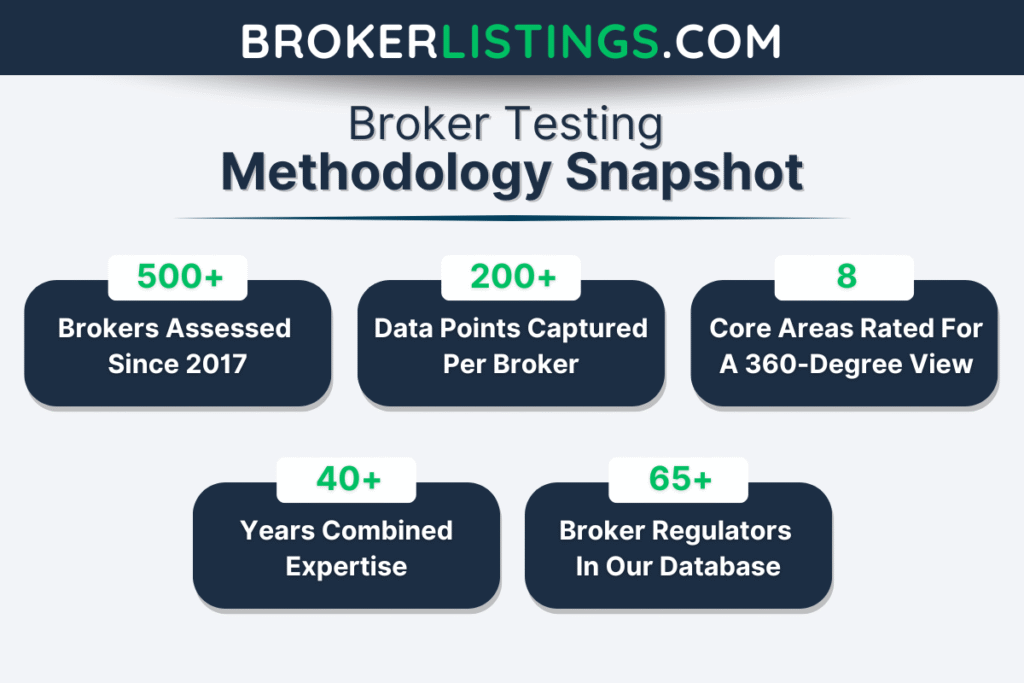
Then we used our broker testing methodology, evaluating firms across more than 200 data points and balancing the observations from our testing team. This fed into in an overall rating which we sorted TSX brokers on.
How To Choose A Broker To Trade The Toronto Stock Exchange
Traders have a wide range of brokerages they can choose from to deal in securities on the TSX. Unfortunately this market explosion means there’s also been a sharp rise in the number of bad actors in operation and companies offering poor levels of customer service.
It’s therefore critical to properly research the broker you’re considering before depositing cash or divulging any personal information.
Want to know the key things to focus on during the selection process?
Trustworthiness
By some distance, the most important factor to consider when choosing a service provider is their regulatory status.
According to the Canadian Securities Administrators (CSA) and Canadian Investment Regulatory Organization (CIRO), regulators closed down roughly 3,900 fake investment platforms and cryptocurrency scam websites between June 5 and November 23, 2025.
The question of trustworthiness isn’t just based on whether a broker is trying to steal your cash, either. You’ll also want to be confident that you’ll enjoy a seamless and stress-free trading experience, and that you’ll have clear legal recourse available if you have a bad experience.
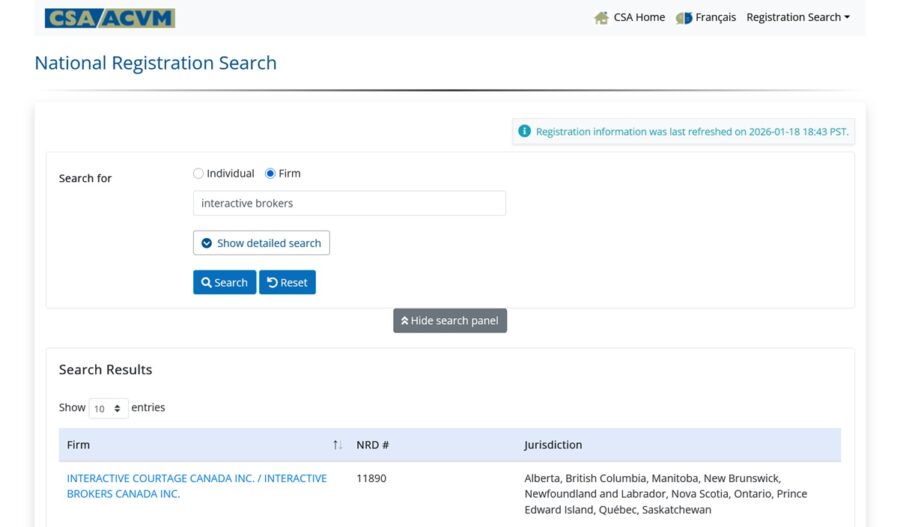
For all these reasons, it’s critical to check the broker you’re considering is licensed to trade by a respected global regulator. To this end, the CSA – operating as the umbrella organization for Canada’s provincial and territorial securities regulators – maintains a list of approved brokerages that traders can check online. We’ve also ranked the top CIRO-regulated trading brokers.
Pro tip: Traders can also take confidence in using brokers trading under the supervision of other top-tier global regulators.
BrokerListings.com’s Regulator Ranking System provides a comprehensive list of respected financial services watchdogs that traders can check.
Top broker for trustworthiness: Interactive Brokers is overseen by around a dozen of the world’s foremost regulators. Along with Canada’s provincial regulators, it has received approval from the UK’s Financial Conduct Authority (FCA), reference number 208159.
Source: CSA
Trading Costs
With regulatory status confirmed, the next key thing to consider is trading costs. Transaction charges, overnight fees, account inactivity costs, and deposit and withdrawal charges are just a few things to consider.
The level of charges can differ greatly across brokers. Some service providers might not impose some of these charges at all on their customers.
However, they may compensate for this with wider bid and ask spreads. It’s important, therefore to consider this along with those headline charges I’ve described.
Brokers who operate in regions with strict regulations are required to publish full and comprehensive lists of fees and charges to their customers. Pay close attention to this, as large costs can take a huge (and sometimes unnecessary) bite out of a trader’s profits.
Top broker for trading costs: Pepperstone is one of the most competitive operators on the market when it comes to costs. It offers zero trading commission fees and ultra-tight spreads, and high-frequency traders can receive juicy rebates with its Active Trader program.
Pro tip: Traders in Canada may also wish to consider using brokers that offer trading in Canadian dollars (CAD). IC Trading is one company offering trading in the North American currency. Over time, these accounts can save individuals a small fortune in currency conversion fees.
Trading Platforms
The question of which broker offers the ‘best’ trading software can be an even more personal thing than which broker is most cost effective for you.
Differences in appearance and functionality may be enormous but highly subjective. Trading styles can also vary significantly from person to person, rendering issues like which broker has the greatest mobile app redundant among those who plan limited trading ‘on the go.’
However, there are some common features that almost all traders will be keen to examine. These include:
- Trade execution speeds.
- Availability of real-time market data.
- Access to research and other resources (such as news feeds, economic calendars and analyst reports).
- Provision of advanced charting tools.
- Security features (for instance, is two-factor (2FA) sign-in verification available?).
- The degree to which the trading platform can be customized.
- Community or social trading features.
- Availability of risk management tools (like stop loss orders).
- Compatibility with third-party trading platforms such as MetaTrader 4 (MT4) and OmniTrader.
- Provision of automated and algorithmic trading tools.
- Availability of a demo trading account to ‘try out’ the platform and get up to speed with market movements.
- Quality and availability of customer service (for example, what channels can traders use to communicate?).
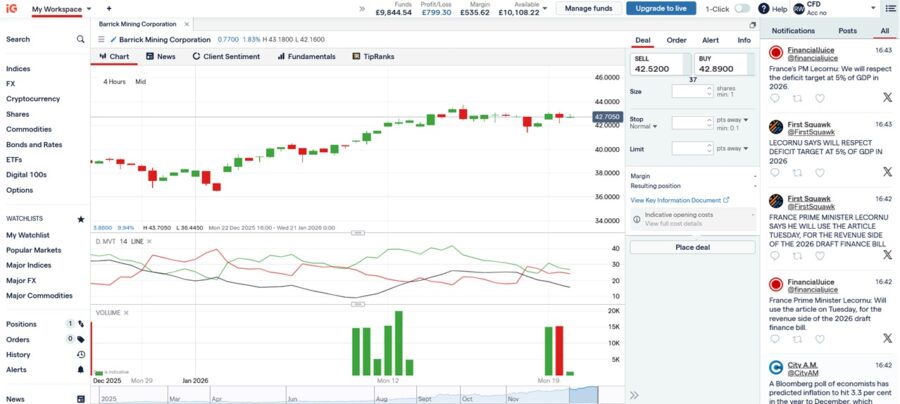
Top broker for trading platform: IG offers an excellent proprietary platform. Quick and highly customizable, it offers sophisticated charting tools, price alerts, artificial intelligence (AI) trading, and a mobile app for devices that run on both Android and iOS.
Individuals who don’t fancy using IG’s web-based platform can choose to use a third-party platform instead. The broker’s trading system is compatible with around half a dozen popular platforms including MT4 and TradingView.
Source: IG
Asset Range
The range of securities on offer can differ substantially from broker to broker. One service provider, for instance, may not provide access to particular Canadian small-cap stocks. Another might not allow you to trade a specific exchange-traded fund (ETF).
It’s important, though, not just to consider what assets you might want to trade straight away. Having access to a wider pool of securities can provide unexpected opportunities for you to nip in and make a profit.
Top broker for asset range: Interactive Brokers offers one of the largest ranges of TSX-listed stocks and ETFs from our tests.
How To Begin Trading The Toronto Stock Exchange
The practical steps from beginning your broker search to trading TSX securities won’t be exactly the same across companies. But broadly speaking, the process involves three key stages:
- Find a brokerage. The market is huge and competition fierce, which works to the advantage of traders. Make the most of this and spend time to find the broker which best suits your needs. On top of the four key things described above, you may want to consider the availability and level of leverage (borrowed funds), an important, but high-risk consideration among many active traders.
- Open an account. The next step should take five to 10 minutes, and could involve me answering basic questions on my investing goals and experience, in line with typical regulatory requirements. I’ll also need to upload documents to prove who I am and where I’m located.
- Deposit some funds. I can’t trade without money in my account. So I’ll next need to top it up with some cash. The method of payment can differ among brokerages, but popular options include debit card payment, bank transfer, and payment via digital wallet (like Apple Pay) or third-party transaction platform (such as PayPal).
With these steps completed, I’ll be ready to start trading the TSX. Investors should begin trading slowly to get up to speed with the broker’s platform and the markets, and to put in place proper risk management tools to reduce risk of losses and boost their chances of making a profit.
What Is The Toronto Stock Exchange?
The Toronto Stock Exchange (TSX) is the largest financial securities trading hub in Canada. It’s also significant globally – home to around 2,000 companies, it’s on of the largest exchanges on the planet by total market capitalization.
The TSX was established in 1852 and merged with the Montreal Stock Exchange in 2009 to form TMX Group.
TMX Group also operates the TSX Venture Exchange, which comprises micro- and small-cap companies favored by growth investors, and derivatives marketplace the Montréal Exchange.
Ways To Trade The Toronto Stock Exchange
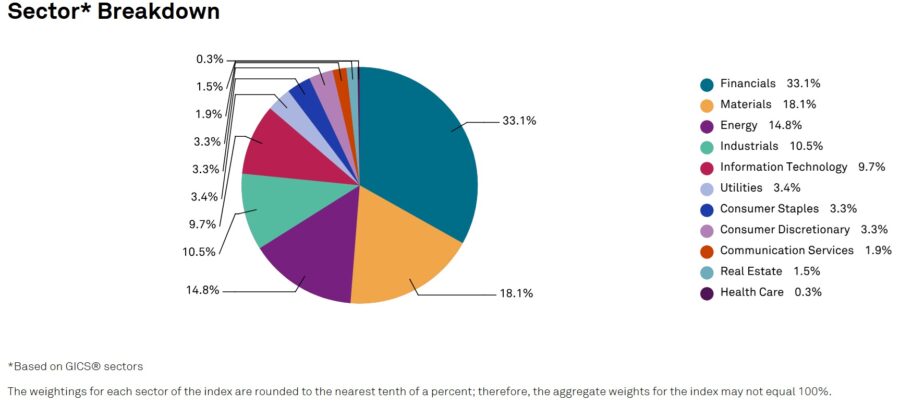
Equities are the dominant asset class that change hands on the TSX. This is best represented by the S&P/TSX Composite Index, which represents roughly three-quarters of the exchange’s total market capitalization.
Comprising more than 200 stocks, the S&P/TSX Composite Index is dominated by financial services companies like Royal Bank of Canada, Toronto-Dominion Bank and Brookfield Corporation.
Canada’s enormous reserves of raw materials also mean miners (such as Barrick Mining Corporation) and energy producers and energy services providers (including Enbridge) are well represented.
Source: S&P Global
Pro tip: The TSX isn’t limited to Canadian companies, with shares in US and Latin American businesses also readily available.
Excluding share trading, investors can also deal in ETFs covering asset classes, industries and geographies. There are more than 1,000 such funds listed on the TSX. It’s also possible to deal in closed-end funds and structured notes.
Bottom Line
There’s no shortage of top brokers that traders can choose from to deal in TSX-listed securities. So take the time to find the one that fits your needs best based on factors like cost, trading platform and asset range.
Whichever service provider you go with, it’s critical to ensure that they’re approved to do business by a top-level watchdog, whether that be one in Canada or another well-regulated part of the world.