

TradingPilotAI Review 2026: Is It Legit Or A Scam?
TradingPilotAI (‘tradingpilotai.com’) sells AI-assisted TradingView indicators and “VIP” Discord communities from $25 a week. I paid for it, and have concerns.
 Written By
Christian Harris
Christian is a seasoned analyst, leveraging his expertise in stocks, forex, and crypto to evaluate brokers worldwide. With hands-on trading experience and a strong focus on risk management, he helps traders find reliable platforms. Christian's work for BrokerListings.com has been cited in the Financial Times.
Christian Harris Profile Page Fact Checked By
Tobias Robinson
Tobias is committed to helping traders find the right brokerage for their needs. He has tested 200+ brokers, spent 2,600+ hours using different platforms, and placed 2,100+ trades.
Tobias Robinson Profile Page Edited By
James Barra
James is an experienced broker analyst with a background in financial services. He has spent 2,500+ hours testing brokers, used 35+ different platforms and apps, audited 120+ broker T&Cs, and verified 300+ regulatory licenses. James has also been on US and UK TV, and been a guest on finance podcasts, discussing reports conducted by BrokerListings.com and sharing his expertise.
James Barra Profile PageSeptember 8, 2026
Quick Verdict
TradingPilotAI Safety Assessment
« Make Full Width »| Safety metric | Status | What to do |
|---|---|---|
| Is it a scam? | No. Products are delivered, access works, no deposit taken, no regulator warning | Judge it on value, not fraud risk |
| What you’re buying | Three indicators that closely mirror free alternatives, plus a Discord and a short course | Load the free equivalents first |
| The “AI” claim | Nothing in the three indicators seemingly is or behaves as artificial intelligence. They are rule-based Pine Scripts | Treat “AI-assisted” as branding |
| Risk management | No position sizing or drawdown controls anywhere. TP ORB alone gives stop and target levels, with the stop far wider than the target | Work out the break-even win rate before trading it |
| Ownership & licensing | The footer names Pilot Ridge LLC but no individual anywhere. No financial licence in any jurisdiction | No ombudsman, no compensation scheme, and no person to hold accountable |
| Price transparency | Prices exclude sales tax: $25/week bills at $30 in the UK. The cheapest tier, $749.99 lifetime. The $15 tier includes the course but no indicator access | Open every billing option before buying |
| Refunds | The advertised 7-day guarantee does not apply to lifetime or other one-time purchases | The largest payment is the only one you can’t reverse |
| Overall risk | Elevated, but on value rather than fraud | Try the weekly version before paying $749.99 for non-refundable lifetime access |
What The Three Indicators Actually Do
TradingPilotAI offers three invite-only Pine Script indicators, a short course, and access to a paid Discord group. It does not execute trades, connect to your broker, or hold your money, so you avoid the main risk I’ve found with many scam brokers: blocked withdrawals. The worst that can happen is you pay too much. If you have not paid, you can only see the marketing material.
Here’s what loaded onto my charts when I signed up for a weekly subscription:
1. TPAI Is SuperTrend With Better Graphics
TPAI plots a thick band that follows price and flips between green and red, printing BUY and SELL labels and triangles. In an uptrend, it sits under price and glows green; when it flips, it moves above price and turns red.
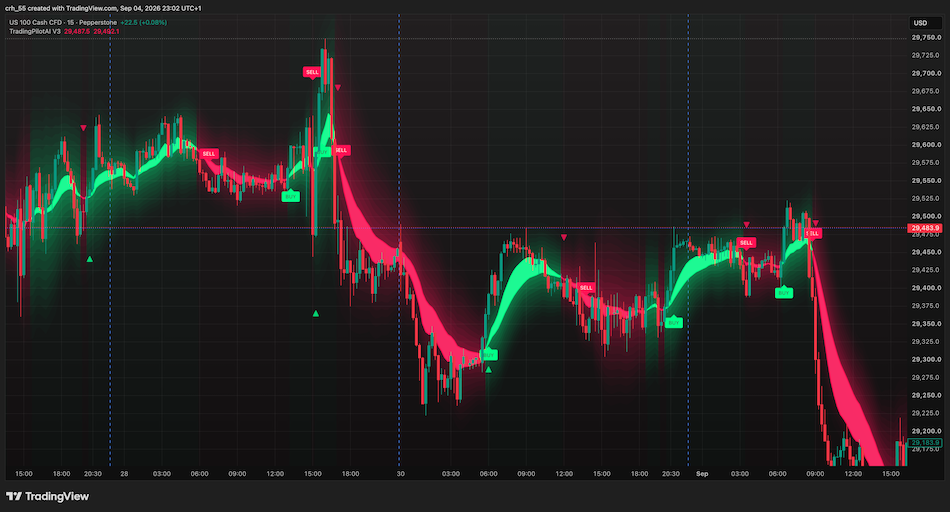
TradingPilotAI V3 on US 100, 15-minute chart
TPAI draws a single volatility band that follows price and flips sides, which is exactly how the free SuperTrend indicator works on TradingView.
I compared both indicators on the same instrument, timeframe, and date range. The bands moved with price in the same way, and the flips happened at nearly the same points. The main difference is appearance: TPAI adds a glow, gradient fill, and text labels, while SuperTrend only changes color. Without the extra styling, they are basically the same tool.
The method TradingPilotAI teaches asks you to mark support and resistance by hand on a higher timeframe, and then take only signals that match the band’s direction. You need to do the main analysis yourself — the indicator only provides a trend color.
TradingPilotAI also says that being rule-based rather than predictive should be reassuring, but that only works if you can see the rules. Paid TradingView scripts are invite-only and closed source. You can read SuperTrend’s code line by line, but you cannot do that with TPAI. So, you are being asked to trust a tool you cannot check.
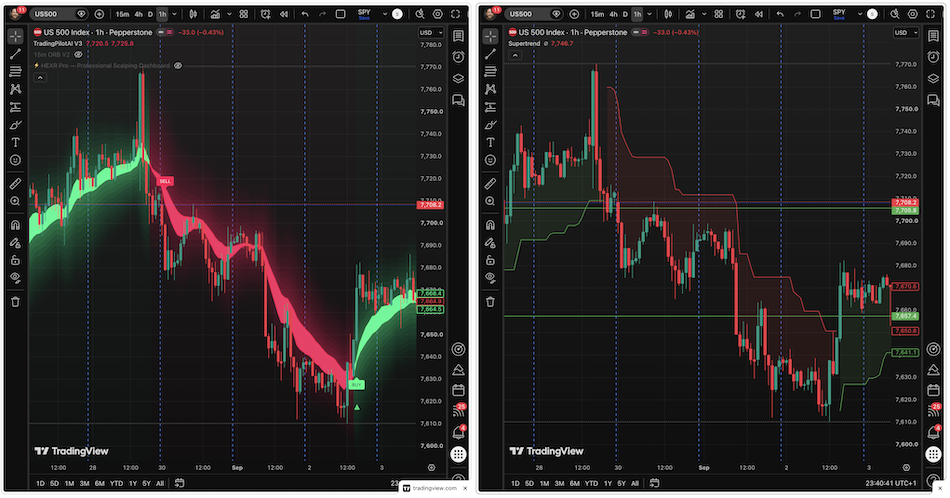
SuperTrend indicator on US 100, 15-minute chart
2. TP ORB Is A Generic Opening Range Script
TP ORB is a simple opening range breakout (ORB) indicator. By default, it waits out the first 15 minutes of the session, boxes the high and low of that window, then flags a break of either side with a label carrying a stop and a target.
Opening range breakout is a trading method that has been around for decades. TradingView’s public library has many free open-source versions with alerts, adjustable windows, and support for multiple sessions. I did not find anything TP ORB does that these free scripts do not.
The signal label shows the main problem. The stop is set at the high of the range, so your risk is the full width of the opening range, but the target is a fixed amount. In my tests, the stop was always wider than the target. This is a big issue, which I explain more below.
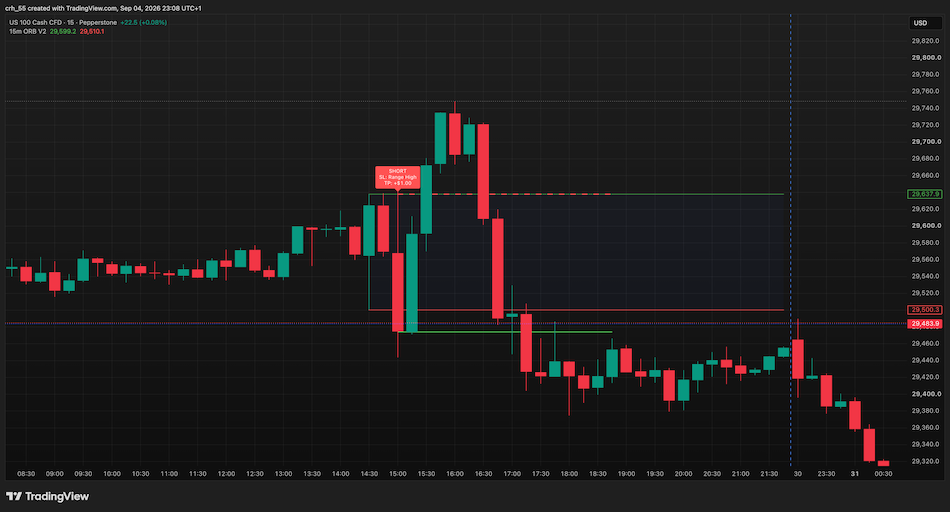
15m ORB V2 on US 100, showing a SHORT signal with the stop set at the range high
3. HEXR PRO Is A Manual Confluence Table
HEXR PRO loads as a corner dashboard titled “Professional Scalping Dashboard”, scoring readings into a single bias number. Two things you can’t see from the sales page:
Four of the six rows scored are moving averages. SMA bias, price versus EMA 21, EMA 50, and SMA 200 all check if price is above a recent average. This does not give you six different trading signals. Instead, you get RSI, MACD, and four versions of the same idea. When market trends change, all of these change at once, so the score jumps instead of moving slowly. A score of −6 might seem like strong proof, but it usually just means the market has been falling.
The components don’t match the marketing. The listing names Bollinger Bands and Stochastic as two of the six inputs. Neither appeared as a scored row on the dashboard I was served.
The free alternative is TradingView’s built-in Technical Ratings, which does the same thing: it scores each part +1, 0, or −1, averages them, and gives you one rating. It uses 26 parts — 15 moving averages and 11 oscillators, including RSI, Stochastic, CCI, ADX, and MACD — while HEXR PRO uses only six. It is also free. Or you can just add RSI, MACD, and three moving averages to a chart and check them yourself.
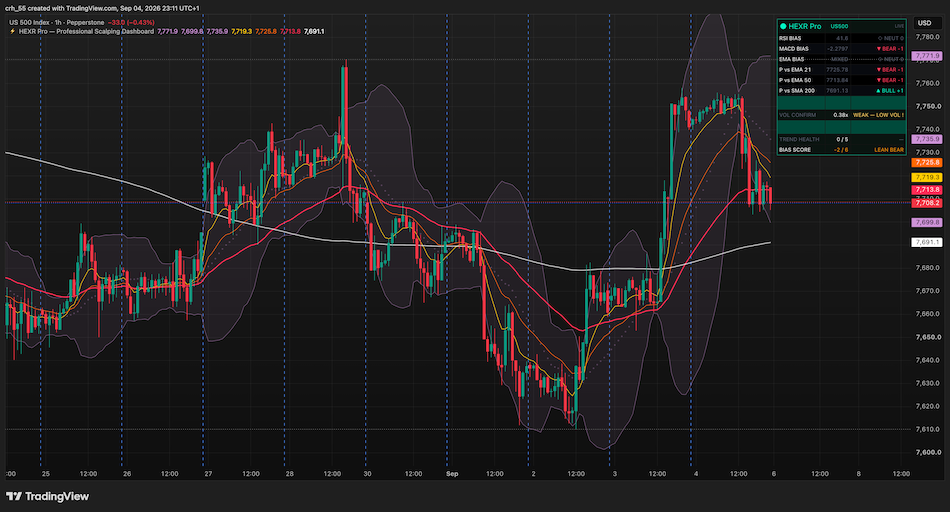
HEXR Pro on US 500
What Comes With The Indicators
The setup guide is a 49-second YouTube video that only shows how to install the tools. The Discord group is more helpful than the video and deserves credit. It gives detailed info on indicator settings and practical use, and is the main value of the subscription. However, all the advice is in chat messages, not organized documents, so you have to scroll to find it, and it could disappear if the operator leaves.
The Three Selling Points, Line By Line
- “AI-assisted buy and sell indicators.” None of the tools I tested are or behave like artificial intelligence in my opinion. HEXR PRO uses RSI (created by Welles Wilder in 1978), MACD, and moving averages. TPAI is just a volatility band. TP ORB only draws two horizontal lines. There is no model, no training data, no learning, and no adaptation. These are basic calculations that have been around since before personal computers.
- “Institutional-grade indicators.” There is no real thing as institutional grade for these tools. No group certifies it, no standard defines it, and no institution buys retail Pine Scripts. Big trading firms spend money on execution systems, market access, order flow data, and risk management — not on these scripts. This claim cannot be disproved, which is why it is used so often.
- “Customizable TradingView alerts.” Alerts are a feature of the TradingView platform, not of this product. You can add alerts to pretty much any indicator, including the free ones, and any Pine Script can include alert conditions with just a few lines of code. The free ORB scripts already have this feature.
The CFTC’s advisory AI Won’t Turn Trading Bots into Money Machines warns that AI cannot predict the future, and lists algorithms that give buy and sell signals to subscribers as a common tool for fraudsters. It does not mention TradingPilotAI. Still, the difference between what “AI-assisted” suggests and what these scripts actually do is what regulators call AI washing.
No Risk Management, No Position Sizing
TP ORB does a bit more by giving you a stop and a target, which the other two do not. But a stop only tells you where to exit, not how much to risk. None of these tools tell you how to size your position, what part of your account to risk, or when to stop after losing trades.
CFD brokers in the UK and EU have to publish the share of retail accounts that lose money, which is usually between 70% and 80%. These losses are not all caused by picking the wrong entries. They often happen because of leverage, guessing position size, and moving stops to avoid taking a loss.
Why TP ORB’s Stop And Target Settings Matter
« Make Full Width »| Stop vs target | Reward to risk | Win rate needed to break even |
|---|---|---|
| Stop = target | 1:1 | 50% |
| Stop = 2× target | 1:2 | 66.7% |
| Stop = 3× target | 1:3 | 75% |
| Stop = 4× target | 1:4 | 80% |
If your stop is three times bigger than your target, three wins are wiped out by one loss, so you need to be right 75% of the time just to break even. Spread and commission take a bigger bite out of small targets than large ones.
Over time, this problem gets worse. A system with a wide stop and small target may win most trades at first, so it feels like it works, and many traders increase their trade size before hitting a losing streak. If you need to win 75% of the time but your accuracy drops to 70%, you go from breaking even to losing money steadily. Most retail traders do not track their accuracy closely enough to notice this change.
This setup also works against the main advantage of the strategy. Opening range breakouts usually have a low win rate but high rewards: most trades lose, but the profits come from the few sessions that trend all day. By limiting the target and widening the stop, you miss out on the big wins that make this strategy work.
The Pricing Ladder Doesn’t Add Up
« Make Full Width »| Plan | Advertised | UK checkout (inc. 20% VAT) | Indicators | Course & Discord |
|---|---|---|---|---|
| Weekly | $25/week | $30/week | All three | Yes |
| Monthly | $75/month | $90/month | All three | Yes |
| Lifetime | $749.99 one-off | £679.24 one-off | All three | Yes |
| VIP Discord | $15/month | $18/month | None | Yes |
There are two things missing from the $25 headline price. The monthly and lifetime options are hidden behind a collapsed “+2 options” link. Also, prices do not include sales tax, so buyers in VAT countries see a 20% increase at checkout with no warning on the product page – something I paid when I subscribed to TradingPilotAI from the UK.
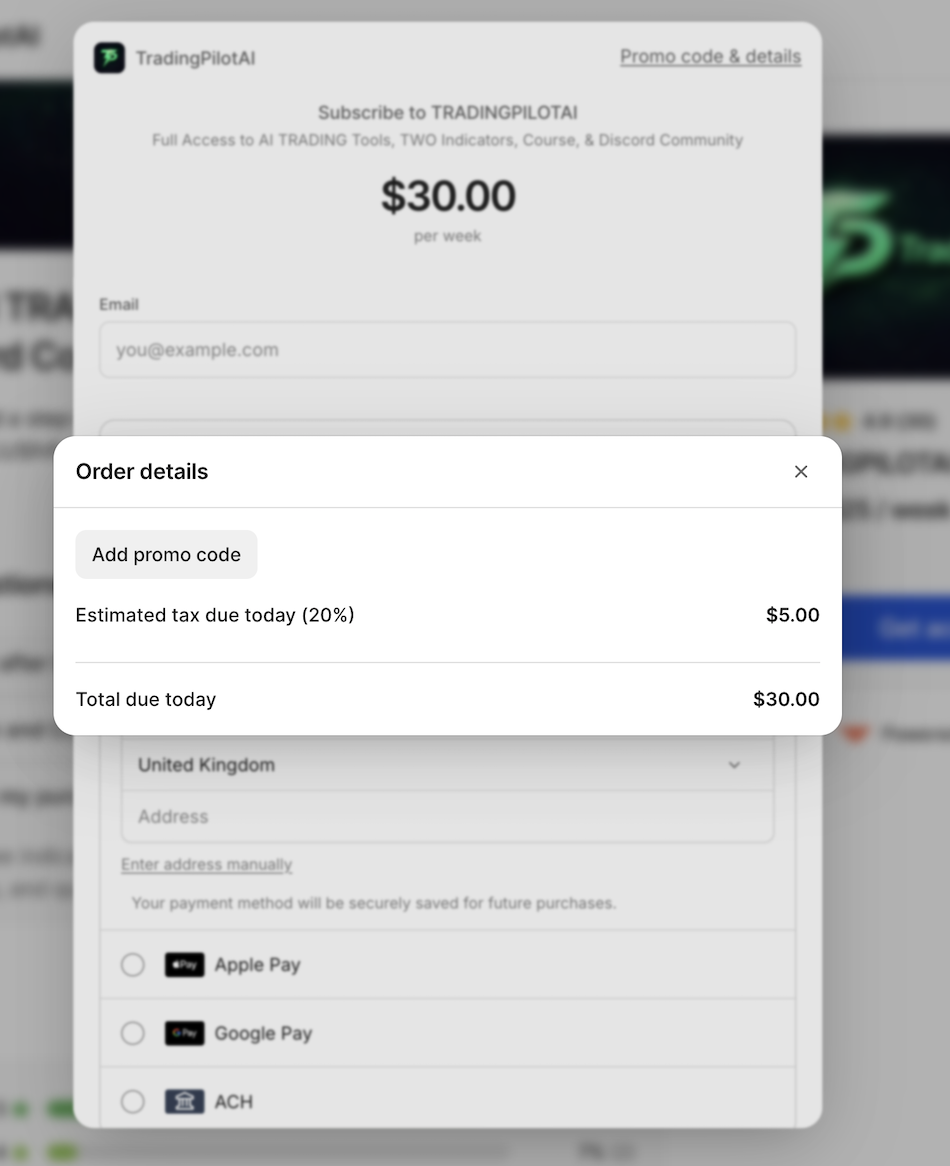
Subscribing
Every subscription carries all three indicators plus the course and Discord, so the only real decision is how often to be billed — and on that the storefront steers you to the worst answer. At $25 a week, you pay about $100 a month for access identical to the $75 plan, 33% more for the same thing, and you pass the $749.99 lifetime price in 30 weeks.
The $15 VIP Discord tier stands out. On paper, it offers a lot: full course access, live trade analysis, daily updates, weekly recaps, and private chat. But the listing clearly says it “DOES NOT COME WITH INDICATOR ACCESS.” So, the cheapest tier sells a course that teaches a system based on three indicators, but you cannot use any of them.
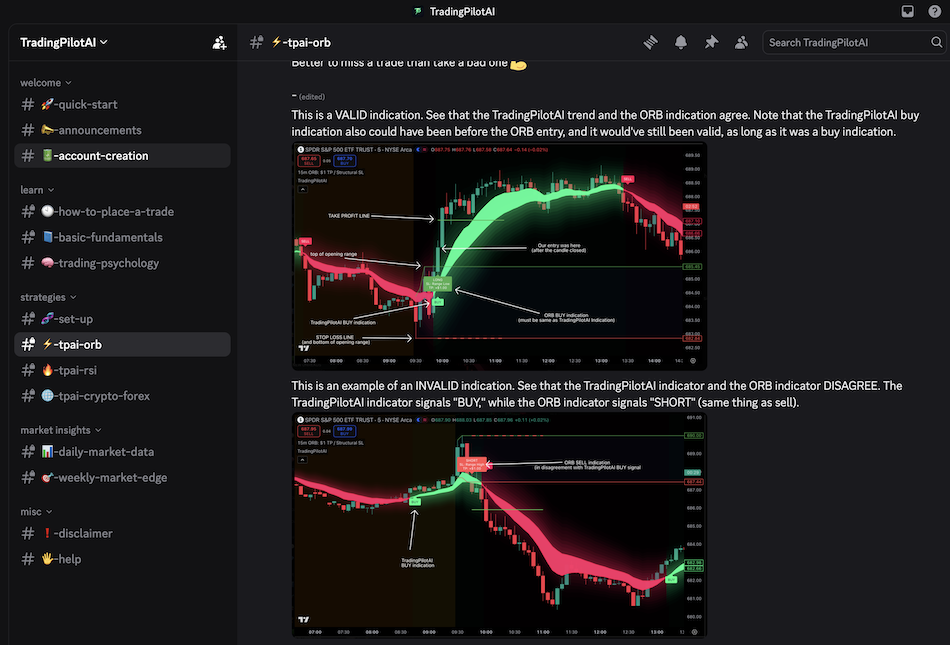
Discord
The 7-Day Guarantee Excludes The Biggest Payment
TradingPilotAI markets a 7-day money-back guarantee. However, when I read the terms page, I noticed that it doesn’t apply to the lifetime tier: one-time purchases are described there as “FINAL SALE and non-refundable”, on the reasoning that access is granted in full the moment you pay.
This means the largest payment the company takes, $749.99, is the only one with no refund option. Nothing at checkout makes this clear. There was only a tick box to confirm I had read the terms, and nothing else.
“Lifetime” also means the lifetime of the product, not your own. These are invite-only scripts, so your access depends on the author keeping you on the permission list. Since there is no refund option and chargeback windows close after a few months, I recommend using a credit card instead of a debit card when making a purchase.
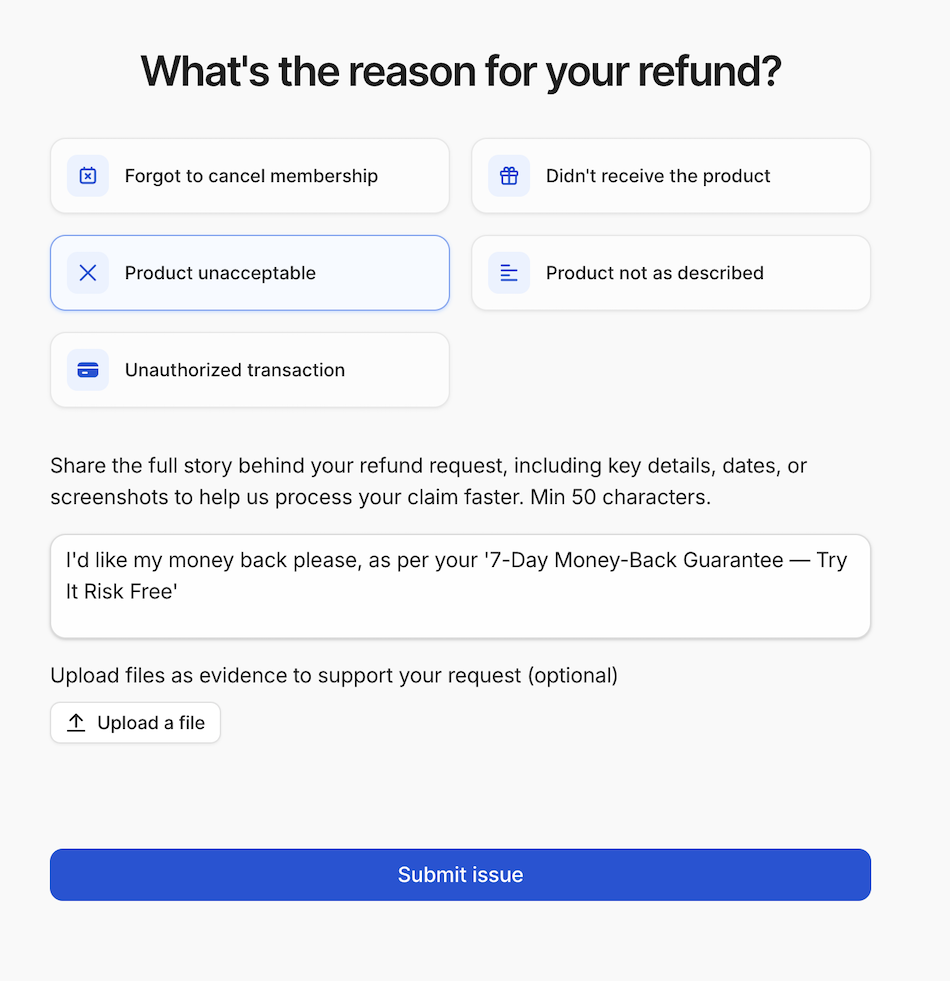
Refund request
Who Is Behind TradingPilotAI?
A company is named, but you have to look for it: the footer credits Pilot Ridge LLC, which is more disclosure than many similar products offer. That is where the trail ends. No individual is named on the site, the storefront, or the listings.
The footer’s contact link did not work during testing, and the only support address is hidden in the terms. The Whop store shows “Location hidden,” ICANN shows the the domain registration (https://tradingpilotai.com/) was on 12 January 2026.
The terms say Pennsylvania law applies, which is where the company should be registered and where you would have to take any dispute.
The Same Author Sells A Bigger Toolkit For A Fifth Of The Price
The indicators are published on TradingView by an account called grahamtrading, which matches the “Graham Ellis” name seen in affiliate write-ups, though this does not confirm it is the same person. The account has 425 followers, nine published scripts, and no published ideas. On the platform where these tools are sold, the author has never posted any public chart analysis.
The profile’s only website link doesn’t point to tradingpilotai.com. It points to gapalgo.com, a separate indicator brand, also branded as AI-engineered, and also sold through Whop.
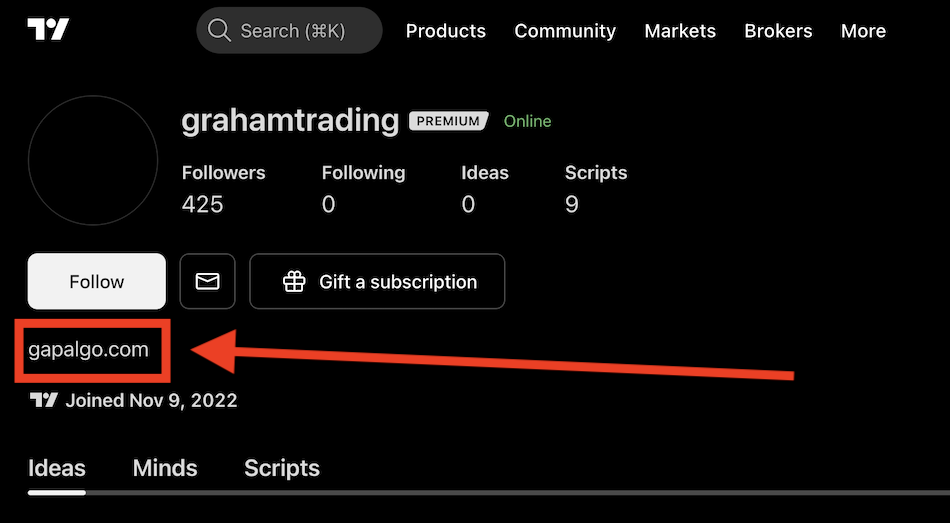
gapalgo TradingView
| TradingPilotAI | GapAlgo | |
|---|---|---|
| Free indicators | None | Five, no card required |
| Monthly | $75, or $15 with no indicator access | $15 |
| Lifetime | $749.99 | $149 |
| Documentation | 49-second silent video | Written setup guides for every indicator |
| Repainting | Not addressed | States signals confirm on bar close, invites you to check in replay mode |
To be fair, these are not just the same scripts with new names. GapAlgo includes tools for order blocks, fair value gaps, divergence, and session timing, each covering distinct aspects of technical analysis. Running multiple brands is common, and many Pine developers do it.
The real issue is not duplication, but pricing and transparency. Anyone considering spending $749.99 should know that the same author offers five indicators for free and sells a larger premium suite for $149 lifetime, with proper documentation, under a different brand.
The flagship listing, the HEXR PRO listing, and the affiliate recruitment listing all show an identical rating: 4.9 stars from 30 ratings, with the same four testimonials. The rating is pooled at store level, not per product, so a 4.9 shown on HEXR PRO says nothing about HEXR PRO.
Whop timestamps reviews with how long after purchase they were written:
- A five-star review calling it the best thing ever made was written just 26 minutes after purchase. No one can judge a trading indicator in 26 minutes.
- A review reporting a $4,000 week was written seven days after purchase.
- A review announcing the writer had quit their job was written two months after purchase.
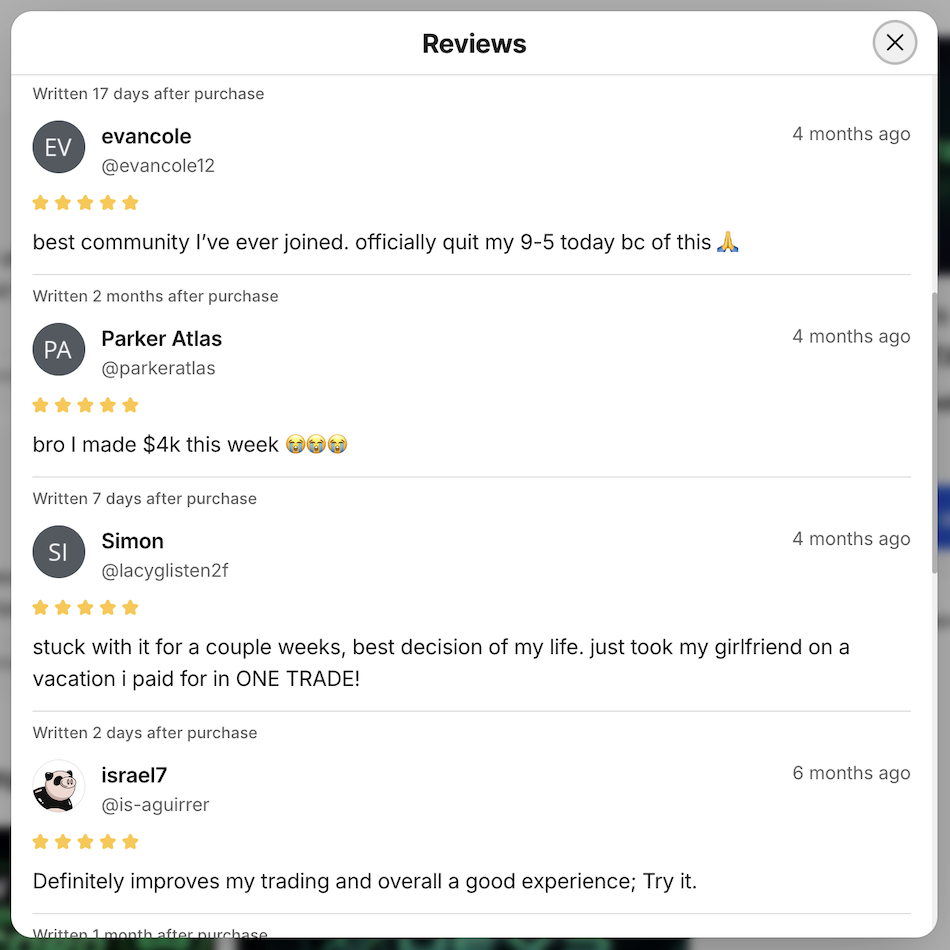
Claimed user reviews
According to the FTC’s Rule on Consumer Reviews and Testimonials, which has been in effect since October 2024, using testimonials that misrepresent the writer’s experience can lead to penalties of up to $51,744 per violation for US-facing businesses. I cannot confirm who wrote these reviews. I can confirm that the operator chose “I made $4k this week” as a main selling point, but has not published any audited results. The Trustpilot profile has two reviews and is unclaimed.
TradingPilotAI also recruits promoters through a listing, paying $1.50 per 1,000 views, not commission on sales. An affiliate paid on impressions is paid for volume, not accuracy, and it shows: articles in Google’s index quote a weekly price of $17.14 against the live $25, and a 2025 launch against a January 2026 domain.
Professional Opinion
TradingPilotAI is not an outright online trading scam. There is no deposit trap, no blocked withdrawal, and no regulator warning. The products are delivered, they load, and they do what they claim on the chart. The Discord group has real, helpful advice.
What they are is expensive repackaging. TPAI is simply SuperTrend with a glow effect; TP ORB is one of many free opening-range scripts; and HEXR PRO is a six-row table. You can replace all three on the same platform, for free. The free indicators are also faster to install, since you do not have to wait for invite-only access.
Add the surrounding decisions, and it sharpens. The plan pushed hardest is the most expensive. The cheapest hides behind a collapsed link and can’t be refunded. Tax appears only at checkout. The star rating is pooled. Promotion is done by people paid per impression. A company is named, but no person is. And the same developer sells more, for less, elsewhere.
None of this is illegal or fraudulent. It just shows a business focused on getting subscribers, not necessarily on helping people become better traders. Even if you pick the cheapest option, the value isn’t there: $749.99 for three tools that already have free versions available on the same charting platform.
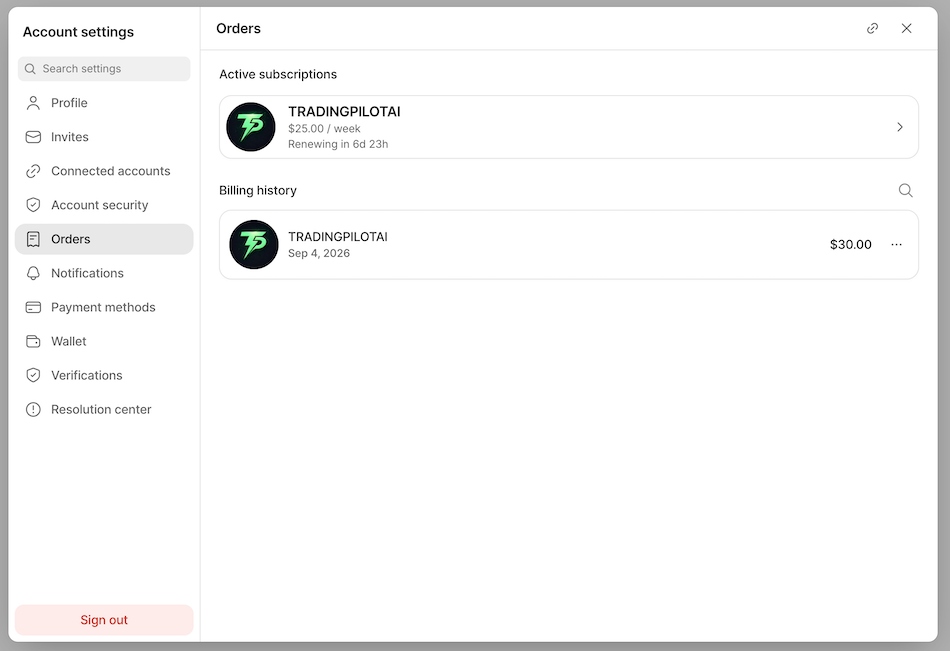
Subscription shows as active upon payment
What To Do If You’re Considering TradingPilotAI
- Try the free comparison first. Add SuperTrend, a free ORB script, and TradingView’s Technical Ratings to a chart. If your results barely change, you have your answer for free.
- Open the “+2 options” link before buying. Weekly costs 44% more than monthly for identical access.
- Learn position sizing before you buy any signal. Decide risk per trade, stop rule, and maximum drawdown first. Nothing here supplies that, and it matters more than the entry.
- Be aware that lifetime access is non-refundable. The 7-day guarantee does not cover it, and nothing at checkout tells you this. Pay by credit card instead of debit.
- Ignore the star rating. It is pooled across the whole store. Check how long after purchase each review was written.
- Ignore anyone who offers to recover your losses. Unsolicited recovery offers are usually another investment scam.
Notes
- This is an opinion-based value warning, not an allegation of fraud. TradingPilotAI appeared on no regulator warning list during my initial investigation, holds no client funds, and delivered everything I paid for.
- Indicator behavior is from hands-on testing of a paid one-week subscription. Screenshots are unedited captures from my own charts, with free equivalents run on the same instruments and timeframes.
- I originally identified the TPAI band as Ichimoku based on the marketing copy. Testing showed it behaves as a SuperTrend-style volatility band, and that the analysis above is correct.
- The refund carve-out is on the tradingpilotai.com terms page. At checkout, there was a tick box confirming the terms had been read, but no separate consent to immediate supply and no acknowledgment of the loss of a cancellation right. The card descriptor reads Whop, not the seller.
- HEXR PRO appears as a separate Whop listing but not on tradingpilotai.com. Every subscription includes it, so it isn’t shown as a separate plan.
- Prices, ownership details, and review totals reflect the site and the Whop storefront at September 2026. Break-even figures are arithmetic and apply to any strategy at those reward-to-risk ratios.
This article is for information only and is not financial advice. Trading indicators and signals carry a significant risk of capital loss, and no indicator predicts market direction. Verify a provider’s regulatory status and demand audited, live performance evidence before paying for signals.