
Best Trading Signal Providers 2026
After testing extensively, we’ve identified these brokers as the top choices for trading signals, alerting traders to potential opportunities.
 Written By
Paul Holmes
With over 15 years of trading experience, including developing algorithmic strategies on MetaTrader and evaluating brokers, he brings deep expertise in market analysis and trader education, helping traders choose the right platform for their requirements.
Paul Holmes Profile Page Fact Checked By
Tobias Robinson
Tobias is committed to helping traders find the right brokerage for their needs. He has tested 200+ brokers, spent 2,600+ hours using different platforms, and placed 2,100+ trades.
Tobias Robinson Profile Page Edited By
James Barra
James is an experienced broker analyst with a background in financial services. He has spent 2,500+ hours testing brokers, used 35+ different platforms and apps, audited 120+ broker T&Cs, and verified 300+ regulatory licenses. James has also been on US and UK TV, and been a guest on finance podcasts, discussing reports conducted by BrokerListings.com and sharing his expertise.
James Barra Profile PageFebruary 21, 2026
-
1NinjaTrader is a US-based brokerage regulated for trading futures. It offers three different pricing plans for varied needs and budgets, along with extremely low margins on popular contracts. The company's renowned charting software and trading platform provides extensive customization options and excellent technical analysis features.
Top Trading Signal Providers Comparison
| Broker |  |
USD Account |
Demo Account |
Minimum Deposit |
Minimum Trade |
Leverage |
Copy Trading |
Regulator |
Instruments |
Platforms |
Account Currencies |
Automated Trading |
AI |
Guaranteed Stop Loss |
|---|---|---|---|---|---|---|---|---|---|---|---|---|---|---|
 |
✓ | ✓ | $0 (live trades must meet intraday margin minimums, e.g., $50 to trade micro contracts) | 0.01 Lots | $50 intraday margins for Micro contracts and $500 for popular E-mini contracts | ✗ | NFA, CFTC, CySEC | Futures, Forex, Stocks, Options, Commodities, Futures, Crypto (non-futures depend on provider) | NinjaTrader Desktop, Web & Mobile, eSignal | USD, EUR, GBP, CAD, AUD | NinjaScript or via Automated Trading Interface | ✗ | ✗ | |
| Broker | |
USD Account |
Demo Account |
Minimum Deposit |
Minimum Trade |
Leverage |
Copy Trading |
Regulator |
Instruments |
Platforms |
Account Currencies |
Automated Trading |
AI |
Guaranteed Stop Loss |
Safety Comparison
Compare how safe the Best Trading Signal Providers 2026 are.
| Broker | Trust Rating |
Guaranteed Stop Loss |
Negative Balance Protection |
Segregated Accounts |
|---|---|---|---|---|
|
✗ | ✗ | ✓ | |
| Broker | Trust Rating |
Guaranteed Stop Loss |
Negative Balance Protection |
Segregated Accounts |
Mobile Trading Comparison
Compare the mobile trading features of the Best Trading Signal Providers 2026.
| Broker | Mobile Apps |
iOS Rating |
Android Rating |
Smart Watch App |
|---|---|---|---|---|
|
iOS & Android | ✗ | ||
| Broker | Mobile Apps |
iOS Rating |
Android Rating |
Smart Watch App |
Comparison for Beginners
Compare how suitable the Best Trading Signal Providers 2026 are for beginners.
| Broker | Demo Account |
Minimum Deposit |
Minimum Trade |
Education Rating |
Support Rating |
Fractional Shares |
Demo Competitions |
|---|---|---|---|---|---|---|---|
|
✓ | $0 (live trades must meet intraday margin minimums, e.g., $50 to trade micro contracts) | 0.01 Lots | ✗ | ✗ | ||
| Broker | Demo Account |
Minimum Deposit |
Minimum Trade |
Education Rating |
Support Rating |
Fractional Shares |
Demo Competitions |
Comparison for Advanced Traders
Compare how suitable the Best Trading Signal Providers 2026 are for advanced or professional traders.
| Broker | Automated Trading |
VPS |
API |
AI |
Pro Account |
Leverage |
Low Latency |
Extended Hours |
|---|---|---|---|---|---|---|---|---|
|
NinjaScript or via Automated Trading Interface | ✗ | ✗ | ✗ | ✗ | $50 intraday margins for Micro contracts and $500 for popular E-mini contracts | ✓ | ✗ |
| Broker | Automated Trading |
VPS |
API |
AI |
Pro Account |
Leverage |
Low Latency |
Extended Hours |
Accounts Comparison
Compare the trading accounts offered by Best Trading Signal Providers 2026.
| Broker | Demo Account |
Interest on Cash |
Islamic Account |
Joint Account |
Managed Account |
PAMM |
MAM |
LAMM |
Pro Account |
|---|---|---|---|---|---|---|---|---|---|
|
✓ | ✗ | ✗ | ✓ | ✗ | ✗ | ✗ | ✗ | ✗ |
| Broker | Demo Account |
Interest on Cash |
Islamic Account |
Joint Account |
Managed Account |
PAMM |
MAM |
LAMM |
Pro Account |
Detailed Rating Comparison
Compare how we rated the Best Trading Signal Providers 2026 in key areas.
| Broker | Trust |
Platforms |
Assets |
Mobile |
Fees |
Accounts |
Research |
Education |
Support |
|---|---|---|---|---|---|---|---|---|---|
|
|||||||||
| Broker | Trust |
Platforms |
Assets |
Mobile |
Fees |
Accounts |
Research |
Education |
Support |
Fee and Cost Comparison
Compare the cost of trading with the Best Trading Signal Providers 2026.
| Broker | Cost Rating |
Fixed Spreads |
Inactivity Fee |
EUR/USD Spread |
Crypto Spread |
|---|---|---|---|---|---|
|
✗ | $35 | 1.3 | Floating | |
| Broker | Cost Rating |
Fixed Spreads |
Inactivity Fee |
EUR/USD Spread |
Crypto Spread |
Customer Ratings
Compare how customers of these brokers feel about them, with real user ratings from Trustpilot, the Apple App Store and Google Play.
| Broker | Customers |
Trustpilot Score |
Trustpilot Reviews |
Android App Rating |
iOS App Rating |
|---|---|---|---|---|---|
|
1,800,000 | 1,226 | |||
| Broker | Customers |
Trustpilot Score |
Trustpilot Reviews |
Android App Rating |
iOS App Rating |
Broker Popularity
See how popular the Best Trading Signal Providers 2026 are in terms of number of clients.
| Broker | Popularity |
|---|---|
| NinjaTrader |
|
Why Trade With NinjaTrader?
NinjaTrader consistently satisfies active futures traders with its low-cost service and high-quality analysis tools. It offers superior charting features, including hundreds of indicators and over 10 chart types.
Pros
's ecosystem offers traders access to thousands of add-ons and applications from developers in over 150 countries. These include indicators, strategies, and custom tools that extend the platform's native features. - Nano contracts, which are one-hundredth the size of standard contracts, let traders adjust positions precisely and manage risks on a smaller scale. This is beneficial for those who build positions gradually.
- The market replay feature lets you download tick-by-tick historical data, go back to any date, and interact with it as if trading live. It's useful for strategy testing and real-world practice.
Cons
- NinjaTrader was fined $250,000 in 2025 for not implementing a sufficient anti-money laundering program and for supervisory failures.
- NinjaTrader was bought by Kraken in May 2025. Although it still operates independently, traders concerned about long-term stability may worry about changes in the platform's direction and pricing under new ownership.
- Intraday margin requirements can rise up to four times in the 15 minutes before major economic news and remain high for several minutes after volatility decreases.
Filters
Methodology
We evaluated numerous platforms offering trading signals and assigned each a comprehensive score. Using these scores, we created a definitive ranking.
What To Look For in a Signal Provider
Not all trading signal offerings are created equal, so picking a broker that matches your needs is essential.
Here’s a breakdown of the key factors to keep in mind when evaluating brokers with trading signals:
Signal Accuracy and Reliability
The effectiveness of trading signals depends on their accuracy. Check whether the broker’s signals have a proven track record or whether reputable providers generate them.
Look for user reviews or performance reports, as these can give you a clearer picture of the signals’ reliability.
Source of Signals
Manual vs automated signals: Some brokers provide signals crafted by professional analysts, while others rely on algorithmic models or AI-driven tools like Autochartist. Understand which type suits your trading style better.
Third-party integration: Brokers that support external signal providers, like TradingView or MetaTrader 4, offer more flexibility and variety.
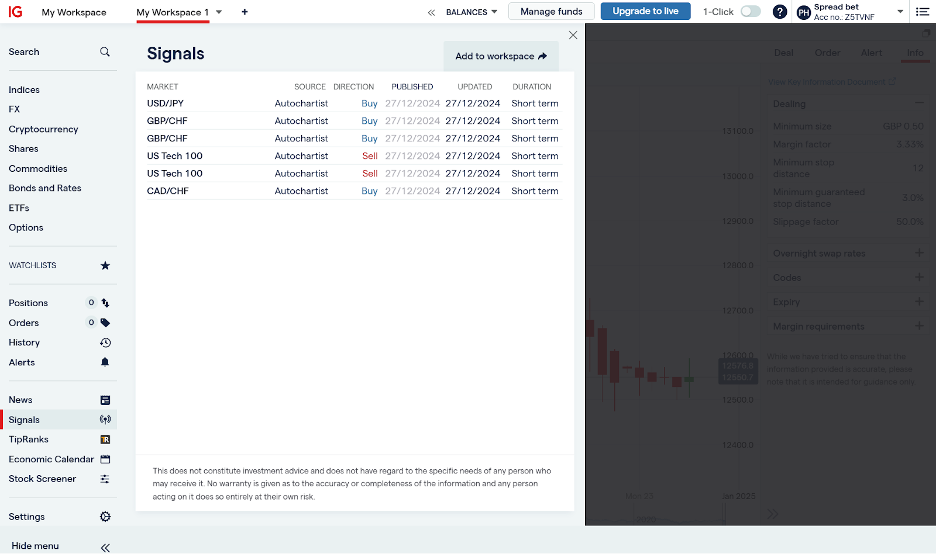
IG – Signals
Asset Coverage
Ensure the broker provides signals for the markets and assets you’re interested in – whether it’s forex, stocks, cryptocurrencies, or commodities.
Broad asset coverage is critical if you like to diversify your trading portfolio.
Delivery Methods
Signals need to be timely, so consider how the broker delivers them. Common methods include:
- Platform alerts: Integrated directly into the trading platform.
- SMS or email: Ideal for traders who are often on the go.
- Mobile app notifications: Perfect for real-time updates.
Additional Features
Look for brokers offering extra features that complement trading signals, such as:
- Risk management tools (eg stop-loss and take-profit levels).
- Educational resources to help you understand the signals.
- Customizable signals based on your trading preferences.
- Signals based on clients’ sentiments.
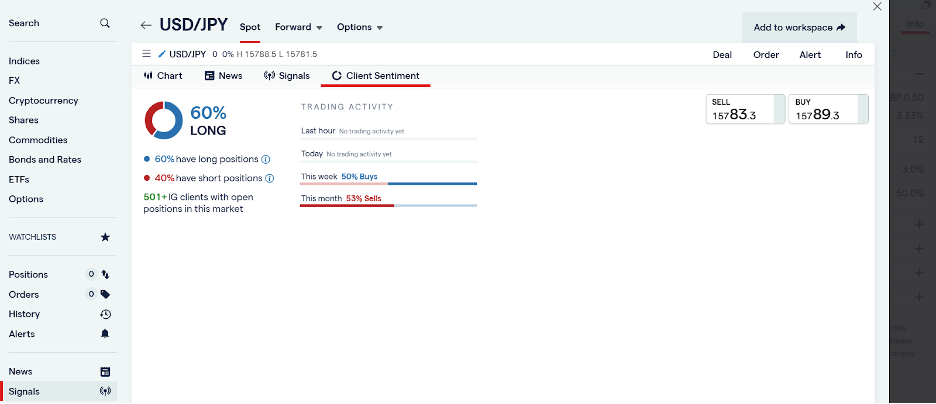
IG – Client Sentiment
Costs and Fees
While some brokers offer free trading signals, others may charge a subscription or higher spreads. Compare the costs and ensure the value justifies the expense.
Also, check for hidden fees that could impact your overall profitability.
Regulation and Trustworthiness
Always prioritize brokers regulated by reputable authorities to ensure your funds and data are secure.
A trustworthy broker will provide transparency about how their signals are generated and supported.
Support and Customer Service
Fast and reliable customer support can be a lifesaver if you encounter issues with trading signals.
Look for brokers that offer responsive service through multiple channels, such as live chat, phone, or email.
Demo Account Availability
Brokers with demo accounts let you test their trading signals without risking real money.
This can help you determine whether the signals align with your trading goals and style.
Tips for Choosing the Best Broker for Trading Signals
Finding the ideal broker with trading signals can feel overwhelming, but a few practical tips can make the process much smoother:
Define Your Trading Goals
- Are you a short-term trader who relies on frequent signals, or do you prefer long-term strategies? Understanding your goals helps you focus on brokers that align with your style.
- If you’re just starting, look for brokers with beginner-friendly signals and plenty of educational resources.
Research the Signal Providers
- Find out if the broker generates signals in-house or partners with trusted third-party providers. Platforms integrated with reputable tools like TradingView often offer diverse options.
- Check the credentials of the analysts or algorithms behind the signals.
Focus on User Experience
- Opt for brokers with intuitive platforms that make it easy to understand and act on trading signals. Clear charts, customizable alerts, and seamless navigation can save you time and effort. For example, I really like the clean design and interface at IG.
- Mobile-friendly platforms are a bonus if you trade on the go.
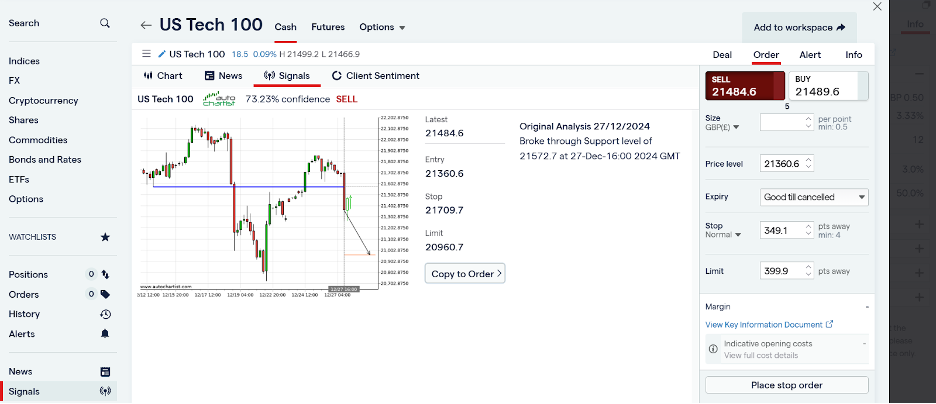
IG – Signals Interface
Check Reviews and Ratings
- Read reviews from other traders to gauge the reliability of the broker’s trading signals. Look for testimonials on accuracy, timeliness, and ease of use.
- Trust brokers with a strong reputation in the trading community.
Look for Customization Options
- Some brokers allow you to customize signals based on your risk tolerance, trading preferences, or asset focus. Tailored signals can make a big difference in your strategy.
Evaluate the Delivery Speed
- Timing is critical in trading. Make sure the broker delivers signals quickly via in-platform notifications, emails, or app alerts.
- Delayed signals could mean missed opportunities.
FAQ
What Are Trading Signals?
Trading signals are like having a trusted co-pilot in your trading journey. They’re recommendations or alerts based on market data, technical analysis, or algorithmic predictions.
Signals tell you when to potentially buy, sell, or hold a specific asset, often including details like price targets and stop-loss levels.
Professional analysts can manually create trading signals or generate them automatically through advanced algorithms, depending on their source.
Many brokers now integrate these signals directly into their platforms, making it easier for traders to act quickly and efficiently.
How Do Trading Signals Work?
Here’s a simple rundown:
- Data collection & analysis: Signals gather market info like price and trends.
- Signal generation: Based on this info, signals identify potential trading chances.
- Delivery: Signals can be sent via various channels like email, SMS, or increasingly apps.
- Interpretation: Traders use these signals with their strategies and risk assessments.
- Execution of trades: Decide whether to trade based on signals’ alert.
- Continuous monitoring: Keep an eye on your trades and adjust based on market changes.
Remember, while trading signals can be helpful, they’re not guaranteed. Always use your knowledge and strategy alongside them.
Are Trading Signals Legal?
Yes, they are legal, but legality can vary by region, depending on adherence to financial regulations.
What Are The Risks Of Using Trading Signals?
Risks include potential errors, over-reliance without understanding, and costs associated with subscription services.
Remember, there is no guarantee that a trading signal will work, regardless of the broker or provider.