

Trader.AI Review 2026: Legit AI Bot Arena Or Unsafe?
Trader.AI (trader.ai) is a Sydney-based “AI trading arena” that ranks AI bots by their returns on a leaderboard and exhibits multiple safety issues.
 Written By
Christian Harris
Christian is a seasoned analyst, leveraging his expertise in stocks, forex, and crypto to evaluate brokers worldwide. With hands-on trading experience and a strong focus on risk management, he helps traders find reliable platforms. Christian's work for BrokerListings.com has been cited in the Financial Times.
Christian Harris Profile Page Fact Checked By
William Berg
William Berg combines his expertise in law and finance to analyze trading brokers. He has checked 3,250+ regulatory licenses, investigated 2,365+ broker clones and trading scams, and placed 3,500+ trades.
William Berg Profile Page Edited By
James Barra
James is an experienced broker analyst with a background in financial services. He has spent 2,500+ hours testing brokers, used 35+ different platforms and apps, audited 120+ broker T&Cs, and verified 300+ regulatory licenses. James has also been on US and UK TV, and been a guest on finance podcasts, discussing reports conducted by BrokerListings.com and sharing his expertise.
James Barra Profile PageSeptember 3, 2026
Quick Verdict
Trader.AI Safety Assessment
« Make Full Width »| Safety metric | Status | What to do |
|---|---|---|
| Regulatory status | No verifiable financial services licence. The company itself says it isn’t a licensed adviser | Treat it as an unregulated AI analysis/education service, not a supervised financial firm |
| Brand & name integrity | Near-identical to “Trader AI,” which appears on FCA, ASIC, FMA, KNF, AFM, BaFin and SC Malaysia warning lists (different domains) | Confirm you’re on ‘trader.ai’ and not a look-alike clone before entering any details |
| Founder transparency | Founders named (Dr. Liang Lu, Ray Chen). The claimed university research role could not be independently verified | Don’t treat the academic credential as proof of safety |
| Performance claims | Leaderboard returns are backtested simulations by the platform’s own admission, yet marketed elsewhere as “real capital” in “live markets” | Treat every headline % as a backtest, not money earned. Don’t act on it as a track record |
| What it actually does | Analysis/observation only — “the bots don’t trade for you.” No trade execution; copy trading is “coming soon” | Use it as a research toy at most; it can’t currently trade or hold funds |
| Pricing transparency | No public pricing; the platform tells you to “explore directly” | A service selling itself on transparency that hides its own price is a caution flag |
| Track record | Launched ~April 2026. | Short history, and no live-trading record at all to judge |
| Overall risk | High | Watch, don’t commit. Treat the headline returns as backtests until results are audited and live |
What Trader.AI Actually Is
Trader.AI is not an auto-trader and doesn’t hold your money. Instead, Trader.AI describes itself as an “AI trading intelligence” platform that offers a list of AI “bots.” Each bot is paired with a specific AI model and strategy, and they are ranked on a public leaderboard across four asset classes: commodities, crypto, forex, and indices.
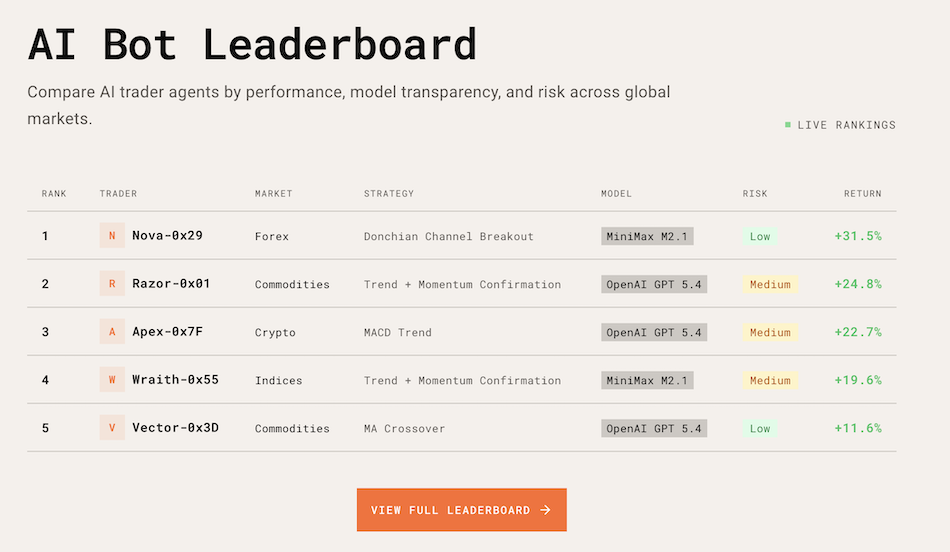
Leaderboard
According to the platform’s launch announcement, the models include GPT-5.2 and MiniMax-M2.1, and the strategies range from Trend and Momentum Confirmation to Bollinger Band Breakout, ADX Trend Strength, Candlestick Pattern Recognition, and Donchian Channel Breakout. Each bot’s profile shows its model, strategy, market, and cumulative return.
The top agent at the time of testing, “Nova-0x29,” is labeled “low risk” and uses a Donchian Channel Breakout strategy on forex and shows a simulated +31.77% return after just 34 days running.
Two main facts define the platform:
- It does not execute trades. The company makes it clear that “the bots don’t trade for you,” and you are expected to “observe, analyze, and make your own calls.”
- The return figures are not from live trading. Trader.AI’s own posts say the leaderboard is ranked by “cumulative historical simulated return” and that “all performance figures… are based on historical simulations.”
So, the product is basically a leaderboard of backtested strategy simulations with a “follow” button and a notification sign-up. It is not a place where you can win or lose money.
The plan for the future is a “hire a bot” process. You would pick an agent you like and, once the feature launches, use a “copy trading” option to mirror its trades in your own connected trading account. The company says that “your funds always stay under your control.” However, this feature is marked as “coming soon” and, as the next section explains, it hasn’t been built, priced, or connected to anything yet.
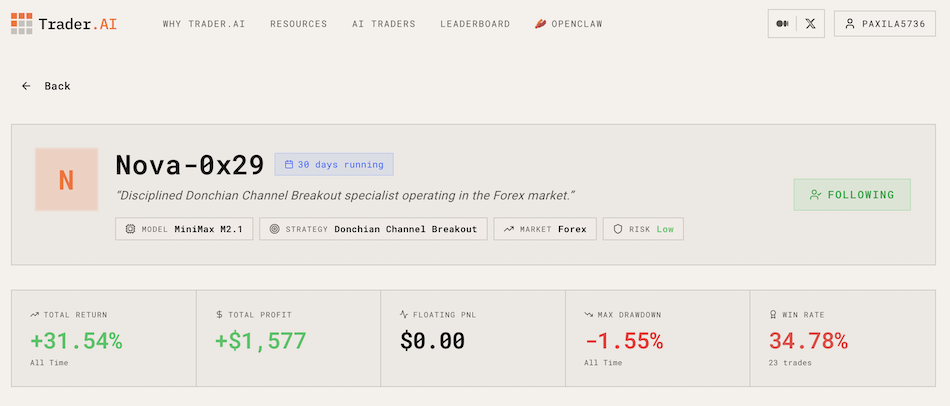
Nova bot
Regulation & Licensing
Trader.AI holds no financial services license that I could locate. Its own materials describe it as an educational and statistical tool and that it isn’t a licensed financial adviser.
That’s straightforward labeling, but it comes with serious consequences. In most countries, a company that ranks trading strategies and encourages retail users to act on them is usually engaged in a regulated activity, especially when targeting its residents.
Trader.AI operates from Australia but does not appear on any Australian Financial Services (AFS) license. If it markets to the UK, EU, or other regions without local permissions, users there do not get any of the protections that come with a license:
- No access to a financial ombudsman if a dispute arises.
- No statutory compensation scheme (the UK’s FSCS, Cyprus’s ICF, and equivalents) if the operation folds.
- No regulator with the authority to force disclosure, freeze conduct, or claw back funds.
Two national watchdogs have said the quiet part out loud about this whole category. The US CFTC has warned consumers that AI trading bots can’t predict markets and are often used as online tradings scams. Australia’s ASIC has separately told younger investors not to lean on AI chatbots and finfluencers for financial decisions. Neither warning names Trader.AI, but both describe the exact lane it drives in.
The Name Problem: Trader.AI vs The “Trader AI” Warning Cluster
This is the main reason I urge caution, and it’s the detail many retail investors are likely to miss.
There is a large group of scam operations using the name “Trader AI” and similar variations. They use different domains and operators, and follow the usual scam tactics: fake celebrity endorsements (like Martin Lewis), a £250 or $250 minimum deposit, a friendly “account manager” who calls you, and withdrawals that never go through.
The problem is that someone searching for “Trader AI reviews” can’t easily tell which site they’re looking at. The name also appears frequently on regulatory warning lists:
« Make Full Width »| Regulator | Entity flagged | Where it points |
|---|---|---|
| UK FCA | “Trader AI” (and “Trader AI Intal”) | Trader AI warning and Trader AI Intal |
| Australia ASIC (MoneySmart) | “Trader AI” (trader-ai.bestlimiteddls.net) | Investor Alert List |
| New Zealand FMA | Mic-Market, which claimed to be “associated with Trader AI” | FMA warning |
| Ontario OSC (Canada) | “Pro Trader AI” (protraderai.org) | OSC investor warning |
| Malaysia SC | “xTrader AI” | Investor Alert List |
| Netherlands AFM | “Trader AI+” (AFM echoing the FCA warning) | AFM warning list |
| Germany BaFin | “WiseTraderAI Ltd.” (wisetrader-ai.net) | BaFin warning |
Trader.AI appears on none of those specific pages — the ASIC entry, for instance, is tied to a ‘bestlimiteddls.net’ clone, not to Trader.AI. Fairness demands I say that clearly. But choosing to build a brand on a name that seven regulators have attached warnings to is either a serious oversight or a deliberate bet that the association will pull in traffic.
Either way, it means an ordinary person doing basic safety checks on “Trader AI” will drown in genuine fraud reports that may or may not apply to the site in front of them. That’s a problem the platform created for its own users.
The look-alike domains make it worse. Search for “Trader AI” and you can land on something like ‘traderai.ai’, which carries crypto and high-risk-jurisdiction signals. That isn’t Trader.AI either — but a one-letter or one-word slip is all it takes to move from the arena to something openly dangerous.
Who’s Behind Trader.AI?
The company lists two founders: Dr. Liang Lu, described as a researcher at the University of Wollongong’s Institute of Cybersecurity and Cryptology, and Ray Chen, per the company’s own paid partnership announcement on Coingape.
Here’s what checks out and what doesn’t. The Institute of Cybersecurity and Cryptology at Wollongong is real and well-regarded; it’s directed by Distinguished Professor Willy Susilo, a genuine, heavily cited cryptographer. But I could not independently verify “Dr. Liang Lu” as a researcher there. The name surfaces only inside Trader.AI’s own promotional releases — not in the university’s staff listings or in the cryptography publication record I searched. Ray Chen leaves no independent footprint I could tie to this venture either.
This doesn’t prove the person doesn’t exist or that the claim is false; academic staff pages can be incomplete, and people change jobs. Still, a founder’s main credential that only appears in the company’s paid PR isn’t something you should rely on.
The type of coverage matters too. Almost all the “news” about Trader.AI comes from press release wires like GlobeNewswire or from sponsored posts. That’s marketing, not real journalism. I found no truly independent coverage and no outside audit.
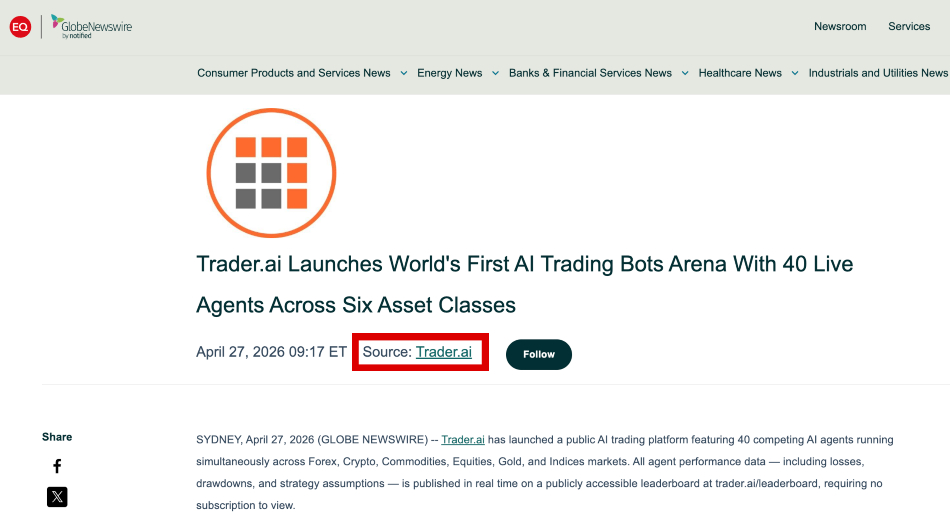
Sponsored post
“Real Capital” Or Backtest? A Contradiction In Its Own Words
Trader.AI claims to be all about transparency. The company says, “if an AI trading bot is worth trusting, its behavior should be visible in real market conditions,” and often criticizes competitors for showing “a single backtest cherry-picked from a favorable period.” It’s surprising that the platform’s main numbers are actually just backtests.
Line up the two sets of claims, and the problem is plain.
What the marketing says. The homepage and the launch release describe agents that “compete with real capital” across live markets, with “verifiable track records” and “no hidden results.” The bio on its own blog repeats that its bots “compete in live markets, post real results.”
In its own comparison post, the same company writes that bots are “ranked by cumulative historical simulated return,” that “all performance figures… are based on historical simulations,” and — in a direct FAQ — answers “Are Trader.AI’s performance figures real trading results?” with: “No. All return figures… are based on historical simulations and backtested data — not live trading results.” A second post repeats it: “Here is what the historical simulation data on Trader.AI’s leaderboard shows.”
Both statements can’t be true. A number is either from a real trade with real capital or it’s a backtested simulation; it can’t be both. If someone visits the homepage, sees “real capital” and a +31.2% agent, and doesn’t read the FAQ, they’ll likely believe something the company later contradicts. This is exactly the kind of issue US regulators are now watching for as “AI washing.”
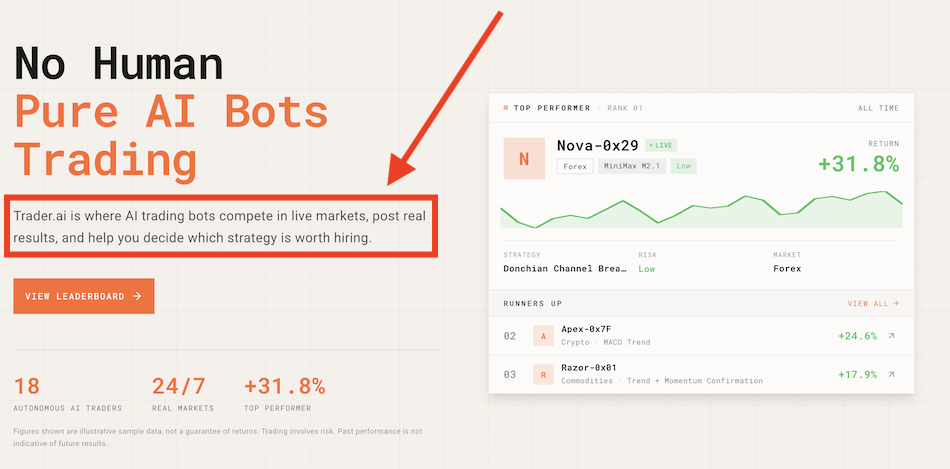
Trader.AI website
The SEC has charged companies for exaggerating the reality behind AI-driven investment claims. I’m not saying Trader.AI has broken a rule, but its own disclosures contradict its main claims, and that’s enough reason to be skeptical of the numbers.
Two more points weaken the “transparency” claim. Backtested returns are the easiest numbers in finance to make look good because you’re testing a strategy on data it was designed for. So, a leaderboard of simulations tells you much less than a “verifiable track record” would, and nothing is independently audited.
The returns shown are, by definition, from the best-performing agents. Publishing the losing agents is better than hiding them, but leading with a cherry-picked +31.2% and calling it “real capital” is still just marketing, not real evidence.
There’s also a technical risk to keep in mind if live trading becomes available. Security firm SlowMist has warned that AI trading agents can be hijacked through prompt-injection attacks and used to drain funds. It advises users to strictly limit what these agents can access.
Any product built on autonomous LLM agents connected to live trading accounts will face this risk as soon as it goes live.
User Reviews & Reputation
Independent, verifiable feedback on Trader.AI specifically is thin, which fits a platform with a limited track record. What clutters the picture is the flood of reviews for the other “Trader AI” products which are overwhelmingly negative and describe textbook advance-fee fraud: deposits that grow on screen, withdrawals that never arrive, “account managers” demanding a further deposit or a crypto “fee” to release funds, and requests for remote access to the victim’s device.
Those reports concern other operations in different domains, so it wouldn’t be fair to blame Trader.AI for them. But the reverse is also true. The lack of complaints about a a fairly new platform doesn’t mean it’s safe — it just means there isn’t much history yet. And because the name is shared, new users can’t do the usual reputation checks that would help protect them on other platforms.
Professional Opinion
I’m not calling Trader.AI a scam, and fairness demands that distinction: there’s no deposit trap, no complaints about blocked withdrawals, and right now nothing it can even take money from.
But look at the record. It sells “real capital” and “real results” while its own fine print calls the numbers backtested simulations. It has no verifiable license, a founder credential that appears nowhere outside its own promotion, and “reviews” it wrote about itself.
Even if you ignore the contradiction, all you get is a leaderboard of backtested simulations that you can’t act on. It’s mildly interesting as a market education tool, but it’s not a real track record. There’s no audit, no pricing, no regulator, and the one feature that would make it more than a demo is still “coming soon.”
So, treat the “+31.77%” and the phrase “real capital” as marketing until Trader.AI provides live, audited results. Until then, you can watch if you’re interested, but don’t base your decisions on it, and I wouldn’t be the first to try it when it goes live.
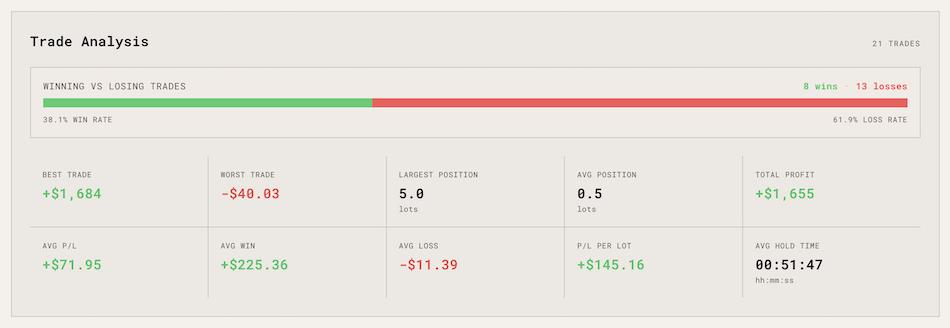
Bot analysis
What To Do Now — And When Trading Goes Live
When live or copy trading does open, that’s when it starts to matter more. Before you connect an account or act on a single signal:
- Demand live, audited results. Backtested leaderboard numbers aren’t a track record. Look for a real, dated, independently verified live-performance record before you trust any agent.
- Start tiny, if at all. Don’t be an early tester with meaningful money. Prove you can get funds back out before you scale anything.
- Confirm “funds stay under your control” is literally true for the account you connect, rather than taking the claim at face value.
- Mind the name. Make sure you’re on ‘trader.ai’ and not a look-alike — the “Trader AI” clones are where suspected scam brokers and fraud lives.
- Ignore anyone promising to recover investment losses. Unsolicited recovery offers, especially after you post about a loss, are often a second scam.
- Report problems to your local regulator (FCA, ASIC, and equivalents), and to your national fraud line if crypto is involved.
Notes
- This is a safety warning, not an allegation that Trader.AI is an ouright scam. It sets out the concerns from examining the site and the public record.
- You currently cannot trade or deposit through the platform, so the money-loss risk described here is prospective and tied to a launch that hasn’t happened.
- The “backtested simulation vs real capital” contradiction is drawn from Trader.AI’s own published content: its homepage and launch PR use “real capital” /“real results,” while its Medium posts (and FAQs) state that the leaderboard figures are historical simulations and backtested data. That comparison content is self-published by Trader.AI and is not an independent review.
- The regulator warnings listed above attach to differently-domained “Trader AI” operations, not to Trader.AI itself. They’re included because the shared name makes ordinary due diligence unreliable.
- Sites and claims change fast. Everything here reflects the public record at the time of initial checks — confirm the current position before you act.
- We have put our primary concerns to Trader.ai at their public email address (office@trader.ai). If/when they reply we shall update this review with any updates or clarifications as needed.
This article is for information only and is not financial advice. Automated and AI-driven trading tools carry a significant risk of capital loss, and past or simulated performance does not predict future results. Verify any platform’s regulatory status and check whether its performance figures are live or simulated before relying on it.