 Top Lists for USA
Lucid Trading: Suspicious Prop Firm Alert
 Written By
James Barra
James is an experienced broker analyst with a background in financial services. He has spent 2,500+ hours testing brokers, used 35+ different platforms and apps, audited 120+ broker T&Cs, and verified 300+ regulatory licenses. James has also been on US and UK TV, and been a guest on finance podcasts, discussing reports conducted by BrokerListings.com and sharing his expertise.
James Barra Profile Page Fact Checked By
Tobias Robinson
Tobias is committed to helping traders find the right brokerage for their needs. He has tested 200+ brokers, spent 2,600+ hours using different platforms, and placed 2,100+ trades.
Tobias Robinson Profile Page Edited By
William Berg
William Berg combines his expertise in law and finance to analyze trading brokers. He has checked 3,250+ regulatory licenses, investigated 2,365+ broker clones and trading scams, and placed 3,500+ trades.
William Berg Profile PageOctober 26, 2026
Quick Verdict
| Safety Metric | Status | What To Do |
|---|---|---|
| Regulatory status | Unregulated | Think carefully about paying an evaluation fee. Don’t expect robust dispute channels. |
| Domain integrity | ’https://lucidtrading.com/’ was registered in December 2020, but the prop firm launched in 2025. | Don’t confuse domain age with the prop firm’s short record. |
| Corporate Transparency | Average for a prop firm – operated by Lucid Trading Group LLC, contact address is 3500 S Dupont Hwy, Dover, DE 19901, United States, CEO is AJ Campanella, but limited additional details about management. | A named CEO is a start, but clearer transparency about the team and ownership structure is needed. |
| User reviews | Mixed – high average ratings on Trustpilot, but concerning complaint patterns surrounding blocked payouts, accounts terminated, and weak support. | Approach user reviews with caution. Recurring complaints indicate potential problems getting paid. |
| Terms | One-sided – Just one year to bring claims, must be settled in the US legal system, damages limited to $100. | Expect a long, costly uphill battle in the US court system or any dispute forced into the American Arbitration Association (AAA). |
| Overall risk | High Risk | Consider safer prop firms linked to established brokers. |
Regulation
Lucid Trading is not authorized by any respected financial regulator. I confirmed this by searching for it in the databases of the 90+ Category A bodies in BrokerListings.com’s regulator bandings.
I also tried to verify its regulatory position directly with Lucid Trading’s support team, as you can see below, but there was no way to start a live chat conversation during testing on a Monday, despite the prop firm claiming to offer 24/5 support.
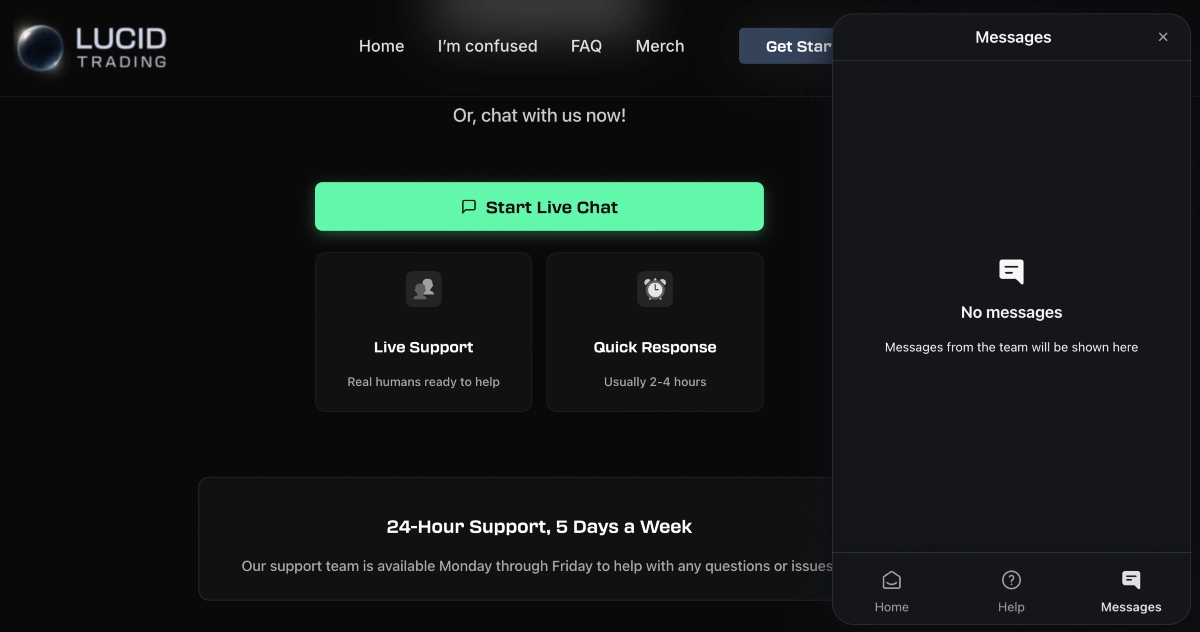
The “Start Live Chat” button would not actually start a live chat conversation
Interestingly, Lucid Trading is not authorized by the Commodity Futures Trading Commission (CFTC) or the National Futures Association (NFA) in the United States, which is where Lucid Trading is registered, despite offering futures prop trading.
Now technically, Lucid Trading does not require authorization because it is not a true brokerage – users trade with virtual money in a simulated environment – it does not take client money for live trading. However, there are still significant risks when using an unregulated prop firm, notably:
- No recourse: There are no statutory-mandated compensation schemes or dispute resolution channels should Lucid Trading refuse to pay out withdrawals – something I found in a significant number of user reviews.
- Opaque rules: Lucid Trading can create and enforce a wide range of rules that can lead to accounts being blocked and payouts refused. When analyzing user reviews, as I explain later, I found many claims of this, particularly concerning “hedging violations”.
- Possible execution manipulation: There is no body scrutinizing Lucid Trading’s operations to make sure it is not manipulating trading conditions, such as spreads and fees, through to execution and slippage. I am not saying Lucid Trading does this, but the lack of external scrutiny means it’s a greater risk.
For these reasons, it’s my opinion that using the prop trading services of a more established traditional brokerage, which has tightly regulated entities within its group, such as Kraken (via Kraken Prop) and CMC (via CMC Funded), is generally safer.
Even though their simulated trading accounts themselves may not be regulated, other branches and the parent groups often follow much higher standards for corporate accountability, data protection, and transparency. This oversight within the wider group, I believe, substantially reduces the chances of outright scams and unfair rule enforcement.
User Reviews
Lucid Trading had a high Trustpilot rating of roughly 4.5/5 at the time of our initial assessment. This was from around 8,000 reviews – a large review footprint that is difficult to fake.
However, it’s also true that Lucid Trading has a paid subscription to Trustpilot and uses automated invitations to prompt users to leave feedback. This doesn’t mean the positive feedback isn’t true, but it does mean many reviews are very short, with limited details about their experience or the service provided.
It’s also a fact that many prop firms we’ve analyzed (lots of which we have safety concerns about) have very high Trustpilot ratings. Again, this doesn’t mean they aren’t legitimate, but in my opinion, it’s the negative reviews that are worth paying particular attention to.
For example, in Lucid Trading’s case, around 10% of its reviews during our investigation were 1-star. I analyzed the entire approximately 800 1-star reviews, and the findings were both interesting and concerning:
- Level of detail: Instead of the average 15-40 words in the 5-star reviews that provide very little detail about the actual Lucid Trading experience, the 1-star reviews were often far more in-depth, averaging 80-250+ words.
- Review timings: When a trader secures a single account and requests a modest first or second payout, Lucid Trading pays it quickly and sometimes prompts the user to leave a review, leading to a large number of positive ratings. However, when traders scale up to more accounts (e.g. up to 5) and request much larger payouts in the thousands, compliance checks become more stringent and some traders have their payouts refused. Unlicensed prop firms pay winnings out of their evaluation fee revenue, so there’s a business model conflict of interest whereby Lucid Trading acts as jury and judge on payout disputes with no regulator or external body ensuring they act fairly.
- Common complaints: The same issues crop up again and again, pointing to legitimate issues rather than one-offs:
- Accounts deleted: Many users say they passed the evaluation phase smoothly, but when they accumulate significant payouts (often between $1,000 and $18,000+), their accounts are frozen and deleted, often without proper explanation.
- Hedged accounts: A notable portion claim their accounts were unfairly accused of breaching terms around hedging/copying other traders’ positions and often not given clear evidence, such as timestamps of trades. I also found similar reports on Reddit that echoed this, with some arguing that if you manually scalp high-volume futures contracts like NQ, your trades can be automatically flagged if they happen to align with entry timestamps of other traders.
- Non-responsive support: Many users claim that when their accounts are frozen, or they run into issues, they either get unhelpful responses from support that don’t provide sufficient evidence, or follow-up messages get no response at all. Lucid Trading is also unusual amongst other prop firms we’ve tested, in that it doesn’t reply to 1-star reviews on Trustpilot, which could help explain and resolve user complaints.
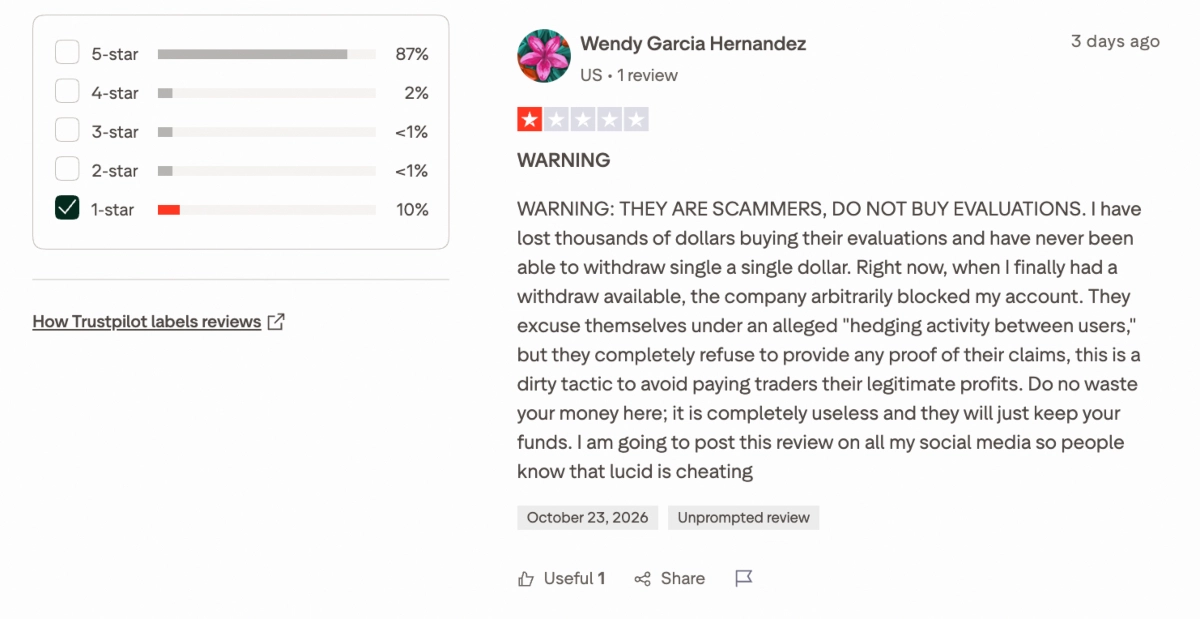
1-star review on Trustpilot
So whilst Lucid Trading does have a positive Trustpilot profile on average, hundreds of negative reviews, often going into granular detail and covering similar complaints, warrant consideration in my opinion.
The lack of support responsiveness is also compounded by the lack of regulatory oversight, as users have very limited recourse options should the prop firm go radio silent or refuse to pay out withdrawals.
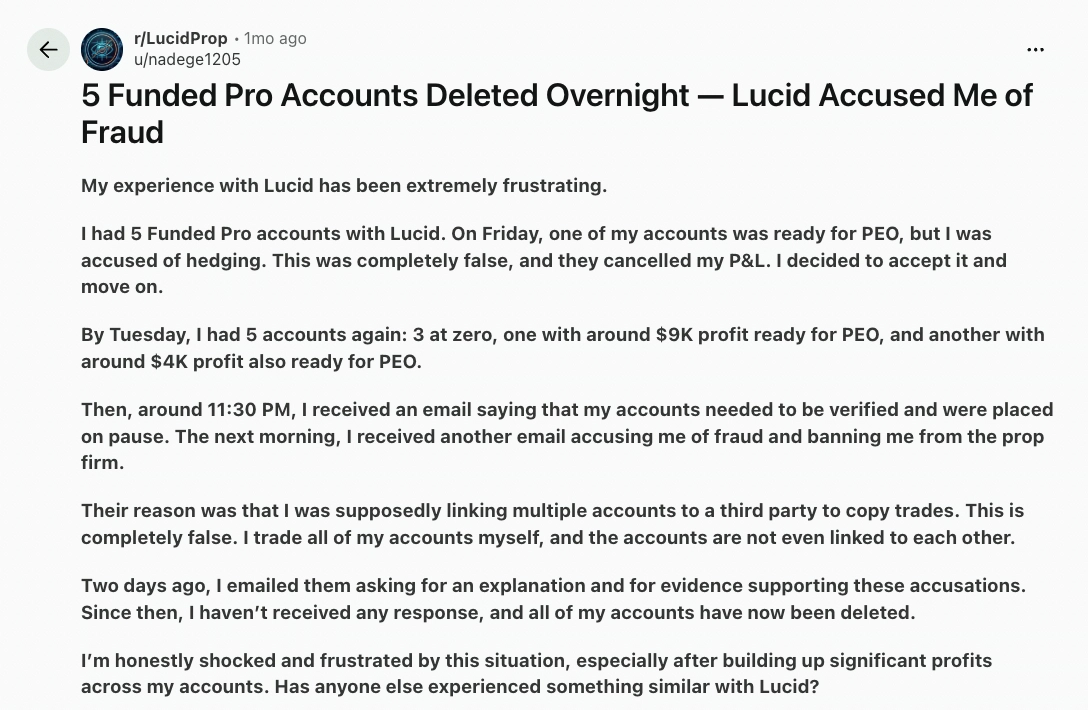
Reddit complaint
Note: we have not been able to independently verify all of Lucid Trading’s user reviews on Trustpilot, Reddit or other third parties.
What The Terms Really Say
I did the boring job some prospective users will forget to do or gloss over – I read the entirety of their ‘Terms of Use‘, ‘Disclaimer of Liability, Refunds and Chargeback Policy‘, ‘Privacy Policy‘, and ‘Risk Disclosure Statement‘. I was looking for any unfair, onerous or unusual rules that prospective users should be aware of.
There are many questionable terms, but I’ve called out three particularly worrying findings:
1. Unprofessional Typo Blunder
The Terms of Use state “Trading activity that is knowingly or unknowingly circumventing targets and rules or generates profits that could otherwise be achieved in live market trading is a violation of the Terms of Use.” I suspect Lucid Trading’s lawyers or copywriters forgot to add the word “not” (“generates profits that could not otherwise be achieved in live market trading is a violation of the Terms of Use”).
Essentially, as written in our investigation, using the platform for its intended purpose could constitute a technical breach of the contract. And courts often focus on the specific wording of contracts. This is extremely sloppy.

Terms of Use – Prohibited Uses
2. Wide-Reaching “Connected Accounts” Clause
The Terms of Use state “Performing… in concert with any other persons, including connected accounts, or accounts held with different Users, trades, or combination of trades, the purpose of which is to manipulate, abuse, or give any User an unfair advantage while using the Website or Services.”
This clause explains the large number of user complaints I’ve read about being banned for trading like other users. As it’s written, in theory, two strangers could unknowingly follow the same YouTuber influencer or educator online, trade the same opening-range breakout on the NQ, and have their accounts banned.

Terms of Use – Prohibited Uses
It’s normal for prop firms to prohibit copy trading rings, but the step to include “unconnected accounts” with open-ended wording like the “same trading strategy” elsewhere in the terms, without requiring substantial proof of collusion, gives them significant authority to ban profitable traders operating in similar market windows using popular setups. And this may not crop up as an issue until you’ve gone through the time and effort to generate a significant potential payout.

Terms of Use – Prohibited Uses
3. Taking Legal Action Would Be Difficult
The Terms of Use state “Any legal suit, action, or proceeding arising out of, or related to, these Terms of Use or the Website shall be instituted exclusively in the federal courts of the United States or the courts of the State of Delaware although we retain the right to bring any suit, action, or proceeding against you for breach of these Terms of Use in your country of residence or any other relevant country.”
They also say “TO THE EXTENT EITHER PARTY IS PERMITTED BY LAW OR COURT OF LAW TO PROCEED WITH A CLASS OR REPRESENTATIVE ACTION AGAINST THE OTHER, THE PARTIES AGREE THAT: (A) THE PREVAILING PARTY SHALL NOT BE ENTITLED TO RECOVER ATTORNEYS’ FEES OR COSTS ASSOCIATED WITH PURSUING THE CLASS OR REPRESENTATIVE ACTION (NOTWITHSTANDING ANY OTHER PROVISION IN THIS AGREEMENT); AND (B) THE PARTY WHO INITIATES OR PARTICIPATES AS A MEMBER OF THE CLASS WILL NOT SUBMIT A CLAIM OR OTHERWISE PARTICIPATE IN ANY RECOVERY SECURED THROUGH THE CLASS OR REPRESENTATIVE ACTION.”
The terms further add “ANY CAUSE OF ACTION OR CLAIM YOU MAY HAVE ARISING OUT OF OR RELATING TO THESE TERMS OF USE OR THE WEBSITE MUST BE COMMENCED WITHIN ONE (1) YEAR AFTER THE CAUSE OF ACTION ACCRUES; OTHERWISE, SUCH CAUSE OF ACTION OR CLAIM IS PERMANENTLY BARRED.”
As well as “NOTWITHSTANDING THE FOREGOING, IN NO EVENT WILL OUR LIABILITY FOR ANY CLAIM OF ANY KIND, WHETHER BASED IN CONTRACT, WARRANTY, TORT, STRICT LIABILITY, OR OTHERWISE, FOR ANY LOSSES OR DAMAGES ARISING OUT OF, CONNECTED WITH, OR RESULTING FROM, THESE TERMS OR THE PERFORMANCE OF BREACH THEREOF, OR ANY PRODUCT OR SERVICE OR THE USE OR PERFORMANCE THEREOF, EXCEED THE GREAT OF (A) THE AMOUNT PAID BY YOU TO US IN THE IMMEDIATELY PRECEDING MONTH FOR OUR PRODUCTS OR SERVICES, OR (B) $100.00.”
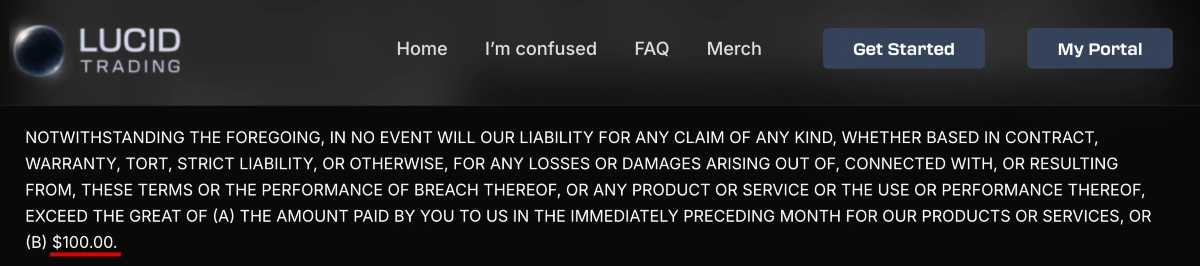
Terms of Use – Limitation of Liability
Taken together, this means you only have one year to bring a claim against Lucid Trading, say in the event of a withdrawal dispute (cutting Delaware’s standard three-year statute of limitations by two-thirds), your damages are capped at $100, and even if a judge threw out your class action waiver, it tries to force you to forego any money won in the class action, while your lawyers can’t recover their fees.
This is essentially a “poison pill” that makes litigating against Lucid Trading an expensive, challenging battle with limited chance of significant financial remuneration at the end.
Lucid Trading Vs Trusted Prop Firm Providers
I believe that Lucid Trading is a higher risk to use than the simulated prop trading services offered by more established brokerage groups. To demonstrate that I have compared Lucid Trading with Kraken Prop and CMC Funded below across key safety factors.
| Consideration | Lucid Trading | Kraken Prop | CMC Funded |
|---|---|---|---|
| History | Operated by Lucid Trading Group LLC; Launched in March 2025 | Kraken founded in 2011; Kraken Prop launched in May 2026 | Commercial partner CMC Markets founded in 1989; CMC Funded launched in October 2026 |
| Regulatory Background | No financial services licenses | Kraken’s group includes regulated entities, but Kraken Prop is an unregulated service | CMC Markets’ brokerage financial licences do not extend to CMC Funded |
| Publicly Listed Parent | No | No; parent Payward is privately held | CMC Markets plc is listed on the London Stock Exchange, but it’s a commercial partner to CMC Funded |
| Simulated Account Sizes | $25K, $50K, $100K and $150K | $5K to $200K; $200K combined limit across active evaluation and funded accounts | $10K, $25K, $50K and $100K |
| Market Access | Futures only | 60+ crypto pairs, XYZ100 and SP500 perpetuals | Forex, indices, commodities, shares, cryptocurrencies and prediction markets |
| Safety Advantage | Published rules, established connections with multiple futures platforms | Integrated with Kraken Pro, part of a major crypto exchange, with clear evaluation rules, and Payward Oceanic Ltd is the programme counterparty | Published programme rules and a commercial relationship with widely respected CMC Markets, an established brokerage group |
| Safety Weakness | Unregulated; Some concerning user reviews; Poor customer support; Some troublesome terms. | Prop service is unregulated despite the wider group’s licences; Eligibility and payout conditions still apply | CMC Markets itself does not own or operate the programme; Newest of the three to the funded account scene |
For transparency, BrokerListings.com does have affiliate deals with Kraken and CMC Markets brokerages; however, in my opinion, they remain less risky choices. Note that the availability of Kraken Prop and CMC Funded depends on your location.
What To Do
If you’re thinking about using Lucid Trading but have safety concerns:
- Confirm whether traders from your country are allowed and can qualify for payouts. Their Terms of Use contain conflicting information about the eligibility of non-US clients.
- Ask for written clarification on prohibited strategies, plus drawdown and profit target requirements. If you run into issues later down the line, this will serve as important evidence.
- Send a marketing opt-out email to support@lucidtrading.com. If you don’t when you register, according to their Privacy Policy, they may share your personal information with undisclosed third parties, something many well-established financial services companies do not do.
- Think twice. If you have doubts, consider other prop firm providers before paying money for an evaluation fee you may not see again.
If you’ve already paid for Lucid Trading and have concerns:
- Be careful about where you log in. Don’t use a public WiFi or a VPN where another trader might use the same IP address, as payouts could be refused under the Terms of Use.
- Ask for a refund if you’ve funded but not traded. Act quickly, but keep in mind that Lucid Trading says refunds for accounts that haven’t traded are discretionary.
- Request a formal, detailed explanation if a payout is refused. Ask for timestamps, the specific trades, and clear evidence that your trades have breached their Terms of Use, and the specific clauses in question.
- Don’t delete your account before saving down evidence. Save platform and account screenshots, conversations with support, and any information that may support a later dispute.
- Raise disputes with the relevant body. Depending on the nature and severity of your issue, you may want to raise it with bodies like the Delaware Consumer Protection Unit. You can also report your experience directly to BrokerListings.com, which after reviewing your claim and any evidence, may publish it to help warn other prospective users.
Notes
- We are not labeling Lucid Trading an outright scam trading provider like some firms on our trading blacklist. We are presenting our safety concerns after reviewing its regulatory credentials, legal documents and terms, and thousands of user reviews across multiple platforms.
- We have put our chief concerns to Lucid Trading via email at support@lucidtrading.com. Should they reply, we will update or clarify aspects of this review where appropriate.