 Top Lists for USA
Is FXCC Safe, Legit, and Regulated?
In our assessment, FXCC is a legitimate, regulated broker. Our team opened four live and demo accounts, executed over 20 trades on MT4 and MT5 during various market conditions, and contacted support more than six times via live chat and email. We also checked multiple regulator databases for warnings or clone alerts, and found one notable finding. On balance, the approach supports our conclusion that FXCC is not a scam.
 Written By
Christian Harris
Christian is a seasoned analyst, leveraging his expertise in stocks, forex, and crypto to evaluate brokers worldwide. With hands-on trading experience and a strong focus on risk management, he helps traders find reliable platforms. Christian's work for BrokerListings.com has been cited in the Financial Times.
Christian Harris Profile Page Fact Checked By
Tobias Robinson
Tobias is committed to helping traders find the right brokerage for their needs. He has tested 200+ brokers, spent 2,600+ hours using different platforms, and placed 2,100+ trades.
Tobias Robinson Profile Page Edited By
James Barra
James is an experienced broker analyst with a background in financial services. He has spent 2,500+ hours testing brokers, used 35+ different platforms and apps, audited 120+ broker T&Cs, and verified 300+ regulatory licenses. James has also been on US and UK TV, and been a guest on finance podcasts, discussing reports conducted by BrokerListings.com and sharing his expertise.
James Barra Profile PageOctober 7, 2026
Is FXCC Regulated?
Regulation determines legitimacy, so we verified FXCC’s licenses directly with the issuing authorities. FXCC operates through multiple legal entities, each offering different levels of protection. We confirmed each license using the regulator’s official register, not the broker’s marketing materials.
| Regulator | Entity | Regulator Category | License Verification |
|---|---|---|---|
| Cyprus Securities and Exchange Commission (CySEC) | FX Central Clearing Ltd — Cyprus investment firm serving eligible clients across the European Economic Area | Category A | CySEC licence 121/10 |
| Mwali International Services Authority (MISA) | Central Clearing Ltd (KM) — Comoros-based international brokerage serving eligible non-EEA clients | Category C | MISA licence BFX2024085 |
Regulator classification is based on BrokerListings.com’s regulator scoring system.
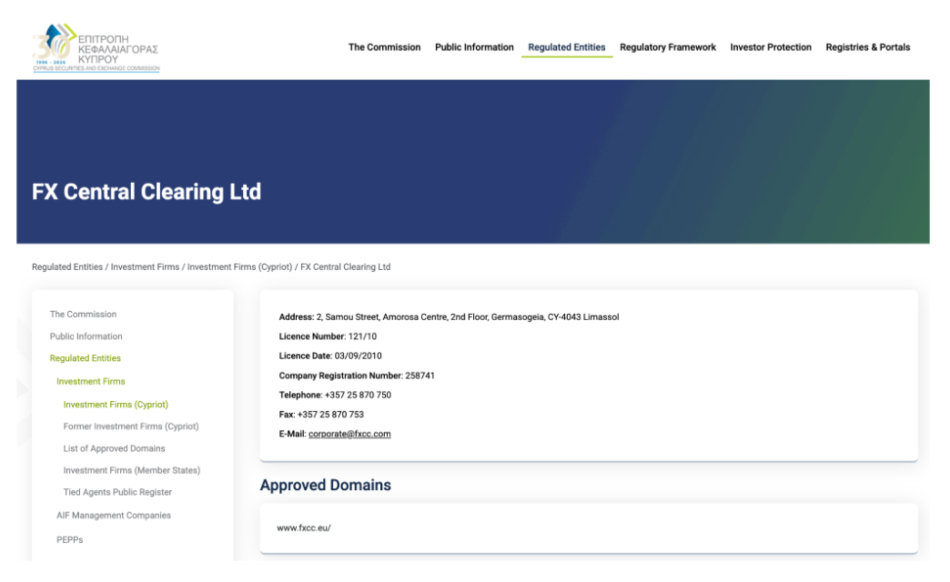
CySEC FXCC Entry
In addition, FXCC holds offshore registrations in St Vincent & the Grenadines (SVGFSA) and maintains a corporate presence in Nevis. While these registrations extend the legal reach, they offer significantly less investor protection than the Cyprus license, so we do not place much weight on them.
It’s worth noting that the Vanuatu Financial Services Commission (VFSC), another offshore location, listed FXCC on a public note – making clear it isn’t overseen by the VFSC – another offshore jurisdiction.
Here’s what the licensing means for your money in practice:
- CySEC entity (EEA clients). Under license 121/10, FX Central Clearing Ltd applies EU MiFID rules. You get segregated client funds, negative balance protection, EU leverage caps, and eligibility for the Cyprus Investor Compensation Fund up to €20,000 if the firm becomes insolvent.
- MISA entity (international clients). Through Central Clearing Ltd, you can reach higher leverage up to 1:1000, but the safety net is thinner. There’s no EU-style compensation scheme, and more depends on FXCC’s own conduct than on a strict, well-resourced regulator.
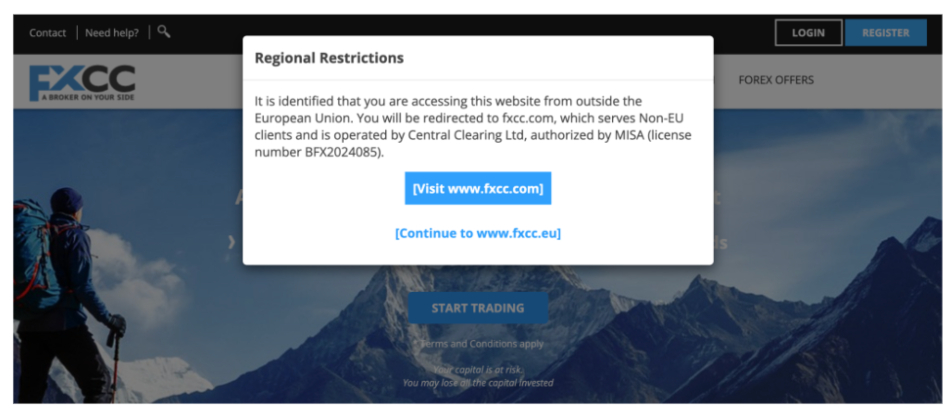
FXCC redirects non-EU residents to its higher-risk, offshore entity
How To Verify FXCC’s Licenses Yourself
You can independently verify this information by following the same steps we use:
- Check which FXCC site you’re on. The domain signals the entity: fxcc.eu is the CySEC-regulated arm, fxcc.com is the offshore MISA arm. Your protection depends on which one you join.
- Find the license number. It sits in the website footer and on the regulation page: CySEC 121/10 for the EU entity, MISA BFX2024085 for the international one.
- Open the regulator’s own register. Use the CySEC public register for the EU arm or the MISA register for the international arm. Type the address yourself rather than trusting a forwarded link.
- Search the firm name or license number on that register.
- Match four things: the legal entity name, the license number, an “authorized” or active status, and the services it’s cleared to offer.
- Scan the warnings list. Check the regulator’s investor alerts and clone-firm notices for the FXCC name before you move any money. For example, you can check CySEC’s alerts.
3 Trust Considerations
FXCC is not without challenges that lower its trust score. Three key findings from our testing stand out:
- Withdrawal costs bite. We were charged the published rates: $45 for bank wires and 2% for crypto and e-wallet payouts, such as Neteller. Deposits, by contrast, were fee-free aside from crypto network costs. For active traders cashing out often, those payout fees erode returns.
- The finance side is slower than the front line. Live chat replies arrived within 3 minutes in our checks, and agents handled platform and account questions well. When a query moved to payments or account review, the speed and clarity dropped. That pattern shows up in third-party complaints, too, so it isn’t a one-off.
- Clones trade on the FXCC name. The real broker is legitimate, but copycat domains, fake “account managers,” and unsolicited Telegram or WhatsApp contacts are the real danger. Before you deposit, confirm the exact domain in your browser, match the license number against the regulator’s register linked above, and ignore any payment instructions sent outside the official client area. European traders should register through the CySEC-regulated entity and avoid being redirected to the offshore site due to VPN use, travel, or regional redirects. While the ECN XL account marketing appears identical across regions, the underlying legal protections differ significantly.