

Which Exness Account Is Best?
For most traders, the Standard account from Exness is the best choice. It has no minimum first deposit, no commission, and access to every market. If you trade often and can deposit at least $200, the Pro account is a better option. In cost tests, Pro matched or beat the Raw Spread account on EUR/USD. Raw Spread and Zero accounts are mainly for high-volume, short- term trading.
 Written By
Christian Harris
Christian is a seasoned analyst, leveraging his expertise in stocks, forex, and crypto to evaluate brokers worldwide. With hands-on trading experience and a strong focus on risk management, he helps traders find reliable platforms. Christian's work for BrokerListings.com has been cited in the Financial Times.
Christian Harris Profile Page Fact Checked By
Tobias Robinson
Tobias is committed to helping traders find the right brokerage for their needs. He has tested 200+ brokers, spent 2,600+ hours using different platforms, and placed 2,100+ trades.
Tobias Robinson Profile Page Edited By
James Barra
James is an experienced broker analyst with a background in financial services. He has spent 2,500+ hours testing brokers, used 35+ different platforms and apps, audited 120+ broker T&Cs, and verified 300+ regulatory licenses. James has also been on US and UK TV, and been a guest on finance podcasts, discussing reports conducted by BrokerListings.com and sharing his expertise.
James Barra Profile PageOctober 15, 2026
Exness Accounts Compared
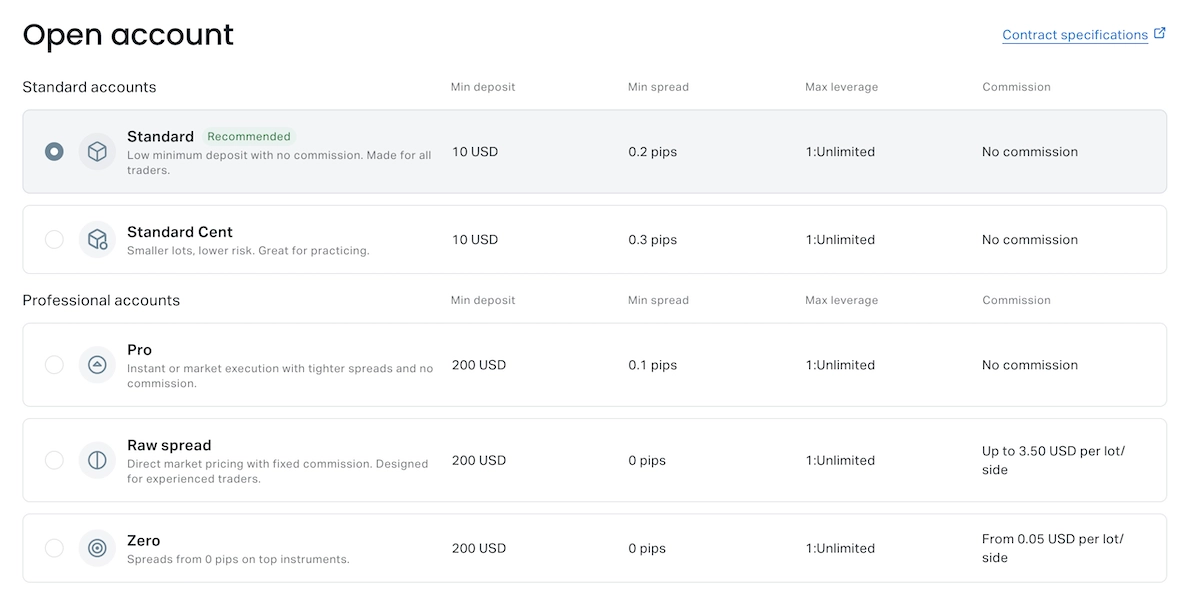
Exness has five live accounts, divided into two groups in its client dashboard, called the Personal Area. Standard and Standard Cent are under ‘Standard accounts’,’ while Pro, Raw Spread, and Zero are under ‘Professional accounts’.
The table below combines Exness’ published conditions with the typical EUR/USD costs from my spread tests.
« Make Full Width »| Feature | Standard Cent | Standard | Pro | Raw Spread | Zero |
|---|---|---|---|---|---|
| Minimum first deposit | From $10, by region | From $10, by region | From $200, by region | From $200, by region | From $200, by region |
| Spreads from | 0.3 pips | 0.2 pips | 0.1 pips | 0.0 pips | 0.0 pips |
| Commission | None | None | None | Up to $3.50 each side per lot (up to $7 a round trip) | From $0.05 each side per lot |
| Maximum leverage | 1:Unlimited | 1:Unlimited | 1:Unlimited | 1:Unlimited | 1:Unlimited |
| Execution | Market | Market | Instant (market on crypto) | Market | Market |
| Margin call | 60% | 60% | 30% | 30% | 30% |
| Typical EUR/USD cost per lot (our tests) | Cent lots | $8–$11 | $6–$7 | Up to $7 commission plus spread | Varies by instrument |
Exness doesn’t set a deposit floor for Standard or Standard Cent, but your payment method usually does, typically around $10, as I explain in the Exness minimum deposit guide.
Which Exness Account Should You Choose?
Standard: Best For Beginners And Casual Traders
Since there’s no commission, the spread you see on the Standard account is your total trading cost, making it easy to understand. In my tests, EUR/USD spreads were about 0.8 to 1.1 pips, or $8 to $11 per standard lot.
Exness triggers a margin call at a 60% margin level, which is double the 30% on professional accounts. This gives you an earlier warning if a trade goes against you.
Standard Cent: Best For Testing A Strategy With Real Money
The Standard Cent account displays your balance in cents, so a $10 deposit shows as 1,000 USC. A 0.01 cent-lot EUR/USD trade moves about $0.001 per pip.
You can trade around 30 markets, including 26 forex pairs, gold, silver, Bitcoin, Ethereum, and US oil, but the two crypto pairs aren’t available on MT4. There’s no demo version.
For more details, see our Exness cent account guide.
Pro: Best For Experienced Manual Traders
The data changes the usual advice here. The Raw Spread account seems cheaper because its spreads start at 0.0 pips, but it charges up to $3.50 per side per lot, which adds up to $7 for a round trip on each standard lot, before any spread.
The Pro account doesn’t charge commission, and its EUR/USD spread was about 0.6 to 0.7 pips in my tests, or $6 to $7 per lot total. So for EUR/USD, the Pro account matched or beat the Raw Spread account, even when the Raw’s spread was zero.
The main drawback is execution. The Pro account uses instant execution for forex, metals, energies, stocks, and indices, and Exness says “requotes can happen”. In fast markets, you might get a new price instead of an immediate fill.
To avoid this, open a Pro account in USD, JPY, THB, CNY, IDR, or VND, as these are the only currencies where you can set Pro to market execution.
Raw Spread: Best For Scalpers And Expert Advisors
The Raw Spread account uses market execution with no requotes, making it a good fit for scalpers and Expert Advisors (EAs) that need uninterrupted fills.
It can still be cheaper than the Pro account on instruments with wider spreads than EUR/USD. The Raw Spread account charges up to $3.50 per lot per side, or up to $7.00 per standard lot for a round-trip trade. Exness charges both sides when you open a position, so a one-lot trade starts with that cost.
Zero: Best For Predictable Spreads On Popular Markets
The Zero account keeps spreads at 0.0 pips on its top 30 instruments for 95% of the day, and on other instruments for 50% of the day, according to Exness. However, I noticed that spreads can still widen during economic news and rollovers.
Commission depends on the instrument and starts at $0.05 per side per lot, so check the rate for your market first.
How To Check What An Exness Account Will Really Cost You
Exness’ ‘from’ prices show the best-case scenario. Here’s how to find out what you’ll actually pay on the markets you trade:
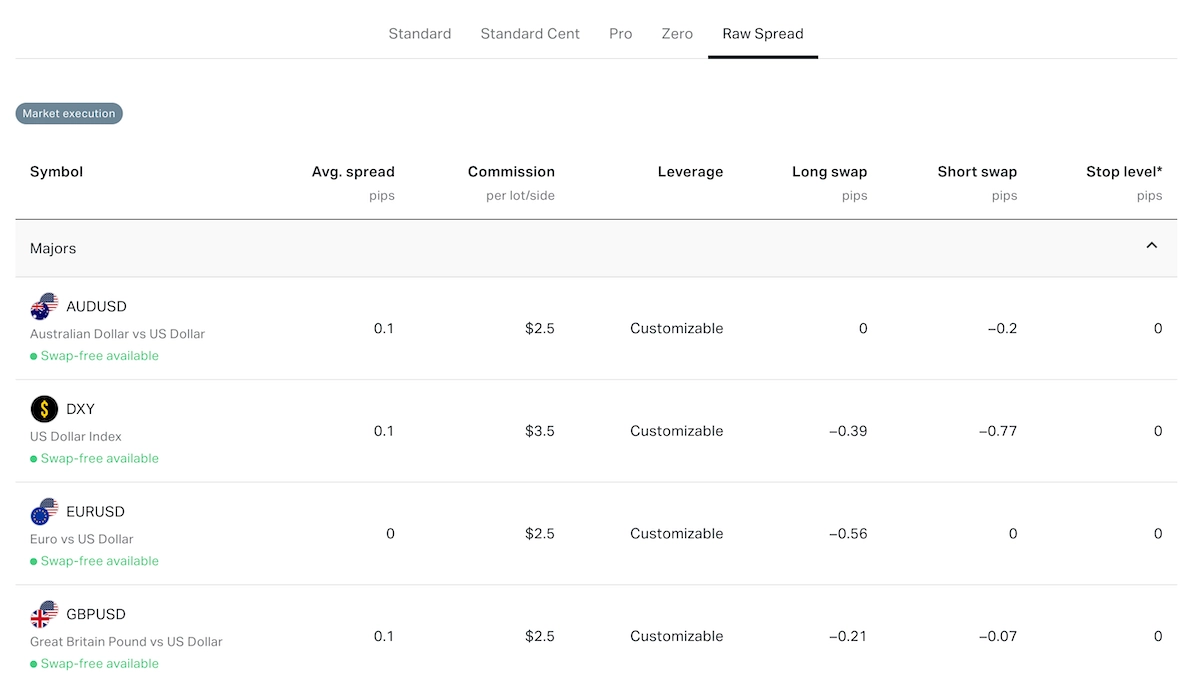
- Find the contract specifications. Log in to the Exness Personal Area (my.exness.com), click ‘Accounts’ in the ‘Trading’ dropdown menu, then click the ‘+ Open account’ button. Click ‘Contract Specifications’. This page lists the commission
per instrument for Raw Spread and Zero accounts. - Check your regional minimum. Open the ‘Deposit’ section in the ‘Payments and wallet’ dropdown to see the minimum and maximum deposits for your country.
- Compare the accounts using a single trade. Using the Exness trading calculator, enter the same instrument and lot size for Pro, Raw Spread, and Zero accounts to compare spread cost, commission, and margin. Exness uses the previous trading day’s average for spread cost, so use this as a guide, not an exact quote.
- You can add a second account instead of starting over. Go to ‘Accounts’, click ‘+ Open account’, and choose from the list. Exness lets you have up to 100 real MT4 and 100 real MT5 accounts per Personal Area, so you can trade Pro and Raw Spread accounts side by side and move money between them using the ‘Transfer’ feature.
Verdict
If you’re new, I recommend you start with the Standard account because it’s easy to price and requires very little money. Then consider moving to the Pro account once you trade regularly and can meet the $200 minimum deposit, since it matched or beat the Raw Spread account on EUR/USD in my tests with no commission.
Look at the Raw Spread account if you scalp, use EAs, or if your contract specifications show it’s cheaper for your markets. Consider the Zero account as a specialist account and the Standard Cent account for practice.
Your account conditions also depend on which Exness entity you sign up with. The 1:Unlimited leverage shown in the table above applies to offshore entities and is subject to eligibility. For example, clients of the Kenyan entity are limited to 1:400 leverage.
For more details on Exness fees, safety, and platforms, check out our full Exness review.