 Top Lists for USA
Is Eightcap Legit?
In our assessment, Eightcap is a legitimate broker. It started in Melbourne in 2009 and has been operating for over 15 years. The company holds three ‘Category A’ licenses in well-known jurisdictions and maintains client funds with top-tier banks, including the National Australia Bank and Barclays. We opened a real-money account, made trades, and withdrew funds without any problems. Scam brokers rarely last this long or hold top licenses, but Eightcap does both.
 Written By
Christian Harris
Christian is a seasoned analyst, leveraging his expertise in stocks, forex, and crypto to evaluate brokers worldwide. With hands-on trading experience and a strong focus on risk management, he helps traders find reliable platforms. Christian's work for BrokerListings.com has been cited in the Financial Times.
Christian Harris Profile Page Fact Checked By
Tobias Robinson
Tobias is committed to helping traders find the right brokerage for their needs. He has tested 200+ brokers, spent 2,600+ hours using different platforms, and placed 2,100+ trades.
Tobias Robinson Profile Page Edited By
James Barra
James is an experienced broker analyst with a background in financial services. He has spent 2,500+ hours testing brokers, used 35+ different platforms and apps, audited 120+ broker T&Cs, and verified 300+ regulatory licenses. James has also been on US and UK TV, and been a guest on finance podcasts, discussing reports conducted by BrokerListings.com and sharing his expertise.
James Barra Profile PageOctober 7, 2026
Why Eightcap Is Legit
There are several signs that support Eightcap being a legitimate broker. Eightcap’s Trustpilot rating is around 4.0 from over 3,800 reviews, with about 70% of ratings at five stars. The broker is open about its Standard and Raw pricing before you deposit, and requires KYC checks upfront, which is normal for a top-tier, trusted broker.
On the downside, Eightcap is not listed on a stock exchange, does not hold a banking license, and it has run into some regulatory issues. Most notably in 2023, when Eightcap Pty Ltd was one of seven CFD providers that self reported issuing some CFDs at leverage levels beyond ASIC’s permitted limits (1:30), with the seven firms collectively agreeing to pay A$4.3 million to over 1,500 clients.
Is Eightcap Regulated?
A core reason we treat Eightcap as legitimate is its multi-jurisdiction licensing. Which entity holds your account depends on where you live, and that choice sets the protections and leverage you receive. Category A to C classifications are based on BrokerListings.com’s regulator bandings.
| Regulator | Entity | Regulator Category | License Verification |
|---|---|---|---|
| Australian Securities and Investments Commission (ASIC) | Eightcap Pty Ltd – Melbourne-based holder of an Australian Financial Services Licence serving Australian clients | Category A | AFSL 391441 |
| Financial Conduct Authority (FCA) | Eightcap Group Ltd – UK-authorised firm providing regulated trading services to British clients | Category A | FCA reference 921296 |
| Cyprus Securities and Exchange Commission (CySEC) | Eightcap EU Ltd – authorised Cyprus investment firm serving eligible EEA clients | Category A | CySEC licence 246/14 |
| Securities and Commodities Authority of the UAE (SCA) | Eightcap Financial Services MΕΝΑ LLC – Category 5 entity supporting Eightcap’s UAE presence; doesn’t authorize forex and CFD trade execution | Category B | SCA-licensed |
| Securities Commission of The Bahamas (SCB) | Eightcap Global Limited registered to deal in and arrange CFDs for international clients outside the licensed onshore markets | Category C | SCB registration SIA-F220 |
| Financial Services Authority of Seychelles (FSA) | Eightcap International Ltd offshore-licensed entity serving select international clients | Category C | FSA registration SD100 |
| Financial Services Commission of Mauritius (FSC) | Eightcap International Trading offshore-licensed entity serving select international clients | Category C | FSC licence GB25204603 |
How We Verified Eightcap’s Licenses
We don’t take a broker’s word for its licensing. Here’s the check anyone can repeat to confirm that Eightcap is authorized rather than just claiming to be:
- Find the entity and number. Eightcap’s website footer and its About Us page list each legal entity and its license number. We noted Eightcap Pty Ltd (ASIC 391441), Eightcap Group Ltd (FCA 921296), and Eightcap EU Ltd (CySEC 246/14).
- Check the ASIC register. We searched the official register and confirmed the license was active and held by Eightcap Pty Ltd.
- Check the FCA register. We looked up reference 921296. Tip: cross-check the number, since some third-party sites list 684312 for Eightcap, which is actually a different broker’s reference.
- Check the CySEC register. We confirmed that license 246/14 appears on the CySEC-regulated entities list and that it covers contracts for difference under its investment services.
- Match the name exactly. A license only protects you if your account is opened with the entity that holds it. We confirmed which entity our account was assigned to and matched it against the register entry, rather than assuming the brand name alone meant we were covered.
- Scan for warnings. We searched the regulator warning lists for clone-firm alerts using the Eightcap name to rule out an impersonator.
Doing this yourself takes about 10 minutes and is the single best way to separate a regulated broker from a copycat.
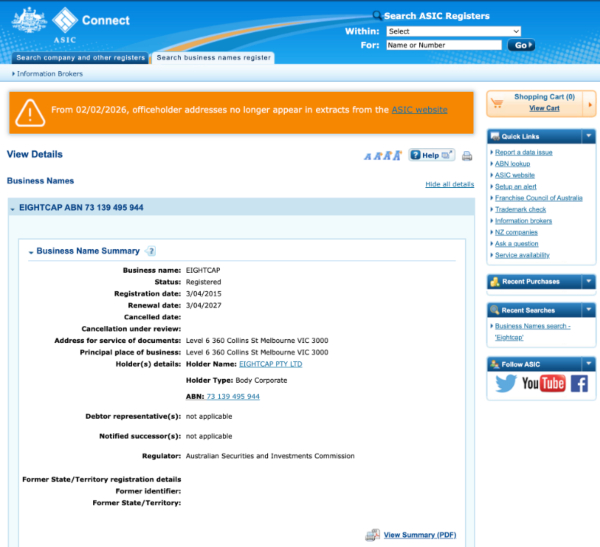
The entity split matters. Clients onboarded under ASIC, the FCA, or CySEC receive the stronger package: segregated funds, negative balance protection, leverage capped at 1:30 for retail clients, and access to a compensation scheme (not for Australian clients).
Clients routed to the Bahamas, Seychelles, or Mauritius entities trade under lighter frameworks, can reach leverage as high as 1:500, and may fall outside any compensation backstop. Higher leverage cuts both ways, magnifying losses as fast as gains, so confirm which entity is opening your account before you fund it.
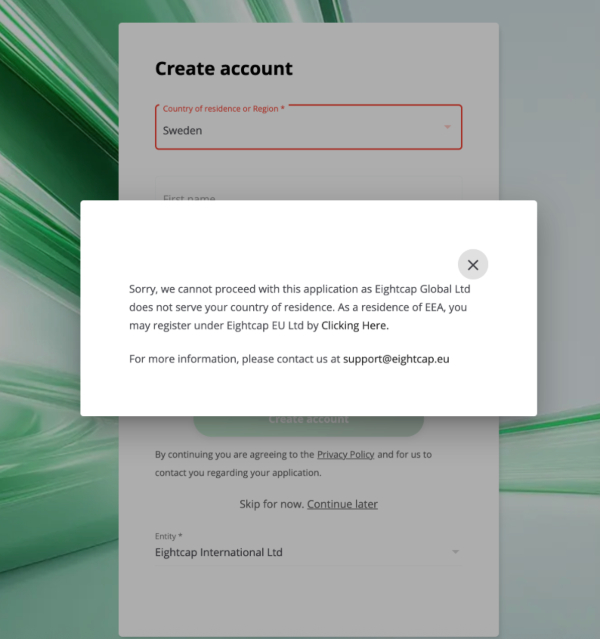
Safety Considerations To Keep In Mind
Being legitimate does not mean there is no risk. Trading CFDs with leverage is risky, and most retail traders lose money. Eightcap’s own data shows a large percentage of retail accounts lose money, which matches the industry average and is a reminder to manage your position sizes carefully.
There are also differences in protection between onshore and offshore entities, and Eightcap does not hold a banking license or is publicly listed. So, we consider it a solid broker, but not without risks.
Also, be careful of fake sites – if anything about the URL or company details seems wrong, check the official registers before proceeding.