 Top Lists for USA
Is Eightcap Legal in India?
Eightcap accepts clients from India (we confirmed by signing up for an account with an Indian IP address and checking with their support team), however they are not authorized by either of India’s domestic regulators, the Securities and Exchange Board of India (SEBI) or the Reserve Bank of India (RBI). Eightcap is legally regulated abroad but operates outside the Indian regulatory framework.
 Written By
Christian Harris
Christian is a seasoned analyst, leveraging his expertise in stocks, forex, and crypto to evaluate brokers worldwide. With hands-on trading experience and a strong focus on risk management, he helps traders find reliable platforms. Christian's work for BrokerListings.com has been cited in the Financial Times.
Christian Harris Profile Page Fact Checked By
Tobias Robinson
Tobias is committed to helping traders find the right brokerage for their needs. He has tested 200+ brokers, spent 2,600+ hours using different platforms, and placed 2,100+ trades.
Tobias Robinson Profile Page Edited By
James Barra
James is an experienced broker analyst with a background in financial services. He has spent 2,500+ hours testing brokers, used 35+ different platforms and apps, audited 120+ broker T&Cs, and verified 300+ regulatory licenses. James has also been on US and UK TV, and been a guest on finance podcasts, discussing reports conducted by BrokerListings.com and sharing his expertise.
James Barra Profile PageAugust 25, 2026
Is Eightcap Regulated In India?
No. We searched the SEBI database for ‘Eightcap’, and as you can see below, ‘no results were found’. This is pretty common amongst overseas brokers that accept Indian clients. However, unlike many competitors, Eightcap does not feature in RBI’s Alert List of unauthorized forex trading platforms, though it still doesn’t mean it’s licensed.
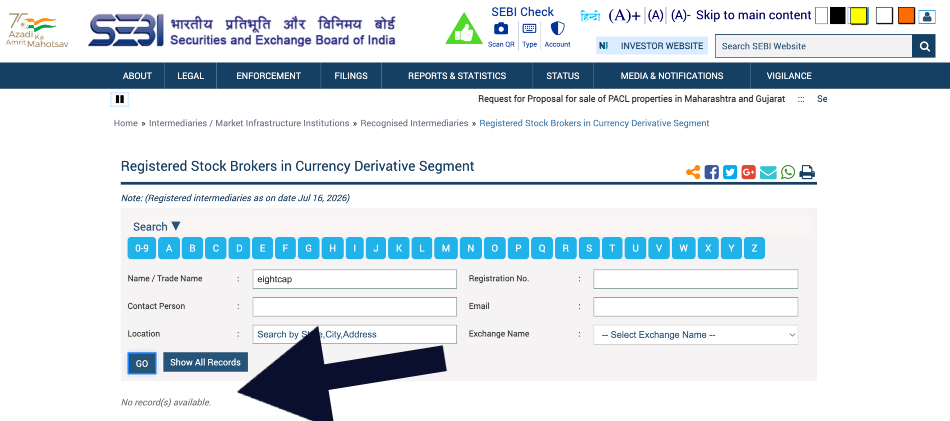
SEBI register shows Eightcap is not regulated in India
What does that mean in practice? Eightcap is a legitimate broker, not a scam, but under the Foreign Exchange Management Act (FEMA), Indian residents should only trade specified INR-paired currency derivatives on recognized domestic exchanges such as the NSE and BSE. Leveraged spot forex and CFD trading through an overseas broker falls into a restricted category that may not be compliant with local rules.
Money sent abroad should also fit within the RBI’s Liberalised Remittance Scheme, which caps overseas remittances at $250,000 a year. RBI states that Indians cannot use LRS to remit margin to overseas firms or counterparties for online forex trading. Plenty of Indian traders use offshore brokers anyway, but the activity may not be compliant and there could be no local dispute-resolution route if something goes wrong.
Should Indian Traders Use Eightcap?
Two practical limits to factor in:
- No INR accounts. Eightcap’s base currencies are AUD, CAD, EUR, GBP, NZD, SGD, and USD. Since the rupee isn’t on that list, you’ll pay a conversion charge each time you deposit or withdraw from an INR bank account. Instead, you may want to consider a broker with an INR-based trading account.
- No local protection. Without SEBI or RBI registration, India’s investor protection mechanisms don’t apply to your account. Given that Indians are onboarded through Eightcap’s higher-risk, offshore entities (we were registered through Eightcap International in Seychelles from a Mumbai IP address), access to legal recourse in the event of e.g. withdrawal issues could be challenging. Consider SEBI-regulated trading brokers.
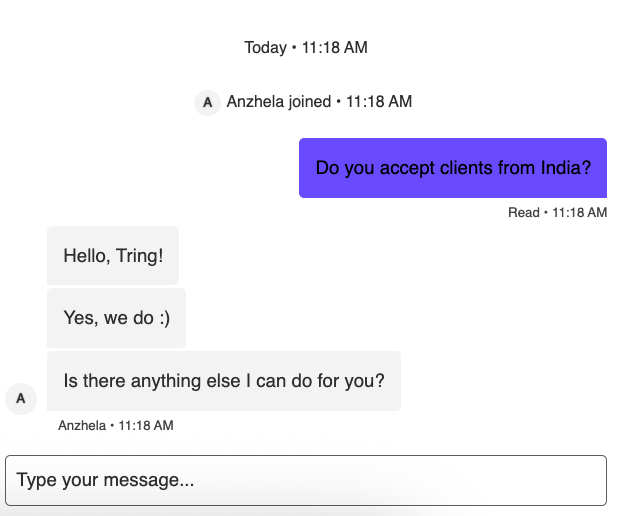
Eightcap’s live chat support confirmed Indian residents are accepted
Funding Realities for Indian Residents
Because local banking institutions regularly flag and block direct Visa or Mastercard remittance transfers to offshore retail brokers to comply with RBI mandates, Indian traders cannot rely on local debit cards. To navigate payment processing hurdles without breaking transaction limits, active retail participants often use the following primary payment rails supported directly via the client hub:
- Stablecoin Funding (USDT): Depositing via Tether (TRC-20 or ERC-20 networks) provides immediate 24/7 internal clearing with zero structural processing fees on Eightcap’s end. This avoids direct cross-border reporting gates in retail banking.
- Electronic Wallets: Neteller and Skrill function as alternative intermediary accounts. Traders fund their digital wallets via local peer-to-peer options before routing the capital seamlessly to Eightcap in USD, EUR, or CAD.
- The Conversion Penalty: Because INR is not a supported base account currency, local bank wire routing requires your funding institution to apply a double-conversion rate. This typically drains between 2% to 4.5% of your total starting balance right at the entry gate, making third-party e-wallets or stablecoins notably more cost-effective.
If you choose to go ahead using Eightcap from India, make sure you check your situation against the latest FEMA and RBI rules, as enforcement and bank reporting for overseas trading have become stricter.