 Top Lists for USA
Is Coinbase FDIC Insured?
No, Coinbase is not FDIC insured because it isn’t a bank.
 Written By
Christian Harris
Christian is a seasoned analyst, leveraging his expertise in stocks, forex, and crypto to evaluate brokers worldwide. With hands-on trading experience and a strong focus on risk management, he helps traders find reliable platforms. Christian's work for BrokerListings.com has been cited in the Financial Times.
Christian Harris Profile Page Fact Checked By
Tobias Robinson
Tobias is committed to helping traders find the right brokerage for their needs. He has tested 200+ brokers, spent 2,600+ hours using different platforms, and placed 2,100+ trades.
Tobias Robinson Profile Page Edited By
James Barra
James is an experienced broker analyst with a background in financial services. He has spent 2,500+ hours testing brokers, used 35+ different platforms and apps, audited 120+ broker T&Cs, and verified 300+ regulatory licenses. James has also been on US and UK TV, and been a guest on finance podcasts, discussing reports conducted by BrokerListings.com and sharing his expertise.
James Barra Profile PageOctober 29, 2026
Your crypto and USDC do not get any Federal Deposit Insurance Corporation (FDIC) protection. Your US dollar cash can be protected up to $250,000, but only if one of Coinbase’s partner banks fails. If Coinbase itself fails, the FDIC will not pay you back.
Coinbase may also invest some of your cash in US government bonds or money market funds, and that part is not covered. Also, the $250,000 limit includes any money you already have in your own name at the same bank.
This is the same setup at most crypto exchanges operating in the US, including Gemini.
What Is And Isn’t FDIC Insured At Coinbase
US dollar balances may be kept in pooled custodial accounts at FDIC-insured banks or credit unions, in US Treasuries, or in money market funds. But Coinbase also tells customers not to assume where their money is held. Only the part kept as a bank deposit can get FDIC coverage.
| What you hold | Who holds it | FDIC insured? | Other protection |
|---|---|---|---|
| USD cash kept as bank deposits | Coinbase, Inc., in pooled accounts at partner banks | Eligible for pass-through cover up to $250,000 (NCUSIF at VyStar Credit Union) | State money transmitter rules |
| USD cash invested in Treasuries or money market funds | Coinbase, Inc. | No | State money transmitter rules |
| Crypto, including USDC | Coinbase, Inc.’s custodial wallets | No | Crime insurance on a portion of holdings |
| Stocks | Coinbase Capital Markets, with Apex as custodian | No | SIPC, up to limits |
| Futures margin | Coinbase Financial Markets | Not covered by Coinbase’s FDIC terms | CFTC customer fund |
Coinbase’s Own Pages Give Different Answers
When I compared Coinbase’s different pages, I found four that give incomplete or conflicting information about its insurance.
| Coinbase page | What it says | What it leaves out |
|---|---|---|
| US help page, crypto section | All crypto Coinbase holds online is insured, and under 2% is held online | The legal insurance page says the crime policy covers only a portion of crypto across its storage systems |
| US help page, cash section | Cash held at US banks gets pass-through FDIC insurance | One of the five partners, VyStar, is a credit union, where the legal page says NCUSIF insurance applies instead |
| Stocks vs. crypto page | Cash for stock trading is held in pooled accounts at FDIC- insured banks or credit unions | The legal page says that cash can also sit in Treasuries or money market funds |
| Advanced Trade FAQ | FDIC-insured USD balances of up to $250k | The same Treasuries and money market fund caveat |
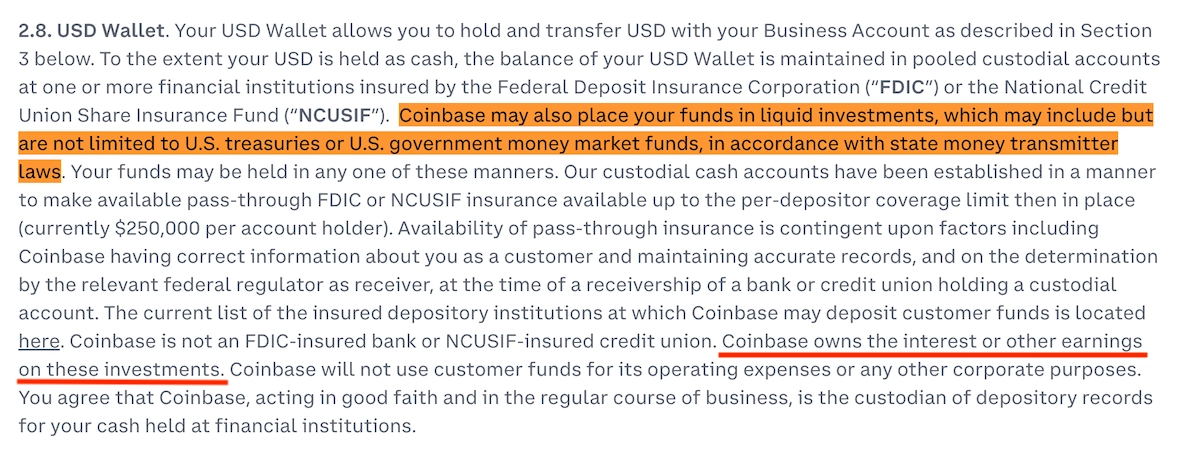
The US User Agreement is the document that actually binds Coinbase. Section 2.8 says your dollars can be held as cash or put into liquid investments, and it adds a detail the other pages don’t mention: Coinbase keeps any interest those investments earn.
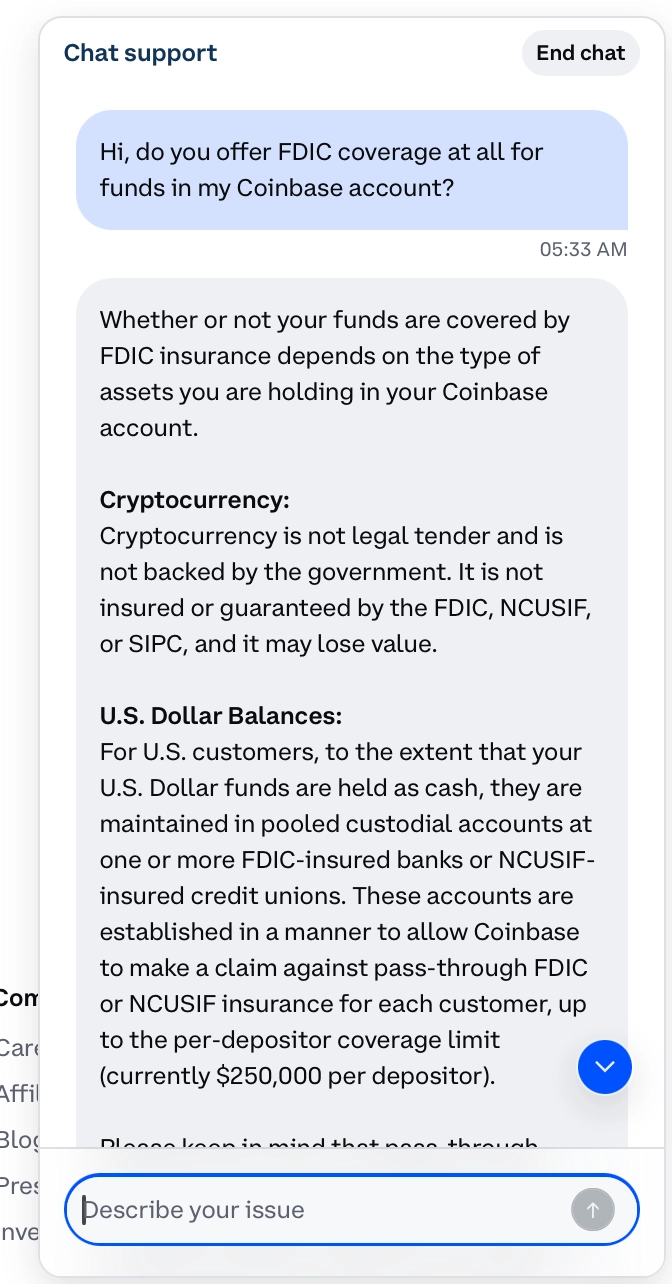
That’s why I also signed into my Coinbase account, fired up the chat support, and asked them directly about the extent of FDIC coverage. They responded with the below, which aligns with this article’s overall findings – crypto assets aren’t covered, US cash balances might be, depending on the circumstances.
How Your Dollars Move In And Out Of FDIC Cover
Even the part kept as a bank deposit has conditions that Coinbase’s headline $250,000 figure doesn’t fully explain.
- FDIC insurance only covers bank failures. The FDIC says its insurance does not protect you if a nonbank company goes out of business. If a partner bank fails, pass-through coverage might apply. If Coinbase itself fails, the FDIC will not pay.
- Your FDIC coverage is shared with your own accounts. The FDIC adds pass-through deposits to any accounts you already have in the same ownership category at the same bank. For example, if you have $180,000 in a personal Chase checking account and $120,000 in your Coinbase USD balance, and Coinbase puts your share at JPMorgan Chase, you would have $300,000 there, so $50,000 would be uninsured. You can’t see which of the five partners holds your share.
- Coverage also depends on Coinbase’s records. Under section 2.8 of the US User Agreement, you agree that Coinbase keeps the records for your cash at partner banks, so any payout would rely on Coinbase’s ledger. The FDIC checks this paperwork only if a bank fails. If the records are incomplete, the money is insured as Coinbase’s own deposit, with a $250,000 cap for all customers at that bank.
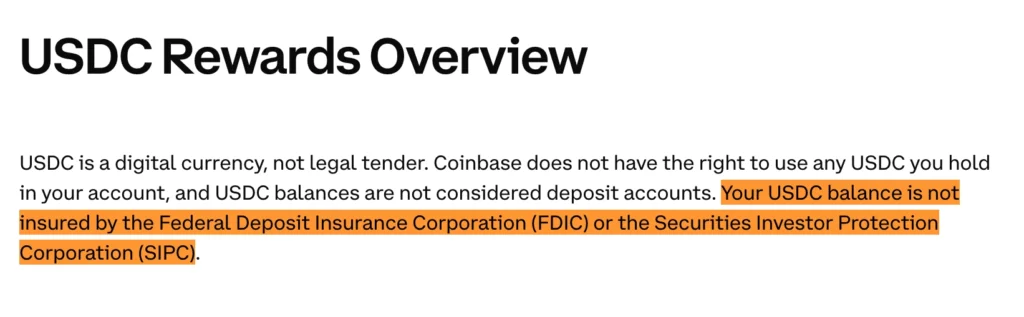
- If you convert your cash to USDC, FDIC coverage ends. Coinbase pays eligible customers rewards for holding USDC, but its USDC rewards help page says your USDC balance is not insured by the FDIC or SIPC. Moving your dollars to USDC removes FDIC protection.
- Futures margin is not kept in your USD wallet. On Coinbase Advanced, cash needed for futures margin is moved automatically to Coinbase Financial Markets, which provides CFTC customer protections instead.
What Protects You Instead Of The FDIC
Coinbase’s crime insurance covers some of the crypto in its storage systems against theft, including cyber breaches. It does not cover NFTs or losses caused by someone using your stolen login. Coinbase also warns that total losses could exceed what the policy pays.
Money transmitter licenses require state bonds, but the state disclosures in Coinbase’s US User Agreement warn that these bonds may not cover all customer losses.
Legal title is important if Coinbase itself has problems. Section 2.7.1 of the US User Agreement says your crypto stays your property and is not subject to claims from Coinbase’s creditors. Stocks bought through Coinbase Capital Markets are held at Apex with SIPC protection up to certain limits, while the cash you use to buy them stays with Coinbase, Inc. under the same FDIC terms as your other dollars.
How To Check Your FDIC Coverage On Coinbase
There are three ways to check how much of your Coinbase cash is actually protected:
- First, check if your dollars are shown as USD or USDC. Only a USD cash balance can qualify for FDIC coverage. Anything held as USDC is considered crypto.
- Next, add up your other deposits at Coinbase’s partner banks. Partners include JPMorgan Chase, Cross River Bank, Customers Bank, VyStar Credit Union (retail and business customer funds only), and Pathward (previously known as MetaBank). If your own balance at any of these banks plus your Coinbase cash is more than $250,000, the extra amount may not be insured.
- Finally, check your futures balance if you trade futures. Cash in your futures account is held by Coinbase Financial Markets under CFTC rules, not in the USD balance that Coinbase’s FDIC terms cover.