 Top Lists for USA
Best Tokenized Stocks Platforms For 2026
We’ve tested and compared the top-rated platforms and crypto exchanges for buying and trading tokenized stocks.
 Written By
James Barra
James is an experienced broker analyst with a background in financial services. He has spent 2,500+ hours testing brokers, used 35+ different platforms and apps, audited 120+ broker T&Cs, and verified 300+ regulatory licenses. James has also been on US and UK TV, and been a guest on finance podcasts, discussing reports conducted by BrokerListings.com and sharing his expertise.
James Barra Profile Page Fact Checked By
Tobias Robinson
Tobias is committed to helping traders find the right brokerage for their needs. He has tested 200+ brokers, spent 2,600+ hours using different platforms, and placed 2,100+ trades.
Tobias Robinson Profile Page Edited By
William Berg
William Berg combines his expertise in law and finance to analyze trading brokers. He has checked 3,250+ regulatory licenses, investigated 2,365+ broker clones and trading scams, and placed 3,500+ trades.
William Berg Profile PageOctober 27, 2026
Filters
How We Tested
- We took our evolving database of 58 trading providers and logged into each of their platforms to check whether they offer tokenized stocks and ETFs.
- We counted the range of tokenized securities available and evaluated their coverage across different sectors and regions, with US-listed technology firms the most common.
- We analyzed the trading conditions, from the minimum deposit and spreads and/or commissions through to the availability of fractional shares and 24/7 trading.
- We weighed their safety profiles by verifying their regulatory licenses, proof of reserves where used, account safeguards, and wider user reviews on platforms like Trustpilot.
- Where accessible, we tested the trading experience – performing technical analysis on stock charts, investigating the order book and liquidity, and buying and trading tokenized stocks.
- We documented all these data points and testing observations, which fed into an overall rating that trading platforms and crypto exchanges were ultimately sorted by.
What Is A Tokenized Stock?
A tokenized stock tracks the price of a real stock, such as Microsoft, but is based on a blockchain token. They primarily provide a mechanism to speculate on share prices.
They have proven popular because of their flexibility, notably that they provide trading opportunities beyond traditional trading hours, e.g. pre- and post-market, and over the weekends, while leveraging crypto-based infrastructure and tools.
The value of the token is designed to closely follow the price of the underlying stock, but as we’ve seen in our tests, liquidity quality and execution speeds can vary, along with spreads, particularly if you’re trading in quiet periods.
Importantly, tokenized stocks generally fall into three categories:
- Issuer-sponsored: These are on-chain shares that typically provide legal ownership of the underlying shares and grant rights like the receipt of dividends.
- Custodial 1:1 backed tokens: These normally pass the economic value of dividends via balance adjustments or rewards but very rarely grant voting rights.
- Synthetic price trackers: These don’t provide either – no voting rights and dividends, neither directly or indirectly.
How To Buy Tokenized Stocks
You can buy tokenized stocks or ETFs in several steps:
1. Choose A Trading Platform Or Crypto Exchange
Our toplist above ranks the providers that performed best in our hands-on tests, but everyone has individual preferences. Key things to consider are:
- What you’ll actually own: Will you get legal ownership of a real company share (less common) or can you just speculate on the stock’s price without owning anything?
- How easy it is to cash out: Are there enough active buyers on the platform so you can sell quickly at your desired price? Some platforms pool liquidity from multiple providers to help here.
- Protection against bankruptcy: Are the real shares stored with a secure, independent third party, known as a custodian? Crypto exchanges especially, more so than traditional stock brokers, have a track record of going bankrupt.
- The choice of tokenized securities: For example, do you want to speculate on AI-linked firms listed in the US, or financial services firms listed in Asia or Europe?
- Fees charged: Does the broker charge a variable spread and/or a commission and are there blockchain network fees or withdrawal charges? Some platforms offer commission-free trading on tokenized stocks and ETFs.
- Regulatory licenses: Is the platform authorized by a trusted regulator? See our regulator directory for top-tier bodies. Buying tokenized securities through offshore entities is higher risk, though some crypto exchanges use proof of reserves as a partial safety net.
Once you’ve found a provider that suits your needs, open an account. Every platform in our toplist requires basic information like your name, email and phone number, plus you’ll need to verify your ID and address for know your customer (KYC) and anti money laundering (AML) purposes, and usually complete a short questionnaire about your trading experience and source of funds.
2. Find A Tokenized Security
With your account open, download their trading app or open their web or desktop-based platform. Most firms we’ve tested make it very easy to find their tokenized securities, usually having their own label under ‘Stocks’ or ‘Spot’. You can see an example of this from the Pionex platform below.
Alternatively, if you know what you want to trade, e.g. Tesla, you can search for it in the instrument bar. There will normally be an indicator that it’s a tokenized version of the security following the ticker, e.g. SPCX.ex or SPCX/USDT.
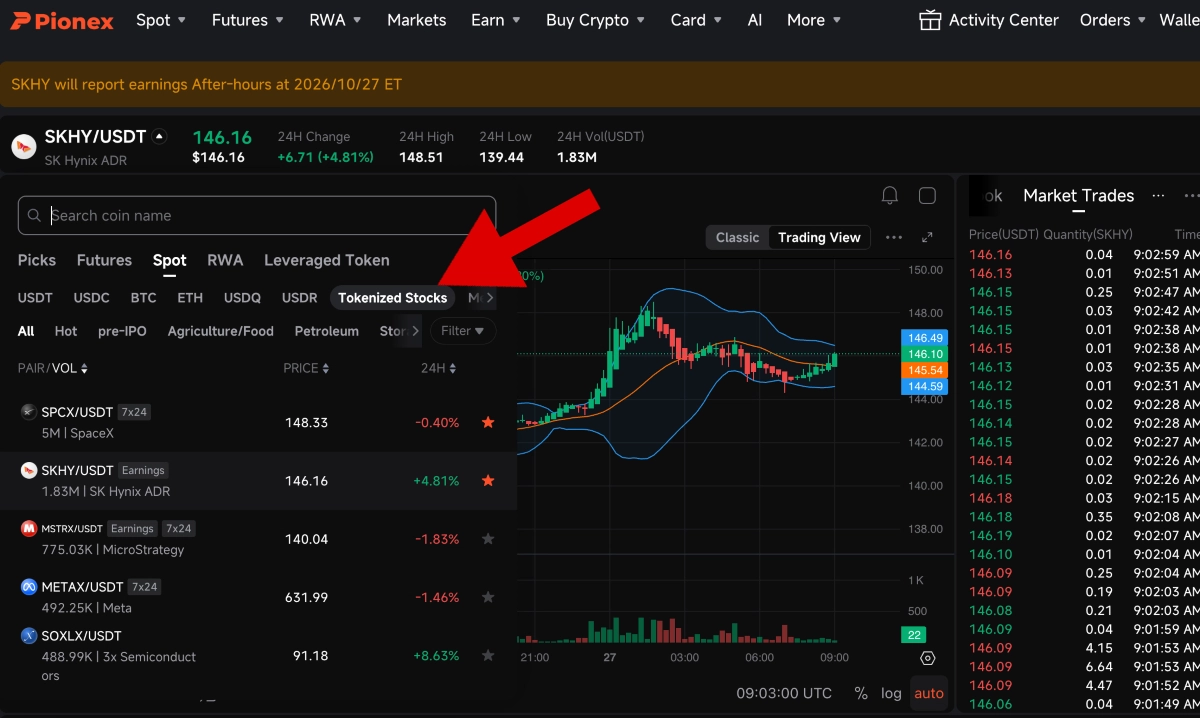
Trading tokenized US stocks on the Pionex platform in testing
With the security open in the platform or app, you can run your analysis to inform your trading decision, whether that’s technical analysis based on charts and indicators or a decision based on fundamentals.
If the platform supports it, it can also be worth checking the order book and data on current buy and sell positions. This will give you insights into liquidity, which is an important consideration when trading tokenized stocks over actual shares, especially in short-term strategies.
3. Place A Buy Position
When you’re ready, you can configure your buy parameters. You can normally enter how much you want to buy by value or quantity, see an estimation of the fees, and some platforms allow you to choose from different order types, such as market or limit. For risk management, consider entering a take profit and/or stop loss.
When you’re happy, click the ‘Buy’ button, which is usually green and clearly visible in the order panel. You should get a trade confirmation message and see the open position in your account area or trading history.
Legal Considerations
Tokenized stocks and ETFs are increasingly being recognized as tradeable securities globally. However, rules are also evolving and vary depending on the region:
- US: Tokenized securities fall under federal securities laws and the SEC introduced a five year ‘innovation exemption’ in September 2026 alongside approvals for tokenized stock trading on traditional exchanges like the Nasdaq in March 2026. US residents can legally buy tokenized exchange-listed stocks on-chain through registered brokers or approved Tokenized Securities Venues (TSVs) using approved automated market makers (AMMs). They should give you shareholder rights so you can get dividends and voting rights, and should not be synthetic derivatives.
- EU: Tokenized securities are regulated as transferable under MiFID II, the Prospectus Regulation and the EU DLT Regime. EU citizens have amongst the broadest access to tokenized stocks globally, especially through European-licensed investment platforms.
- UK: Tokenized stocks are classed as ‘Security Tokens’ under the FCA’s Regulated Activities Order. They should only be bought from FCA-authorized brokers or platforms that are part of the Digital Securities Sandbox (DSS). Some overseas providers may accept British residents, but using one brings higher risks as you may not get locally mandated safeguards like access to investor compensation.
- Asia Pacific: Tokenized securities are governed by the Securities and Futures Act (SFA) via MAS in Singapore and the SFC’s ‘See-Through’ Securities Framework in Hong Kong. Whilst tokenized stocks are legal, access for retail investors is fairly restricted, with buyers often having to be ‘Accredited’ or ‘Professional Investor’ status, requiring meeting wealth thresholds.
Note that many overseas crypto platforms that offer token stocks, including some of those featured in the list above, don’t use native SEC/EU DLT-compliant equity issuances. Instead, they use custodial wrappers, e.g. via Alpaca, Ondo or Backed.
Are Tokenized Securities Right For You?
Buying, selling and trading tokenized securities could be right if:
- You want to bet on the price direction of shares.
- You want to trade stocks with cryptos, such as Tether (USDT), as the base currency that the trade can also be settled in depending on the platform.
- You want to trade shares outside of listed exchange hours, particularly over the weekends, as many traditional brokerages have extended trading hours, but only to pre- and post-market weekday sessions.
- You’re an experienced trader with a solid understanding of what drives stock and ETF prices and a robust risk management plan.
You should avoid buying or trading tokenized stocks or ETFs if:
- You want to own and hold physical shares in a traditional brokerage account.
- You aren’t willing to check the token structure to verify whether you’ll get rights like dividend payments.
- You’re a beginner trader who doesn’t understand the micro and macro economic factors that can drive stock prices.