 Top Lists for USA
Is Fusion Markets Legit, Safe and Regulated?
We consider Fusion Markets to be a legitimate broker. It has held an Australian license since 2017, keeps client money in separate trust accounts, and has a high rating from thousands of Trustpilot reviews. We’ve opened four accounts with Fusion over the years and traded on each of its platforms, so our verdict is based on real experience. However, being ‘legit’ and being ‘safe for you’ are not the same thing – the protection you receive depends on which entity you sign up with.
 Written By
Christian Harris
Christian is a seasoned analyst, leveraging his expertise in stocks, forex, and crypto to evaluate brokers worldwide. With hands-on trading experience and a strong focus on risk management, he helps traders find reliable platforms. Christian's work for BrokerListings.com has been cited in the Financial Times.
Christian Harris Profile Page Fact Checked By
Tobias Robinson
Tobias is committed to helping traders find the right brokerage for their needs. He has tested 200+ brokers, spent 2,600+ hours using different platforms, and placed 2,100+ trades.
Tobias Robinson Profile Page Edited By
James Barra
James is an experienced broker analyst with a background in financial services. He has spent 2,500+ hours testing brokers, used 35+ different platforms and apps, audited 120+ broker T&Cs, and verified 300+ regulatory licenses. James has also been on US and UK TV, and been a guest on finance podcasts, discussing reports conducted by BrokerListings.com and sharing his expertise.
James Barra Profile PageOctober 7, 2026
Why We Rate Fusion Markets As Legitimate
- Top-tier license: Its Australian entity holds an ASIC license via FMGP Trading Group Pty Ltd, which sits in our highest regulator band. Fraudulent brokers almost never hold a Category A license.
- Segregated client funds: Client money is kept separate from the company’s own funds at National Australia Bank, one of Australia’s biggest banks (for Australian clients). This means your balance should be protected from the company misusing it.
- Independent feedback aligns with our experience: Fusion Markets’ high Trustpilot score from over 8,000 reviews aligns with what we’ve seen while using it. Most praise is for tight spreads, low commissions, and quick withdrawals.
- Our live tests went well: We’ve funded real Fusion Markets accounts, traded forex, indices, and commodities, and contacted support over 100 times in the past few years. Deposits, withdrawals, and trade execution all worked as promised.
- Pricing is clear: Both the $2.25-per-side commission and the spread-only Classic pricing are shown before you sign up. We didn’t find any hidden deposit, withdrawal, or inactivity fees from Fusion Markets itself.
- Track record: Fusion Markets started in Melbourne in 2017 and now serves traders in about 180 countries. Scam brokers usually disappear after a few weeks or months, but Fusion has lasted many years.
Is Fusion Markets Regulated?
Fusion Markets runs three regulated entities. Where you live decides which one you trade under, and that single fact drives almost the entire safety picture. The table below shows each entity, its license, and the regulator we band it with.
| Regulator | Entity | Regulator Category | License Verification |
|---|---|---|---|
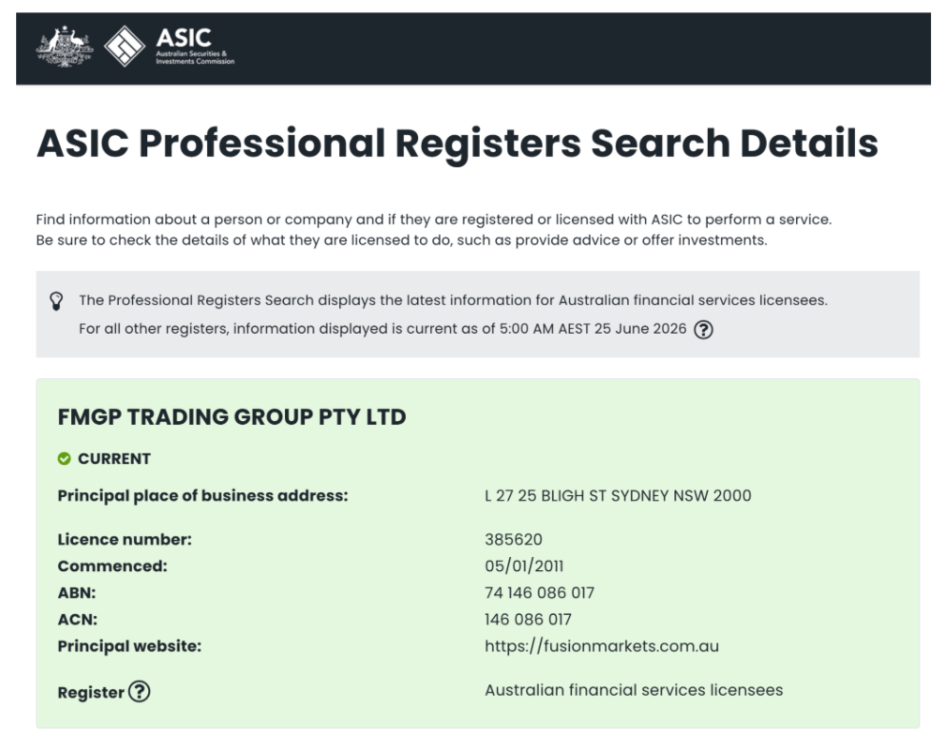
| Australian Securities and Investments Commission (ASIC) | FMGP Trading Group Pty Ltd — Australian entity holding a financial services licence, with the strongest retail safeguards in the group | Category A | AFSL 385620 |
| Financial Services Authority of Seychelles (FSA) | Fusion Markets International Ltd — offshore entity used for many international clients, with lighter formal protections and no investor compensation scheme | Category C | Securities Dealer SD096 |
| Vanuatu Financial Services Commission (VFSC) | Gleneagle Securities Pty Limited — offshore entity used for some global clients depending on the onboarding route, again with no compensation scheme | Category C | Licence 40256 |
Our regulator banding (A to C) is based on BrokerListings.com’s trust score system.
Here’s the bottom line: Australian clients who sign up under the ASIC entity get leverage limits up to 1:30, negative balance protection, margin close-out rules, and access to Australia’s dispute resolution system. Clients under the Seychelles or Vanuatu branches get higher leverage (up to 1:500) but much less protection.
Safety Points To Weigh Before You Sign Up
We consider Fusion Markets trustworthy for its target traders, but remember that no leveraged broker is without risk. Here are some important points to keep in mind:
- Offshore protection is limited. If you end up with the Seychelles or Vanuatu entity, you won’t have the same ASIC-level safeguards. Higher leverage can help or hurt, and there’s no investor compensation if things go wrong.
- Fusion isn’t a bank and isn’t publicly listed. It doesn’t have a banking license or trade on the stock market, so you don’t get the extra oversight or public financial reports that brokers like Plus500 provides.
- India has flagged Fusion. In November 2025, the Reserve Bank of India put Fusion Markets on its Alert List of unauthorized forex platforms. We cover this in more detail in the India section below.
- Canada has also flagged Fusion. In February 2026, the Alberta Securities Commission warned that Fusion Markets isn’t registered to deal in securities or derivatives in Alberta.
- There is a risk of clones. The Seychelles regulator warned that another company was misusing Fusion Markets’ SD096 license number. Always make sure you are on the official website before depositing money.
- Most retail CFD traders lose money. This is true across the industry and applies to Fusion Markets as well. Tight spreads don’t change your chances, so manage your risk carefully.
Quick Way To Confirm You’re On The Real Fusion Markets
This is the kind of broker where the wrong sign-up link genuinely changes your protections, so run this check:
- Type the official website address yourself instead of clicking on ads or email links. Look out for similar-looking sites like fusionmarkets.co, fusion-markets.com, or fusionmarketsfx.com.
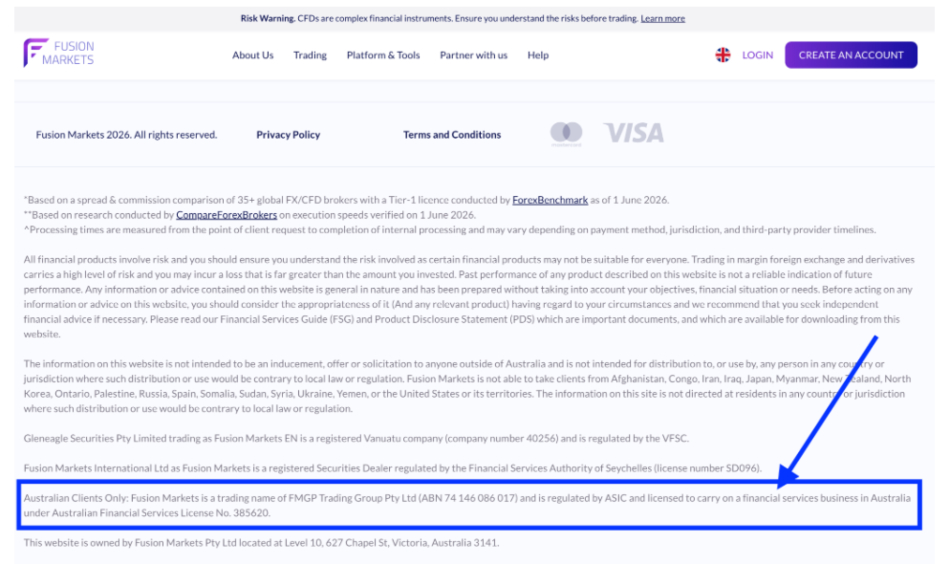
- Scroll down to the website footer and check the legal entity name. Australians should see FMGP Trading Group Pty Ltd and ASIC details, not an offshore company.
- Copy the license number from the footer and check it on the regulator’s official register using the links above. Don’t rely only on the footer text, since fake sites can copy it.
- If you’re traveling or using a VPN, check the entity again. Broker websites often redirect based on your location, which can affect which entity you sign up with.