

What Are Plus500 Fees And Are They Low?
Plus500 doesn’t charge a commission, but you pay a spread each time you open a position. Extra fees can apply if you hold positions overnight, trade assets based in a currency other than your account base, use a guaranteed stop loss order (GSLO), and leave your account inactive for three months.
 Written By
James Barra
James is an experienced broker analyst with a background in financial services. He has spent 2,500+ hours testing brokers, used 35+ different platforms and apps, audited 120+ broker T&Cs, and verified 300+ regulatory licenses. James has also been on US and UK TV, and been a guest on finance podcasts, discussing reports conducted by BrokerListings.com and sharing his expertise.
James Barra Profile Page Fact Checked By
Tobias Robinson
Tobias is committed to helping traders find the right brokerage for their needs. He has tested 200+ brokers, spent 2,600+ hours using different platforms, and placed 2,100+ trades.
Tobias Robinson Profile Page Edited By
William Berg
William Berg combines his expertise in law and finance to analyze trading brokers. He has checked 3,250+ regulatory licenses, investigated 2,365+ broker clones and trading scams, and placed 3,500+ trades.
William Berg Profile PageSeptember 25, 2026
Is Plus500 Free?
Plus500 should not be thought of as ‘free’. This confusion can stem from Plus500 being a commission-free broker in most regions (excluding the US), which means it doesn’t charge a fixed amount per trade, typically around $7 per round lot turn on forex at most online brokers.
Commission-free brokers often appeal to casual and inexperienced traders who want fewer costs to factor in, especially those dealing in shares and funds.
It’s also true that Plus500 does not charge for several services where some brokers we’ve tested do:
« Make Full Width »| Service | Free? | Normal? |
|---|---|---|
| Account opening | Yes | Yes |
| Account maintenance | Yes | Yes |
| Deposits and withdrawals* | Yes | Mixed |
| Charts in the Plus500 platform and app | Yes | Yes |
| Plus500+ Insights | Yes | Yes |
| +AI Bites | Yes | Yes |
| ESG scoring | Yes | Mixed |
*While Plus500 does not levy a fee for deposits and withdrawals, some payment providers may have their own charges.
Still, it would be a mistake to think of Plus500 as an entirely free broker. Instead, it bakes its cut in other ways…
Does Plus500 Have Fees?
Plus500 is a for-profit brokerage that still has to make money. So, in place of a commission, you incur costs for the following, with the spread normally being the primary and largest cost to factor in, particularly for active traders.
« Make Full Width »| Service | Detail | Example | Low/Average/High |
|---|---|---|---|
| Spread | Difference between the ask and bid price of an asset. | In test trades, we got 0.6 on EUR/USD, 0.06 on oil, 2.0 on FTSE, 1.28 on Apple (variable with market conditions). | Average |
| Overnight funding | Interest for holding positions overnight, which can be added or subtracted from your account. CFD formula: Trade Size * Position Opening Rate * Point Value * Daily Overnight Funding %. | A 10,000-unit EUR/USD trade opened at 1.1800 with a $1 point value and 0.01% daily overnight funding rate would cost $1.18 overnight (10,000 × 1.1800 × $1 × 0.01%). | Average |
| Currency conversion | Up to 0.7% on net profit/loss if you trade an instrument based in a different currency. | A EUR-based account trading €1000 profit in Apple shares, which are based in a USD market, would incur an FX fee up to €7. | Average |
| GSLO | Guarantees a trade will be closed at a set price, protecting against slippage. Charged as a wider spread that varies depending on asset and conditions. | In one of our test trades, we paid a 0.73 wider spread on a gold position. | Average |
| Inactivity | A charge if there is no account activity. | $10 monthly fee after 3 months. | Average – some brokers have no inactivity fee. |
Plus500 charges competitive fees overall, but costs for active traders can be higher than some of BrokerListings’ cheapest brokers.
Where Can I Check Plus500 Spreads?
Log into the Plus500 platform, search for or select an instrument from the left menu, and it should appear in the central panel with two clear columns titled ‘Sell’ and ‘Buy’. I’ve highlighted these in red below, which shows the bid and ask prices for assets in my watchlist on the Plus500 platform.
To work out the spread, simply subtract the Sell price from the Buy price. E.g. for Natural Gas below, I’d subtract 3.288 from 3.294, giving me a spread of 0.006. This is what I’d pay to open a trade.
Keep in mind Plus500’s spreads are dynamic, so they will change depending on current market conditions. For example, during slower, less busy periods, expect to see wider spreads where you’ll pay more to trade.
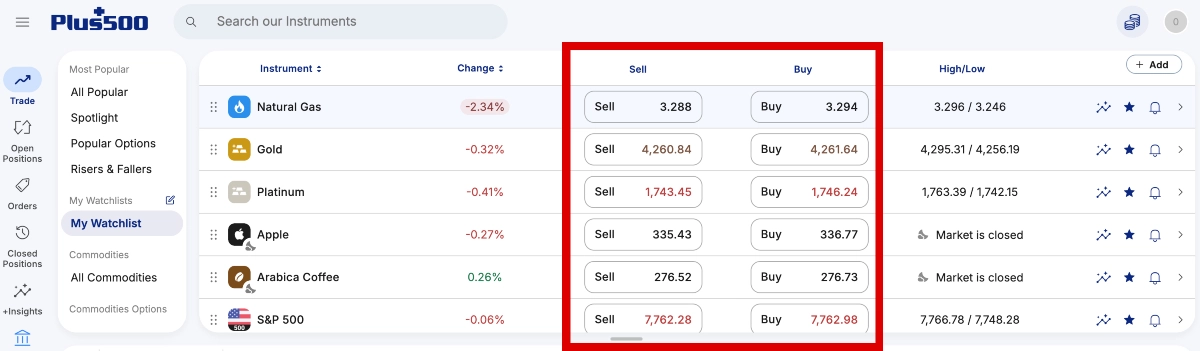
Spreads in the Plus500 platform
Tip: The ‘High/Low’ column to the right shows the highest and lowest prices the asset has reached in that trading session, giving you a quick snapshot of intraday prices. I’ve placed dozens of trades on the Plus500 platform and have found this useful intelligence not provided, at least so clearly, in many online trading platforms.