 Top Lists for USA
Does Coinbase Report To The IRS?
Yes, if you’re in the US, Coinbase reports your crypto sales and coin-to-coin swaps to the IRS for trades made from 2025 onward. It also reports staking rewards over a certain amount, as well as stock sales and futures trades.
 Written By
Christian Harris
Christian is a seasoned analyst, leveraging his expertise in stocks, forex, and crypto to evaluate brokers worldwide. With hands-on trading experience and a strong focus on risk management, he helps traders find reliable platforms. Christian's work for BrokerListings.com has been cited in the Financial Times.
Christian Harris Profile Page Fact Checked By
William Berg
William Berg combines his expertise in law and finance to analyze trading brokers. He has checked 3,250+ regulatory licenses, investigated 2,365+ broker clones and trading scams, and placed 3,500+ trades.
William Berg Profile Page Edited By
James Barra
James is an experienced broker analyst with a background in financial services. He has spent 2,500+ hours testing brokers, used 35+ different platforms and apps, audited 120+ broker T&Cs, and verified 300+ regulatory licenses. James has also been on US and UK TV, and been a guest on finance podcasts, discussing reports conducted by BrokerListings.com and sharing his expertise.
James Barra Profile PageNovember 2, 2026
But the IRS still only sees part of the picture. Coinbase’s crypto forms show what you sold for, not what you paid, and they don’t report some of your activity on Coinbase at all. If you fill in those gaps incorrectly, you might pay tax on profits you never made or leave the IRS with a sale it can’t match to your return.
Importantly, Coinbase is not alone in reporting to the IRS. All US-based, centralized crypto exchanges should.
You could try using an offshore exchange that doesn’t send annual 1099-DA forms to the US, but this is fraught with risk. You could face civil or criminal tax repercussions in the US, while we’ve seen exchanges refuse withdrawals when US residents don’t pass know your customer checks, or get caught using a VPN.
What Coinbase Reports To The IRS
You might receive up to four different tax forms from Coinbase and its partners each year, and the IRS gets a copy too. The forms you get depend on your activity on the platform, not on how much crypto you own.
| Form | What triggers it | What the IRS sees |
|---|---|---|
| 1099-DA | Selling crypto for cash or swapping one coin for another, from 2025 | What you sold for in 2025; sale price plus cost on qualifying crypto from 2026 |
| 1099-MISC | Staking, rewards and other income Coinbase pays you: over $600 in 2025, then $2,000 or more for 2026 | Your total income for the year |
| 1099-B | Selling stocks or ETFs, or trading futures and perpetuals | Stock and ETF sale details, including cost; on futures overall profit or loss |
| 1099-DIV | Stock dividends of $10 or more | Dividends paid |
Stock, futures, and dividend forms are combined into one Consolidated Form 1099. Crypto sales aren’t included there. Coinbase reports those on a separate 1099-DA, so if you trade both, you’ll have at least two documents to review.
What Changes On Your 1099-DA From 2026
Your 2025 form only tells the IRS what you sold for. From January 2026, Coinbase includes what you paid, but only for “covered” crypto. According to IRS 1099-DA instructions, this means coins you bought after 2025 within your Coinbase account and kept there until you sold them. Anything bought before 2026, or transferred in from another wallet or exchange, is considered noncovered.
Here’s how that works. Suppose you bought 0.1 BTC somewhere else in 2024 for $4,000, moved it to Coinbase, and sold it in 2026 for $9,000. Your 1099-DA will show $9,000 as proceeds, mark it as noncovered, and leave the cost blank.
The IRS’s broker reporting FAQ says Coinbase can’t use purchase records from other exchanges, even if you provide them. You’ll need to enter the $4,000 yourself on Form 8949, or the IRS will see a $9,000 sale with no cost to offset it.
The year cut-off can be tricky. Coinbase uses Eastern Time for tax reporting, so if you sell at 10pm on December 31 in California, it’s already 1am on January 1 in New York, and the sale will appear on the next year’s form.
Where Coinbase’s Pages Don’t Match The IRS
When I compared Coinbase’s tax pages to the IRS’s rules, I found four areas where the information isn’t complete. These don’t change what you owe, but they might affect what you expect to see on your form.
| Coinbase page | What it says | What the IRS rules say |
|---|---|---|
| 1099-DA help page | Coinbase must issue a 1099-DA to all US customers | Brokers using IRS optional methods can skip stablecoin sales for cash or other stablecoins up to $10,000 a year and NFT sales up to $600, and an account with no sales has nothing to report |
| 1099-DA help page | From tax year 2026 the form will also include cost basis | Cost is only required for crypto bought after 2025 and held at Coinbase until sold |
| Tax forms guide | For tax year 2025, a 1099-MISC goes out if you earn more than $600 in rewards | For 2026 payments the threshold is $2,000, which the page doesn’t mention |
| Prime tax notice | Prime clients can update cost basis details for use on 2026 1099-DAs | Brokers can use customer-supplied purchase details only to pick which lots were sold, not to report cost |
The last row is most important if you moved coins to Coinbase from another place. Editing your cost basis in Coinbase Taxes helps keep your records organized, but under IRS rules, those edits won’t show up as reported cost on the IRS’s copy.
What Coinbase Doesn’t Report, And What The IRS Gets Anyway
Not getting a form doesn’t mean you don’t owe taxes. The IRS says you must report every taxable crypto transaction, even if you don’t get a 1099. These Coinbase activities aren’t included on the forms or in Coinbase’s own reports:
- Coinbase Wallet, now called the Base App, is Coinbase’s self-custody app. According to Coinbase’s tax guide, its gain/loss report doesn’t include this activity.
- Small staking and rewards income. If your rewards are below the 1099-MISC threshold, you won’t get a form. The 1099-DA instructions also exclude rewards and staking payments.
- Crypto you send off Coinbase. Only the coins used to pay network fees show up on the 1099-DA, not the amount you moved. Moving coins between your own wallets isn’t taxable anyway.
The IRS also has records from Coinbase directly. In November 2017, a federal court ordered Coinbase to hand over records on accounts with at least $20,000 in any one transaction type (buy, sell, send, or receive) in a single year between 2013 and 2015. That covered more than 13,000 customers and more than 8.9 million transactions.
One of those customers took the fight to the Supreme Court, which declined to hear it. That left an appeals court ruling in place that he had no Fourth Amendment privacy right to his Coinbase records.
How To Find And Check Your Coinbase Tax Forms
You’ll find everything in the Taxes section of your Coinbase account. Here are the steps I’d follow, in this order, since the first one only works before you sell.
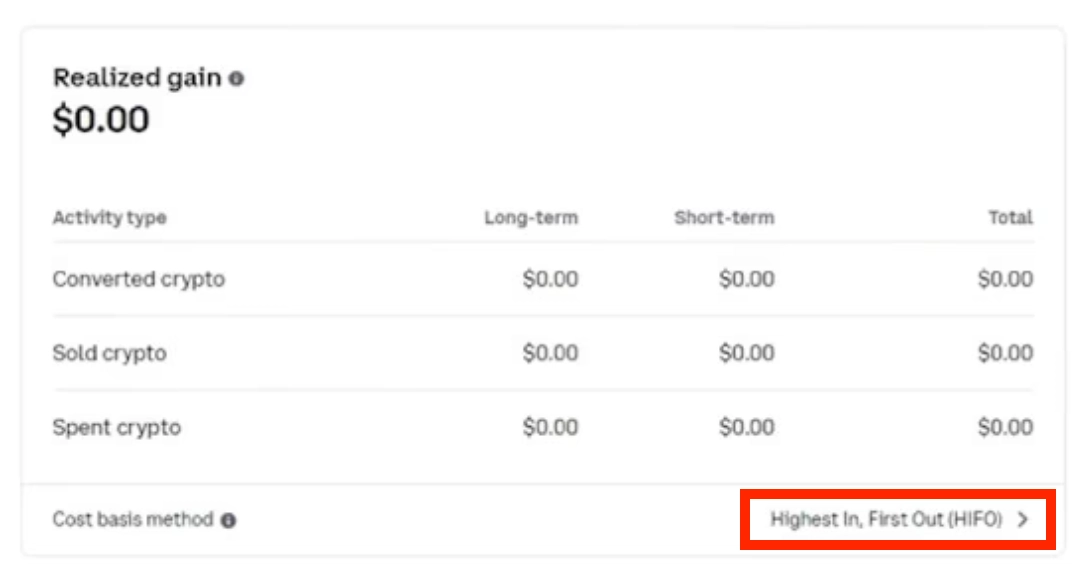
1. Choose your cost basis method before you start trading. In your cost basis settings, you can pick FIFO (First-In, First-Out), LIFO (Last-In, First-Out), or HIFO (Highest-In, First-Out). If you don’t choose, brokers have to use FIFO, and any change only affects sales made after you switch.
2. Check your name, Social Security number, and state. Coinbase will only correct a 1099-DA for those details or if you move to a new state. It won’t reissue one for any other address change.
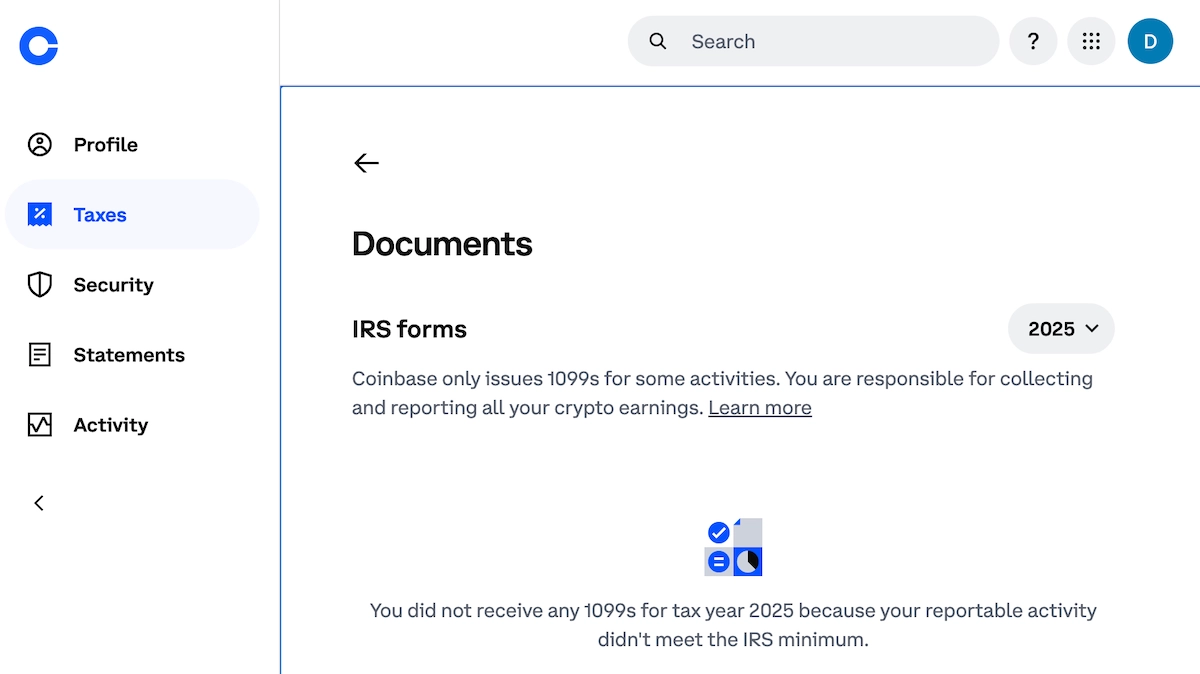
3. Download your forms from the Documents section. If you have both, your 1099-DA and Consolidated 1099 are separate files.
4. Generate the gain/loss report under ‘Custom Reports’ on the same page. Coinbase calculates gains for trades it records, so transfers will create gaps.
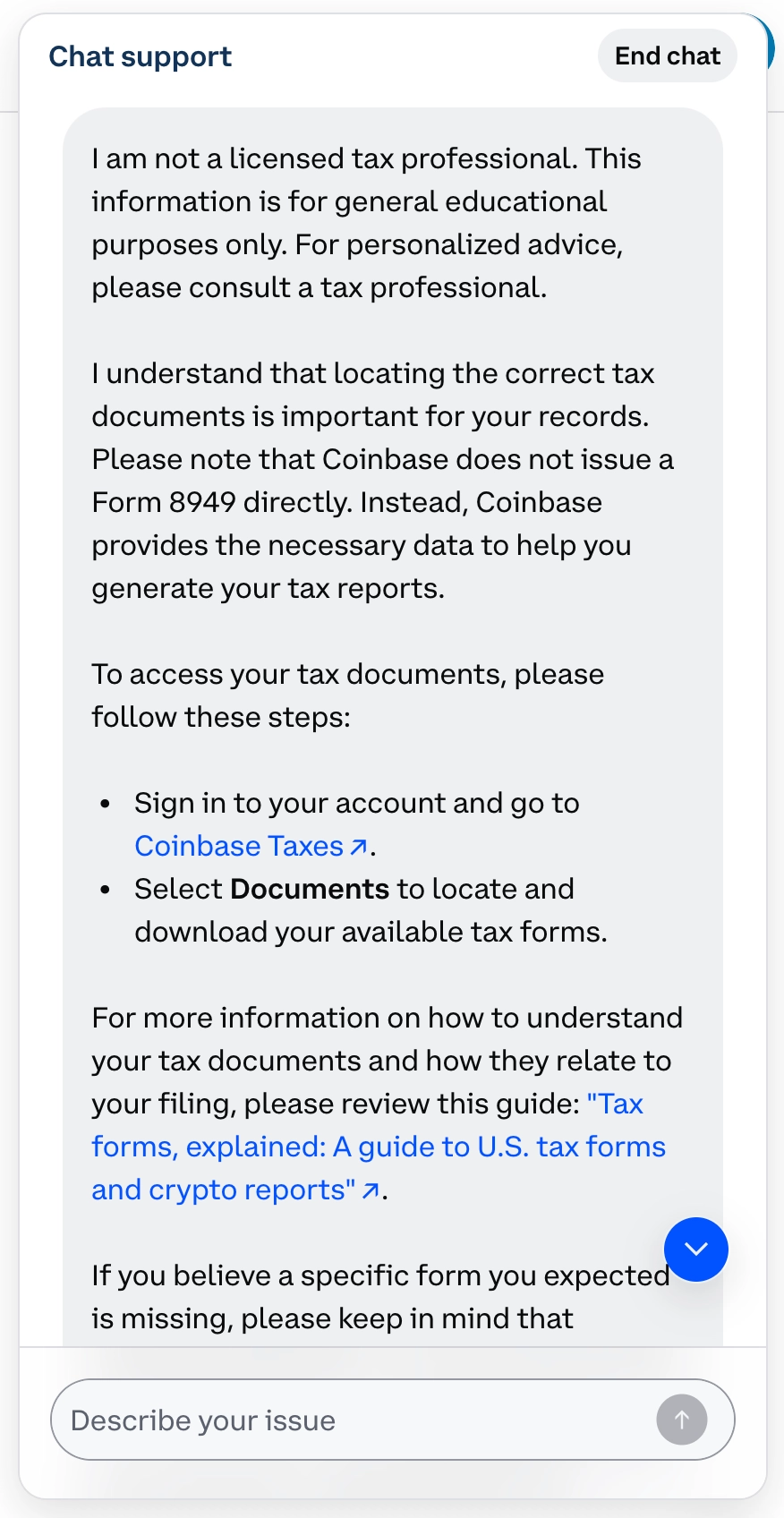
5. Fill in the noncovered lines yourself. For each 1099-DA line marked noncovered, enter your actual cost from your own records on Form 8949.
Bottom Line
Coinbase reports to the IRS, but it still only sends a partial picture: your sales, rewards above the threshold, and the cost of coins you bought on Coinbase after 2025 and kept there.
The rest is on you. I’d treat the 1099-DA as the IRS’s copy of your crypto sales, not your tax bill. Keep your own purchase records for anything you bought before 2026 or moved in from another wallet or exchange, because that’s the one number Coinbase won’t send, and it decides how much of each sale is taxable profit.
For more insights into the Coinbase trading experience, fees, products and more, see our detailed Coinbase review.
FAQ
Does Coinbase Report Small Crypto Trades?
Yes. Regular crypto sales have no minimum, and Coinbase says your 1099-DA will include small trades. The IRS only exempts small sales in three cases: stablecoin sales for cash or other stablecoins up to $10,000 a year, NFT sales up to $600, and some crypto payment-processor sales.
The first two exemptions only apply if the broker uses the IRS’s optional method.
Does Coinbase Send A 1099 If You Only Bought Crypto?
Not a 1099-DA. Buying crypto with dollars isn’t a sale, and Coinbase’s 1099-DA only covers cash-outs, coin-to-coin swaps, and other trades where you get something in return for your crypto. You can still get a 1099-MISC if you earned enough from staking or rewards.
Does Coinbase Report To The IRS If You Lost Money?
Yes. The 1099-DA shows what you sold for, whether you made a profit or not. If you leave a losing trade off your return, the IRS still has the sale on file, and for noncovered coins, there’s no cost to offset it, which can look like a gain.
Coinbase also says the wash sale rule doesn’t apply to crypto, so selling at a loss and buying right back doesn’t cancel the loss under current rules.
Does Swapping Crypto For USDC Count As A Sale?
Yes. Coinbase treats every crypto-to-crypto exchange as a sale, and USDC counts as crypto. Moving into USDC to lock in a gain is a taxable sale of the coin you gave up.
Does Coinbase Withhold Tax From Your Crypto Sales?
Usually not. Backup withholding mostly applies if a broker doesn’t have your correct taxpayer ID, and the IRS has excused brokers from it on crypto sales made in 2025 and 2026.
From 2027, brokers can skip it for customers whose name and taxpayer ID match IRS records, so keep those details accurate in your account.