

Exness vs Fusion Markets
Which broker is superior: Exness or Fusion Markets? Read our comparison of the two brokers to help you choose the right one for your trading needs.
Exness and Fusion Markets were both tested in a live account by the BrokerListings team. We spent 50+ hours reviewing Exness and Fusion Markets and comparing them.
 Written By
James Barra
James is an experienced broker analyst with a background in financial services. He has spent 2,500+ hours testing brokers, used 35+ different platforms and apps, audited 120+ broker T&Cs, and verified 300+ regulatory licenses. James has also been on US and UK TV, and been a guest on finance podcasts, discussing reports conducted by BrokerListings.com and sharing his expertise.
James Barra Profile Page Fact Checked By
William Berg
William Berg combines his expertise in law and finance to analyze trading brokers. He has checked 3,250+ regulatory licenses, investigated 2,365+ broker clones and trading scams, and placed 3,500+ trades.
William Berg Profile Page Edited By
Tobias Robinson
Tobias is committed to helping traders find the right brokerage for their needs. He has tested 200+ brokers, spent 2,600+ hours using different platforms, and placed 2,100+ trades.
Tobias Robinson Profile PageSeptember 7, 2026
Quick Verdict
Neither Exness nor Fusion Markets accepts traders from USA. Instead, we recommend FOREX.com, a top-rated alternative that impressed our team during testing and accepts traders from your location.


Fusion Markets is the stronger choice for active forex traders. Its low-commission ZERO account, fast execution setup, and choice of MT4, MT5, cTrader, and TradingView give it a clear edge for advanced trading.
Exness is more flexible for account choice and everyday funding. It offers more live account types, over 40 base currencies, fast payment processing, and a polished TradingView-powered terminal.
Both brokers focus on forex and CFDs, offer demo accounts, support automated trading, and charge no inactivity fee. Fusion Markets has stronger protection for Australian clients, while Exness stands out for its 24/7 multilingual support and easier mobile-first experience.
Regulation & Trust
Fusion Markets has the stronger trust profile, especially for Australian clients. Its ASIC-regulated Australian entity offers negative balance protection, leverage limits, margin close-out rules, and access to Australia’s complaints framework. In our hands-on checks, we found that the legal entity shown during onboarding matters greatly because international users can be placed under Seychelles or Vanuatu entities with weaker safeguards.
Exness has operated since 2008, uses segregated client accounts, and provides negative balance protection. However, retail clients are not covered by its former FCA or CySEC permissions, and protection differs widely by region. We also found that both brokers require care around regional availability, as each has faced regulator warnings in certain countries.
A major protection upgrade at Fusion Markets is the rollout of negative balance protection for eligible retail accounts across its client base in 2026. Fusion’s ASIC licence, where available, gives it a clearer safety advantage, but traders should still check the website footer and account entity before depositing. During direct use of the signup flow, this was not a detail to overlook.
Accounts & Banking
Exness is better for account variety and quick payment handling. It has Standard, Standard Cent, Pro, Raw Spread, and Zero accounts, while Fusion Markets keeps things simple with Classic and ZERO accounts. In our live account checks, Exness gave more ways to match an account to a trader’s experience level and pricing needs.
Exness Standard and Standard Cent accounts can start from $10, while the Pro account requires $200. Fusion Markets has a major advantage for testing a live setup: its minimum deposit is $0. Both brokers provide free demo accounts, though Exness includes $10,000 in virtual funds that can be adjusted.
Exness supports cards, e-wallets, and crypto, with card deposits generally instant, Skrill and Neteller taking about 30 minutes, and Bitcoin or Tether deposits processed within roughly one hour. It also supports more than 40 base currencies, which can reduce conversion costs. The weak points we found were region-based payment limits, and a Standard Cent account limited to six base currencies.
Fusion supports cards, transfers, e-wallets, and local payment methods, but our funding tests highlighted more uncertainty on withdrawals. Intermediary bank deductions and payment-method mismatches can affect the final amount or route. Exness is the smoother option for traders who need many currencies and fast everyday payments, while Fusion’s $0 entry point is useful for a small live test.
Assets & Markets
Exness and Fusion Markets are fairly evenly matched for forex and CFD trading. Exness offers more than 100 currency pairs, plus crypto, commodities, indices, and stock CFDs. Fusion Markets provides more than 250 instruments and over 90 currency pairs, with metals, energies, soft commodities, indices, US stock CFDs, and crypto CFDs.
From our platform testing, Exness felt stronger for traders who want a very broad currency-pair list. Fusion felt more focused: its market range is built around forex, indices, and commodities rather than broad equity investing. Neither is a full investment broker for building a traditional long-term portfolio.
Exness has expanded its stock-CFD list with high-profile names such as SpaceX after its IPO, but its share selection remains limited. Both brokers lack direct share dealing, ETFs, options, bonds, and interest on idle cash. This is an important limitation we observed when moving beyond short-term CFD trading.
Fees & Costs
Fusion Markets is the better value for frequent forex traders. Its ZERO account charges $2.25 per side, or $4.50 for a full one-lot round trip, with spreads from 0.0 pips. Exness remains very competitive, particularly after its 2024 spread reductions, but its several account models take more time to compare.
Using quoted minimum EUR/USD pricing, a 1-lot trade on Fusion ZERO costs about $4.50 total: a 0.0-pip spread plus $2.25 to open and $2.25 to close. On Exness Raw Spread, the stated 0.0-pip spread plus $3.50 per lot per side gives an estimated $7.00 total under that quoted commission structure. Actual costs can be higher when spreads widen, and this simple example excludes swaps, slippage, and any payment-provider charge.
In direct trading use, Fusion’s two-account structure was easier to understand: Classic uses spreads from around 0.9 pips, while ZERO uses raw spreads plus commission. Exness Standard accounts offer spreads from 0.2 pips without commission, Pro starts from 0.10 pips, and Zero and Raw Spread accounts target near-zero spreads. The downside is that new traders can find Exness’s spread and commission choices confusing.
Both brokers charge no inactivity fee, which is valuable for traders who do not trade every month. Exness also waives most deposit and withdrawal fees, although e-wallet and crypto processors can charge small amounts. We found one small annoyance at Exness: inactive demo accounts can be deleted.
Trade Execution
Fusion Markets has the clearer edge for execution-focused trading. In our hands-on platform tests, its setup felt built for active users running frequent forex and CFD orders. Independent benchmarks place its market-order execution in the sub-100ms range, supporting scalping and short-term systems.
Exness also offers fast execution and high leverage up to 1:2000, depending on account and region. Its advanced accounts are well suited to active traders, but Fusion gives more detail and flexibility for traders choosing a low-latency platform environment. We would still test both brokers with small live positions during volatile markets, because fill quality can change when liquidity drops.
Fusion supports VPS use, Expert Advisors, and automated strategies across MT4, MT5, and cTrader. Exness provides free VPS hosting when clients meet requirements such as a $2,000 balance, or a $500 balance plus $1.5 million monthly trading volume. A key testing limitation was that neither setup gave enough independently audited slippage data to promise identical fills in every market condition.
Platforms & Tools
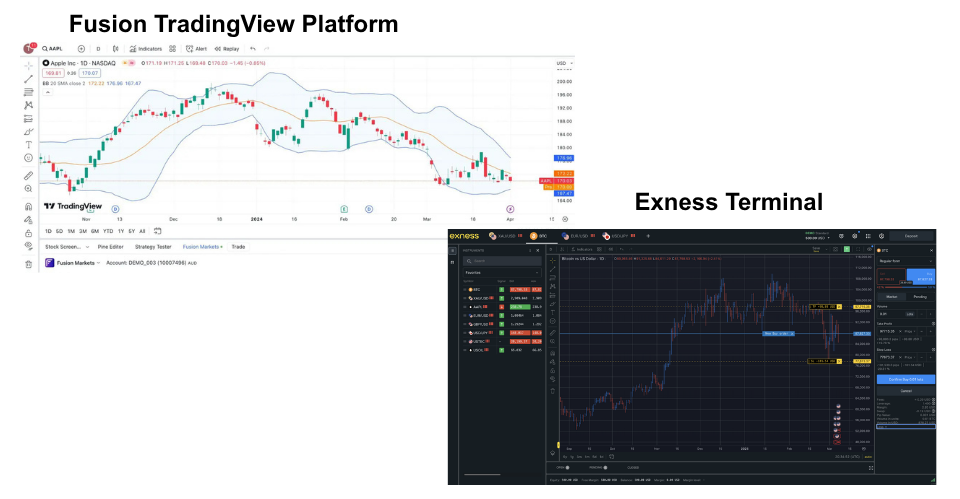
Fusion Markets offers the better platform range for experienced traders. It supports MT4, MT5, cTrader, and TradingView, so users can choose their preferred charts, automation tools, and trading workflow. After placing test trades across the available terminals, cTrader stood out as cleaner and more modern than MetaTrader for day-to-day use.
Exness offers MT4, MT5, and Exness Terminal. Its proprietary terminal is powered by TradingView and has a simple watchlist, clear account controls, and user-friendly charts. In our direct use of Exness Terminal, it was easier to learn than MT4 or MT5, though it lacks tools such as Renko charts.
Both brokers support MetaTrader automation, chart indicators, and mobile access. Fusion’s addition of TradingView connection and its Fusion+ copy-trading service broaden its offering, while DupliTrade gives MT4 users another copy-trading route. Exness’s platform weakness is that MT4 and MT5 feel dated, while Fusion’s weakness is the lack of a polished proprietary terminal for less experienced users.
Fusion is best for traders who already know whether they prefer cTrader, TradingView, or MetaTrader. Exness is better for traders who want an easier proprietary web platform alongside the MetaTrader suite. During our workflow tests, switching between Exness account settings was smooth, while Fusion gave more freedom once the preferred platform was connected.
Research
Exness provides the stronger research package. It includes FXStreet news, Trading Central signals, an economic calendar, a trading calculator, and a live currency converter. In our hands-on checks, the calculator was especially useful because it estimated margin, pip value, spread, and commission before placing an order.
Fusion Markets provides an economic calendar, market news, trading calculator, Analyst Views, Technical Insight, and Market Buzz. Market Buzz was helpful in direct use because it made market-moving stories faster to scan. However, the overall research library is lighter and works better as a trading prompt than a full research desk.
Exness still has gaps. Its economic calendar needs better filters, it has limited in-house analyst content, and Trading Central is not fully integrated into Exness Terminal. Fusion also lacks deep macro reports and frequent in-house video analysis, so self-directed traders may still use outside research sources.
Education
Fusion Markets and Exness are fairly evenly matched, but neither is ideal for a complete beginner education program. Exness offers market articles, strategy content, a helpful Help Center, and a practice account. Fusion provides explainers, blog content, and useful topic guides.
From our direct review of the learning areas, Exness explains basic terms and platform functions more clearly. Fusion’s material is useful but feels like a collection of articles rather than a course with a clear path. Both fall short because they do not provide a strong academy with structured lessons, regular webinars, and detailed beginner videos.
Exness’s demo account and easy terminal make practice simpler, while Fusion’s articles better suit traders who already understand spreads, leverage, and swaps. The education gap is one of the biggest user-experience issues at both brokers. New traders will likely need outside learning material before risking real money.
Customer Support
Fusion Markets and Exness are fairly matched for customer support. Across more than 10 live-chat and email queries over repeated tests, Fusion’ team was responsive, practical, and easy to reach. This makes Fusion a strong fit for traders who value direct help with platforms, account settings, and trading issues.
Exness has an excellent support schedule, with 24/7 assistance in 15 languages. In our live chat test, a withdrawal-fee question was answered within minutes, while a more detailed VPS query by email took a few hours and received a useful reply. That level of language coverage is a major benefit for global traders.
Exness does not offer phone support or dedicated account managers, which can make complex matters harder to resolve. Fusion’s support is more personal, but its opening hours and channel availability may not match Exness’s around-the-clock multilingual coverage in every region. Both were helpful in testing, but Fusion delivered the more complete service feel.
Is Exness or Fusion Markets Better For Beginners?
Exness is better for beginners. Its Standard Cent account supports micro-lot trading from $10, the Exness Terminal is easier to use than the usual MetaTrader layout, and the demo includes $10,000 in adjustable virtual funds. Its 24/7 support in 15 languages also gives new traders more help when they get stuck.
Fusion Markets has a compelling $0 minimum deposit and a free demo, which makes a small live test easy. However, its platform choice can feel overwhelming, its learning content is not structured, and the mobile setup is less guided. In our onboarding tests, Exness had more account choices to sort through, but its overall trading journey was easier for a first-time user.
Is Exness or Fusion Markets Better For Experienced Traders?
Fusion Markets is better for experienced traders. It combines low-cost ZERO pricing with MT4, MT5, cTrader, TradingView, VPS support, and tools suited to Expert Advisors and other automated systems. Its sub-100ms execution benchmarks also make it a more natural match for traders who care about speed and platform choice.
Exness remains a capable advanced option, especially for traders using MT4 or MT5 and those who meet its VPS criteria. It also offers leverage up to 1:2000 where permitted and has low-cost Raw Spread and Zero accounts. Still, Fusion’s cTrader and TradingView access gave us more control in hands-on use.
Is Exness or Fusion Markets Better For Short-term Traders?
Fusion Markets is better for short-term traders. Its ZERO account costs $2.25 per side, raw spreads can start at 0.0 pips, and the broker supports scalping, algorithmic trading, and VPS-based setups. Our trading tests showed a practical environment for active forex, metals, and index traders.
Exness is also highly competitive for short-term trading, with low spreads, fast withdrawals, and Raw Spread pricing from 0.0 pips plus a stated $3.50 per lot commission. Its high leverage can appeal to experienced traders, but it also raises risk sharply. Fusion’s simpler low-cost model and broader platform selection give it the edge for frequent trading.
Is Exness or Fusion Markets Better For Long-Term Traders?
Exness is the slightly better choice for long-term CFD traders, but neither broker is built for traditional investing. Exness has more than 100 currency pairs, a broader CFD range, more account types, and no inactivity fee. Its large choice of base currencies may also reduce conversion costs for traders holding positions over time.
Fusion Markets also charges no inactivity fee and offers indices, commodities, US stock CFDs, and forex. Yet both brokers lack direct shares, ETFs, bonds, interest on uninvested cash, and automated portfolio investing. For a buy-and-hold investor, these missing features matter more than small spread differences.
Is Exness or Fusion Markets Better For Trading On Mobile?
Exness is slightly better for trading on mobile. Its proprietary app and TradingView-powered Exness Terminal provide a clearer, more unified experience for checking prices, managing positions, and monitoring account details away from a desktop. The clean watchlist and simple account controls were noticeable strengths in our mobile workflow tests.
Fusion users can trade through the mobile versions of MT4, MT5, cTrader, and TradingView. These apps are capable, but Fusion does not offer a standout in-house mobile platform, so the experience depends more on the third-party app selected. Exness has made the better mobile-first product improvement for traders who use a phone as more than a backup screen.
Why Pick Exness Over Fusion Markets?
Pick Exness if you want more account types, low-entry Standard and Cent accounts, over 40 base currencies, and fast payment processing. It is also a strong choice if you value 24/7 multilingual support, a simple proprietary terminal, and a more polished mobile trading experience.
Exness is particularly useful for forex traders who want a wide list of currency pairs and flexible leverage settings. Its key drawbacks are weaker retail regulatory coverage in many regions, no bank wire transfers, limited long-term investment assets, and thin structured education.
Why Pick Fusion Markets Over Exness?
Pick Fusion Markets if your priority is low-cost active trading. The ZERO account’s $2.25-per-side commission, raw spreads, fast execution profile, and support for cTrader and TradingView make it a strong package for scalpers, day traders, and experienced forex users.
Fusion is also appealing for traders who want a $0 minimum deposit, simple account selection, and responsive support. Australian clients gain the strongest protection through its ASIC-regulated entity. Its main trade-offs are weaker safeguards under offshore entities, less complete education, narrower research depth, and no premium proprietary mobile app.
Compare Exness and Fusion Markets Details
|
Exness
|
Fusion Markets
|
|
|---|---|---|
Established in 2008, Exness is a respected broker known for offering over 40 account currencies, a wide choice of CFD instruments, and an intuitive web platform with features like currency converters and trading calculators. | Fusion Markets, an online broker since 2017, is regulated by the ASIC, VFSC and FSA. Known for its low-cost forex and CFD trading, it offers a variety of accounts and copy trading options for all types of traders. New traders can register and begin trading in three easy steps. | |
| Payment Methods | Airtel, Bitcoin Payments, JCB Card, M-Pesa, Mastercard, Neteller, Perfect Money, Skrill, Sticpay, Visa, WebMoney, Wire Transfer | AstroPay, Bitcoin Payments, Credit Card, Debit Card, Doku Wallet, Dragonpay, Ethereum Payments, FasaPay, JetonCash, Mastercard, Neteller, PayID, PayPal, Perfect Money, Skrill, Sticpay, TransferWise, Visa, Wire Transfer |
| Account Currencies | USD, EUR, GBP, CAD, AUD, NZD, INR, JPY, ZAR, MYR, IDR, CHF, HKD, SGD, AED, SAR, HUF, BRL, NGN, THB, VND, UAH, KWD, QAR, KRW, MXN, KES, CNY | USD, EUR, GBP, CAD, AUD, NZD, JPY, CHF, HKD, SGD |
| Trustpilot Score | ||
| App Review | Exness Trade provides a comprehensive mobile trading experience with quick execution, hundreds of tradable CFDs, and easy-to-use charts powered by TradingView. With over 10 million downloads, it is ideal for traders who want to manage accounts and seize market opportunities on the go. | Fusion Markets integrates smoothly with cTrader, MT4, MT5, and TradingView on Android and iOS. The MetaTrader app feels outdated, impacting user experience, despite its excellent charts, news stream, and alerts. The cTrader app performed better in tests, with a superior design and over 70 indicators and 26 timeframes, ideal for advanced traders. |
| Awards |
|
|
| Account Types | STP, ECN | ECN, MAM, PAMM |
| Robo Advisor | ✗ | ✗ |
| Market Maker | ✓ | ✗ |
| P2P Trading | ✗ | ✗ |
| Spot Trading | ✓ | ✓ |
| Copy Trading Platform | Exness offers copy trading through its dedicated service and MetaTrader signals, allowing hands-off traders to follow experienced traders’ positions. | The broker's native trading platform, Fusion+, provides easy access to skilled traders at low costs and with a simple follower process. Additionally, DupliTrade, an independent tool, links novice investors and experienced traders, offering a variety of automated options to suit different tastes. |
| Tournaments | ✗ | ✗ |
| Demo Competitions | ✗ | ✗ |
| Ethical Investing | ✗ | ✗ |
| Custodial Account | ✗ | ✗ |
| Islamic Account | ✓ | ✓ |
CFD Trading | ||
Exness offers CFDs on forex, stocks, indices, commodities, and cryptocurrencies with leverage for experienced traders, featuring over 100 technical indicators in its proprietary terminal. | You can trade a variety of CFDs including forex, commodities, stocks, indices, and cryptocurrencies. Leverage up to 1:500 is accessible for experienced traders in certain regions, while newcomers can use micro-lots. There are no limits on short-term CFD trading strategies. | |
| Leverage | 1:Unlimited (via offshore entities) | 1:500 (Exceeds ESMA limits; high risk)(Exceeds CIRO limits; high risk) |
| FTSE Spread | 15.2 | 1.0 |
| GBPUSD Spread | 0.0 | 0.13 |
| Oil Spread | 0.20 | 2.0 |
| Stocks Spread | 0.5 (Apple Inc.) | 0.01 |
Forex Trading | ||
Exness provides about 100 forex pairs, more than many brokers we reviewed, with competitive spreads on major pairs starting at 0.1 pips. Traders also have access to strong forex analysis tools, including market news from FXStreet. | Fusion Markets provides a wide array of over 90 currency pairs, offering numerous trading opportunities. The company stands out for its ultra-narrow spreads, starting as low as 0.0 pips, along with very low commissions of $2.25 per side. The platform also offers access to the premier forex software, MetaTrader 4. | |
| Assets | 100+ | 90+ |
| Currency Indices | USD | |
Cryptocurrency Trading | ||
Exness offers popular crypto-fiat pairs with zero swap fees and no commissions on Standard accounts, available on desktop and mobile apps. Crypto deposits are available in some regions, and reduced Bitcoin spreads increase its appeal for traders. | Fusion Markets provides well-recognized cryptocurrency tokens paired with USD and allows up to 1:10 leverage based on your location. Bitcoin spreads begin at a competitive rate of 0.04%. The platform also stands out for its high-quality charting tools in MT4, MT5, cTrader, and TradingView. | |
| Crypto Spread | Floating | From 0.04% |
| Crypto Coins | BTC, ETH, SOL, XRP, ADA, DOT, AVAX, LINK, MATIC, UNI, LTC, BCH, DOGE, XTZ, AAVE, BNB | BTC, BCH, ADA, ETH, LTC, EOS, XLM, DOT, LNK, AVAX, SOL, MATIC, DOGE, BNB |
| Crypto Lending | ✗ | ✗ |
| Crypto Mining | ✗ | ✗ |
| Crypto Staking | ✗ | ✗ |
| Auto Market Maker | ✗ | ✗ |
 Interactive Brokers
  NinjaTrader
  eToro USA