

Pivex Review: High-Risk Prop Firm Alert
Pivex (pivex.com), or “Pivex Funded,” is an unregulated prop trading firm. It sells one-off “challenges”: meet a 10% profit target, and you get a “funded” account that keeps up to 90% of your results. But the model doesn’t work in your favor.
 Written By
Christian Harris
Christian is a seasoned analyst, leveraging his expertise in stocks, forex, and crypto to evaluate brokers worldwide. With hands-on trading experience and a strong focus on risk management, he helps traders find reliable platforms. Christian's work for BrokerListings.com has been cited in the Financial Times.
Christian Harris Profile Page Fact Checked By
Tobias Robinson
Tobias is committed to helping traders find the right brokerage for their needs. He has tested 200+ brokers, spent 2,600+ hours using different platforms, and placed 2,100+ trades.
Tobias Robinson Profile Page Edited By
James Barra
James is an experienced broker analyst with a background in financial services. He has spent 2,500+ hours testing brokers, used 35+ different platforms and apps, audited 120+ broker T&Cs, and verified 300+ regulatory licenses. James has also been on US and UK TV, and been a guest on finance podcasts, discussing reports conducted by BrokerListings.com and sharing his expertise.
James Barra Profile PageSeptember 3, 2026
Quick Verdict
Professional Opinion
I’m not saying Pivex is a downright scam. There are no regulatory warnings and some users say they’ve been paid. But that doesn’t make it safe in my opinion. The business operates in a legal grey area, the owners are unnamed, the brand is fairly new, and its “Most Reliable Prop Firm 2025” award came from an affiliate review site, not an independent group.
Its advertising also leans on “AI” buzz and courts beginner traders, who I believe have a higher chance of failing the evaluation phase and losing their entry fee.
Pivex Safety Assessment
« Make Full Width »| Safety Metric | Status | What To Do |
|---|---|---|
| Regulatory oversight | None. Sells “simulated” and “educational” products to sit outside broker rules. Not on the CySEC, FCA, CFTC, NFA registers, and not required to be | Don’t assume any authority is watching your money. There’s no compensation scheme behind a challenge fee |
| Corporate transparency | Operator named as a Cyprus firm (VITIORIA LIMITED), but no founder or CEO is named and the domain uses a privacy proxy | Know that a Cyprus registration is not a financial licence, and no person is publicly accountable |
| Product risk | You pay upfront to attempt a target most buyers miss. Tight 4% daily / 6% overall drawdown against a 10% target is hard to clear | Treat the fee as money you might not see again, not an investment |
| Fund protection | Payouts come from the firm’s own revenue, not real market profits. If cash flow dries up, “rewards” can stall | Withdraw early and often. Don’t let a balance build up on the platform |
| Advertising | Social content and Academy catering to “complete beginners” | Securing funding for a beginner trader is not realistic and could well see them lose evaluation fees. The site also has a gamified feel with discount pop-ups and banners with users receiving rewards |
| Track record | Brand only launched in 2025. A self-described industry “award” is marketing, not oversight | Weigh the short history heavily. New firms sometimes fail or vanish |
| Overall risk | Greylisted – higher-risk than longer-established alternatives | Understand the model fully before paying |
What Is Pivex?
First, clear up a common mix-up. Pivex is not a crypto exchange, and it has nothing to do with PIVX, the decentralized, privacy-focused Proof-of-Stake (PoS) cryptocurrency launched in early 2016. You can’t deposit savings and buy tokens here.
Pivex is a proprietary trading firm, or “prop firm.” The business works like this: you pay a one-time fee for a “challenge” on a simulated account. If you hit a profit target while staying inside the risk rules, you move to a “funded” account — which is also simulated — and you can request payouts based on the performance you produce there. Pivex calls those payouts “rewards,” and that word choice matters, as I’ll explain below.
The main point is that no real money is put into live markets for you. The platform copies live prices, but your trades don’t go to an exchange or liquidity provider. When Pivex pays a successful trader, the funds come from the company itself, primarily from challenge fees paid by other users. This setup is legal in most places, but it affects all the risks involved.
Regulation & Licensing
Prop firms like Pivex are mostly outside financial regulation, and that’s intentional. Because Pivex doesn’t hold client deposits and describes its accounts as “simulated” and “for educational and evaluation purposes,” it argues it isn’t running a brokerage, a fund, or an advisory service.
That framing is exactly what keeps firms like this off the registers of bodies such as Cyprus’ CySEC, the UK’s FCA, and the US’ NFA. Pivex isn’t authorized by any of them — and under the current setup, it doesn’t have to be.
This has two sides. Pivex isn’t breaking any rules by operating without regulation. But if your payout is delayed, your account is closed for a technical reason, or the company stops trading, there’s no regulator to help you and no compensation scheme. You’re depending only on the company’s honesty and financial health.
Regulators have started circling this whole sector. The “it’s only simulated” defense is now necessary but no longer enough, with the FCA, CFTC, ASIC, and EU authorities all signaling that a fee-for-evaluation, profit-share model can fall inside their remit depending on how it’s run.
The use of the word “rewards” is intentional. Companies like this avoid terms like “profits” or “salary” because those raise questions about employment law, securities rules, and taxes. Calling a payout a “reward” for a “challenge” makes it sound more like a game or a course. This is on purpose, and you should keep that in mind.
Excluded Jurisdictions
Pivex does not allow traders from the US, Russia, Iran, Myanmar, and North Korea, and at the time of writing, the UAE and Poland are also not supported. Some of these bans are due to standard sanctions. The US ban stands out because the CFTC has taken major action against prop firms, so many offshore companies block US residents to avoid trouble.
The Challenge Model, Fees & Trading Conditions
To Pivex’s credit, the rules are clear, and the leverage is reasonable. The evaluation has just one phase, not a long multi-step process, and these are the main conditions:
- Profit target: 10% on the chosen account size
- Daily drawdown: capped at 4%
- Overall drawdown: capped at 6%
- Minimum activity: 5 trading days
- Leverage: up to 1:30
- Rewards: earn up to 90% of trading performance
- Payout schedule: every 14 days
- Scale: Hit 15% profit, scale by 30% each quarter, and grow your account to $1,000,000
- Platform: Third-party Match-Trader
The 1:30 leverage limit is much more reasonable than the 1:100 or higher seen on some offshore prop firm platforms. But the key ratio is a 10% profit target with only a 6% total drawdown allowed. This is a tough challenge by design. The harder it is, the more people fail, and every failure means more revenue for Pivex.
Here’s where you need to read carefully, because Pivex sells its challenges two different ways, and the fees below are the ones shown to a UK visitor in GBP (the site displays your local currency).
The first is Classic: a single, one-time fee for one challenge account, advertised as fully refundable.
« Make Full Width »| Account Size (simulated) | One-Time Fee | Refund |
|---|---|---|
| $10,000 | £199.99 | 100% |
| $25,000 | £399.99 | 100% |
| $50,000 | £599.99 | 100% |
| $100,000 | £1,099.99 | 100% |
The second is Membership, which Pivex flags as “RECOMMENDED.” It’s a monthly subscription that bills you again every 30 days and hands you a fresh account attempt each month:
« Make Full Width »| Account Size (simulated) | Monthly Fee |
|---|---|
| $10,000 | £49.99 / month |
| $25,000 | £99.99 / month |
| $50,000 | £199.99 / month |
| $100,000 | £299.99 / month |
That distinction matters more than it looks. The cheaper monthly headline number is the one the site pushes hardest, but it’s a recurring charge that keeps taking money for as long as you keep failing — and failing is the likely outcome for many retail investors against a 10% target with a 6% total loss cap. The one-time “Classic” fee is higher upfront, but that’s it. Steering newcomers toward the subscription is the more profitable choice for Pivex, not for the trader.
Pass either way, and the profit split is 80%, or 90% with paid upgrades. Payouts are processed on a 14-day schedule, with a $50 minimum, and payments are made via bank transfer or crypto. On the Classic plan, Pivex advertises a 100% refund of the fee — its stated condition is clearing three successful payouts, which a large share of buyers probably never reach.
One more thing worth reading twice. Each pricing card shows an eye-catching “Average Payout” or “Average Profit” figure — up to $6,942 on the top membership tier. The small print underneath admits these averages are based only on “profitable traders in virtual Pivex accounts.” In other words, the figure ignores everyone who lost their fee, and the accounts are virtual. It’s a best-case number dressed up as a typical one.
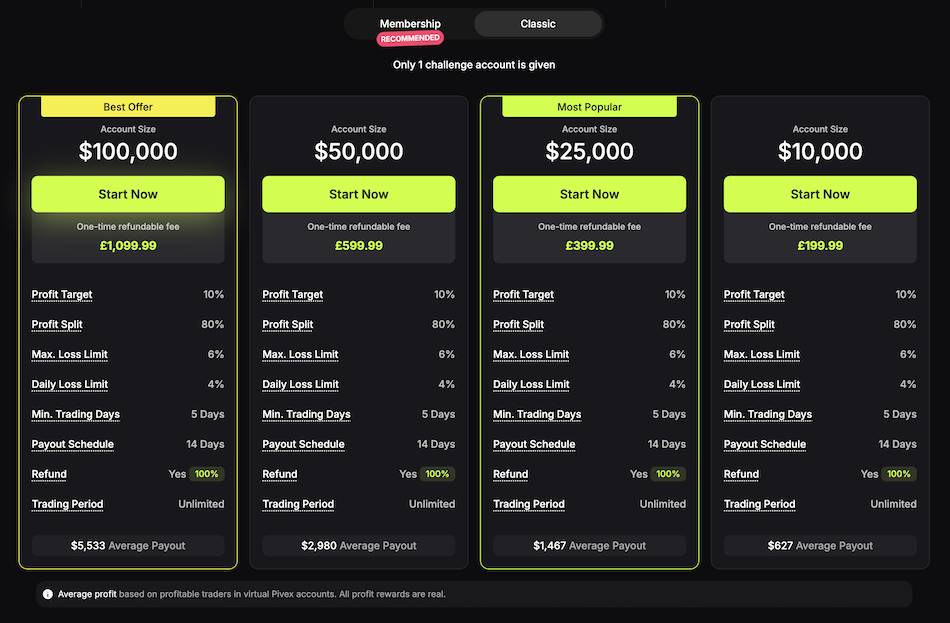
Membership tiers
Who’s Behind Pivex?
For a company asking people around the world for money, Pivex shares very little about who is in charge. There’s no named founder, no CEO with a public profile, and no real leadership page. The website is registered through a privacy service that started in 2025 hides the owner, and the brand only started in 2025.
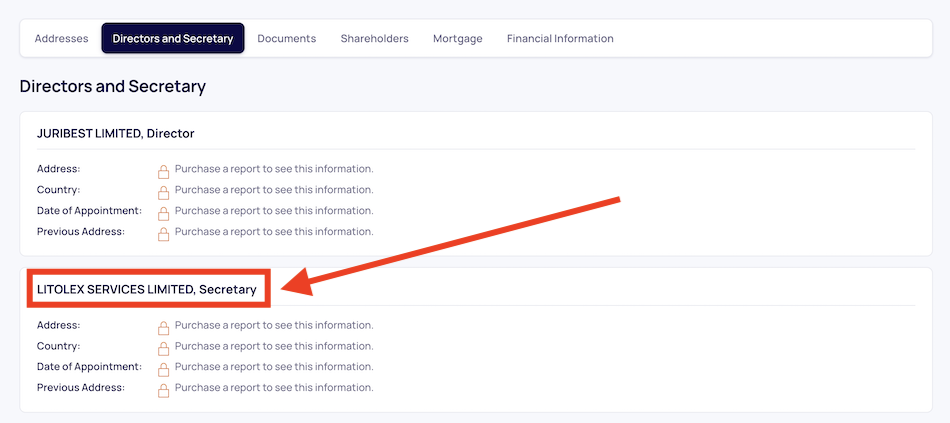
The only company you can identify is listed in the site’s footer: Pivex says it is operated by VITIORIA LIMITED, registered in Limassol, Cyprus, under number HE 477841. This matches the Cyprus companies registry, but look closely before feeling reassured.
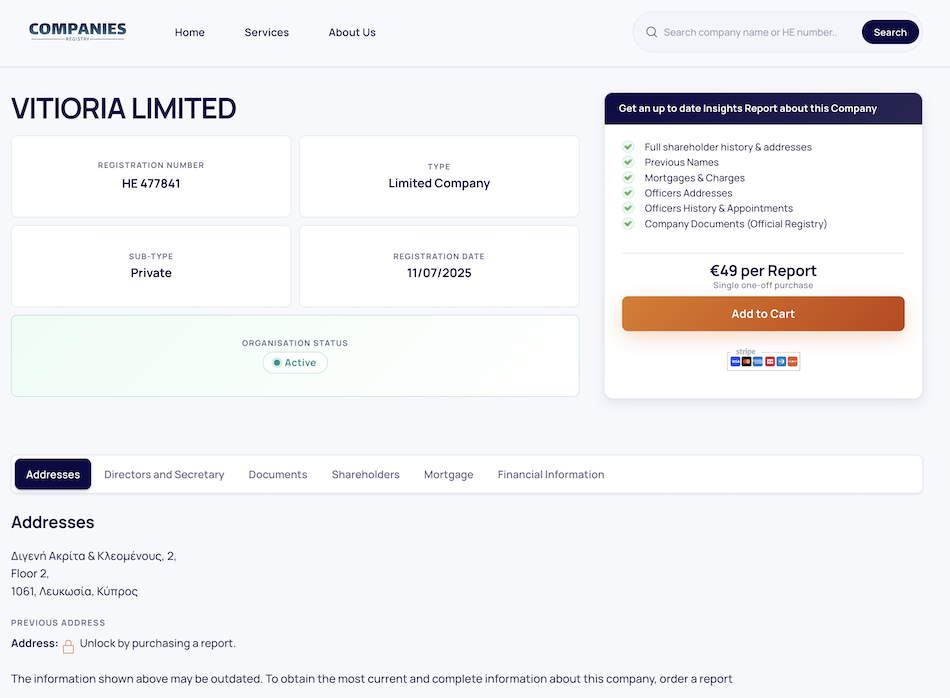
Cyprus company registration
Cyprus is in the EU, so registration there sounds respectable, but a basic company registration is not a financial license. Pivex is not authorized by CySEC or any other regulator; it’s just a company on paper. The registry also lists a corporate secretarial firm as the company secretary, which is a setup that keeps the real owners hidden. So you get a company name and address, but still no person who is responsible if something goes wrong.
Being anonymous doesn’t automatically mean bad intentions. Many small tech companies keep a low profile. But in an industry where even big names have suddenly shut down without warning, having an unknown operator behind a less well-established brand is a risk you shouldn’t ignore.
Brand & Domain Integrity
Pivex uses some trust signals that don’t stand up to closer inspection.
The main example is the “Most Reliable Prop Firm 2025” award. If you look into it, the award comes from a prop-firm review site that also runs affiliate and discount-code deals in the same industry. This is marketing, not an audit, not a regulator, and not an independent panel. Keep that in mind.

Industry award
Oddly, when we asked Pivex’s support team about the origins of the award, we got the strange response below, which we suspect is AI-generated, but suggests they don’t have clear details in their records about the chief award they promote on their website and materials.
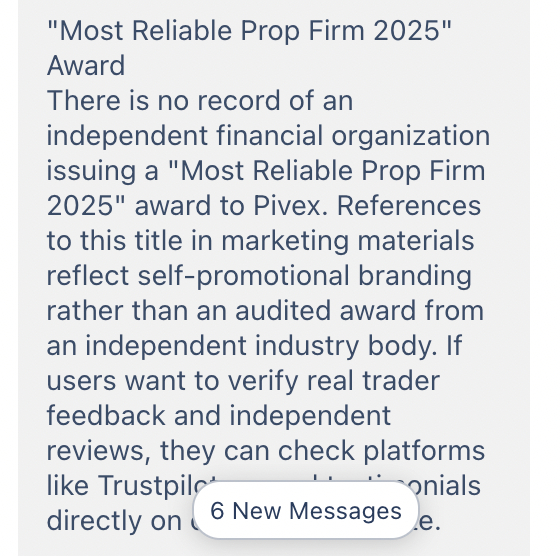
Pivex live chat response
The domain history is a trap for automated tools, and it caught one. Run pivex.com through ScamAdviser, and it comes back “Very Likely Safe” with a top-tier score — the kind of green badge a firm loves to point to. Read why, though, and the verdict falls apart.
The tool rewards the domain for being old: pivex.com was first registered back in 2003, more than 20 years before Pivex Funded existed. The prop firm launched in 2025 and is operating on a decades-old domain it took over, not one it built any reputation on.
ScamAdviser flags exactly this risk itself — noting that scammers sometimes buy up aged domains — and still lists the hidden WHOIS owner, a registrar “popular amongst scammers,” and “high-risk financial services” among its own negative highlights. A “safe” score resting on a 2003 registration date tells you nothing about a 2025 operation.
That’s the wider lesson with these automated ratings: they’re weak signals in both directions. A high score here is not a clean bill of health, just as a low one wouldn’t be proof of fraud. Judge Pivex on the substance — the model, the ownership, the record — not a badge a bot handed out for a registration date.
None of this proves wrongdoing. A repurposed domain, a privacy proxy, and a self-styled award are each common and, on their own, forgivable. Stacked together on a platform that wants your card details, they’re a pattern worth respecting.
Questionable Advertising
I first came across Pivex after seeing its advertising online. So I watched all of its videos and content on YouTube, TikTok, X, Instagram, and Facebook. What I found was some content that was concerning.
For example, there’s lots of content that trivialises the seriousness of online trading with memes and jokes. Then there’s also content that makes subtle and sometimes overt suggestions that users may make a significant amount of money, as you can see below. The trusted brokers with funded trading accounts BrokerListings have evaluated do not generally post such adverts and content on social media.

TikTok content
But the greater concern for me is that some of the posts give the impression that Pivex is geared towards newer retail investors. For example, the below pushes their Academy, which given that there were just 4 modules and 18 lessons, with a total run time of 1 hour and 30 minutes at my latest checks, I doubt will be enough to get a beginner to the level that they can qualify for funded accounts and consistently make money.
In my opinion, funded trading accounts like Pivex’s offers are not suitable for anyone less than a very experienced retail trader with a proven edge and excellent risk management. Pursuing such programs as an inexperienced trader could see them lose evaluation fee after evaluation fee, and that’s my concern with Pivex, which even says in its YouTube profile description “where you’re just starting out…” and “Trading is for everyone” on its X bio.
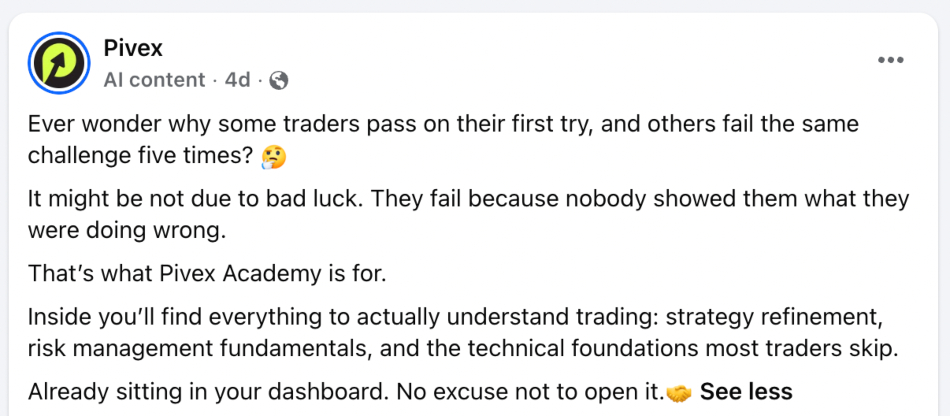
Social post
How Pivex Compares To A Longer-Established Prop Firm
If you compare Pivex to a prop firm with a longer history and clearer ownership, the differences become obvious.
« Make Full Width »| Feature | Pivex | Longer-Established Prop Firm |
|---|---|---|
| Regulator | None; unregulated by design | Also usually unregulated, but some pursue registration or clearer disclosure |
| Track record | Launched 2025 | Multiple years, thousands of documented payouts |
| Tools | Promotes “AI assistant” to capitalize on interest in AI | Focuses on value-add features rather than buzzwords |
| Ownership | No named leadership; privacy-proxy domain | Usually a named founder and a stated legal entity |
| Payout funding | From firm revenue, mostly challenge fees | Same model, but longer proof it keeps paying |
| Recourse if unpaid | None; no regulator, no scheme | Also limited, but stronger public reputation as pressure |
| “Awards” | Self-selected industry marketing | Same caution applies — verify the source |
Pivex doesn’t offer anything you can’t get from a more established broker with funded trading accounts, and the prop trading model is risky everywhere. What Pivex adds is a short track record and hidden ownership. That’s not a good deal in my view.
User Reviews & Reputation
Pivex’s reputation is mixed, so here are both sides.
On Trustpilot, Pivex has a respectable 4+ out of 5 rating from 1,145+ reviews, with many positive comments about fast payouts and helpful support. Some of these reviews are probably genuine. However, it’s common in this industry for firms to ask traders for reviews right after a win or payout, which can raise the average and hides the experiences of those who lost money and left quietly.
The negative reviews cluster into familiar themes:
« Make Full Width »| Theme | What Users Describe |
|---|---|
| Non-refundable fees | Charges treated as final even when a purchase was a mistake or a payment was still pending |
| Hard-to-clear rules | The 10% target against tight drawdown limits described as designed to fail |
| Account closures | Accounts shut after a rule breach with little room for appeal |
| “Simulated” confusion | Buyers not fully grasping that no real trades are placed until it’s too late |
One example of a complaint is from a buyer who was charged over $400 twice, was refused a refund on a payment that hadn’t cleared, and then had their account closed after a losing day. On the other hand, some users say they passed, withdrew, and were paid on time. Both experiences can be true at the same time, which is why it’s smart to read the one-star reviews before you pay, not after.
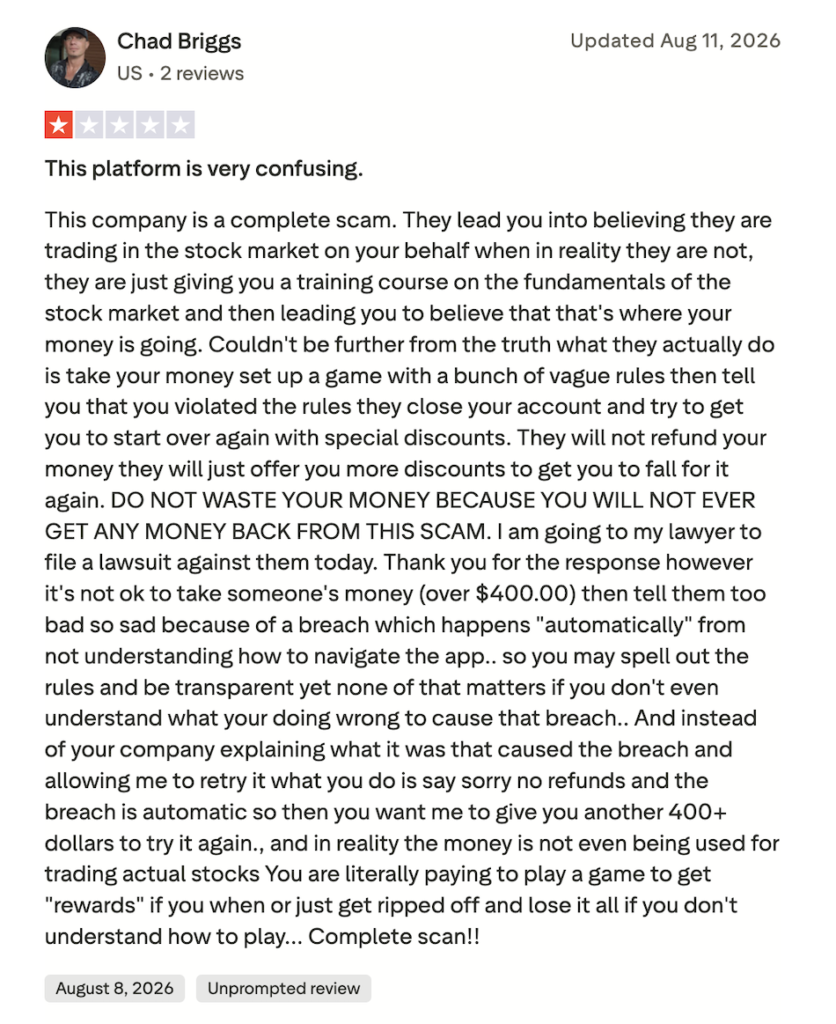
1-star Trustpilot review
One more warning: be careful with review sites, whether they are very positive or very negative. Some praise Pivex because they get affiliate commissions, while others call it a “scam” and try to send you to a competitor they’re paid to promote. Always check claims against original sources instead of trusting any review at face value.
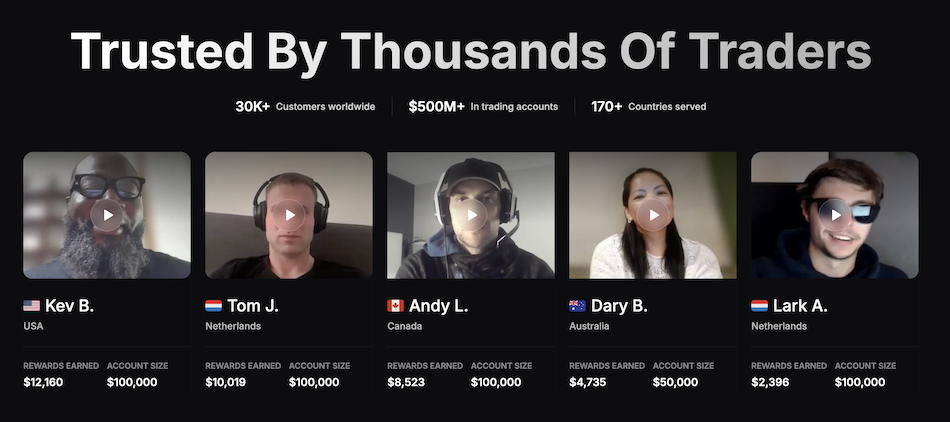
Be wary of reviews featured on the website as these have been carefully selected for visitors
Pivex Review Verdict
Pivex is not just another fly-by-night clone site. The rules are clear, the leverage is reasonable, there are no regulator warnings, and some traders have been paid. It’s only fair to mention these points.
But there are plenty of reasons to keep your money elsewhere. The whole business is unregulated, so there’s no safety net if something goes wrong. Payouts come from the company’s own revenue, which likely only lasts as long as new buyers keep joining. No one’s name is linked to the business, the brand is fairly young, and its main award is ‘self-given’. What you’re really buying is a tough test, set up so most people lose their fee.
Altogether, this makes Pivex high-risk — not criminal, but not safe either. If you decide to try it, treat the challenge fee as money you might lose, withdraw your balance early, and don’t let profits build up on the platform. I’d suggest inexperienced retail investors especially steer clear of it.
If You’ve Already Paid
If you’ve already bought a Pivex challenge or reached the funded stage and now have concerns:
- Keep records: Take screenshots of your dashboard, trade history, payout requests, and all support messages before anything changes.
- Withdraw early and often: Don’t let your balance grow. Request payouts as soon as you can and keep copies with timestamps. Never pay an extra fee, tax, or deposit to unlock your own payout. That’s a scam pattern, full stop.
- Be alert for recovery scams: Anyone who promises to get your fee back for an upfront payment is often another scammer looking for victims.
- Check who contacts you: Always verify the credentials of anyone claiming to be from Pivex, a regulator, or law enforcement.
- Be realistic: Without a home regulator, it’s very hard to recover money from an unregulated, anonymous company. Act quickly.
FAQ
Is Pivex Legit?
Pivex is a real prop firm, not a fake clone site or outright online trading scam, and some users say they’ve been paid. But calling it trustworthy is more complicated. It’s unregulated on purpose, has no named leaders, is young, and its main award is self-given. Treat it as high-risk, not clearly safe.
Is Pivex Available In The US?
No. Pivex does not allow residents from the US. The US ban is due to strict regulations on prop firms there, and it’s a reason to be cautious, not reassured.
Is Pivex Safe?
We consider Pivex high-risk. There’s no proven fraud, and the leverage is lower than many competitors. But there’s no regulator in charge, no compensation scheme, payouts come from the company’s own revenue, and the track record is short and anonymous. If keeping your money safe is your main goal, this isn’t a good place for it.
Notes:
- We’re not calling Pivex a confirmed scam. We’re just pointing out specific concerns that, in our view, make it higher-risk rather than clearly safe. Use the sources above to make your own decision.
- The prop-firm model is unregulated in most countries. The risks described here apply to the whole sector, not just to Pivex.
- Fees, rules, profit splits, and supported countries change often in this industry. Always check Pivex’s own website for the latest terms before you act.
- All content here is for information only and isn’t financial advice. Trading carries a significant risk of loss.
- We have put some of our chief concerns to Pivex. Should they reply, we will update this review with corrections or clarifications where appropriate.