

Fomo App Review 2026: Is It Legit Or A Scam?
Fomo is an app that offers trading on memecoins. Given its high-risk products and limited record, we felt it warranted inspection by our scam experts. To understand whether fomo is safe or a scam, we looked into the corporate record, funding history, Trustpilot and app store reviews, US and international regulations, and the app’s help documentation. We also signed up, funded a fomo account, executed over 20 trades, withdrew funds, and sent questions to support.
 Written By
Christian Harris
Christian is a seasoned analyst, leveraging his expertise in stocks, forex, and crypto to evaluate brokers worldwide. With hands-on trading experience and a strong focus on risk management, he helps traders find reliable platforms. Christian's work for BrokerListings.com has been cited in the Financial Times.
Christian Harris Profile Page Fact Checked By
Tobias Robinson
Tobias is committed to helping traders find the right brokerage for their needs. He has tested 200+ brokers, spent 2,600+ hours using different platforms, and placed 2,100+ trades.
Tobias Robinson Profile Page Edited By
James Barra
James is an experienced broker analyst with a background in financial services. He has spent 2,500+ hours testing brokers, used 35+ different platforms and apps, audited 120+ broker T&Cs, and verified 300+ regulatory licenses. James has also been on US and UK TV, and been a guest on finance podcasts, discussing reports conducted by BrokerListings.com and sharing his expertise.
James Barra Profile PageSeptember 3, 2026
Here’s a snapshot of the key safety questions we asked as part of our investigation:
« Make Full Width »| Question we asked | What we found | Our opinion |
|---|---|---|
| Is there a real company behind it? | FOMO Labs Inc., a registered US entity, with named founders | Verified |
| Is it funded, or a shell? | About $19M raised, including a $17M Series A led by Benchmark | Strong signal |
| Are the founders public? | Paul Erlanger and Se Yong Park, ex-Uniswap/OpenSea team | Named and traceable |
| Is it regulated like a broker? | No — it’s a self-custodial crypto app, not a licensed broker or exchange | Know what that means |
| Do users get their money out easily? | Deposits are smooth; several report withdrawal/verification friction | Real complaints |
| Can you fund with a credit/debit card? | Not yet — the platform lists card funding as “coming soon”; crypto for now | Fewer ways in |
| Does it actually copy trades for you? | No — it’s social trading only; you place every trade yourself | Marketing overstates this |
| Is support responsive? | Weak — public reviews and our own read point to generic, slow replies | Weak point |
| Any impersonation risk? | A typosquat clone (fomoo.family) existed; it appears to have been taken down | Stay alert to clones |
| Is the core product a scam? | No evidence of that | Not an outright scam |
What Is The Fomo App?
Fomo is a self-custody, ‘social-first’ crypto trading app. It lets you buy and sell memecoins, altcoins, and stablecoins across chains like Solana and Base from a single balance, without manually bridging assets or juggling gas fees, and it wraps a social feed, leaderboards, and follow-and-alert tools around that. It’s on both the Apple App Store and Google Play, with a desktop web version added in April 2026.
Onboarding is designed to be fast. We signed up in seconds with Google ID (Apple ID is also available), but there’s no email-and-password option. This makes things quick, but it also means your account is linked to a third-party login from the beginning, which matters if you prefer to keep accounts separate.
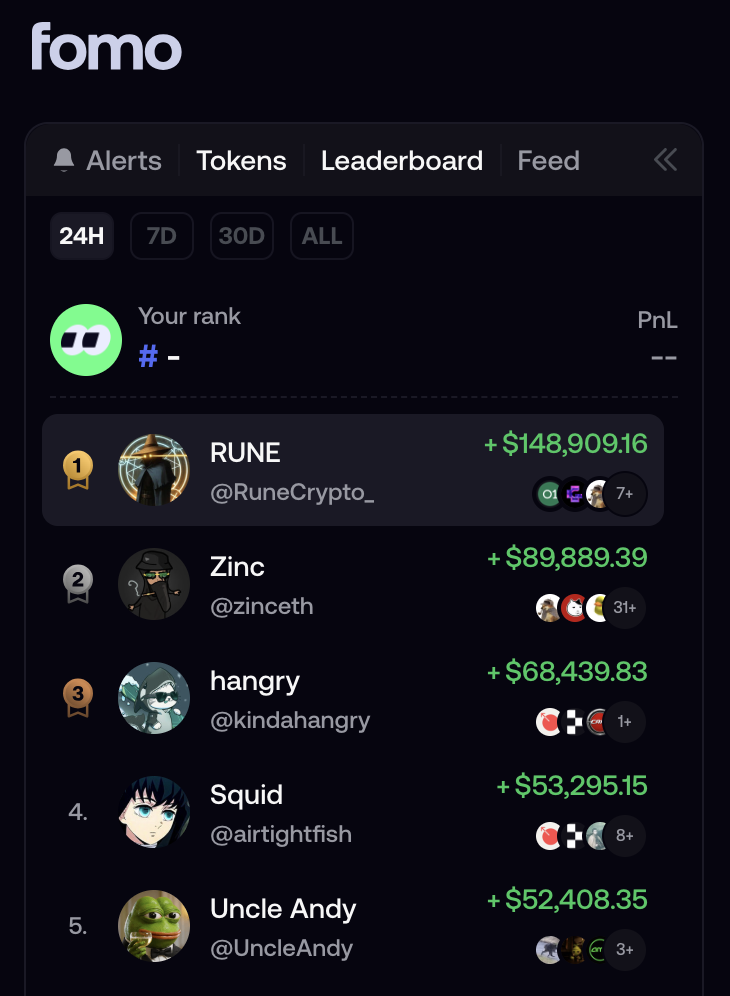
It’s important to be clear about one thing, since fomo’s marketing can be confusing: this is social trading, not copy trading. With true copy trading, your account automatically mirrors another trader’s moves – when they buy, you buy, without doing anything. fomo doesn’t offer that.
We checked fomo’s help pages to confirm: you can follow traders, see leaderboards, and get notifications when someone you follow makes a move, but you still have to place every trade yourself. It’s a tool for discovery and learning, not for automatic trading. If you want a set-and-forget feature, it’s not available here.
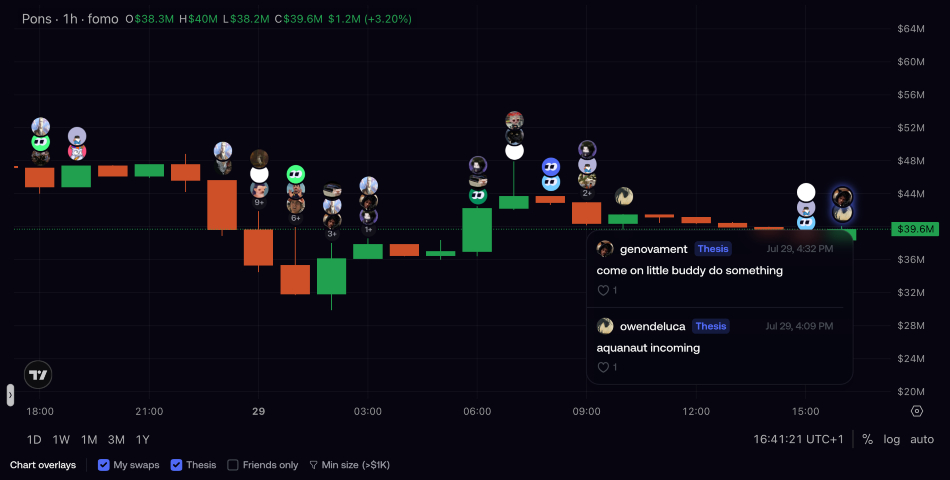
Social chart
Who’s Behind The Fomo App (And Why That Matters)
This is where fomo stands out from the broker trading scams we often cover. The people behind fomo are named and can be traced.
Fomo was launched in May 2025 by Paul Erlanger and Se Yong Park, with a founding team that includes members from Uniswap, OpenSea, Square, and Google. The company, FOMO Labs Inc., is a registered US business based in New York, with a corporate address in Dover, Delaware. This is a standard setup for a US startup.
The funding is the biggest sign of trust. In November 2025, fomo closed a $17 million Series A led by Benchmark, which is one of the most selective venture firms in the world. This brought total funding to about $19 million. Early backers include well-known names in crypto: Raj Gokal (co-founder of Solana), Marc Boiron (CEO of Polygon Labs), and Balaji Srinivasan (former CTO of Coinbase).
By the end of 2025, fomo reported over 120,000 users and monthly trading volume in the tens of millions. That alone rules out the “outright fraud” theory, and independent site-safety checkers like Scamadviser reach the same conclusion.
The Regulatory Reality Check
Here’s an important detail beginners often miss: fomo is not a regulated broker or exchange, and it doesn’t claim to be. It’s a self-custodial crypto app, meaning you hold your own keys, which puts it in a different, lighter regulatory category than a licensed brokerage. This isn’t a red flag by itself, but it does change your protections, and it’s important to understand this.
In the US (fomo’s home market):
- FinCEN / MSB rules: According to US Treasury guidance, businesses that exchange or send crypto are usually considered Money Services Businesses and must register with FinCEN. Self-custodial software is in a real grey area. Pure ‘you hold your keys’ apps can fall outside money-transmitter rules, but any fiat on-ramp or custody can bring a service back under those rules. You can check if a company is a registered MSB using FinCEN’s free registrant search. We’d treat a self-custodial app as offering fewer protections than a registered custodial exchange.
- SEC and CFTC: Depending on the token, US securities (SEC) and commodities (CFTC) rules can apply. Memecoins largely sit outside clear investor-protection frameworks.
- No FDIC or SIPC cover: This is the big one. Bank-style deposit insurance and brokerage protection do not apply to crypto balances. If funds are lost, there’s no federal backstop.
- Where to report problems: The FTC and the FBI’s IC3 handle crypto-fraud complaints. The IC3 has publicly warned that an app being in an app store doesn’t mean it’s a legal, compliant service – a useful reminder for any crypto app, fomo included.
Internationally:
- UK: The FCA regulates crypto promotions, and the FSCS compensation scheme does not cover crypto losses.
- EU: The MiCA framework governs crypto-asset service providers, though the status of a self-custodial app varies.
- Australia: ASIC oversees crypto-related financial products.
None of this means fomo is a scam. But it does mean you’re trading with fewer safety nets than you’d have with a licensed broker, so plan accordingly.
One practical note about funding. At our last tests, the platform listed credit and debit card funding as ‘coming soon.’ So for now, you’ll need to deposit crypto, with Apple Pay available on mobile in some regions. If you were hoping for a debit-card top-up like on Coinbase, that isn’t available yet. Check what your own region offers before committing money.
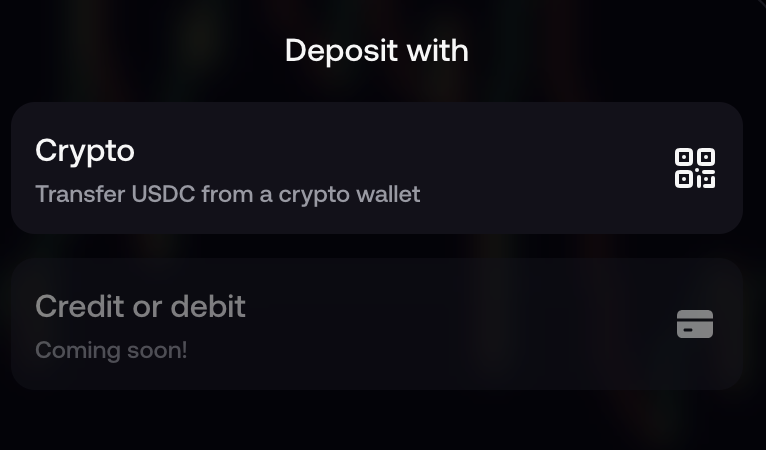
Funding
What Users Are Saying
We spent hours reading through public reviews ourselves rather than trusting fomo’s own testimonials. Three themes come up again and again, and this is what concerns us.
- Withdrawal and verification hurdles. The most-cited gripe: money goes in easily, but coming out can stall on a “verification issue.” One App Store reviewer described depositing $20, trading, then hitting a verification block on withdrawal with little explanation, and said support was hard to reach. To be fair, fomo’s team replies to these publicly and points people to in-app support for bank-withdrawal verification — so it reads more like clunky onboarding than money being trapped. But the negative user experience is real.
- Trouble selling, and impersonal support. On fomo’s Trustpilot profile, there were only two reviews at the time of writing, giving both 1-stars. The more detailed review describes a worrying experience: buying was easy (using Apple Pay, instant trades, live price updates), but when the reviewer tried to sell, the transaction failed or wouldn’t go through. They wondered if there was real liquidity behind the tokens, or just price movement they couldn’t actually access. Their second complaint was getting generic copy/paste replies from the developer instead of a clear answer. Trustpilot also flags the company as possibly linked to high-risk investments. Two reviews aren’t enough for a final verdict, but it’s a bad start and the trouble selling matches the withdrawal issues App Store users mention, so we see it as a real concern, not just a one-off.
- Losses from bad tokens. Some reviews blame the app for losing money on a ‘scam coin.’ This is more about context than a flaw in fomo: the app offers fast, easy access to memecoins, and many of those tokens may be rug pulls or worthless by design. The app itself didn’t take the money — a bad token did. But the simple, one-tap design makes it very easy to buy something risky.
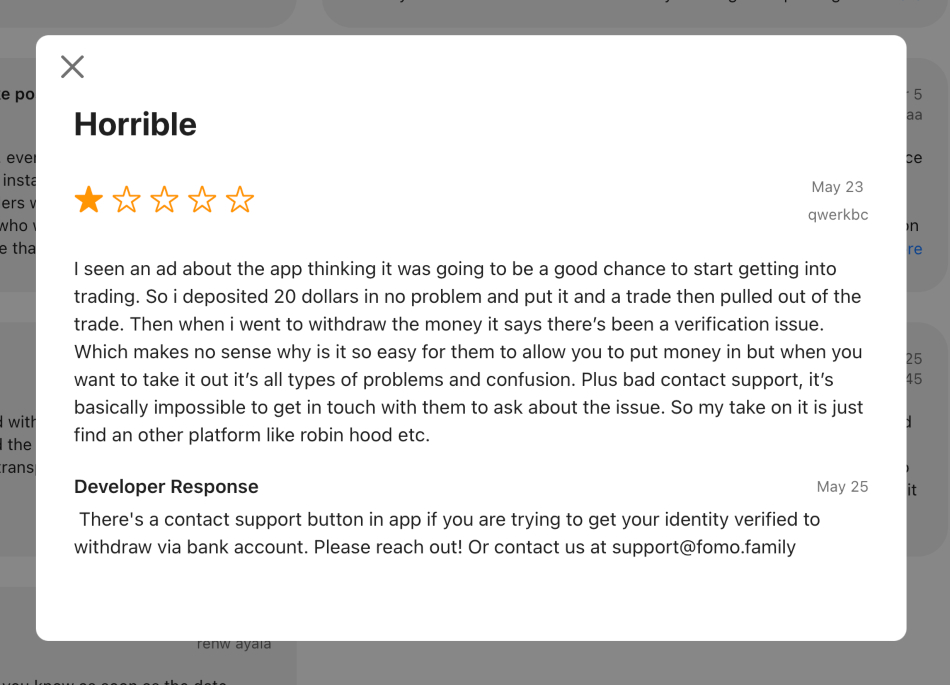
App Store review
Our Hands-On Checks
Here’s what we did directly:
- Research: We cross-checked fomo’s funding and the founder’s claims. We compared fomo’s marketing against its own help documentation and found the ‘copy trading’ language overstates what the app does. We confirmed the sign-up flow offers only Apple or Google login, no email or wallet setup.
- Deposit and withdrawal test: Money in is the easy part — we funded with USDC on Solana and the balance landed in under 20 minutes, with no card route yet since fomo lists card funding as ‘coming soon.’ The way out is where users hit a wall. When we tried to withdraw to an external wallet, the app triggered a ‘verification issue’ that we had to complete before we could withdraw our funds.
- Trading test: We ran fomo through a full loop as there is no demo account option — a buy, a short hold, and, most importantly, a sell, since the loudest user complaint is that sells don’t execute. Buying was the easy part: our orders on SOL/USD filled instantly. The real test is the exit, so we tried to sell MPLX/USD, and the order executed cleanly, which clears the failed-sell reports we’d read about.
- Support test: When we tried to gauge support responsiveness, the public record — the Trustpilot reviews plus multiple App Store comments — describes generic, slow replies and unanswered questions about failed sells. We wanted to check a few issues, so we emailed support and received a helpful reply within a few hours. Disappointingly, there is no live chat.
- Fee test: Every buy and sell costs 0.5%, but a $0.95 minimum kicks in on Solana trades (Base and BNB Chain have no minimum) — so a $10 Solana trade really costs about 9.5%, and you don’t beat the flat rate until you’re trading roughly $190. To its credit, fomo absorbs blockchain gas fees instead of passing them on, though a one-time ‘token rent’ applies the first time you buy any given token.
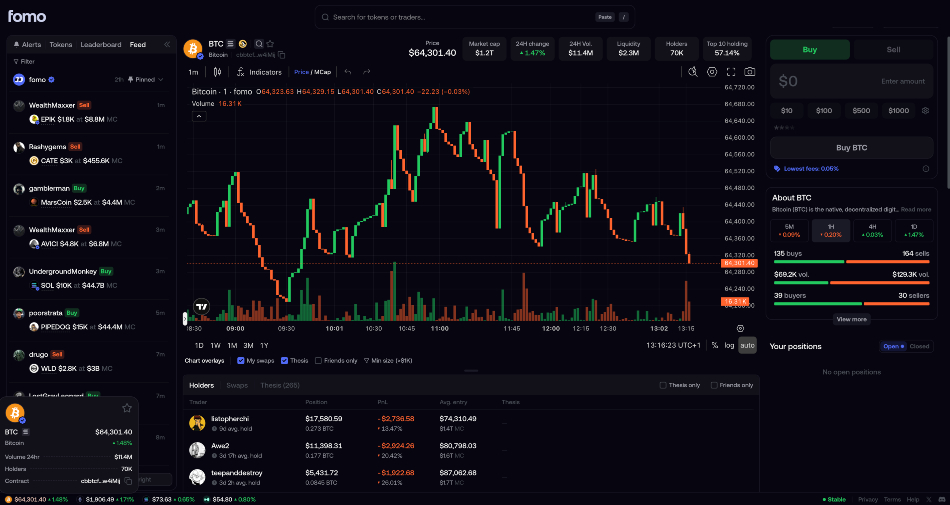
Platform
The Risks Fomo’s Marketing Skips
- In our opinion, Memecoins are almost like gambling. The whole product is about buying trending tokens quickly, and many memecoins end up worthless. The social feed and leaderboards make it even more tempting to chase trends, which, given the app’s name, is probably intentional.
- It’s a young app, launched in 2025. It has strong funding but only a short track record in withdrawals, security, and support at scale.
- Fees can add up. The main fee is a flat 0.5% per transaction, but if you trade often and include on-chain costs, the total can grow quickly. There’s also not much public detail on withdrawal or network fees.
Leaderboard
Staying Safe: Make Sure You’re On The Real Fomo.Family Site
Popular crypto brands get cloned, and fomo is no exception. Security researchers documented a typosquat — fomoo.family (note the double ‘o’) — built to look like the real site. Instead of a ‘Download app’ button, the fake page showed a ‘Connect wallet’ button that triggered a crypto drainer once a wallet was linked. At the time of our last tests, that clone appears to have been taken down.
We’re flagging it anyway, because these sites come and go and a new one can appear. Never access it through an ad or a direct message link. Simple habits protect you:
If a ‘fomo’ page asks you to ‘connect wallet’ before you’ve downloaded anything, close the tab. The real app is download-first.
Check the URL letter by letter. Clones rely on you skimming past an extra character.
Bottom Line
fomo is a legitimate crypto trading app, not an outright scam. Yet that doesn’t mean it’s safe. It’s not a good fit for anyone who wants regulated broker protections, reliable support, card funding right now, or a low-risk place to grow savings.
The real risks are also the volatility of what you’re trading, the challenges with getting money out, thin support, and the need to double-check you’re on the genuine site.
This review is general information, not personal financial advice, and reflects the opinion of our researchers. Crypto assets are volatile and largely unregulated, and you can lose all the money you put in.