

Delta Exchange Review 2026: High-Risk Crypto Futures and Options Exchange Warning
Delta Exchange India is a Mumbai-based crypto futures and options platform. I made 12 trades on the platform – fees made up most of my losses. Some user reviews complain about execution problems, high costs, and allege manipulation.
 Written By
Christian Harris
Christian is a seasoned analyst, leveraging his expertise in stocks, forex, and crypto to evaluate brokers worldwide. With hands-on trading experience and a strong focus on risk management, he helps traders find reliable platforms. Christian's work for BrokerListings.com has been cited in the Financial Times.
Christian Harris Profile Page Fact Checked By
William Berg
William Berg combines his expertise in law and finance to analyze trading brokers. He has checked 3,250+ regulatory licenses, investigated 2,365+ broker clones and trading scams, and placed 3,500+ trades.
William Berg Profile Page Edited By
James Barra
James is an experienced broker analyst with a background in financial services. He has spent 2,500+ hours testing brokers, used 35+ different platforms and apps, audited 120+ broker T&Cs, and verified 300+ regulatory licenses. James has also been on US and UK TV, and been a guest on finance podcasts, discussing reports conducted by BrokerListings.com and sharing his expertise.
James Barra Profile PageSeptember 23, 2026
Quick Verdict
Risk Snapshot
« Make Full Width »| Risk area | What we found | What to do |
|---|---|---|
| Regulation | FIU-registered for AML only; no SEBI or RBI oversight | Treat it as an ID check, not protection |
| Leverage | 1:100 per its web app, 1:200 per its instrument listings | Stay at 1:5 to 1:10 leverage, or avoid perpetuals |
| Fees | Charged on position size plus GST; 11.8% of margin per round trip at 1:100 | Do the maths before every trade |
| Overall | High-risk greylist | Trade small or use a regulated route |
“FIU-Registered” Doesn’t Mean Regulated
Delta Exchange India’s homepage claims it is fully compliant with Indian regulations and one of India’s safest platforms. The registration is genuine: Excelium Technologies Private Limited, REID VA00041101.
But this registration only covers basic requirements like know your customer (KYC), suspicious transaction reports, and keeping records for five years. No one checks if liquidations are fair or if fees are properly disclosed.
Delta Exchange India’s terms say so outright. Clause 3.8: the products aren’t listed on a recognized Indian exchange, aren’t offered through a SEBI-registered intermediary, and lack investor protection, surveillance, settlement guarantees, and compensation.
Clause 3.7 puts the risk on you if SEBI later decides a Delta Exchange India product is a security. The app repeats it before your first gold or stock-token trade: these products aren’t “subject to any specific regulatory framework in India”, and Delta Exchange India can close positions without notice.
Clearer rules aren’t close either, with the government’s crypto discussion paper shelved again in April 2026.
Built For The Traders SEBI Tried To Protect
Delta Exchange India tries to attract equity traders by offering daily BTC and ETH options expiries, always-open markets, contracts starting at about ₹5,000, and margin rules that let you trade larger amounts with less capital.
SEBI moved the other way, raising the minimum index derivative contract to ₹15 lakh in November 2024 and cutting each exchange to one weekly expiry. Even so, 87.7% of individual futures and options traders lost money in FY26, dropping ₹91,685 crore between them at roughly 1:13 leverage.
Delta Exchange India offers eight times more leverage and much smaller lot sizes than SEBI’s minimum. This is not an upgrade over Nifty weeklies. It is the same product, just without the usual protections.
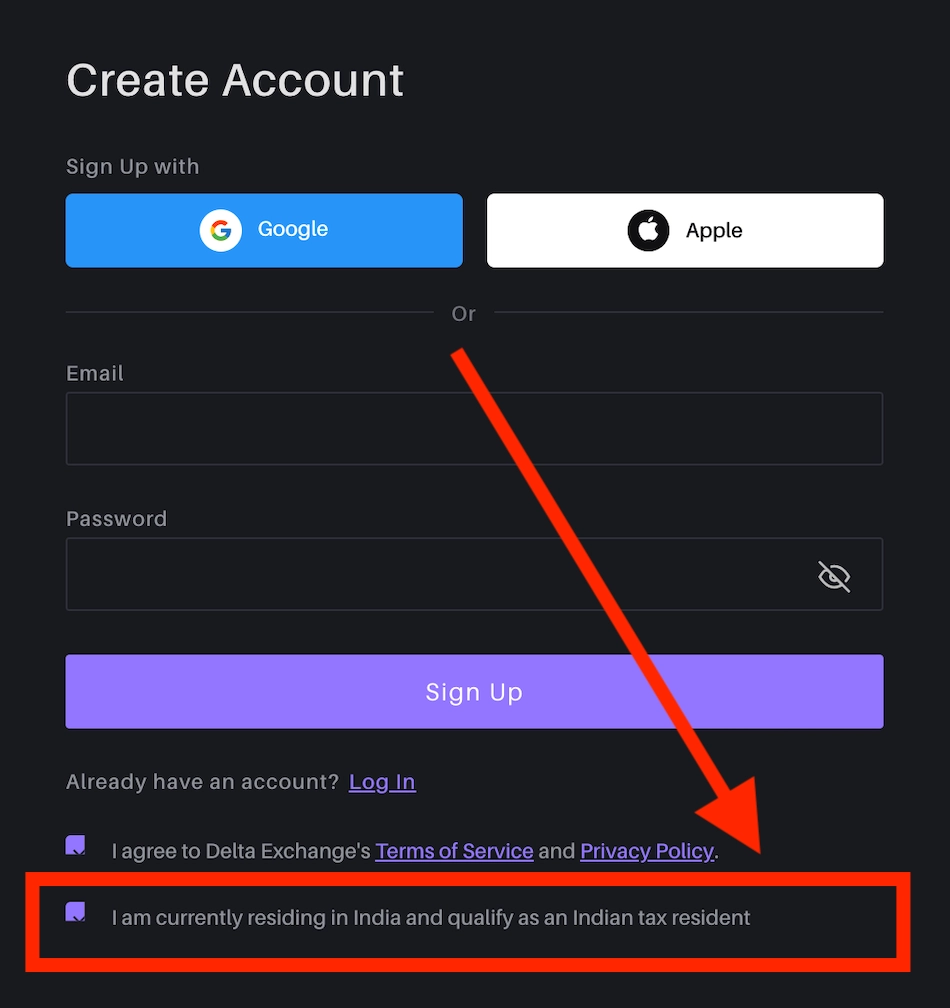
Delta Exchange is geared to Indian residents
The Fee Maths At 1:100 Leverage
Delta Exchange India charges a 0.05% taker fee and a 0.02% maker fee on futures, plus 18% GST, all calculated on your full position value instead of just your margin. This means leverage increases the fees you pay on your capital. Here’s what one round trip with market orders on ₹5,000 of margin looks like:
« Make Full Width »| Leverage | Position size | Round-trip fees | Fees as % of margin | Move that wipes your margin |
|---|---|---|---|---|
| 1:10 | ₹50,000 | ₹59 | 1.2% | ~10% |
| 25x | ₹1,25,000 | ₹148 | 3.0% | ~4% |
| 1:50 | ₹2,50,000 | ₹295 | 5.9% | ~2% |
| 1:100 | ₹5,00,000 | ₹590 | 11.8% | ~1% |
| 1:200 | ₹10,00,000 | ₹1,180 | 23.6% | ~0.5% |
This calculation uses Delta Exchange India’s published fees and does not include funding or slippage. Liquidation can happen even faster than the last column shows. For example, in Delta Exchange India’s own example, a BTC/USD long at example maximum leverage is liquidated after just a 0.5% price drop.
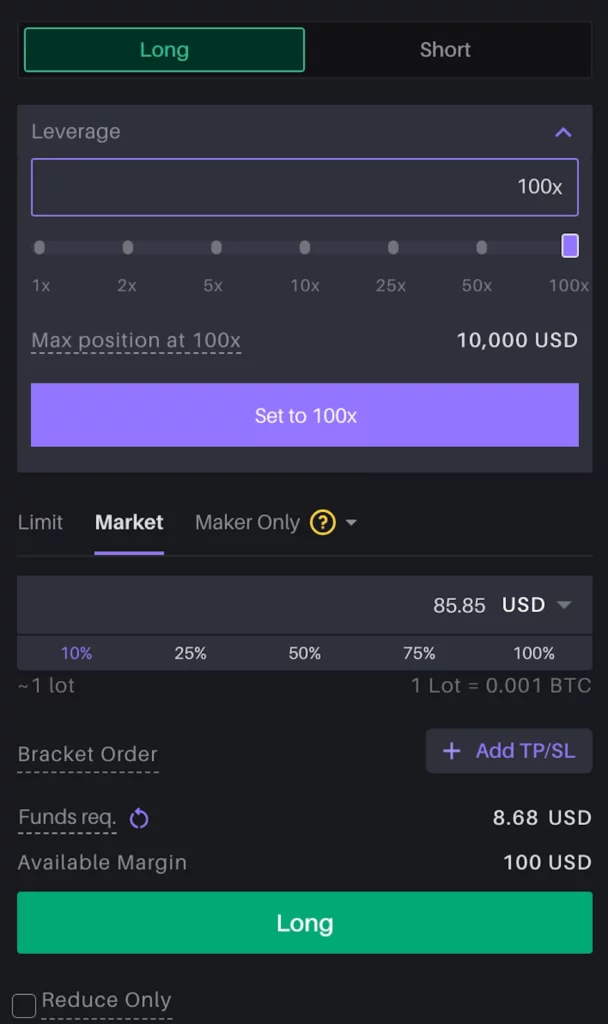
Leverage settings
The Delta Exchange India Trading Experience
Delta Exchange India does not have a separate demo site. The help center directs you to ‘demo.delta.exchange’, which requires a separate login and sets the wallet value at a fixed ₹85 per dollar. My demo wallet started with $99.89. When I tried to use the ‘Reload Wallet’ feature, it added $100 once, but then refused because my balance was ‘above $99’.
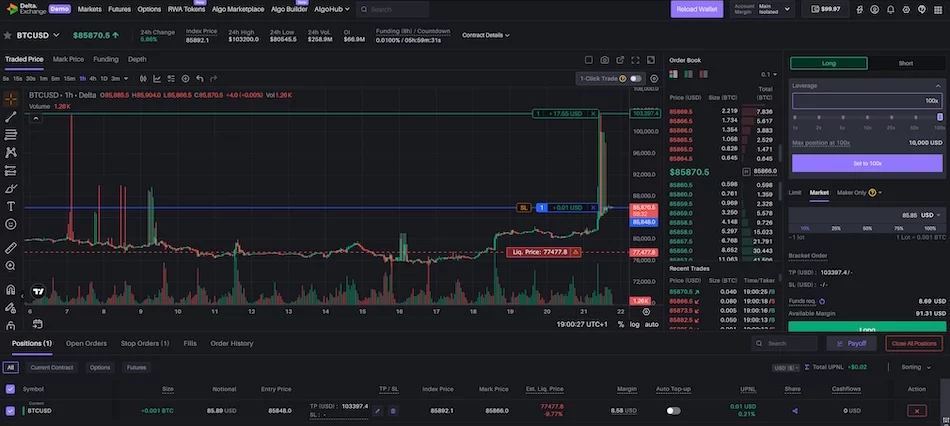
Platform interface
I opened and closed 12 positions across ten markets: BTC, ETH, SOL, XRP, and DOGE perpetuals, tokenized gold, NVIDIA and S&P 500 tokens, and BTC and ETH options, using market, limit, stop, bracket, and trailing-stop orders.
Of the 12 trades, only two went in my favor, and only one ended with a small profit of $0.12. My wallet dropped from $199.89 to $187.73, with $9.06 of the $12.16 loss coming from fees.
The most obvious example was a 1:100 BTC long using $49.82 of margin. BTC moved $6.50 against me in three minutes, which cost me $0.38. But fees took $5.28. I lost 11.4% of my margin even though the price moved less than 0.01%.
The fee rate isn’t the main issue. Delta Exchange India’s 0.05% taker fee is lower than CoinDCX’s 0.075%. The real problem is leverage. A Nifty futures lot requires about 7.6% margin, so a similar round trip costs about 1.4% of your margin there, compared to 10.6% at Delta Exchange India’s 1:100 leverage.
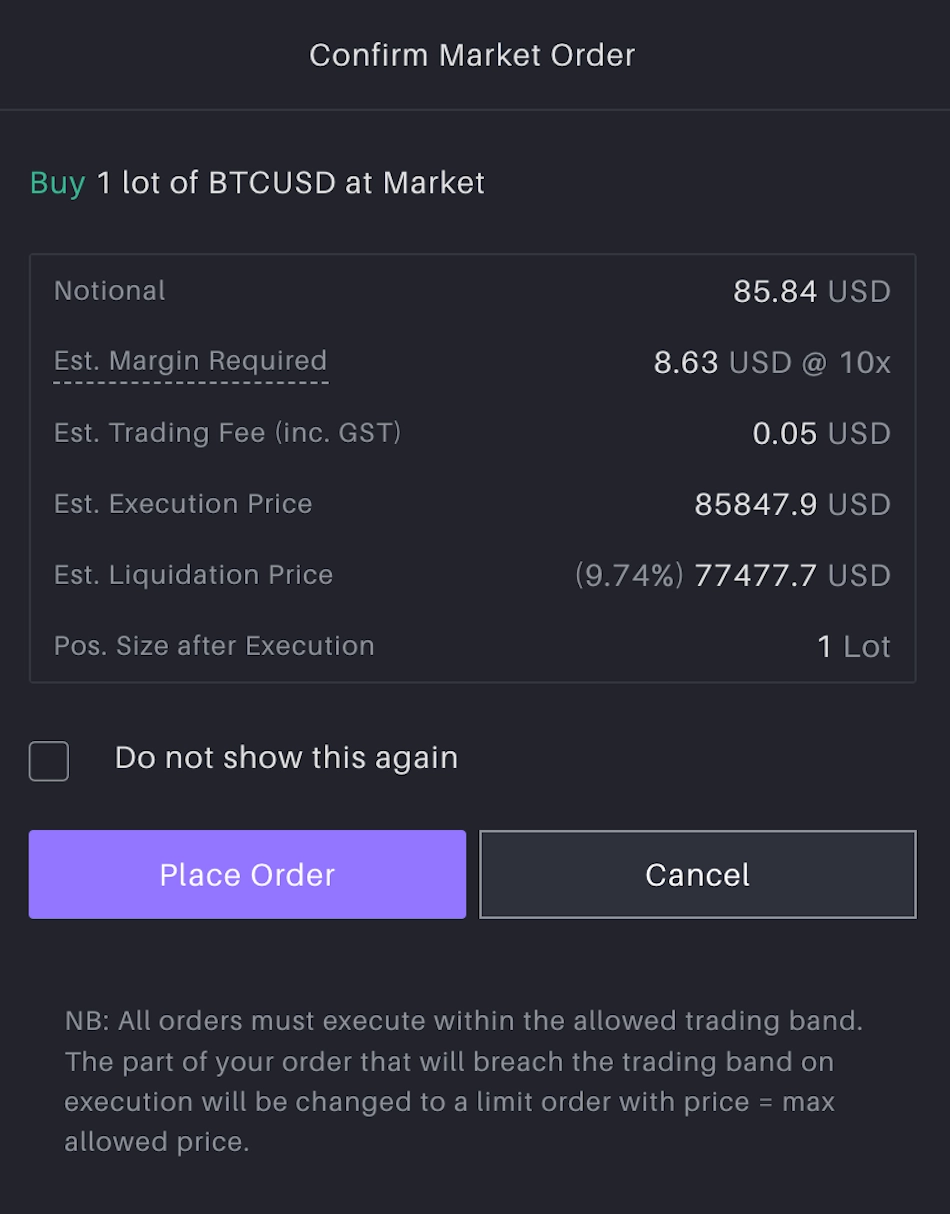
Trade confirmation
I also found the markets aren’t very active. Only 16 perpetual contracts are listed. Litecoin showed ‘No Products Found’, and BTC/USDT and ETH/USDT spot markets had $0.00 volume. The Algo Marketplace, which is supposed to let you copy ‘expert traders’, had no listings. Charts often took more than five seconds to load in my tests, and the demo feed sometimes showed price spikes that never happened, like a $103,200 BTC high when the chart actually peaked near $86,100.
There is no real barrier to using high leverage. When I set BTC to 1:100, I just got a small ‘Order leverage changed’ pop-up and saw a liquidation price only 0.74% away. The gold contract opened at 1:100 by default, with liquidation just 19 cents below that day’s low. Market and limit order tickets show margin, fees, and liquidation price before you confirm, but stop orders do not show any of these details.
Some numbers on the platform can be misleading. The close box showed ‘Expected Profit: $0.05’ in green, but this ignored fees, just like the stop-loss previews do. For example, on a SOL short, the 1% preset put my stop at $118.39, which was below my $118.83 entry, and still called it ‘Stop PnL +$3.52’.
The Payoff tool showed ‘Max Profit: Unlimited’ for a net-short position. Funding costs are not shown at all. My S&P 500 short had a funding rate of -0.4591% every eight hours, which is about 27.5% of margin per day at 1:20 leverage.
The Share button lets you turn any demo position into a Delta profit card with your referral code, but there is nothing to show that the money is not real.
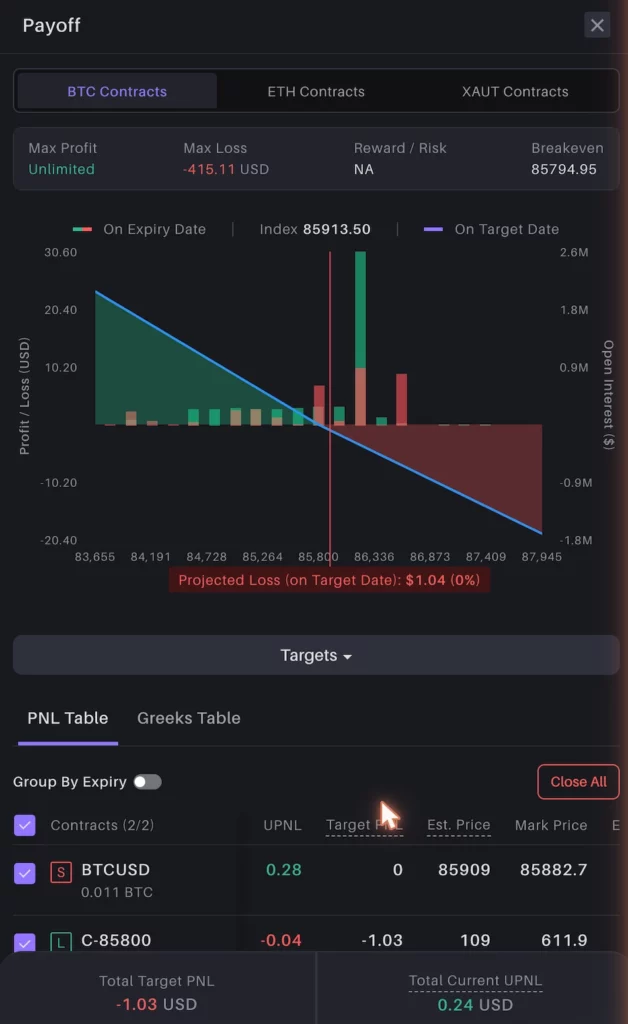
Payoff calculator
The Tax Pitch Isn’t Settled Law
Delta Exchange India’s App Store listing promotes trading without the 1% TDS and 30% flat tax. Its user guide says neither applies to F&O because your balance stays in rupees, while confirming both apply to spot purchases.
That is just one interpretation of the law, but it is presented as a fact. The CBDT has not issued any circular, and no court has ruled on this that I can find, so the safest approach is to assume 30% tax under Section 115BBH applies. If the Income Tax Department disagrees later, you bear the risk.
What Delta’s Terms Allow
- It can trade against you. Clause 4.13 lets Delta Exchange India and its affiliates act as counterparty or market maker, with conflicts managed on a “voluntary best effort” basis. When a liquidation can’t be filled, Delta Exchange India’s own engine takes the position at its bankruptcy price.
- Fills can change afterward. Clause 4.14 lets Delta Exchange India amend, reverse, or void trades and balances even after settlement.
- Downtime is your loss. Clause 4.5 disclaims liability when the platform is down, and warns prices may differ sharply on return.
- Accounts can be frozen. Clause 4.7 allows frozen withdrawals and forced closures without notice; clause 9.15 blocks your balance during an investigation.
- Money moves slowly by contract. Five business days to credit a deposit, three for withdrawals, and 30 for larger ones.
- The dispute window is one-sided. You get three business days to challenge a record; Delta Exchange India can correct records at any time, and disputes go to private arbitration in New Delhi, with group claims excluded.
- “Zero” deposit fees, with an asterisk. The fees page advertises none, while clause 10.5 charges one on every deposit without saying how much.
None of this proves any wrongdoing, but clause 4.5 means that if you are liquidated during maintenance, you have no way to get your money back.
Who Runs Delta Exchange India?
The leadership is public, which counts in Delta Exchange India’s favor. CEO Pankaj Balani is ex-UBS, CBO Jitender Tokas worked at Citigroup and GIC, and CTO Saurabh Goyal co-founded Housing.com.
However, the company’s structure is not straightforward. The technology is licensed from another company, Chainlabs India Pvt Ltd, and Excelium’s CSR committee lists Ishan Kanungo and Santhosh Bugata instead of the founders.
Excelium was set up on 3 January 2023, but the Play Store listing claims over eight years of smooth operation, which comes from the global group. Its FY2025–26 CSR plan budgets ₹7.6 crore, and since Indian law sets CSR at 2% of average net profits, this suggests the fee business is profitable.
What Do Other Users Say?
At the time of initial testing, Delta Exchange India had a Trustpilot score a of 2.3 out of 5 from 70 reviews, with 64% being one-star, and Trustpilot warns of a possible link to high-risk investments. The profile covers the whole domain since 2019, so some reviews are about the global platform. Indian users can only withdraw rupees, but one complaint mentioned a stuck USDT withdrawal.
I read 40 reviews, from April 2025 to August 2026: 30 negative, 10 positive.
« Make Full Width »| Complaint theme | Reviews (of 30) | What users describe |
|---|---|---|
| Fees and charges | 11 | Profits wiped out; hidden charges |
| Execution and stop-losses | 8 | Stops filled away from the trigger |
| Support | 7 | Template replies; one user blocked on Telegram |
| Freezes and outages | 6 | Hangs in volatility; liquidation in maintenance |
| Deposits and withdrawals | 5 | Bank debited, wallet not credited |
| Influencer marketing | 5 | Signed up through YouTube promoters |
| Manipulation claims | 5 | Unverified claims of rigged prices |
Three patterns stand out. No positive review appeared between April 2025 and March 2026, then 10 arrived in eight weeks, all short, all from single-review accounts. Two negatives from 2025 share near-identical wording. One review credits a recovery service with returning the user’s crypto, which the India platform can’t do.
There is no proof of manipulation. Affiliates earn 10% of the net fees from users they refer, so influencers make more when their followers pay higher fees. On Google Play, at the time of my initial investigation, Delta Exchange India had around a 4.0-star rating from roughly 132,000 ratings, but top reviews mention slow loading, high fees, and lower referral payouts.
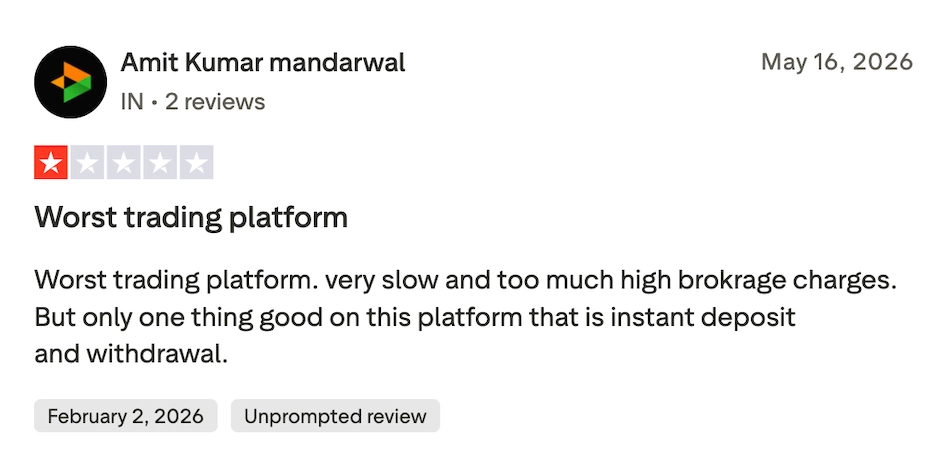
Trustpilot review
Does It Offer Anything You Can’t Get Elsewhere?
« Make Full Width »| What Delta sells | Where else | How it compares |
|---|---|---|
| Rupee-settled BTC and ETH futures and options | Other FIU-registered Indian exchanges | Same regulatory gap; only backing and track record differ |
| Tokenised gold and silver | ETFs or SEBI-regulated commodity futures | Regulated, no token-issuer risk, no tax question |
| Futures on tokenised US stocks | US shares under the Liberalised Remittance Scheme | You own shares, not a contract on a token |
| 1:100 to 1:200 leverage on small contracts | Nowhere regulated in India | The one real difference |
All of Delta Exchange India’s products are available elsewhere with the same lack of regulation, or in regulated forms that SEBI tried to limit in 2024 offer more protection. The only exception is the extreme leverage on small contracts, which SEBI tried to limit in 2024. If you choose Delta Exchange India for this reason, you are taking on the main risk.
Professional Opinion
Delta Exchange India is not a blacklisted scam broker. It has named founders, is an Indian company, is FIU-registered, and there is no evidence of theft or hacking. My concern is how these factors come together.
The anti-money-laundering registration is used as a sign of safety. Fees are charged on the full position size while leverage goes up to 1:200, so traders attracted by ₹5,000 contracts can quickly lose their margin to costs.
The tax situation is unsettled, but presented as fact. The terms also give Delta Exchange India a lot of control over trades and accounts. My own test matched what reviews say: previews that hide fees, tickets that default to maximum leverage, and costs that outpace the market.
If You Plan To Use Delta Exchange
- Cap leverage at 1:10, and use limit orders for the maker rate.
- Screenshot everything, and dispute errors within three business days.
- Test withdrawals with a small amount first, and don’t park profits there.
- Keep tax records as if 30% applies, and have your accountant sign off.
- Ignore “recovery” services. Report fraud at or on 1930.
This Delta Exchange review is not labelling the crypto futures and options platform a scam. It is pointing out the safety concerns discovered during hands-on tests and wider research and represents the opinions of the tester.