

Is Exness Legal in Pakistan?
Exness isn’t legal in Pakistan, but traders can technically still use accounts – we checked by opening an account from a Pakistani IP address. It isn’t locally licensed, like many international brokers accepting Pakistani residents, so there are key considerations to understand.
 Written By
Christian Harris
Christian is a seasoned analyst, leveraging his expertise in stocks, forex, and crypto to evaluate brokers worldwide. With hands-on trading experience and a strong focus on risk management, he helps traders find reliable platforms. Christian's work for BrokerListings.com has been cited in the Financial Times.
Christian Harris Profile Page Fact Checked By
Tobias Robinson
Tobias is committed to helping traders find the right brokerage for their needs. He has tested 200+ brokers, spent 2,600+ hours using different platforms, and placed 2,100+ trades.
Tobias Robinson Profile Page Edited By
James Barra
James is an experienced broker analyst with a background in financial services. He has spent 2,500+ hours testing brokers, used 35+ different platforms and apps, audited 120+ broker T&Cs, and verified 300+ regulatory licenses. James has also been on US and UK TV, and been a guest on finance podcasts, discussing reports conducted by BrokerListings.com and sharing his expertise.
James Barra Profile PageAugust 25, 2026
Exness Regulatory Status In Pakistan
Two bodies shape the rules. The Securities and Exchange Commission of Pakistan (SECP) licenses firms operating inside the country, and the State Bank of Pakistan (SBP) governs foreign exchange. Neither currently issues licenses to global CFD brokers like Exness, so the broker serves Pakistani clients through its overseas entities rather than under a local permit.
We downloaded the list of licensed securities brokers and futures brokers from the SECP and searched for ‘Exness’ – no result.
Using an international trading provider that isn’t headquartered and regulated in Pakistan is high risk, even if Exness is a legitimate brokerage. You may not get any legal protections in the case of disputes.
In 2022, the State Bank of Pakistan instructed banks and exchange companies to stop facilitating payments to offshore forex and CFD platforms, describing their operations as illegal under Pakistan’s foreign-exchange framework.
This has since escalated into a coordinated crackdown. The SECP partners with the Pakistan Telecommunication Authority (PTA) and the Federal Investigation Agency (FIA) to block access to the unauthorized domains of overseas brokerages and investigate their operations under FERA 1947.
Should I Still Use Exness From Pakistan?
A few points to consider:
- Islamic accounts. Exness applies swap-free conditions automatically for clients in Muslim-majority countries, so overnight positions don’t accrue interest. That’s a big reason it’s popular locally.
- Funding. Card, e-wallet, and crypto options are supported, and many withdrawals are processed near instantly from our experience. That said, in practice, standard Pakistani debit and credit cards may be declined by local banks enforcing SBP mandates. This forces some local traders to rely on informal third-party e-wallets or peer-to-peer (P2P) transfers, which carries a higher risk of automated bank account freezes. Base accounts at Exness can be denominated the Pakistani rupee (PKR), as you can see below where we selected a PKR account when we signed up.
- Tax. Trading profits may fall under the Income Tax Ordinance, 2001, depending on your status and trading activity. Keep records of deposits, withdrawals, and gains, since larger bank transfers can prompt questions about the source of funds.
- No local protection. Because there’s no SECP oversight, disputes can’t be escalated to a Pakistani regulator. You rely on Exness’s international licensing.
- Alternatives. Anyone looking for a domestically regulated route can consider brokers tied to the Pakistan Mercantile Exchange (PMEX), though the instrument range differs from that offered by Exness. Unlike the decentralized over-the-counter (OTC) market maker model used by many overseas platforms, including Exness, PMEX operates a centralized, cleared exchange for dealing regulated futures contracts.
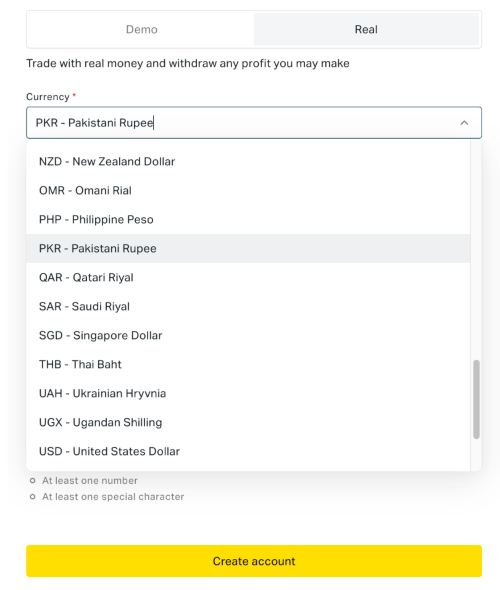
You can choose an Exness account based in Pakistani Rupees when you register