 Top Lists for USA
Is Eightcap An ECN Broker?
Partly. Eightcap routes client orders to external liquidity providers rather than relying purely on traditional B-book market-making. However, calling it a true ECN broker overstates it as in line with its legal terms, Eightcap is still the counterparty to CFD traders and market maker, using those external providers to hedge its exposure behind the scenes.
 Written By
Christian Harris
Christian is a seasoned analyst, leveraging his expertise in stocks, forex, and crypto to evaluate brokers worldwide. With hands-on trading experience and a strong focus on risk management, he helps traders find reliable platforms. Christian's work for BrokerListings.com has been cited in the Financial Times.
Christian Harris Profile Page Fact Checked By
Tobias Robinson
Tobias is committed to helping traders find the right brokerage for their needs. He has tested 200+ brokers, spent 2,600+ hours using different platforms, and placed 2,100+ trades.
Tobias Robinson Profile Page Edited By
James Barra
James is an experienced broker analyst with a background in financial services. He has spent 2,500+ hours testing brokers, used 35+ different platforms and apps, audited 120+ broker T&Cs, and verified 300+ regulatory licenses. James has also been on US and UK TV, and been a guest on finance podcasts, discussing reports conducted by BrokerListings.com and sharing his expertise.
James Barra Profile PageOctober 7, 2026
ECN Execution By Account
Here’s the breakdown of Eightcap’s execution by account:
- Raw account – this is the ECN-style option. Spreads start at 0.0 pips on major pairs, with a $3.50 commission per side ($7 round-trip commission per standard lot). Pricing is aggregated from liquidity providers and passed through with no spread markup. This is the setup scalpers and algorithmic traders want.
- Standard account – an STP-style account, spread-based model with no separate commission. Spreads start around 1.0 pip, with the broker’s cost built into the spread. Simpler for beginners, slightly pricier for high-volume trading.
The term “true ECN” does not fully apply here because a classic ECN matches client orders with each other and other participants in a central network. Eightcap instead gathers quotes from its liquidity providers and routes orders to them. This gives you the main benefits — tight raw spreads and minimizing no dealing-desk conflict —even if it is not a textbook ECN.
In our tests, order fills were fast and slippage was limited except during major news events, which is what really matters.
If you want raw-spread, commission-based execution, open the Raw account, and you’ll get ECN-style conditions. Just don’t expect a central order-book ECN in the strictest sense.
How We Tested Eightcap’s ECN-Style Execution
To judge whether the ECN/STP claim holds up, we ran a simple repeatable test on a live Raw account. You can do the same to check any broker:
- Open a Raw account. In the client portal, request an account and select the Raw type so you get the 0.0-pip-plus-commission structure rather than the spread-only Standard model.
- Note the quoted spread at a quiet time. We recorded the EUR/USD bid-ask spread during a liquid, low-news session as a baseline.
- Place small market orders. We sent minimum-size market orders and logged the requested price against the filled price to measure slippage and any requotes.
- Repeat around a news release. We ran the same orders near a scheduled data release to see how far spreads widened and whether fills stayed reasonable under pressure.
- Compare the all-in cost. We added the raw spread to the $3.50-per-side commission to get the true round-turn cost, then set it beside a couple of named rivals priced on the same day.
We found that fills were fast and slippage was contained outside major news, with spreads widening as expected during releases. That behavior is consistent with no-dealing-desk routing to liquidity providers, which supports the ECN/STP description even though it isn’t a textbook central-network ECN.
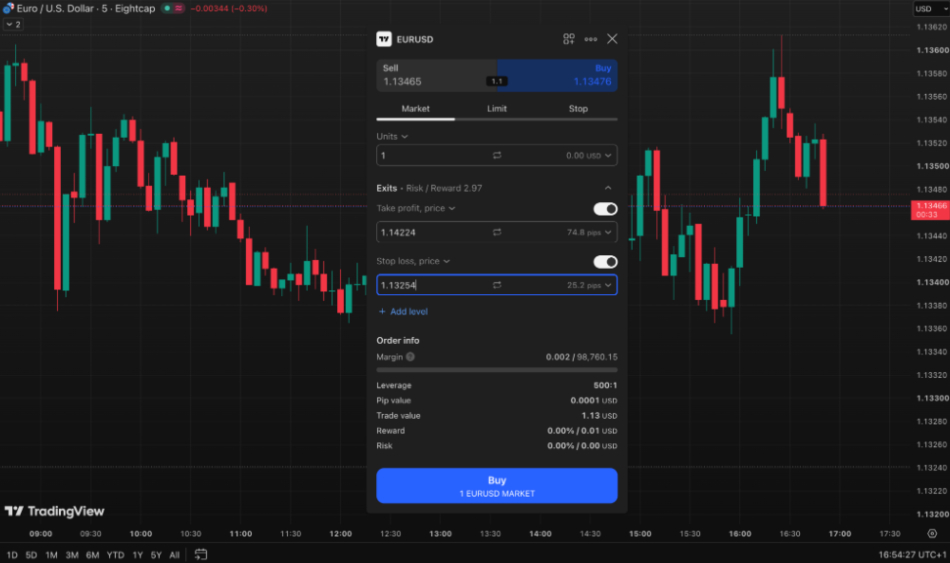
Raw account ECN-style trade placed through Eightcap’s TradingView