 Top Lists for USA
Copy-Trading Blow-Ups Aren’t Bad Luck – The System Rewards The Risk
On copy-trading networks and crypto exchanges, a strategy provider can lose most of their followers’ money, open a new account, and return to the leaderboard in just a few weeks. Many platforms allow this, and many payment models actually encourage it. Most strategy providers are not out to ruin their followers. They chase the high returns that boost their rankings, and the system rewards that behavior. This report reveals how this quietly happens.
 Written By
Christian Harris
Christian is a seasoned analyst, leveraging his expertise in stocks, forex, and crypto to evaluate brokers worldwide. With hands-on trading experience and a strong focus on risk management, he helps traders find reliable platforms. Christian's work for BrokerListings.com has been cited in the Financial Times.
Christian Harris Profile Page Fact Checked By
Tobias Robinson
Tobias is committed to helping traders find the right brokerage for their needs. He has tested 200+ brokers, spent 2,600+ hours using different platforms, and placed 2,100+ trades.
Tobias Robinson Profile Page Edited By
James Barra
James is an experienced broker analyst with a background in financial services. He has spent 2,500+ hours testing brokers, used 35+ different platforms and apps, audited 120+ broker T&Cs, and verified 300+ regulatory licenses. James has also been on US and UK TV, and been a guest on finance podcasts, discussing reports conducted by BrokerListings.com and sharing his expertise.
James Barra Profile PageOctober 23, 2026
Key Takeaways
- As an investor, I have spent hundreds of hours copying other traders across more than 10 strategies, primarily with high ROI rankings, yet every one lost between 95%-100% within six months.
- For over two years, I’ve also been a strategy provider on cTrader Copy and eToro, so I understand both what providers see and what followers do not.
- This experience led to this investigation to lift the lid on how some platforms rank providers, the risks taken by some followers, and how easily providers can reinvent themselves after blowing up accounts.
- In our analysis of the highest-ranked strategies of cTrader Copy, one provider invested just $947 vs $87,971 from followers, with relatively little skin in the game.
- 40% of strategies used very high and risky levels of leverage at 1:500 and 1:1000, with one advertising an all-time return high of 19,393% after three and a half months.
- Strategy providers can quietly earn even while followers lose, including from subscriptions, management and trading volume fees, which are still paid during losses.
- Following a 90% drawdown, a strategy provider account needs a 900% gain to recover, so starting a new profile conveniently clears the performance-fee barrier.
- Independent research also raises concerns, with the OSC in Canada finding those given a copy trading service placed 18% more trades.
- Copy trading is not inherently bad – it can help educate aspiring traders, but this study found some platform safeguards can vary substantially, notably around risk limits, controls, and transparency, making choosing a trusted platform key.
Followers Lose Money, Providers Lose A Profile
If a copy-trading strategy collapses, followers (investors) lose their deposits, often traded with leverage that regulators in tightly controlled regions like the EU, UK, and Australia do not allow for retail clients.
The provider loses only its track record, which is easy to replace. On cTrader Copy, for instance, there is no limit to how many strategies one person can create.
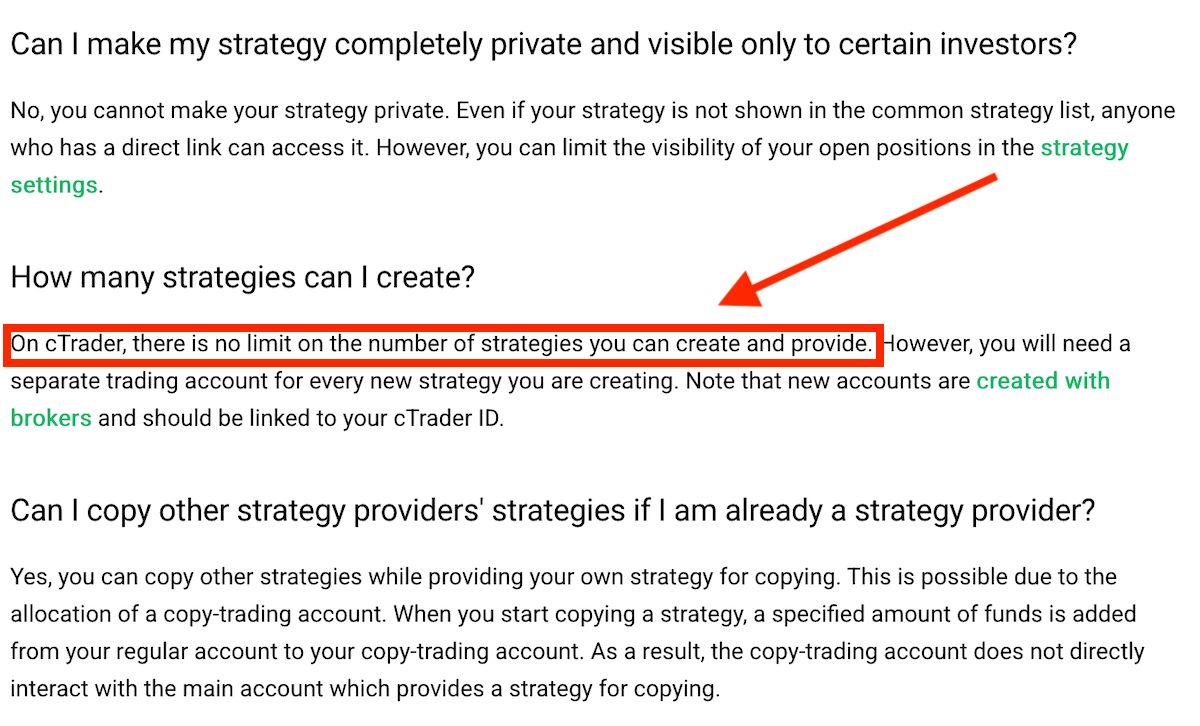
No limit on cTrader strategies
Two Hotspots
Most of the problems happen on broker-agnostic networks like MetaTrader’s MQL5 Signals, cTrader Copy, and ZuluTrade, as well as on crypto exchange copy-trading desks.
Broker-run platforms with stricter rules, like eToro, show that it can be different.
1. The Odds Are Bad Before Anyone Hits Copy
Copy trading uses leveraged products that already cause most retail traders to lose money. EU regulators found that 74% to 89% of retail CFD accounts lose money.
Copy trading, when not approached carefully, can make this problem worse. A peer-reviewed study found that seeing others’ results made people take more risks, and having a copy button increased this even more.
2. How Providers Get Paid
Different copy trading platforms pay providers in different ways. As a provider, I have worked under both eToro’s and cTrader’s rules, and they encourage very different behaviors. In many cases, subscription and volume models pay providers in full even if followers lose 80% of their money.
- Broker-run platforms: eToro pays its Popular Investors up to 1.5% per year on the assets copying them, not a share of profits, and limits their daily risk score to 7. If they break risk limits, they lose the payment and can be blocked from being copied, so reckless trading directly affects the provider.
- Broker-agnostic networks: These connect providers and followers across many brokers, and almost anyone can list a strategy:
| Network | How providers are paid | Paid when followers lose? | Risk control |
|---|---|---|---|
| MQL5 Signals | A monthly subscription set by the provider; MQL5 keeps 20% | Yes | Signals above 1:500 leverage can’t take subscribers |
| cTrader Copy | A performance fee up to 40%, an optional management fee up to 10% a year, and an optional volume fee | Management and volume fees, yes | Follower-set equity stop |
| ZuluTrade | Volume pay at around $5 per lot; profit sharing dropped for followers from 2023 | Volume pay, yes | Ranked traders must keep drawdown under 30% of profit |
| DupliTrade | Not disclosed | Not disclosed | Pre-vetted roster; minimums such as $5,000 |
| Darwinex | 15% of investor profits, above a high-water mark | No | A risk engine holds every strategy at 3.25% to 6.5% monthly value-at-risk |
On crypto exchanges like Binance, Bybit, Bitget, OKX, MEXC, and KuCoin, copy trading is offered on leveraged perpetual futures. Binance started with a 10% profit share and a 10% rebate on followers’ trading fees. On Hyperliquid, anyone can open a public vault and take 10% of profits.
The High-Water Mark Only Works If The Account Survives
A high-water mark prevents a provider from charging twice on the same gains, but after a 90% loss, followers need a 900% gain before fees start again. A new account does not need to recover anything.
Other researchers found that providers paid this way change their risk-taking depending on how close they are to the mark. Anyone who has managed a strategy through a big loss knows this math.
Skin In The Game: $947 At Risk, $87,970 Copying
No link exists between how much a provider risks and how much their followers risk. cTrader Copy sizes each copied trade using an equity-to-equity formula: investor equity divided by provider equity, multiplied by the provider’s trade size. The percentage gains and losses are the same, but the actual money at risk is not.
I took a snapshot of the top five strategies in cTrader Copy’s default ranking, with names blurred. Rankings change every day, so this is just one day’s view. cTrader says the ranking considers factors like ROI, investor own funds, and the provider’s own funds. Two strategies with less than $1,000 of the provider’s money still made the top five.

Strategy A, captured in testing
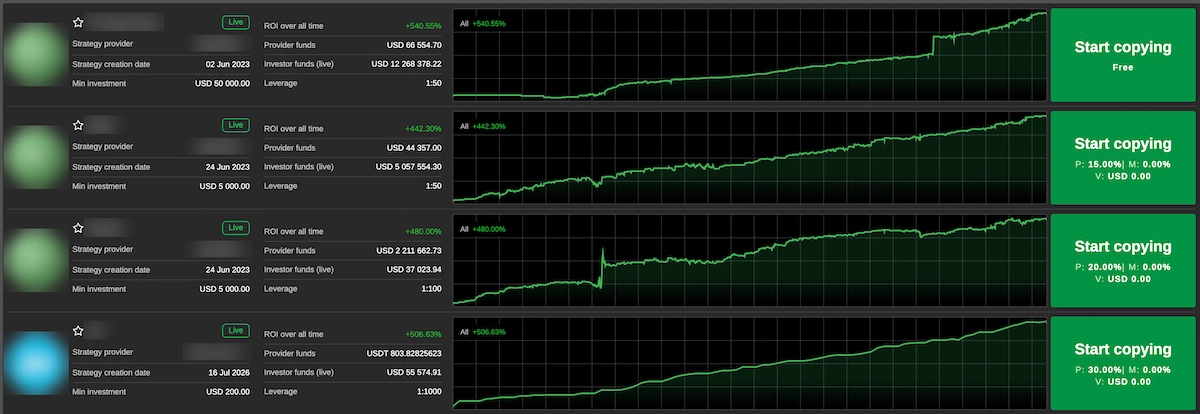
Strategies B to E, captured in testing
| Strategy | Launched | All-time ROI | Provider funds | Investor funds | Investor $ per provider $ | Minimum | Leverage | Performance fee |
|---|---|---|---|---|---|---|---|---|
| A | Jun 2026 | +19,393% | $947 | $87,971 | 93 | $200 | 1:500 | 30% |
| B | Jun 2023 | +541% | $66,555 | $12,268,378 | 184 | $50,000 | 1:50 | None |
| C | Jun 2023 | +442% | $44,357 | $5,057,554 | 114 | $5,000 | 1:50 | 15% |
| D | Jun 2023 | +480% | $2,211,663 | $37,024 | 0.02 | $5,000 | 1:100 | 20% |
| E | Jul 2026 | +507% | 804 USDT | $55,575 | 69 | $200 | 1:1,000 | 30% |
The two newest strategies, launched in summer 2026, use less than $1,000 of the provider’s own money at 1:500 and 1:1000 leverage, with $56,000 to $88,000 copying them. Strategy A gained 19,393% in about three and a half months. If it collapses, the provider loses $947, but followers could lose up to $87,971. Browse the rankings, and you’ll see some providers use as little as $100.
The older strategies use much lower leverage, and the provider of Strategy D has 60 times more money in the strategy than all its investors combined. Still, Strategies B and C have $114 to $184 of investor money for every dollar the provider has. Three of the top five strategies belong to one provider.
The Provider Sets The Minimum
On cTrader Copy, the provider sets the minimum investment. Spotware added this so providers could earn a “meaningful return”, but it is not linked to the provider’s own balance. Investors cannot withdraw below that minimum unless they stop copying.
If a calculated copy size is below a broker’s minimum, cTrader adjusts it to the broker’s allowed step, which can make small accounts take on more risk. A strategy stays on the public list until its all-time return drops to -90%.
cTrader does show the provider’s own funds next to investor funds. I recommend you check this number before looking at the return chart.
What The Numbers Show
No regulator publishes a survival rate for strategy providers, but the available data points one way. IOSCO’s May 2025 report, drawing on more than 30 regulators, describes copy trading as mostly short-term forex, crypto, and other volatile products. In an Ontario Securities Commission experiment it cites, people offered a copy option made 18% more trades.
Anatomy Of A Blow-Up
Over two years, I copied more than 10 strategies, mostly those with the highest ROI rankings. Every single one lost between 95% and 100% within two to six months. Most of the collapses I have seen follow three steps:
1. A Smooth Curve Hiding A Cliff
Martingale and grid systems add to losing positions instead of closing them. A provider who doubles a 0.01-lot trade after each loss ends up placing a 1.28-lot order after seven losses. Most of the time, the price turns, and the win rate looks great. But when it does not, the account is wiped out. Even a strategy showing mostly winning trades can produce overall net losses.
All my own accounts ended this way, with the final collapse usually happening in a day or two. Traders would add positions or increase trade size on a losing trade, hoping for a turnaround, and often broke their own rules under pressure.
Bots using grid or martingale systems were wiped out by big market moves over a few days, often during major events. When crypto crashed on 11 October 2025, more than 1,000 Hyperliquid wallets were wiped out.
2. Leaderboards Reward The Wrong Window
Binance’s copy-trading profiles started by showing 7-, 30-, and 90-day returns. ESMA’s briefing on copy trading recommends showing past performance over a full 12 months and not making it the main focus. Rankings based on short- term returns highlight whoever took the most risk recently.
That is where I found most of the strategies I copied. In my opinion, few of those providers meant to lose their followers’ money. They were just reckless, increasing size and leverage to stay at the top.
3. The Reset
Once an account is deeply in the red, the high-water mark stops new fees until followers recover their losses. Opening a new account only takes a few minutes.
As a cTrader strategy provider, I could do it today. Unless the platform links accounts publicly, followers only see the new profile’s short, clean history.
Three Real Cases
Case 1: The Provider Who’s Already Been Paid Back (MQL5 Signals)
On one of our test days, a grid-trading strategy paying $30 a month and $403,000 on MQL5 Signals showed 4,419% growth over 84 weeks, with 72 subscribers copying it.
| Measure | Figure |
|---|---|
| Initial deposit | 145,000 yen |
| Withdrawn by the provider | 722,600 yen, five times the deposit |
| Winning trades | 81.96% |
| Average loss vs average win | -1,049 yen vs +453 yen |
| Drawdown, balance vs equity | 15.49% vs 41.68% |
The platform repeatedly flagged drawdowns above 30% as “the absence of risk limitation.” The provider has already recovered their own stake several times, while subscribers’ $403,000 remains at risk with a 40%+ drawdown at the time of this investigation – copying has been suspended and will only be reactivated once drawdown improves.
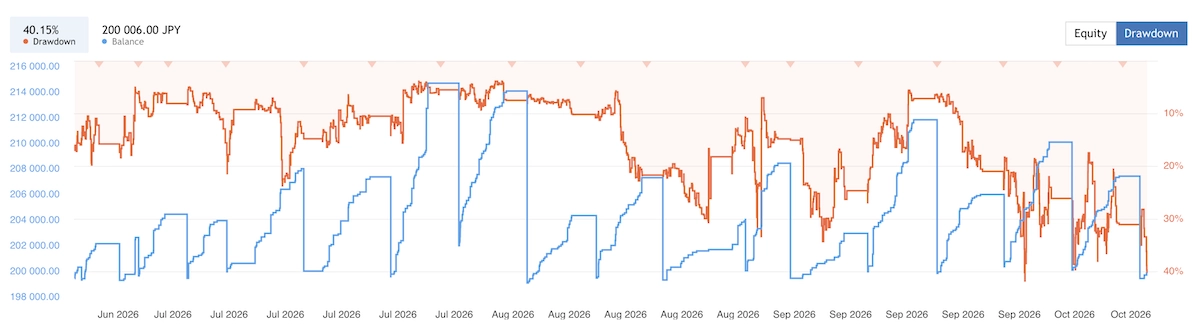
A suspended copy trader’s strategy due to dangerous drawdown
Case 2: The Vault, Then “Vault 2.0” (Hyperliquid)
A crypto influencer’s first Hyperliquid vault reached $405,200 in deposits before closing. A second vault under the same name, called “Vault 2.0,” peaked at $327,600 and now shows a lifetime return of -100%. It looks like the trader over $730,000 of depositors’ money in just 11 days.
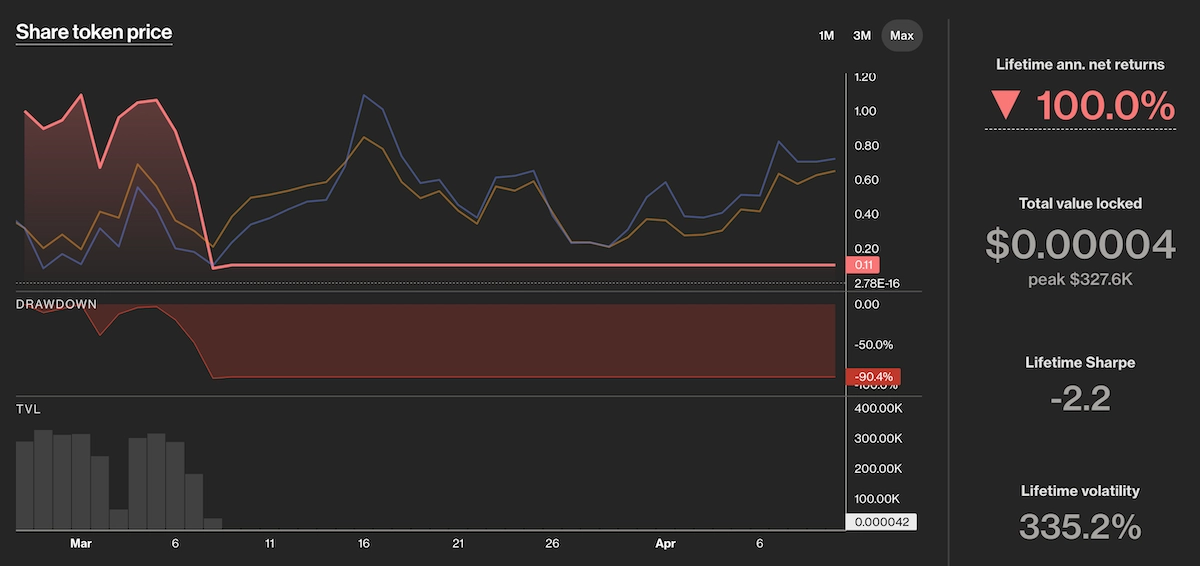
Value of vault drops over 95% from peak in two months
Case 3: Three Providers, One Pattern (cTrader Copy)
A follower on cTrader’s forum asked how three providers with a year of strong results and about $2 million copying them all blew up in the same way. Another thread pointed out that published balance drawdowns of 3% to 5% hid equity drawdowns of 10% to 50%.
These are follower reports, not verified findings, but any cTrader provider, including myself, will recognize the pattern.
Social Media: Where Relaunched Accounts Find Followers
A new strategy account needs followers quickly, and platforms like TikTok, Instagram, YouTube, and Telegram provide them, often through broker links that pay the promoter for every lot traded.
In April 2026, the FCA and 16 other regulators took action against illegal financial influencers. In the UK alone, the FCA found 1,267 illegal financial ads reaching at least 2.34 million accounts.
IOSCO’s report connects this directly to copy trading. France’s AMF recorded 22 copy-trading complaints since 2021 that were actually scams, mostly linked to trading courses. Belgium’s FSMA described courses where the instructor becomes the copied trader, and the students become followers.
The misinformation follows a pattern: showing returns without drawdowns, gains on very small accounts, using “AI” labels, and presenting a new account’s clean history instead of the one it replaced.
The Regulation Gaps
Copy trading is legal in most major markets, but usually only the broker is regulated. On both platforms where I offer strategies, the license belongs to the broker, not to me. Few regulators have specific rules for copy trading.
The UK’s FCA treats automatic copying as portfolio management, which requires authorization, but IOSCO has found little guidance and few enforcement actions. On networks, the provider is usually just another client, and brokers may disclaim responsibility for the signals.
For example, Pepperstone offers the DupliTrade copy trading service but notes in its footer that DupliTrade is a third-party BVI-registered company and that it does not control the signals.
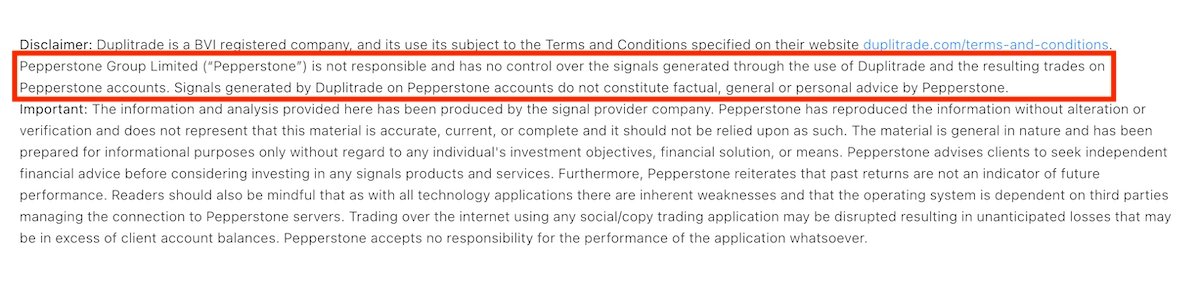
Pepperstone makes it clear it is not responsible for the signals generated through the use of DupliTrade
Leverage limits only apply within certain borders. The EU, UK, and Australia cap retail forex leverage at 1:30, but Seychelles-licensed brokers advertise 1:1000, 1:2000, or even unlimited leverage. Offshore clients can lose access to compensation schemes and ombudsman services.
Crypto copy trading often falls outside securities rules, and decentralized vaults have no intermediary. Most IOSCO respondents said copy trading comes from abroad and is beyond their control.
Stricter regulations do change behavior: in Japan, paid lead traders must register, and only one firm offers copy trading. eToro’s risk-score cap and Darwinex’s risk engine are examples of platform-level controls.
What To Check Before Copying Anyone
Learn from my mistakes. These are the checks I would do, and each one only takes a few minutes.
| Check | Red flag |
|---|---|
| Track record | Under six months, or a profile launched soon after the same operator’s last collapse |
| Drawdown | Equity drawdown above 50%, or a wide gap between balance and equity drawdown |
| Win rate vs loss size | Win rate above 80% with losers held open for days, or a trader adding to losing positions |
| Leverage and broker entity | 1:500 or higher, or an account with an offshore arm of the broker |
| Provider’s own funds | Pressure to sign up under their partner or referral code |
| Who regulates each layer | A broker that disclaims the signals, or a network registered offshore |
| How you found them | A Telegram “VIP” group or screenshots with no live profile. Check the name on the FCA Warning List or your regulator’s equivalent |
I’ve also found that two settings matter as much as choosing the provider: only copy with money you can afford to lose completely, and set a copy stop-loss if the platform allows it.
The Bottom Line
Copy-trading blow-ups are not just bad luck. Most providers aren’t trying to wipe out their followers – they are chasing returns that boost their rankings, and the system rewards them for it.
On most independent networks and crypto exchanges, providers get paid whether followers win or lose, keep any fees already collected, and can start over at almost no cost, often risking much less of their own money than their followers do.
My own experience matches this: I copied more than 10 high-ROI strategies with real money, and every one was wiped out within two to six months. Copy trading isn’t impossible to use, but the platform, the payment model, and the provider’s own stake matter more than any return number. Used correctly, and on a respected platform, they can still be useful for newer traders seeking to watch and learn from more experienced traders.
However, until regulators create rules for copy trading and can oversee offshore entities, followers must do their own checks. By the time an account collapses, the provider has usually already been paid.
Disclaimer:
- The author of this report has a personal stake in copy trading. They offer strategies on two of the platforms discussed here, including eToro, which has strict rules. Please keep this in mind as you read this report, but note there are no links to their own trading strategies to remain impartial.
- This investigation combines the hands-on copy trading experience of the author, who has spent over two years operating as both an investor and strategy provider, along with detailed analysis of strategies in cTrader Copy. The test sample may not be representative of industry-wide copy trading results.
- This report is for general information. It is not investment advice or a recommendation to follow any specific copy trader. You could lose any money you invest. Past copy trading performance results and high rankings on leaderboards do not guarantee future success.