Lowest Margin Rate Brokers In 2026
Margin accounts can be a weapon to ramp up potential profits, with the margin rate the cost of borrowing funds from your broker. The lower the rate, the better overall return you stand to make, though there are trade-offs (more on this later). We’ve ranked trusted brokers by their lowest margin rates for trading.
 Written By
Royston Wild
Royston is a seasoned investor and financial writer with over a decade of experience analyzing brokers and investment markets. With a background in stocks, commodities, and forex reporting - he brings a fresh perspective to broker evaluations.
Royston Wild Profile Page Fact Checked By
Tobias Robinson
Tobias is committed to helping traders find the right brokerage for their needs. He has tested 200+ brokers, spent 2,600+ hours using different platforms, and placed 2,100+ trades.
Tobias Robinson Profile Page Edited By
James Barra
James is an experienced broker analyst with a background in financial services. He has spent 2,500+ hours testing brokers, used 35+ different platforms and apps, audited 120+ broker T&Cs, and verified 300+ regulatory licenses. James has also been on US and UK TV, and been a guest on finance podcasts, discussing reports conducted by BrokerListings.com and sharing his expertise.
James Barra Profile PageAugust 10, 2026
For CFDs and FX, the rate listed below represents the annualized administrative markup charged in addition to the central bank or interbank benchmark rate (e.g., SOFR, SONIA). For traditional stock brokers in the US, the rate represents the total, all-inclusive annualized interest rate charged on debit balances. Borrowing costs can vary based on your account balance, the product traded, and the margin model applied.
 Moomoo
 Firstrade
-
 Available in United States
Not available in United States
Rating breakdown
Available in United States
Not available in United States
Rating breakdownInteractive Brokers (IBKR) is a leading brokerage offering access to over 170 markets in 40 countries and a range of investment services. With 40+ years in the industry, this Nasdaq-listed company follows strict regulations by the SEC, FCA, CIRO, SFC, Europe and beyond, making it a trusted global trading broker.
Margin Rate
5.5% - 6.13% (depending on account tier)- Demo Account
- ✓
- Minimum Deposit
- $0
- Minimum Trade
- $1
- Leverage
- 1:50 (major forex pairs), 1:2-1:4 (equities)
- Copy Trading
- ✗
- Regulator
- SEC, FINRA, CFTC, NFA, CIRO, FCA, CBI, ASIC, SFC, SEBI, JFSA, MAS
- Instruments
- Stocks, Options, Futures, Forex, Funds, Bonds, ETFs, Mutual Funds, Cryptocurrencies, CFDs Stocks, Options, Futures, Forex, Funds, Bonds, ETFs, Mutual Funds, Cryptocurrencies
- Platforms
- Trader Workstation (TWS), IBKR Desktop, GlobalTrader, Mobile, Client Portal, AlgoTrader, OmniTrader, TradingView, eSignal, TradingCentral, ProRealTime, Quantower
- Account Currencies
- USD, EUR, GBP, CAD, AUD, INR, JPY, SEK, NOK, DKK, CHF, AED, HUF
- Automated Trading
- TWS API
- AI
- ✓
- Guaranteed Stop Loss
- ✗
-
Available in United States
Not available in United States
Rating breakdown
Moomoo is a regulated trading platform overseen by trusted regulators like the SEC. It provides a simple, cost-effective method to trade in stocks, ETFs, and various assets from China, Hong Kong, Singapore, the US, and Australia. They provide the option for margin trading, along with no minimum deposit requirement, and several bonus options.
Margin Rate
6.8%- Demo Account
- ✓
- Minimum Deposit
- $0
- Minimum Trade
- $0
- Leverage
- 1:2
- Copy Trading
- ✗
- Regulator
- SEC, FINRA, MAS, SFC, ASIC, CIRO, JFSA, SC
- Instruments
- Stocks, Options, ETFs, ADRs, OTCs ,Futures
- Platforms
- Desktop Platform, Mobile App
- Account Currencies
- USD, CAD, AUD, JPY, MYR, HKD, SGD, CNY
- Automated Trading
- Moomoo OpenAPI
- AI
- ✓
- Guaranteed Stop Loss
- ✗
-
Available in United States
Not available in United States
Rating breakdown
Firstrade is a US-based discount broker-dealer authorized by the SEC and a member of FINRA/SIPC. It offers welcome bonuses, advanced tools and apps, and commission-free trading. Firstrade Securities is a popular top online brokerage, and opening a new account is fast and simple.
Margin Rate
8% – 12%- Demo Account
- ✗
- Minimum Deposit
- $0
- Minimum Trade
- $5
- Leverage
- 1:2
- Copy Trading
- ✗
- Regulator
- SEC, FINRA
- Instruments
- Stocks, ETFs, Options, Mutual Funds, Bonds, Fixed
- Platforms
- Firstrade Invest 3.0, TradingCentral
- Account Currencies
- USD
- Automated Trading
- ✗
- AI
- ✓
- Guaranteed Stop Loss
- ✗
Compare Margin Rates and Trading Features
Compare margin rates, max leverage and whether brokers will stop your account going negative when trading on margin:
| Broker | |
USD Account |
Margin Rate |
Maximum Leverage |
Negative Balance Protection (For Non-US) |
|---|---|---|---|---|---|
 |
✓ | 5.5% - 6.13% (depending on account tier) | 1:50 (major forex pairs), 1:2-1:4 (equities) | ✗ | |
|
✓ | 6.8% | 1:2 | ✗ | |
|
✓ | 8% – 12% | 1:2 | ✗ | |
| Broker | |
USD Account |
Margin Rate |
Maximum Leverage |
Negative Balance Protection (For Non-US) |
Broker Details Comparison
| Broker | Demo Account |
Minimum Deposit |
Minimum Trade |
Leverage |
Assets |
Platforms |
|---|---|---|---|---|---|---|
|
✓ | $0 | $1 | 1:50 (major forex pairs), 1:2-1:4 (equities) | Stocks, Options, Futures, Forex, Funds, Bonds, ETFs, Mutual Funds, Cryptocurrencies, CFDs Stocks, Options, Futures, Forex, Funds, Bonds, ETFs, Mutual Funds, Cryptocurrencies | Trader Workstation (TWS), IBKR Desktop, GlobalTrader, Mobile, Client Portal, AlgoTrader, OmniTrader, TradingView, eSignal, TradingCentral, ProRealTime, Quantower |
|
✓ | $0 | $0 | 1:2 | Stocks, Options, ETFs, ADRs, OTCs ,Futures | Desktop Platform, Mobile App |
|
✗ | $0 | $5 | 1:2 | Stocks, ETFs, Options, Mutual Funds, Bonds, Fixed | Firstrade Invest 3.0, TradingCentral |
| Broker | Demo Account |
Minimum Deposit |
Minimum Trade |
Leverage |
Assets |
Platforms |
Safety Comparison
Compare how safe the Lowest Margin Rate Brokers In 2026 are.
| Broker | Trust Rating |
Guaranteed Stop Loss |
Negative Balance Protection |
Segregated Accounts |
|---|---|---|---|---|
|
✗ | ✗ | ✓ | |
|
✗ | ✗ | ✓ | |
|
✗ | ✗ | ✓ | |
| Broker | Trust Rating |
Guaranteed Stop Loss |
Negative Balance Protection |
Segregated Accounts |
Mobile Trading Comparison
Compare the mobile trading features of the Lowest Margin Rate Brokers In 2026.
| Broker | Mobile Apps |
iOS Rating |
Android Rating |
Smart Watch App |
|---|---|---|---|---|
|
iOS & Android | ✓ | ||
|
Yes (iOS & Android) | ✗ | ||
|
iOS & Android | ✗ | ||
| Broker | Mobile Apps |
iOS Rating |
Android Rating |
Smart Watch App |
Comparison for Beginners
Compare how suitable the Lowest Margin Rate Brokers In 2026 are for beginners.
| Broker | Demo Account |
Minimum Deposit |
Minimum Trade |
Education Rating |
Support Rating |
Fractional Shares |
Demo Competitions |
|---|---|---|---|---|---|---|---|
|
✓ | $0 | $1 | ✓ | ✗ | ||
|
✓ | $0 | $0 | ✓ | ✗ | ||
|
✗ | $0 | $5 | ✓ | ✗ | ||
| Broker | Demo Account |
Minimum Deposit |
Minimum Trade |
Education Rating |
Support Rating |
Fractional Shares |
Demo Competitions |
Comparison for Advanced Traders
Compare how suitable the Lowest Margin Rate Brokers In 2026 are for advanced or professional traders.
| Broker | Automated Trading |
VPS |
API |
AI |
Pro Account |
Leverage |
Low Latency |
Extended Hours |
|---|---|---|---|---|---|---|---|---|
|
TWS API | ✗ | ✓ | ✓ | ✗ | 1:50 (major forex pairs), 1:2-1:4 (equities) | ✓ | ✓ |
|
Moomoo OpenAPI | ✗ | ✓ | ✓ | ✗ | 1:2 | ✓ | ✓ |
|
✗ | ✗ | ✗ | ✓ | ✗ | 1:2 | ✗ | ✓ |
| Broker | Automated Trading |
VPS |
API |
AI |
Pro Account |
Leverage |
Low Latency |
Extended Hours |
Accounts Comparison
Compare the trading accounts offered by Lowest Margin Rate Brokers In 2026.
| Broker | Demo Account |
Interest on Cash |
Islamic Account |
Joint Account |
Managed Account |
PAMM |
MAM |
LAMM |
Pro Account |
|---|---|---|---|---|---|---|---|---|---|
|
✓ | USD: 3.14%, GBP: 3.24% | ✗ | ✓ | ✓ | ✗ | ✓ | ✗ | ✗ |
|
✓ | USD: 3.35% | ✗ | ✗ | ✗ | ✗ | ✗ | ✗ | ✗ |
|
✗ | ✗ | ✗ | ✓ | ✗ | ✗ | ✗ | ✗ | ✗ |
| Broker | Demo Account |
Interest on Cash |
Islamic Account |
Joint Account |
Managed Account |
PAMM |
MAM |
LAMM |
Pro Account |
Detailed Rating Comparison
Compare how we rated the Lowest Margin Rate Brokers In 2026 in key areas.
| Broker | Trust |
Platforms |
Assets |
Mobile |
Fees |
Accounts |
Research |
Education |
Support |
|---|---|---|---|---|---|---|---|---|---|
|
|||||||||
|
|||||||||
|
|||||||||
| Broker | Trust |
Platforms |
Assets |
Mobile |
Fees |
Accounts |
Research |
Education |
Support |
Fee and Cost Comparison
Compare the cost of trading with the Lowest Margin Rate Brokers In 2026.
| Broker | Cost Rating |
Fixed Spreads |
Inactivity Fee |
EUR/USD Spread |
Crypto Spread |
|---|---|---|---|---|---|
|
✗ | $0 | 0.08-0.20 bps x trade value | 0.12%-0.18% | |
|
✗ | $0 | ✗ | 0.49% per spot Bitcoin trade (US), 0.3% to 0.39% (Singapore) | |
|
✗ | $0 | ✗ | Variable | |
| Broker | Cost Rating |
Fixed Spreads |
Inactivity Fee |
EUR/USD Spread |
Crypto Spread |
Customer Ratings
Compare how customers of these brokers feel about them, with real user ratings from Trustpilot, the Apple App Store and Google Play.
| Broker | Customers |
Trustpilot Score |
Trustpilot Reviews |
Android App Rating |
iOS App Rating |
|---|---|---|---|---|---|
|
4,300,000 | 5,531 | |||
|
24,000,000 | 739 | |||
|
✗ | 53 | |||
| Broker | Customers |
Trustpilot Score |
Trustpilot Reviews |
Android App Rating |
iOS App Rating |
Broker Popularity
See how popular the Lowest Margin Rate Brokers In 2026 are in terms of number of clients.
| Broker | Popularity |
|---|---|
| Moomoo |
|
| Interactive Brokers |
|
Why Trade With Interactive Brokers?
Interactive Brokers is ideal for seasoned traders due to its robust charting platforms, updated data, and adaptability, especially with the IBKR Desktop application. Its exceptional pricing and advanced order features appeal to traders, and its variety of stocks remains unmatched in the market.
 Christian Harris
Review Author
Pros
- IBKR, primarily designed for skilled traders, has expanded its appeal recently by eliminating its initial $10,000 deposit requirement.
- IBKR is a highly regarded brokerage, regulated by multiple respected authorities. This speaks to its legitimacy and standing within the online trading industry, providing peace of mind.
- The TWS platform is designed for intermediate to advanced traders. It includes over 100 order types and a dependable real-time market data feed that rarely experiences downtime.
Cons
- TWS is complex, and beginners might find it difficult to use and understand all its features.
- In 2025, IBKR was fined $11.8 million by the US OFAC for offering services in restricted areas. It also faced a $125,000 fine from FINRA in 2025 for failing to disclose municipal bond information.
- IBKR offers many research tools. However, the tools are not uniformly distributed across trading platforms and the web-based 'Account Management' page, causing confusion for the users.
Why Trade With Moomoo?
Moomoo is a great option for beginner and intermediate traders aiming to diversify their investment portfolio. The brokerage's app is easily navigable and the trading fees are significantly low.
James BarraReview Author
Pros
- Moomoo offers detailed analytics and insights compared to other brands.
- The fees for options contracts have been lowered from $0.65 to $0.
- API Skills offers agentic investing for retail traders. Users can connect their AI agents, such as Claude or OpenAI, to Moomoo's platform to execute algorithmic strategies using natural language.
Cons
- Moomoo has received several regulatory penalties lately, including fines and orders in 2026 that temporarily halted the acceptance of some Japanese and Chinese clients.
- No negative balance protection, a standard safety feature at top-tier regulated brokers.
- The account options are limited compared to similar brokerages, with no managed portfolios or robo-advisor solutions.
Why Trade With Firstrade?
Firstrade is ideal for beginners wanting to trade US stocks without commission fees. It offers plenty of free educational resources and high-quality research, including its new FirstradeGPT tool. Users also get trading ideas from Morningstar, Briefing.com, Zacks, and Benzinga.
James BarraReview Author
Pros
- Improved stock trading features now include overnight trading and fractional shares.
- FirstradeGPT ranks among the initial brokers to offer AI-powered analysis.
- Improved platform in 2025 with Firstrade Invest 3.0, featuring a cleaner interface and faster order entry for active traders in key areas like watchlists and options chains.
Cons
- Visa card deposits and withdrawals are not accepted.
- Customer support needs improvement after testing, but 24/7 help is now available.
- Firstrade does not offer a demo or paper trading account, unlike over 90% of other options we've reviewed.
Filters
How We Selected The Top Low Margin Rate Brokers
- We recorded the margin rates, where available, for brokers in our directory. We routinely check these rates and update them as needed.
- We listed our highest rated brokers by their margin rate, from low to high, to reveal those with the cheapest borrowing rates.
What To Consider When Choosing A Broker With A Low Margin Rate
What Is The Actual Margin Rate?
This is a no-brainer. But let’s use this as an opportunity to look at how the margin rate itself is calculated.
Margin rates aren’t charged on the money the trader themselves puts up, but on the capital that’s been borrowed from the brokerage using a margin trading account. Essentially, it’s the central bank base rate plus around 1% to 3% on top. It may be slightly above this range or below it. The exact level of the rate can also differ widely among brokers.
Let’s say you invest $50,000 and make a 7% return. You’d make a profit of $3,500 and come out of the trade with $53,500 in your account.
How about if you used leverage from your broker of 1:2 and put up the same $50,000? This would give you $100,000 to trade with, generating a total value of $107,000 and a gross profit of $7,000 if you made the same 7% return.
Yet this $7,000 isn’t the amount you’d keep. This is because you’d need to deduct the cost of borrowing the extra capital (the margin rate), which is charged as a percentage of the $50,000 you borrowed.
If the margin rate is 3%, you’d have to pay $1,500 in financing costs to the broker (3% x $50,000). That leaves a net profit of $5,500, reducing your total account value to $55,500.
Now if the margin rate was 1%, you’d have to deduct $500 (1% x $50,000) from your $7,000. The result? A more favorable net profit of $6,500 and an account value of $56,500.
As you can see, that 2% difference in those two margin rates creates a net profit variance of $1,000, even though the return on the trade is identical.
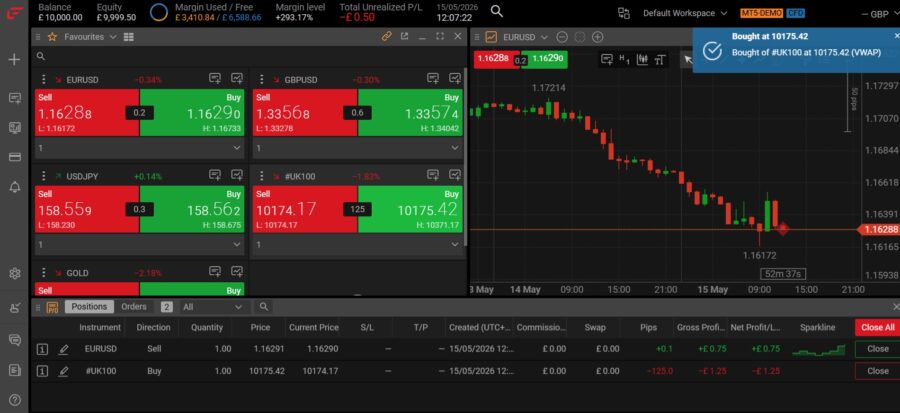
Top brokers, such as FxPro, not only offer some of the lowest margin rates on the market, but also clearly indicate the level of margin used and current margin levels in the top of the platform interface, as you can see below.
What Is The Maximum Leverage?
Maximum leverage refers to the largest position a trader can control relative to the size of the deposit they’ve made. Greater leverage allows you to open large positions even if your own funds are relatively modest.
The amount of leverage you can use can differ among brokers. It can also vary greatly according to the asset class you’re trading, and whether you qualify as a retail or professional trader.
Leverage levels can also be capped by the financial regulations in the region in which you operate. In the UK and European Union, for instance, leverage on major forex pairs is limited to 1:30 to retail investors, while in the US this is restricted to 1:50.
In some overseas territories, brokers are allowed to offer far higher levels of leverage. IC, for example, offers retail investors leverage of up to 1:500 through its subsidiaries in territories with less strict financial regulations (such as the Seychelles).
Pro tip: Investors may be able to get around local leverage restrictions by opening an account with the broker under an overseas subsidiary like this. But this is high risk, as it typically means you surrender essential protections like:
- Greater regulatory oversight on bad business practices and potential scams.
- Access to compensation schemes if the broker goes bust (like the Entschädigungseinrichtung der Wertpapierhandelsunternehmen (EdW) in Germany).
- Client fund segregation.
Choosing a broker with the highest leverage gives you a chance to make greater profits compared with using just your own cash. But beware: using a broker with higher maximum leverage can open the door to blowing a serious hole in your pocket.
Pro tip: As the example above shows, using margin to control larger positions gives investors the opportunity to amplify their profits. But just as they can boost earnings when a trade goes right, they can also mean gigantic losses when the market moves in the ‘wrong’ direction.
Based on that same trading scenario, let’s say you make a 7% negative return on your $50,000 investment instead of a positive one. Without leverage, you’d lose $3,500 and have $46,500 sitting in your trading account.
But what about if you used that leverage at 1:2 instead and at the 3% margin rate? Well you’d be down $7,000, as the 7% loss would apply to the full $100,000 position rather than just your own $50,000 stake.
That’s not all, as you’d also be on the hook for that $1,500 margin cost. After everything is shaken out, you’d have lost $8,500, leaving you with $41,500.
As a consequence, using risk management tools (such as guaranteed stop-loss orders, or GLSOs) are especially critical when trading on margin. Also think about whether you actually need to use high levels of leverage, based on your investment strategy and experience. New investors especially should avoid using borrowed funds.
What Is The Margin Requirement?
While leverage defines the size of the position you can control, the margin requirement determines the amount of your own funds required to open and maintain that position. Margin requirements also varies according to the broker and the market you’re looking to trade.
Pro tip: Margin requirements are typically higher, for example, for major forex pairs than minor or exotic currency pairings.
The reason? Liquidity tends to be higher for major pairs, and as a result price volatility is usually much lower. This subsequently means reduced danger to the broker. The same risk considerations are why greater leverage is almost always available on major currency pairs than for other pairings.
Margin requirements aren’t just important for creating a position. These must be maintained throughout the duration of the trade being open. If your own funds fall below this level, you could be hit by a margin call, where the brokerage will shut your position if you don’t deposit more cash.
Some brokers also operate ‘flexible’ margin requirement structures, where the larger a position you control, the more of your own cash you’ll need to deposit to open and maintain it.
Bottom Line
High margin rates can substantially eat into traders’ profits. So it’s important to keep these to a minimum, though other factors like maximum leverage and margin requirements should also be carefully considered.
Trading on margin can boost an investor’s gains by allowing them to control larger positions. However, using leverage is a double-edged sword as losses can also swell if you take the ‘wrong’ position.
FAQs
What Are Margin Rates In Trading?
This is the cost of using leverage, and is calculated as a percentage of the capital a trader has borrowed from their broker. Keep in mind that the margin rate can and will change over time, so keep an eye on updates from your broker or check our comparison table.