

Pepperstone vs XM
Which broker is superior: Pepperstone or XM? Read our comparison of the two brokers to help you choose the right one for your trading needs.
Pepperstone and XM were both tested in a live account by the BrokerListings team. We spent 50+ hours reviewing Pepperstone and XM and comparing them.
 Written By
James Barra
James is an experienced broker analyst with a background in financial services. He has spent 2,500+ hours testing brokers, used 35+ different platforms and apps, audited 120+ broker T&Cs, and verified 300+ regulatory licenses. James has also been on US and UK TV, and been a guest on finance podcasts, discussing reports conducted by BrokerListings.com and sharing his expertise.
James Barra Profile Page Fact Checked By
William Berg
William Berg combines his expertise in law and finance to analyze trading brokers. He has checked 3,250+ regulatory licenses, investigated 2,365+ broker clones and trading scams, and placed 3,500+ trades.
William Berg Profile Page Edited By
Tobias Robinson
Tobias is committed to helping traders find the right brokerage for their needs. He has tested 200+ brokers, spent 2,600+ hours using different platforms, and placed 2,100+ trades.
Tobias Robinson Profile PageSeptember 9, 2026
Quick Verdict
Neither Pepperstone nor XM accepts traders from USA. Instead, we recommend FOREX.com, a top-rated alternative that impressed our team during testing and accepts traders from your location.


Pepperstone and XM are both strong CFD and forex brokers with MetaTrader platforms, low entry barriers, free demo accounts, broad market coverage, and multilingual support. Both also separate client money and provide negative balance protection, though the exact safeguards depend on the legal entity.
Pepperstone is the stronger fit for platform choice, low-cost active trading, and access to TradingView and cTrader. XM stands out for its wider account range, faster withdrawal handling, richer education, round-the-clock support, and a better-rated mobile experience.
Long-term investors should check the account and region carefully. Pepperstone is mainly a CFD broker, while XM offers a Shares Account in some regions, but neither broker pays interest on idle cash.
Regulation & Trust
Pepperstone and XM are fairly evenly matched for trust, but their protection levels work differently. Pepperstone holds four high-grade licences, including from the FCA, ASIC, DFSA, and CySEC, while XM has a large global group with CySEC and DFSA supervision alongside lighter offshore entities in Belize, Mauritius, and Seychelles.
When we traced the legal entity shown during regional sign-up journeys, XM required more care because protections can change greatly by location. EEA clients can receive CySEC oversight and up to €20,000 in ICF cover, but clients placed under offshore XM entities receive lighter statutory protection.
Pepperstone has a simpler high-tier regulatory profile and offers UK clients FSCS protection up to £85,000. It also keeps client funds separate and provides negative balance protection to retail clients, although professional clients do not receive this protection.
Neither broker is stock-exchange listed or has a banking licence, so both offer less public financial detail than listed rivals. Pepperstone withdrew from the Financial Commission in 2026, while XM’s wider group structure, regional domains, and marketing-only entities make licence and website checks especially important before funding an account.
Accounts & Banking
XM offers the more complete account and banking package. It has Micro, Standard, Ultra Low, and, in selected regions, Shares accounts, compared with Pepperstone’s Standard and Razor accounts plus regional Islamic and UK spread-betting options.
During our account-opening walkthroughs, Pepperstone’s all-digital application took only a few minutes, while XM’s full KYC approval is typically completed within 24 hours. XM starts from $5, which is clear and accessible, while Pepperstone has no fixed minimum deposit but payment-method limits can still apply.
Both brokers offer free demos. Pepperstone provides up to $50,000 in virtual money, but its MT4 and MT5 demos expire after 60 days unless a live account is approved; its cTrader and TradingView demos do not expire. XM provides $10,000 in demo funds, which is less flexible for testing larger strategies.
In our funding-dashboard checks, XM’s card, wire, e-wallet, and local payment choices were easy to identify, although available gateways changed by entity. XM processes verified withdrawal requests within 24 hours, with 92% automatically approved, while Pepperstone withdrawals usually take two to three days; both generally charge no deposit or withdrawal fee, though Pepperstone can charge $20 for bank withdrawals outside the EU and Australia, and XM wires below $200 may carry provider costs.
Pepperstone has added PIX for Brazil, SPEI for Mexico, and funding through USDT, BTC, ETH, and USDC. XM has expanded its account extras through the XM Traders Club, referral rewards, deposit promotions in eligible regions, and demo trading competitions, but promotions should not outweigh trading conditions and withdrawal rules.
Assets & Markets
Pepperstone and XM both score well on market access, though their strengths differ. Pepperstone offers around 1,300 to 2,700+ instruments by region, while XM provides more than 1,400 instruments across forex, share CFDs, indices, commodities, metals, energies, and selected crypto CFDs.
When we compared instrument search results across trading workspaces, Pepperstone’s breadth was clearer in forex, ETFs, and specialist index exposure. It lists 100 currency pairs, 23 major stock indices, 101 ETFs, 21 crypto/fiat pairs, and three crypto funds, although these are CFDs rather than ownership of the underlying asset.
XM offers over 55 currency pairs, more than 1,200 share CFDs, over 30 index CFDs, and thematic indices covering areas such as AI and electric vehicles. Its real Shares Account can suit investors in eligible regions, but it does not offer bonds or ETFs, which leaves a notable diversification gap.
Pepperstone expanded its European share CFDs, equities, currency pairs, and commodities, adding useful choice for global CFD traders. XM remains appealing for commission-free stock CFDs and themed indices, but Pepperstone has the stronger product mix for traders who want ETFs and a larger forex list.
Fees & Costs
Pepperstone is the lower-cost choice for frequent forex traders, especially through its Razor account. Razor spreads start from 0 pips and the cTrader or TradingView commission is $3 per lot per side, while MetaTrader costs $3.50 per side.
For a simple EUR/USD 1-lot example, using a $10 pip value and each broker’s stated starting price, Pepperstone Razor on cTrader costs about $6 round trip: a 0-pip spread plus $3 to open and $3 to close. XM Ultra Low costs about $8 round trip: a 0.8-pip spread worth $8 plus no commission. Actual spreads move with market conditions, so these figures are a clear starting-cost illustration rather than a fixed quote.
XM’s Ultra Low account has spreads from 0.8 pips with no commission, which keeps its pricing simple. Pepperstone’s Standard account has variable spreads around 1.0 pip and no commission, making it easier for newer traders who do not want a separate dealing charge.
When we compared fee details before and after trade entry, Pepperstone’s platform-dependent commission difference was a small but important friction point: MetaTrader costs more than cTrader and TradingView. Pepperstone also has higher-than-average overnight charges, while XM charges a $5 inactivity fee; neither broker pays interest on unused cash, and XM may apply currency conversion fees.
Pepperstone’s Active Trader programme can reduce costs for high-volume clients, including a 5% commodity rebate at around 100 standard lots per month in the UK and EU. Share CFD commissions also apply at Pepperstone, including 0.10% on UK shares and 0.07% on Australian shares.
Platforms & Tools
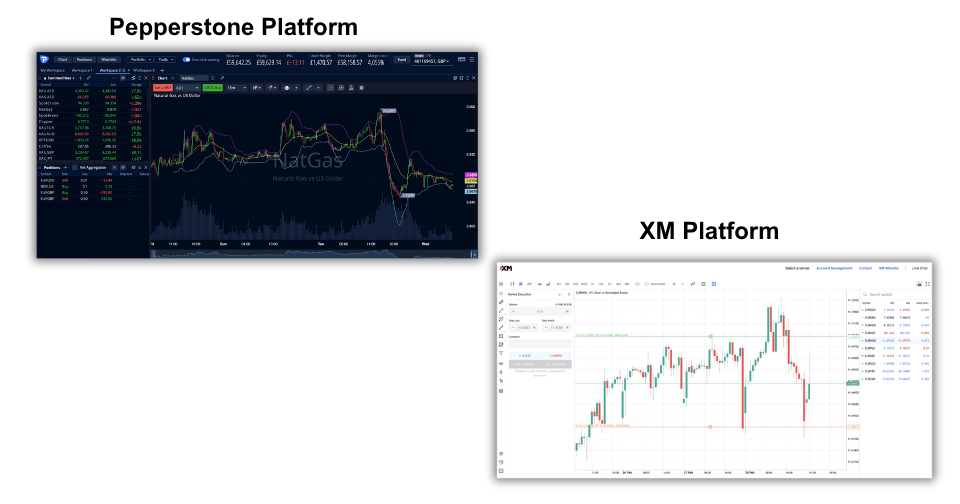
Pepperstone and XM are pretty equal on platforms and tools, but Pepperstone gives active traders more choice. Both support MT4, MT5, browser trading, mobile trading, automated strategies, and copy-trading options.
Across our desktop platform switches, Pepperstone offered the smoother multi-platform setup through MT4, MT5, cTrader, and TradingView. It also adds 28 Smart Trader add-ons for MetaTrader, including sentiment tools, automated trend lines, and a correlation matrix.
XM focuses on MT4 and MT5, where MT4 has more than 60 technical tools and MT5 has more than 80, plus extra order types and wider asset support. Its tools now include TradingView Charts, XM AI, price notifications, advanced watchlists, and market insights, though the mobile app does not carry every advanced charting function.
When we built watchlists and moved from chart analysis to trade tickets, XM’s MetaTrader setup was familiar but less distinctive for traders wanting a modern proprietary desktop platform. Pepperstone’s TradingView link is a major advantage, including spread betting for UK users, but cTrader’s built-in copy trading is not supported.
XM offers a VPS for automated trading when balance and volume conditions are met, otherwise it costs $28 per month, and its MultiTerminal helps users manage several accounts. Pepperstone supports Expert Advisors, scalping, hedging, MetaTrader Signals, DupliTrade, and a broad platform range, making it especially flexible for strategy-led trading.
Research
Pepperstone and XM are both strong for research. Both publish daily market material, technical and fundamental analysis, videos, economic-calendar content, and trading ideas that help traders follow market-moving events.
When we followed a market idea from analysis page to chart, Pepperstone’s in-house articles and videos were easy to access, and its 28 Smart Trader tools added practical support for technical work. The correlation matrix was particularly useful for spotting hidden exposure across similar currency trades.
XM’s research is more beginner-friendly in tone and includes daily analysis, asset reports, an economic calendar, and Trading Central insights. The calendar is useful for short-term traders planning around major data releases, but Trading Central would be more useful if it were fully integrated into the mobile app.
Pepperstone lacks a dedicated news feed and a standalone social community outside TradingView. XM’s research is clear, yet its main edge is third-party Trading Central content rather than a wider suite of advanced market-screening tools.
Education
XM is the stronger choice for education. Its programme combines live webinars seven days a week, 77 presenters, support in more than 20 languages, XM Community, Live Education, Tradepedia videos, and podcasts.
In our review of more than 20 learning and research resources, XM’s regular webinars gave beginners more chances to learn at their own time zone. Its material covers market basics, macro events, trading psychology, and strategy ideas in a clear format.
Pepperstone also offers useful guides, videos, webinars, YouTube content, and practical MT4 setup lessons. Its AI-assisted trading toolkit adds a manual and five expert talks on using AI for analysis, ideas, and performance review.
When we looked for a structured learning path rather than a single topic guide, Pepperstone’s content was harder to sort by skill level. XM could still improve with deeper courses, progress tracking, quizzes, and a glossary, but its overall education service is broader and easier to return to over time.
Customer Support
XM provides the stronger support service overall. It offers 24/7 help by live chat, email, and phone in more than 30 languages, while Pepperstone provides 24-hour weekday service and help across most of the weekend.
During our support-channel checks, XM’s live-chat replies to account questions were prompt and clear, while email responses handled more detailed requests such as leverage changes well. Service depth can still vary by language and region, which is an important issue for global clients.
Pepperstone also performs very well, with phone, email, chat, multilingual agents, and a detailed FAQ centre. Its app added Arabic support, helping more clients use the service in their preferred language.
When we moved from automated chat to a human agent, Pepperstone made the handoff easy and replies often arrived within minutes. The chatbot could be frustrating before that point, while XM users may face uneven response quality depending on their country or contact method.
Is Pepperstone or XM Better For Beginners?
XM is better for most beginners. Its $5 starting deposit, Micro Account, $10,000 demo account, seven-day webinar programme, and 24/7 multilingual support create a more guided first trading experience.
Pepperstone is still a good beginner choice because there is no fixed minimum deposit, its account opening is fast, and it offers $50,000 in demo funds. However, the 60-day MT4 and MT5 demo expiry and less structured education can make long-term learning less convenient.
Is Pepperstone or XM Better For Experienced Traders?
Pepperstone is better for experienced traders. Its choice of cTrader, TradingView, MT4, and MT5, plus Smart Trader tools, Expert Advisors, hedging, scalping support, and Active Trader rebates give skilled traders more ways to build and refine a workflow.
XM remains a capable alternative with MT5, MultiTerminal, copy trading, and a VPS that is free when eligibility conditions are met. Yet our platform workflow checks found Pepperstone’s wider third-party ecosystem better suited to algorithmic, chart-driven, and high-frequency strategy testing.
Is Pepperstone or XM Better For Short-term Traders?
Pepperstone is better for short-term traders. Its Razor account can start at 0-pip spreads with a $6 round-trip commission on a 1-lot cTrader EUR/USD trade under the stated starting conditions, compared with about $8 on XM Ultra Low using its 0.8-pip starting spread.
Pepperstone also supports scalping, hedging, EAs, TradingView, and cTrader, while rebates can help high-volume traders. XM offers no-commission Ultra Low pricing, Trading Central, a VPS, and reported smooth execution, but its platform choice is narrower for short-term strategy work.
Is Pepperstone or XM Better For Long-Term Traders?
XM is the better fit for long-term traders in regions where its Shares Account is available. It can provide access to real company shares rather than only CFDs, while Pepperstone’s offering is primarily built around CFD trading.
Neither broker offers interest on uninvested cash or a clear auto-investing service, and both have limits for buy-and-hold investors. Pepperstone has 101 ETF CFDs and a wider forex and ETF-CFD range, but XM’s real-share option is more suitable for investors who want underlying ownership.
Is Pepperstone or XM Better For Trading On Mobile?
XM is better for mobile trading. Its app combines account tools, copy trading, TradingView Charts, XM AI features, notifications, watchlists, and market insights, while its iOS and Android app feedback is stronger overall.
Pepperstone’s mobile app is simple to use and gives access to signal providers, while its wider TradingView connection remains valuable for chart-focused traders. In mobile usability checks, XM offered the more rounded all-in-one experience, although advanced technical tools are still more complete on desktop platforms.
Why Pick Pepperstone Over XM?
Pick Pepperstone if you want lower-cost active forex trading, a Razor account with raw-spread pricing, and access to cTrader and TradingView alongside MT4 and MT5. It also offers 100 forex pairs, ETF CFDs, Smart Trader tools, no fixed minimum deposit, and strong support for scalping, hedging, and automated trading.
Its regulatory setup is also more straightforward for many clients, with four top-tier licences. The main trade-offs are a smaller account range, two-to-three-day withdrawal processing, higher overnight costs, and no real share dealing.
Why Pick XM Over Pepperstone?
Pick XM if you value a $5 entry point, Micro and Ultra Low accounts, withdrawal processing within 24 hours, a Shares Account in eligible regions, and a very broad education programme. Its 24/7 support in over 30 languages, seven-day webinars, promotions in eligible areas, and strong mobile features also suit newer global traders.
XM is also a practical MetaTrader-focused broker with Trading Central, VPS access, MultiTerminal, and copy trading. Before opening an account, confirm the exact XM entity, because product access, bonuses, and client protections can be very different across its regulated regions.
Compare Pepperstone and XM Details
|
Pepperstone
|
XM
|
|
|---|---|---|
Founded in Australia in 2010, Pepperstone is a highly-rated forex and CFD broker with over 830,000 global clients. It provides access to 1,400+ instruments on top platforms like MT4, MT5, cTrader, and TradingView, with low, clear fees. Pepperstone is regulated by reputable bodies such as the FCA, ASIC, and CySEC, ensuring a secure trading environment. | XM is a trusted global forex and CFD broker with over 20 million clients in more than 190 countries. Since 2009, it has offered low trading fees on 1000+ instruments. XM provides a full MetaTrader experience that we have tested firsthand. 100% deposit bonus + further offers up to $4500100% deposit bonus + further offers up to $4500 | |
| Payment Methods | Apple Pay, BPAY, Credit Card, Debit Card, Google Wallet, M-Pesa, Mastercard, Neteller, PayPal, PIX Payment, Skrill, UnionPay, Visa, Wire Transfer | Airtel, Apple Pay, Credit Card, Debit Card, Google Wallet, M-Pesa, Neteller, Perfect Money, Skrill, TransferWise, Visa, Wire Transfer |
| Account Currencies | USD, EUR, GBP, CAD, AUD, NZD, JPY, CHF, HKD, SGD | USD, EUR, GBP, JPY, ZAR |
| Trustpilot Score | ||
| App Review | Pepperstone stands out for its great integration with MT4, MT5, cTrader, and TradingView apps, making it a top choice for traders familiar with these major platforms. These apps provide a stable, reliable mobile trading experience, boosted by Pepperstone's fast execution speeds and wide asset range. Recent upgrades helped it earn second place in DayTrading.com's annual 'Best Trading App' award for 2025. | provides a mobile app for Android and iOS, optimized for each platform. The app offers MT4 and MT5 software, giving full access to over 1,400 instruments. It is reliable with minimal glitches or delays. Features like built-in news, a trading journal, and push notifications provide all necessary trading tools. |
| Awards |
|
|
| Account Types | STP, ECN, DMA, MAM, PAMM | STP |
| Robo Advisor | ✗ | ✗ |
| Market Maker | ✗ | ✓ |
| P2P Trading | ✗ | ✗ |
| Spot Trading | ✓ | ✓ |
| Copy Trading Platform | Pepperstone supports copy trading through MetaTrader Signals, DupliTrade, and its app, powered by Pelican Trading in select regions. Users can access thousands of traders and set risk levels. However, it does not support cTrader Copy, which may affect cTrader users. | XM provides copy trading through its user-friendly app, featuring exclusive crypto pairs. XM global also offers a built-in signals service on the MT5 platform. Traders can access detailed performance metrics and replicate the trades of strategy managers. The setup is straightforward, requiring just a few steps after logging into your MQL5 community account. |
| Trade Signals | ✓ | ✓ |
| Tournaments | ✗ | ✓ |
| Demo Competitions | ✗ | ✓ |
| Ethical Investing | ✗ | ✗ |
| Custodial Account | ✗ | ✗ |
| Guaranteed Stop Loss | ✗ | ✗ |
| Islamic Account | ✓ | ✓ |
CFD Trading | ||
Pepperstone remains a top-notch CFD broker based on our recent tests. The broker offers swift execution speeds averaging 30ms, a high fill rate of 99.90% and over 1,300 assets to trade. This ensures a smooth trading experience without interruptions or the need for re-quotes. | XM provides CFD traders with flexible leverage and a wide range of markets, including custom indices for sectors like artificial intelligence. The MT4/MT5 platforms are fast and reliable, and traders using algorithmic strategies can access a free VPS. | |
| Leverage | 1:30 (Retail - UK, EU, Australia), 1:500 (Pro), 1:200 (Offshore), 1:400 (Kenya) | 1:10001:30 |
| FTSE Spread | 1.0 | 1.4 |
| GBPUSD Spread | 0.4 | 0.8 |
| Oil Spread | 0.02 | 0.03 |
| Stocks Spread | 0.02 | 1.79 (Apple) |
Forex Trading | ||
Pepperstone offers exceptionally low forex spreads, averaging 0.12 pips on EUR/USD in the Razor account, with over 100 currency pairs to choose from. This exceeds what most competitors offer. Pepperstone uniquely provides three currency indices (USDX, EURX, JPYX), a rare feature in trading platforms. Pepperstone has claimed our 'Best Forex Broker' award twice. | XM provides a wide range of currency pairs with no re-quotes or hidden fees. Spreads now start at 0.6 pips on the EUR/USD in the commission-free account. | |
| Assets | 100+ | 55+ |
| Currency Indices | USD, EUR, JPY | USD |
Cryptocurrency Trading | ||
remains a trusted name in crypto CFD trading. It offers a moderate selection of digital tokens, including popular cryptocurrencies like Bitcoin and altcoins such as Ripple, with up to 1:10 leverage. Its crypto indices offer a comprehensive view of the digital currency markets, which is uncommon on other platforms. has also launched , a dedicated crypto exchange in Australia. | XM offers a limited range of cryptocurrency CFDs against the USD through its South African entity. Traders can access Bitcoin, Ethereum, and Ripple with leverage up to 1:500. Its selection is smaller than the 100+ crypto derivatives offered by some competitors. | |
| Crypto Coins | BCH, BTC, ETH, LTC, DASH, ADA, LINK, DOGE, EOS, DOT, XRP, XLM, XTZ, UNI, BNB | BTC, ETH, LTC, XRP, BCH |
| Crypto Lending | ✗ | ✗ |
| Crypto Mining | ✗ | ✗ |
| Crypto Staking | ✗ | ✗ |
| Auto Market Maker | ✗ | ✗ |
 Interactive Brokers
  NinjaTrader
  eToro USA