Best Dow Jones Industrial Average (DJIA) Brokers 2026
Discover the best brokers with access to the Dow Jones Industrial Average (DJIA) following our rigorous hands-on testing.
 Written By
Royston Wild
Royston is a seasoned investor and financial writer with over a decade of experience analyzing brokers and investment markets. With a background in stocks, commodities, and forex reporting - he brings a fresh perspective to broker evaluations.
Royston Wild Profile Page Fact Checked By
James Barra
James is an experienced broker analyst with a background in financial services. He has spent 2,500+ hours testing brokers, used 35+ different platforms and apps, audited 120+ broker T&Cs, and verified 300+ regulatory licenses. James has also been on US and UK TV, and been a guest on finance podcasts, discussing reports conducted by BrokerListings.com and sharing his expertise.
James Barra Profile Page Edited By
Tobias Robinson
Tobias is committed to helping traders find the right brokerage for their needs. He has tested 200+ brokers, spent 2,600+ hours using different platforms, and placed 2,100+ trades.
Tobias Robinson Profile PageOctober 14, 2026
 Our Top Pick in USA
1
Our Top Pick in USA
1
 eToro USA
-
Available in United States
Not available in United States
Rating breakdownVisit eToro USA Read ReviewSecurities trading offered by eToro USA Securities, Inc. (“the BD”), member of FINRA and SIPC. Cryptocurrency offered by eToro USA LLC (“the MSB”) (NMLS: 1769299) and is not FDIC or SIPC insured. Investing involves risk. This site is not an affiliate and may be compensated if you access certain products or services offered by the MSB and/or the BD.
eToro is a platform for social investing that provides options for both short and long-term trading on stocks, ETFs, options, and crypto. The platform is recognized for its easy-to-use, community-oriented interface and reasonable fees. Used by millions globally with a string of awards, eToro is a reputed name in the industry. Trading on eToro is facilitated by eToro USA Securities, Inc.
- Demo Account
- ✓
- Minimum Deposit
- $50
- Minimum Trade
- $10
- Leverage
- ✗
- Copy Trading
- ✓
- Regulator
- SEC, FINRA
- Instruments
- Stocks, Options, ETFs, Crypto
- Platforms
- eToro Trading Platform & CopyTrader
- Account Currencies
- USD
- Automated Trading
- ✗
- AI
- ✓
- Guaranteed Stop Loss
- ✗
-
Available in United States
Not available in United States
Rating breakdown
Founded in 2001, FOREX.com is part of StoneX, a global financial services firm with over a million customers. Regulated in the US, UK, EU, Australia, and other regions, it offers thousands of markets, not just forex, with competitive pricing on advanced platforms.
- Demo Account
- ✓
- Minimum Deposit
- $100
- Minimum Trade
- 0.01 Lots
- Leverage
- 1:50
- Copy Trading
- ✗
- Regulator
- NFA, CFTC
- Instruments
- Forex, Futures and Options on Metals, Energies, Commodities, Indices, Bonds Forex, CFDs, Stock CFDs, Indices, Commodities, Futures, Options, Crypto
- Platforms
- WebTrader, Mobile, MT4, MT5, TradingView
- Account Currencies
- USD, EUR, GBP, CAD, AUD, JPY, CHF, PLN
- Automated Trading
- Expert Advisors (EAs) on MetaTrader
- AI
- ✓
- Guaranteed Stop Loss
- ✗
Compare Brokers
| Broker | |
USD Account |
Demo Account |
Minimum Deposit |
Minimum Trade |
Leverage |
Copy Trading |
Regulator |
Instruments |
Platforms |
Account Currencies |
Automated Trading |
AI |
Guaranteed Stop Loss |
|---|---|---|---|---|---|---|---|---|---|---|---|---|---|---|
|
✓ | ✓ | $50 | $10 | ✗ | ✓ | SEC, FINRA | Stocks, Options, ETFs, Crypto | eToro Trading Platform & CopyTrader | USD | ✗ | ✓ | ✗ | |
 |
✓ | ✓ | $100 | 0.01 Lots | 1:50 | ✗ | NFA, CFTC | Forex, Futures and Options on Metals, Energies, Commodities, Indices, Bonds Forex, CFDs, Stock CFDs, Indices, Commodities, Futures, Options, Crypto | WebTrader, Mobile, MT4, MT5, TradingView | USD, EUR, GBP, CAD, AUD, JPY, CHF, PLN | Expert Advisors (EAs) on MetaTrader | ✓ | ✗ | |
| Broker | |
USD Account |
Demo Account |
Minimum Deposit |
Minimum Trade |
Leverage |
Copy Trading |
Regulator |
Instruments |
Platforms |
Account Currencies |
Automated Trading |
AI |
Guaranteed Stop Loss |
Safety Comparison
Compare how safe the Best Dow Jones Industrial Average (DJIA) Brokers 2026 are.
| Broker | Trust Rating |
Guaranteed Stop Loss |
Negative Balance Protection |
Segregated Accounts |
|---|---|---|---|---|
|
✗ | ✗ | ✓ | |
|
✗ | ✗ | ✓ | |
| Broker | Trust Rating |
Guaranteed Stop Loss |
Negative Balance Protection |
Segregated Accounts |
Mobile Trading Comparison
Compare the mobile trading features of the Best Dow Jones Industrial Average (DJIA) Brokers 2026.
| Broker | Mobile Apps |
iOS Rating |
Android Rating |
Smart Watch App |
|---|---|---|---|---|
|
iOS & Android | ✗ | ||
|
iOS & Android | ✗ | ||
| Broker | Mobile Apps |
iOS Rating |
Android Rating |
Smart Watch App |
Comparison for Beginners
Compare how suitable the Best Dow Jones Industrial Average (DJIA) Brokers 2026 are for beginners.
| Broker | Demo Account |
Minimum Deposit |
Minimum Trade |
Education Rating |
Support Rating |
Fractional Shares |
Demo Competitions |
|---|---|---|---|---|---|---|---|
|
✓ | $50 | $10 | ✓ | ✗ | ||
|
✓ | $100 | 0.01 Lots | ✗ | ✗ | ||
| Broker | Demo Account |
Minimum Deposit |
Minimum Trade |
Education Rating |
Support Rating |
Fractional Shares |
Demo Competitions |
Comparison for Advanced Traders
Compare how suitable the Best Dow Jones Industrial Average (DJIA) Brokers 2026 are for advanced or professional traders.
| Broker | Automated Trading |
VPS |
API |
AI |
Pro Account |
Leverage |
Low Latency |
Extended Hours |
|---|---|---|---|---|---|---|---|---|
|
✗ | ✗ | ✓ | ✓ | ✗ | ✗ | ✓ | ✓ |
|
Expert Advisors (EAs) on MetaTrader | ✓ | ✓ | ✓ | ✗ | 1:50 | ✓ | ✗ |
| Broker | Automated Trading |
VPS |
API |
AI |
Pro Account |
Leverage |
Low Latency |
Extended Hours |
Accounts Comparison
Compare the trading accounts offered by Best Dow Jones Industrial Average (DJIA) Brokers 2026.
| Broker | Demo Account |
Interest on Cash |
Islamic Account |
Joint Account |
Managed Account |
PAMM |
MAM |
LAMM |
Pro Account |
|---|---|---|---|---|---|---|---|---|---|
|
✓ | USD: 4.05% | ✗ | ✗ | ✓ | ✗ | ✗ | ✗ | ✗ |
|
✓ | ✗ | ✓ | ✗ | ✗ | ✗ | ✗ | ✗ | ✗ |
| Broker | Demo Account |
Interest on Cash |
Islamic Account |
Joint Account |
Managed Account |
PAMM |
MAM |
LAMM |
Pro Account |
Detailed Rating Comparison
Compare how we rated the Best Dow Jones Industrial Average (DJIA) Brokers 2026 in key areas.
| Broker | Trust |
Platforms |
Assets |
Mobile |
Fees |
Accounts |
Research |
Education |
Support |
|---|---|---|---|---|---|---|---|---|---|
|
|||||||||
|
|||||||||
| Broker | Trust |
Platforms |
Assets |
Mobile |
Fees |
Accounts |
Research |
Education |
Support |
Fee and Cost Comparison
Compare the cost of trading with the Best Dow Jones Industrial Average (DJIA) Brokers 2026.
| Broker | Cost Rating |
Fixed Spreads |
Inactivity Fee |
EUR/USD Spread |
Crypto Spread |
|---|---|---|---|---|---|
|
✓ | $10 | ✗ | BTC 0.75% | |
|
✗ | $15 | 1.2 | BTC 1.4%, ETH 2% | |
| Broker | Cost Rating |
Fixed Spreads |
Inactivity Fee |
EUR/USD Spread |
Crypto Spread |
Customer Ratings
Compare how customers of these brokers feel about them, with real user ratings from Trustpilot, the Apple App Store and Google Play.
| Broker | Customers |
Trustpilot Score |
Trustpilot Reviews |
Android App Rating |
iOS App Rating |
|---|---|---|---|---|---|
|
3,200,000 | 32,244 | |||
|
450,000 | 2,541 | |||
| Broker | Customers |
Trustpilot Score |
Trustpilot Reviews |
Android App Rating |
iOS App Rating |
Broker Popularity
See how popular the Best Dow Jones Industrial Average (DJIA) Brokers 2026 are in terms of number of clients.
Why Trade With eToro USA?
eToro is a strong choice for traders seeking social investing and copy trading. Its low deposit, zero commissions, and easy-to-use platform suit new traders.
James BarraReview Author
Pros
- The broker's Academy provides extensive educational resources for traders, ranging from beginners to advanced levels.
- eToro USA Securities is a reliable broker that's regulated by the SEC, part of FINRA, and a member of SIPC.
- The eToro App Store launched in 2026, offering algorithmic trading tools and social analytics. In July, it introduced an AI-powered app for autonomous trading.
Cons
- The range of trading instruments is limited compared to some competitors, offering mainly stocks, ETFs, a large selection of options, and cryptocurrencies.
- Traders used to third-party charting tools won't find MetaTrader 4 platform integration.
- Average fees may reduce active traders' profit margins.
Why Trade With FOREX.com?
FOREX.com is a top-tier brokerage suitable for forex traders of all skill levels. It offers more than 80 currency pairs, has small spreads starting from 0.0 pips, and features low fees. The platform provides powerful charting tools that include over 100 technical indicators and multiple research aids.
 Christian Harris
Review Author
Pros
- FOREX.com provides top-tier forex pricing beginning at 0.0 pips. They also offer competitive cashback rebates up to 15% for dedicated traders.
- Educational resources include tutorials, webinars, and a YouTube channel to help you learn about financial markets.
- The in-house Web Trader is a top platform for new traders, featuring a sleek design and over 80 technical indicators for market analysis.
Cons
- US clients do not have negative balance protection, so you can potentially owe more than your original account deposit.
- FOREX.com's MT4 platform provides around 600 instruments for trading, which is considerably less than the 5,500+ options accessible on its other platforms.
- Demo accounts have a limited time duration of 90 days, which may not be sufficient for thoroughly testing trading strategies.
Filters
How We Choose The Top Dow Jones Industrial Average (DJIA) Brokers
Our comprehensive testing process involves the following steps:
- Opening a trading account with each firm in our growing broker database, then recording which ones provide access to the Dow Jones Industrial Average (DJIA).
- Verifying that each brokerage is authorized by a national regulator such as the US Securities and Exchange Commission (SEC). We then evaluate the strength of the safeguards that investors receive in different jurisdictions. This part of the process also involves us checking to see if the service provider has been reported or investigated for rule breaches.
- Assessing the strengths and weaknesses of each broker in our directory. Trading costs, the quality of their trading platform, and the range of US stocks they allow investors to buy and sell are three specific items we zero in on.
- Regularly re-checking each brokerage’s regulatory status. This is because watchdogs such as the SEC can revoke a brokerage’s license permanently or temporarily and ban them from carrying out certain activities when they can prove misconduct has occurred.
- BrokerListings.com awards each broker in its database an overall rating after evaluating between 200-300 separate data points, and combining these with research from our hands-on testers. Dow Jones brokers are then ranked by this final rating.
How Should I Choose A Broker To Trade The Dow Jones Industrial Average (DJIA)?
Demand for US shares from global investors sits at record levels. A staggering $1.1 trillion worth of US stocks changed hands each day on average in 2025. Trading of blue-chip companies on indices like the Dow Jones and S&P 500 is especially high.
Reflecting this, the number of brokers offering access to the market-leading businesses on the Dow is vast. This gives traders an excellent range of options when deciding which service provider to go with.
So what are the main things to consider when selecting a brokerage? There may be many, based on your individual circumstances and investing strategy. But we at BrokerListings.com believe these are four key items to think about when making your choice.
These are:
Regulatory Status
Whichever part of the world you reside in, it’s critical to ensure the broker you’re considering is above board. According to the Federal Trade Commission (FTC), US citizens reported losses of $7.9 billion in 2025 due to investment scams.
The simplest way to reduce your chances of being a victim is to use a broker that’s authorized by a reputable national regulator. This way, you’ll have means of redress if you are targeted by fraudsters. What’s more, strict rules concerning the conduct of authorized firms mean you’re also less likely to experience poor levels of service.
Pro tip: BrokerListings.com’s regulator ranking system ranks the world’s best (and worst) financial watchdogs, saving you the trouble of having to do so. It contains the Category A operators that provide US residents with robust safeguards, namely:
- The Securities and Exchange Commission (SEC).
- The Financial Industry Regulatory Authority (FINRA).
- The Commodity Futures Trading Commission (CFTC).
Like all Category A regulators under our classification system, these bodies largely maintain online databases that make finding licensed brokerages a doddle. In the case of the CFTC, regulated firms can be found on the National Futures Association’s (NFA) online directory.
Using a top-level regulator in your region can also have other benefits, like negative balance protection (not provided by US regulators, however). Investors can also often claim compensation if the broker they are using becomes bankrupt.
In the US this is the Securities Investor Protection Corporation (SIPC). The scheme protects securities and cash holdings in a broker account up to $500,000, including a $250,000 limit on cash holdings, if the service provider cannot meet their financial obligations. Most SEC- and FINRA-approved brokers are required to be signed up to the SIPC to do business.
Top Dow Jones Industrial Average (DJIA) broker for regulatory status: Interactive Brokers has been providing financial services since 1977. Today it is authorized by the SEC, FINRA and CFTC.
Not only that, but it holds licenses other top-tier regulators including the UK’s Financial Conduct Authority (FCA) and the Australian Securities and Investments Commission (ASIC).
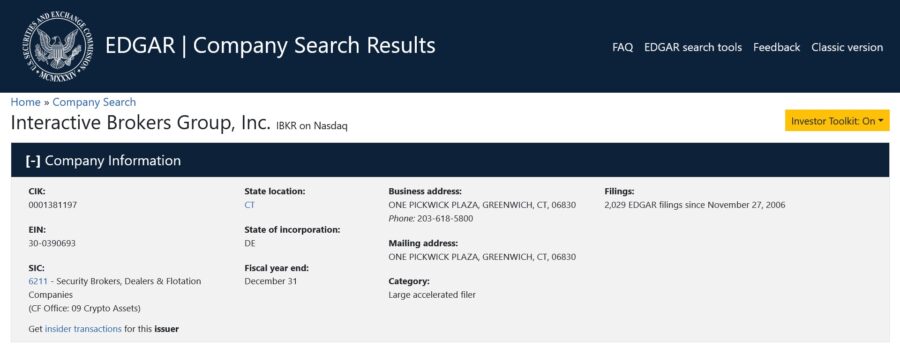
Interactive Brokers’ entry on the SEC’s EDGAR online directory Source: SEC
Trading Costs
Charges on certain items can differ significantly among brokers. Particular service providers won’t charge commissions, for instance, but will make up for this by ramping up other charges or widening their bid (buy) and offer (sell) spreads.
It’s therefore important to take a holistic approach when considering which broker to use. Also think about your investing style and whether a broker’s overall cost structure works for you. Say you’re a frequent trader — a company that charges a high fee every time you buy or sell a stock or other financial instrument may not be the most cost-effective option for you.
Other key charges to keep an eye on include:
- Fees for making deposits and withdrawals.
- Account management and platform charges.
- Currency conversion charges.
- Account inactivity costs.
- Swap fees (if you’re using derivatives).
Pro tip: If you’re living outside the US and plan to trade Dow Jones shares directly, consider using a broker that offers US dollar (USD)-based trading accounts. Over time, this could save you a fortune in foreign exchange costs when dealing these greenback-denominated securities.
The New York Stock Exchange (NYSE) and NASDAQ don’t charge retail or institutional investors to trade Dow stocks. These fees are paid by market members like brokers, who can then choose to pass these costs down to their clients in some form (think trade commissions or account fees, for instance).
Let’s assume a broker has received an order from a trader to buy 1,000 shares in Google owner Alphabet. If the order matches with a sell order on NASDAQ’s order book, the brokerage will pay a transaction fee of $0.0030 for every share they purchase, or $3 in total.
Top Dow Jones Industrial Average (DJIA) broker for trading costs: Pepperstone doesn’t allow traders to deal Dow-listed shares directly. However, the cheapness of its CFD commissions ($0.02 when you’re buying or selling contracts) makes it one of our favorites for gaining exposure to US shares with derivatives. Note CFDs are not permitted for retail investors in the US.
We also like the fact there are no charges for account maintenance or inactivity, while deposits and withdrawals are also free of fees.
Asset Range
The most common route to trading Dow-listed stocks is buying or selling them directly on the NYSE or NASDAQ. This not only lets individuals speculate on price movements of the shares themselves. Other benefits include entitlement to dividends and shareholder voting rights.
Another popular way to get Dow Jones exposure is with exchange-traded funds (ETFs). These diversified products give investors exposure to the entire index, as well as — like buying individual shares — receipt of dividends. These can be paid out or invested back into the fund.
Most standard ETFs that track the index replicate its price-weighted methodology. This means that companies with higher stock prices have a higher influence on the index. But one fund, the First Trust Dow 30 Equal Weight gives each of the Dow Jones’ constituents equal weighting, regardless of share price, thus providing investors more balanced exposure.
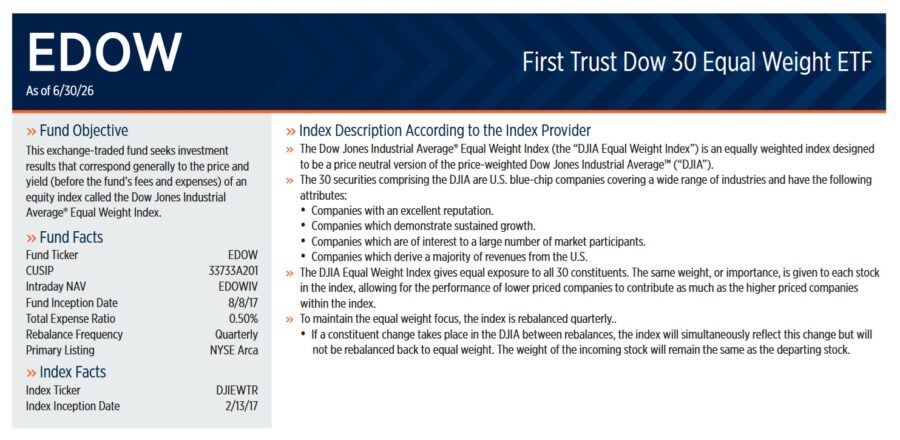
The First Trust Dow 30 Equal Weight ETF. Source: First Trust
Other ETFs include leveraged funds, which provide greater exposure without the need for extra capital; inverse funds, which allow investors to profit when the index retreats; and a combination of the two. Dow-based ETFs change hands on the NYSE alongside other global securities exchanges.
Many derivatives exchanges (like the Chicago Mercantile Exchange (CME)) also provide indirect index exposure with products like futures and options contracts. These allow traders to speculate on the Dow without having to own any underlying assets. Certain brokers also permit Dow access through contracts for difference (CFDs).
Top Dow Jones Industrial Average (DJIA) broker for asset range: Firstrade offers direct trading of NYSE and NASDAQ shares, including the blue-chips of the Dow. That’s not all, as investors can trade more than 2,200 different ETFs.
What I also like is Firstrade’s suite of fractional shares. This is especially handy for those looking to trade the Dow Jones, as shares of some of its constituents trade for hundreds of dollars each, putting them out of range of traders with smaller budgets.
Firstrade also provides exposure to mega-cap US shares via options contracts.
Trading Platform
There are particular qualities every trader should look for in their platform regardless of their investing style or experience. These include:
- Rapid trade execution speeds.
- Reliability, and particularly during busier market periods (such as when the US Bureau of Economic Analysis (BEA) announces growth data).
- Menus, charts and buttons that are simple to understand and utilize.
- Robust risk management tools (such as stop-loss and take-profit orders).
- High levels of customization, including robust charting tools.
- Easy-to-reach customer service, and especially during NYSE and NASDAQ market hours (or CME trading hours if you trade derivatives on US exchanges).
- In-built resources like real-time newsfeeds and economic calendars.
- Strong security features when signing in and withdrawing money (such as two-factor authentication (2FA)).
Other requirements may be more bespoke. Do you want to test your trading strategy with a demo account (an exercise we strongly recommend at BrokerListings.com)? How about mimic the real-time trades of successful investors (known as copy trading), or use artificial intelligence (AI) to tailor your portfolio and improve your decision making?
Top Dow Jones Industrial Average (DJIA) broker for trading platform: AvaTrade’s software is great to use regardless of your trading style or level of experience. It’s simple but highly functional, and if I want to trade on the go I can use the broker’s dedicated smartphone app, too.
An added bonus is AvaTrade’s compatibility with third-party software like MetaTrader 5 (MT5) and TradingView. So if you already use one of these platforms you don’t have to trouble yourself with having to learn the workings of a new system.
How Can I Begin Trading The Dow Jones Industrial Average (DJIA)?
It’s a fairly simple process to start trading Dow-listed securities or derivatives. The three key steps are:
1. Comparing brokers. Ascertaining the regulatory status of each service provider will be the first item to check, followed by the costs I can expect, the range of assets and the trading platform. But this is the bare minimum to consider. Checking other features — such as access to artificial intelligence (AI)-based tools, margin rules, and whether the broker is also a market maker — that are based on my investing style and objectives may also be important and save me a lot of time later on.
2. Registering for an account. After choosing a broker, I’ll need to provide some basic personal information to register for a live account. We’re talking about things like name, date of birth and place of residence. Some companies will also ask me for proof of ID and address at this stage. Finally, if the broker is regulated by a top-level financial watchdog, I can expect to be asked about the source of my trading deposit, and questions on my financial circumstances and trading experience.
3. Depositing money. I’ll need cash in my trading account to begin building my portfolio. Many brokers allow traders to deposit using a variety of methods, including bank wire transfer (from US or international banks like Bank of America), debit card, digital wallet (like Google Pay) and payment service providers (like PayPal).
What Is The Dow Jones Industrial Average (DJIA)?
The Dow Jones Industrial Average (DJIA) is one of the oldest and most famous US stock market indices.
It was created in 1896 by Charles Dow, founder of financial news publisher Dow Jones & Co. The index also takes its name from fellow company founder Edward Jones, though the latter had no participation in the index’s creation.
Also referred to as the ‘Dow’ or ‘Dow Jones,’ the share index initially tracked the performance of a dozen companies. Today it comprises 30 large, established companies, hence its additional moniker of ‘US 30.’ The index covers a diverse range of businesses, although transportation firms and utilities operators are excluded from its listings.
Pro tip: Unlike other share indices like the S&P 500 — another popular bellwether of the US stock market — the Dow is a price-weighted index rather than being weighted by the market capitalisation of its constituents.
This means companies with a higher share price have a greater influence on the broader movement of the index, regardless of their size.
The Dow Jones is part of a broader family of indices managed by S&P Dow Jones Indices, a division of S&P Global. Some of the index’s most prominent names include:
- Banking giant Goldman Sachs.
- Software developer Microsoft.
- Caterpillar, which manufactures construction and mining equipment and vehicles.
- Biotechnology company Amgen.
- Digital payments network Visa.
- Paint manufacturer Sherwin-Williams.
- Boeing, which designs and manufactures aeroplanes and provides aftermarket services.
- Insurance provider Travelers.
- Home improvement retailer Home Depot.
- Consumer electronics manufacturer Apple.
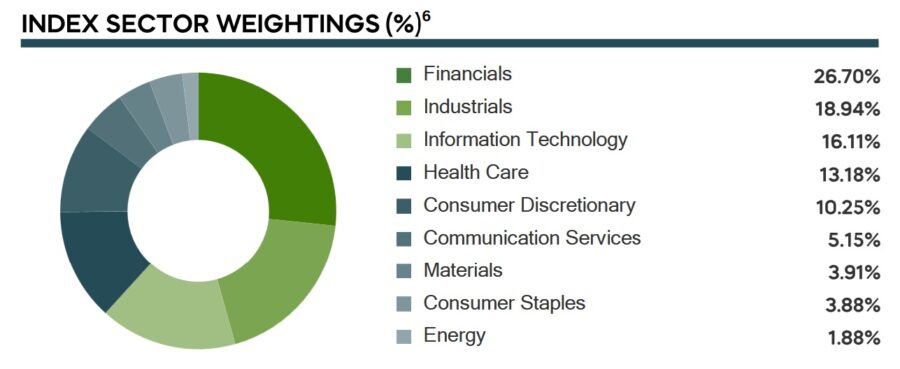
Composition of the Dow Jones Industrial Average index. Source: ProShares
How Can I Trade The Dow Jones Industrial Average (DJIA)?
There are many ways that investors can trade the Dow Jones. The most popular method among retail investors is to buy and sell individual equities that make up the index.
To get full exposure to all the index’s listings, traders will need a broker that offers access to both the NYSE and NASDAQ. This is because the DJIA’s 30 constituents are listed across these exchanges. For instance, Nvidia shares only trade on NASDAQ, while Coca-Cola stock changes hands solely on the NYSE.
The immense popularity of US blue-chip shares means finding a brokerage providing exposure to the entire index should be fairly straightforward.
Investors can also buy ETFs that track the performance of the Dow. Vehicles like the SPDR Dow Jones Industrial Average ETF Trust provide a low-cost and simple way to gain diversified exposure to the index, though they don’t let traders cherry pick which specific Dow members they wish to own.
These exchange-traded instruments can be used to pursue particular trading strategies. The ProShares Ultra Dow30 fund targets twice the daily returns of the index, making it an effective fund for high-risk investors. The ProShares Short Dow30, meanwhile, moves in the opposite direction to the Dow, meaning traders can profit when the index falls in value.
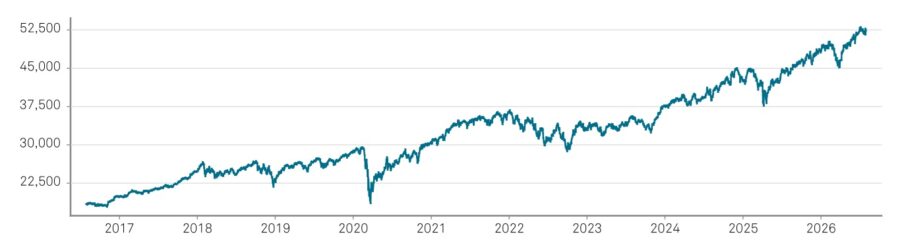
Historical performance of the Dow Jones. Source: S&P Global
Investors can also trade derivatives linked to the Dow Jones. These include futures and options contracts, which track the price performance of individual constituents or the broader index, and which trade on many global derivatives venues like the CME.
Pro tip: Investors can buy and sell shares and ETFs on the NYSE and NASDAQ during regular market hours. These are Monday to Friday (excluding public holidays) between 9.30am and 4pm Eastern Time (ET).
Derivatives on CME are traded almost around the clock from Sunday to Friday, from 6pm to 5pm ET (there is a one-hour daily maintenance break between 5pm and 6pm).
Alternatively, investors can gain exposure to Dow Jones stocks with CFDs that are traded over-the-counter (OTC) instead of on regulated exchanges.
Bottom Line
The Dow Jones is home to a smorgasbord of quality US shares, and access to the index — whether through direct share ownership, with tracker funds, or via derivatives — is provided by a wide range of brokerages.
The first thing to ensure when choosing a service provider is that they are regulated by a reputable financial watchdog like the SEC. Then consider how cost-effective their services are, the range of assets on offer, and the quality of the trading platforms. Other factors will depend on your personal circumstances and trading objectives and style.