

Exness Spreads
Spreads at Exness are floating, which means they tighten in quiet markets and widen around news and rollovers. What you pay depends heavily on which account you’re using. When we benchmarked their spreads with alternatives, Exness came in lower than average but trailed brokers with the lowest spreads.
 Written By
Christian Harris
Christian is a seasoned analyst, leveraging his expertise in stocks, forex, and crypto to evaluate brokers worldwide. With hands-on trading experience and a strong focus on risk management, he helps traders find reliable platforms. Christian's work for BrokerListings.com has been cited in the Financial Times.
Christian Harris Profile Page Fact Checked By
Tobias Robinson
Tobias is committed to helping traders find the right brokerage for their needs. He has tested 200+ brokers, spent 2,600+ hours using different platforms, and placed 2,100+ trades.
Tobias Robinson Profile Page Edited By
James Barra
James is an experienced broker analyst with a background in financial services. He has spent 2,500+ hours testing brokers, used 35+ different platforms and apps, audited 120+ broker T&Cs, and verified 300+ regulatory licenses. James has also been on US and UK TV, and been a guest on finance podcasts, discussing reports conducted by BrokerListings.com and sharing his expertise.
James Barra Profile PageOctober 7, 2026
Spread By Account Type
Here’s the account-by-account reality and how Exness spreads shaped up when we compared spreads on similarly designed accounts at our 60+ strong directory of brokers.
« Make Full Width »| Account | EUR/USD (typical) | Commission | How the cost is structured | Vs average |
|---|---|---|---|---|
| Standard | ~0.8–1.1 pips | None | All-in, built into the spread | Good – broadly in line with or slightly better than the ~1.0–1.3-pip commission-free pricing commonly seen across brokers in our directory |
| Pro | ~0.6–0.7 pips | None | All-in, no commission | Very good – tighter than the typical commission-free account and competitive for an all-in spread model |
| Raw Spread | From 0.0 pips | $3.50 per side ($7 round turn) | Tight spread plus fixed commission | Average to good – 0.0-pip minimums are standard for raw accounts, while $7 round turn is the industry average |
| Zero | 0.0 pips on the top 30 instruments for 95% of the day | Variable, from $0.05 per side | Near-zero spread plus per-instrument commission | Great – materially cheaper than average where the lowest commission applies, though the total cost varies by instrument |
What this means in practice:
- Standard is the simplest. No commission, and the EUR/USD spread runs roughly 0.8 pips in liquid hours, which works out to around $8 per standard lot. That sits below the industry average, though it isn’t the tightest on the market.
- Raw Spread suits active traders. You get spreads as low as 0.0 pips, but you pay a fixed $3.50 per side. Across a mix of instruments, this is often the lowest all-in cost.
- Zero locks 0.0 pips on the top 30 instruments for most of the trading day, then charges a per-instrument commission. On EUR/USD, that commission is small (around $0.20–$0.50 per side), but on exotics or metals it can be higher, so check the specific figure before you trade.
- Pro drops the commission entirely while keeping spreads near 0.6 pips, which some traders prefer for predictable costs.
Spread Observations During Testing
Two key cautions from our live testing of Exness spreads in choppy and quieter markets:
- Gold (XAU/USD) tells a different story than EUR/USD: on a Standard account, we saw gold spreads sitting in the region of 20–35 cents, versus near-zero on Raw Spread or Zero once you factor in the commission, so match your account to what you actually trade.
- “Average 0.0 pips” marketing reflects the best case during deep liquidity. When we checked EUR/USD on a Standard account mid-session, it hovered around 0.8–1.0 pips, but around scheduled news, it widened sharply, so build that into your stop placement rather than assuming the tightest quote holds all day.
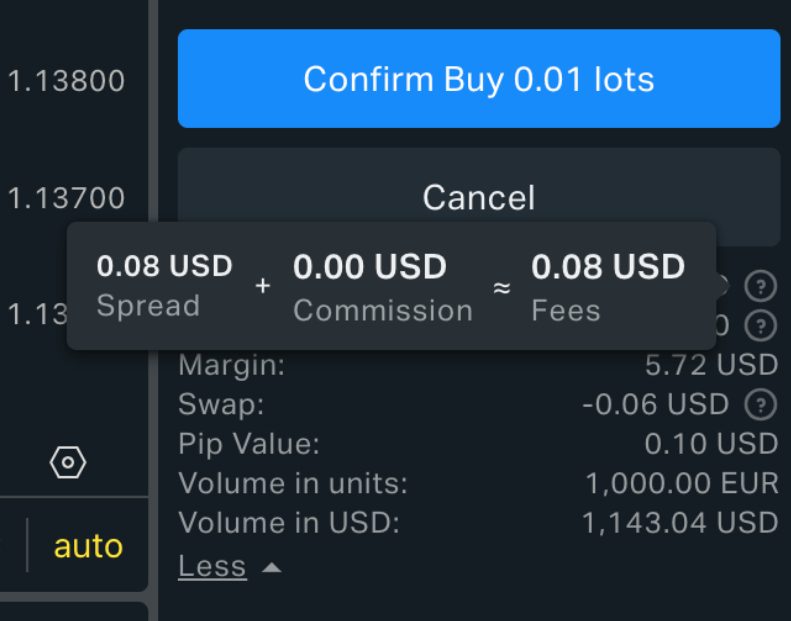
Observed spreads in our Exness account