

Is CMC Markets A Market Maker?
CMC Markets is a market maker. This is not necessarily a problem, but it does have implications for how your trades are handled. CMC sets prices, takes the other side of your trades, but can also offer tools like guaranteed stop loss orders.
 Written By
Christian Harris
Christian is a seasoned analyst, leveraging his expertise in stocks, forex, and crypto to evaluate brokers worldwide. With hands-on trading experience and a strong focus on risk management, he helps traders find reliable platforms. Christian's work for BrokerListings.com has been cited in the Financial Times.
Christian Harris Profile Page Fact Checked By
Tobias Robinson
Tobias is committed to helping traders find the right brokerage for their needs. He has tested 200+ brokers, spent 2,600+ hours using different platforms, and placed 2,100+ trades.
Tobias Robinson Profile Page Edited By
James Barra
James is an experienced broker analyst with a background in financial services. He has spent 2,500+ hours testing brokers, used 35+ different platforms and apps, audited 120+ broker T&Cs, and verified 300+ regulatory licenses. James has also been on US and UK TV, and been a guest on finance podcasts, discussing reports conducted by BrokerListings.com and sharing his expertise.
James Barra Profile PageAugust 18, 2026
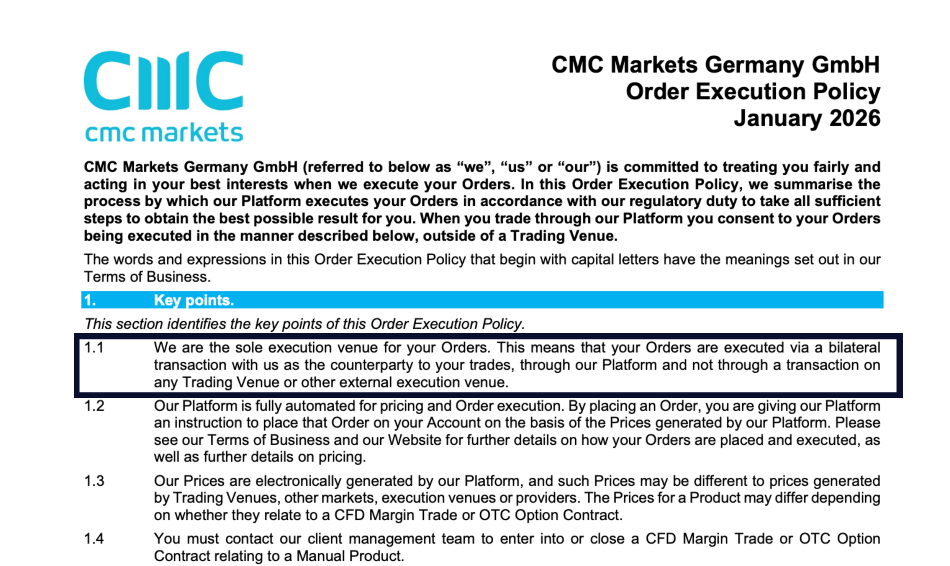
CMC Markets is upfront about its market maker model in its various client documents. For example, in its German order execution policy it states: “We are the sole execution venue for your Orders. This means that your Orders are executed via a bilateral transaction with us as the counterparty to your trades, through our Platform and not through a transaction on any Trading Venue or other external execution venue.”
What Market Maker Actually Means
A market maker – often called a dealing desk or B-Book broker – sets its own buy and sell prices and typically takes the other side of your trades internally. Your order doesn’t get routed to an exchange or liquidity pool. CMC Markets is your counterparty.
It impacts the way CMC Markets makes money, which is primarily the spread between the bid and ask price. Most CFD trades at CMC carry no separate commission – the cost is built into the spread.
« Make Full Width »| Broker Model | How Orders Work | Revenue Source |
|---|---|---|
| Market Maker broker (CMC Markets) | Broker takes the other side internally | Spread |
| ECN broker | Matched with other market participants electronically | Commission |
| STP broker | Routed directly to external liquidity providers | Spread markup |
One benefit of the market maker approach is that CMC Markets offers guaranteed stop loss orders (GSLOs). This is because CMC acts as the principal counterparty, so it can absorb the risk of market gapping (charging a small premium only if triggered) – providing a level of execution certainty that most ECN brokers cannot provide.
Does That Mean CMC Markets Is Trading Against You?
Technically, yes. In most cases, CMC Markets is your counterparty. When you win, their internal position loses. When you lose, they gain.
But three things limit how much that actually matters in practice:
- Best execution rules: CMC’s FCA, ASIC, and other licenses often require it to get the best reasonably available outcome for client orders. It can’t systematically price against you. Its various documents, such as its Singapore execution policy, explain this.
- External hedging: CMC Markets doesn’t carry all client risk internally. It hedges aggregate exposure with external counterparties when positions build up. That’s standard practice for regulated market makers.
- Machine learning in pricing: CMC Markets uses machine learning in its risk management and pricing systems. This helps keep spreads stable during volatile conditions instead of widening them sharply when it would be most inconvenient for traders.
The Alternative – The FX Active Account
This is the closest CMC Markets gets to ECN-style pricing:
- Spreads from 0.0 pips on six major pairs
- Commission of $2.50 per $100,000 notional
- 25% spread discount on 300+ other pairs
The pricing is similar to an ECN broker. However, the underlying model, with CMC Markets as the market maker, does not change. You receive tighter prices, but the order routing remains the same.
What the Market Maker Model Means for You
« Make Full Width »| Instrument | Typical CMC Spread | Typical IC Markets ECN (Raw) Spread |
|---|---|---|
| EUR/USD | 0.7 pips | 0.1 pips |
| GBP/USD | 0.9 pips | ~0.3 pips |
| US 30 (Dow) | 2.2 points | 1.4 points |
| Oil | 3.5 points | ~3 points |
For scalpers and high-frequency traders, this difference can be costly. For swing traders or position traders who hold trades for hours or days, the impact is much smaller.
Requotes
Market makers can issue requotes – rejecting your price and offering a new one. CMC Markets says it fills orders at the price you see wherever possible. During our live testing under normal market conditions, we weren’t requoted.
During high-impact news, fills can slip – but that happens across all broker types – we’ve seen it dozens of times in our own trades.
Scalping
CMC Markets doesn’t explicitly ban scalping. But wider base spreads make very high-frequency, low-pip strategies harder to run profitably than they would be at a true ECN broker.
Bottom Line
Being a market maker doesn’t make CMC Markets less trustworthy. It’s a business model, and CMC runs it within a tightly regulated framework. For example, the FCA applies serious scrutiny to how market makers price and execute. That’s partly why we believe CMC Markets is a trustworthy trading broker.
Where it actually matters:
- Scalpers and HFT traders — you’ll often pay more at CMC Markets than at ECN brokers
- Large positions — internal hedging can affect pricing at scale
- Traders who need full order routing transparency — market makers offer less of that
- For most retail traders — day traders, swing traders, position traders — the market-maker model at CMC Markets is not a practical problem.