
Best Brokers With TRY Accounts 2026
Dig into our top brokers offering TRY accounts after testing, designed to reduce conversion fees and optimize the trading experience for traders in Turkey.
 Written By
James Barra
James is an experienced broker analyst with a background in financial services. He has spent 2,500+ hours testing brokers, used 35+ different platforms and apps, audited 120+ broker T&Cs, and verified 300+ regulatory licenses. James has also been on US and UK TV, and been a guest on finance podcasts, discussing reports conducted by BrokerListings.com and sharing his expertise.
James Barra Profile Page Fact Checked By
Tobias Robinson
Tobias is committed to helping traders find the right brokerage for their needs. He has tested 200+ brokers, spent 2,600+ hours using different platforms, and placed 2,100+ trades.
Tobias Robinson Profile PageFebruary 24, 2026
-
1Crypto.com is a leading cryptocurrency exchange focused on advancing DeFi technologies. It provides token lending, prepaid cards, NFTs, and more. Founded in Hong Kong in 2016, it serves 150 million users.
Compare Brokers With TRY Accounts
| Broker |  |
Payment Methods |
|---|---|---|
 |
Bitcoin Payments, Credit Card, Debit Card, Ethereum Payments, Visa, Wire Transfer | |
| Broker | |
Payment Methods |
Broker Details Comparison
| Broker | Demo Account |
Minimum Deposit |
Minimum Trade |
Leverage |
Assets |
Platforms |
|---|---|---|---|---|---|---|
|
✓ | Varies by payment method | $1 | ✗ | Crypto, Stocks, ETFs, OTC Options, Tokenized Stocks, Prediction Markets and Strike Options (US only) | Own, TradingView |
| Broker | Demo Account |
Minimum Deposit |
Minimum Trade |
Leverage |
Assets |
Platforms |
Safety Comparison
Compare how safe the Best Brokers With TRY Accounts 2026 are.
| Broker | Trust Rating |
Guaranteed Stop Loss |
Negative Balance Protection |
Segregated Accounts |
|---|---|---|---|---|
|
✗ | ✗ | ✓ | |
| Broker | Trust Rating |
Guaranteed Stop Loss |
Negative Balance Protection |
Segregated Accounts |
Mobile Trading Comparison
Compare the mobile trading features of the Best Brokers With TRY Accounts 2026.
| Broker | Mobile Apps |
iOS Rating |
Android Rating |
Smart Watch App |
|---|---|---|---|---|
|
iOS & Android | ✗ | ||
| Broker | Mobile Apps |
iOS Rating |
Android Rating |
Smart Watch App |
Comparison for Beginners
Compare how suitable the Best Brokers With TRY Accounts 2026 are for beginners.
| Broker | Demo Account |
Minimum Deposit |
Minimum Trade |
Education Rating |
Support Rating |
Fractional Shares |
Demo Competitions |
|---|---|---|---|---|---|---|---|
|
✓ | Varies by payment method | $1 | ✗ | ✗ | ||
| Broker | Demo Account |
Minimum Deposit |
Minimum Trade |
Education Rating |
Support Rating |
Fractional Shares |
Demo Competitions |
Comparison for Advanced Traders
Compare how suitable the Best Brokers With TRY Accounts 2026 are for advanced or professional traders.
| Broker | Automated Trading |
VPS |
API |
AI |
Pro Account |
Leverage |
Low Latency |
Extended Hours |
|---|---|---|---|---|---|---|---|---|
|
DCA Auto-Staking | ✗ | ✗ | ✗ | ✗ | ✗ | ✗ | ✗ |
| Broker | Automated Trading |
VPS |
API |
AI |
Pro Account |
Leverage |
Low Latency |
Extended Hours |
Accounts Comparison
Compare the trading accounts offered by Best Brokers With TRY Accounts 2026.
| Broker | Demo Account |
Interest on Cash |
Islamic Account |
Joint Account |
Managed Account |
PAMM |
MAM |
LAMM |
Pro Account |
|---|---|---|---|---|---|---|---|---|---|
|
✓ | USD: 5% | ✗ | ✗ | ✗ | ✗ | ✗ | ✗ | ✗ |
| Broker | Demo Account |
Interest on Cash |
Islamic Account |
Joint Account |
Managed Account |
PAMM |
MAM |
LAMM |
Pro Account |
Detailed Rating Comparison
Compare how we rated the Best Brokers With TRY Accounts 2026 in key areas.
| Broker | Trust |
Platforms |
Assets |
Mobile |
Fees |
Accounts |
Research |
Education |
Support |
|---|---|---|---|---|---|---|---|---|---|
|
|||||||||
| Broker | Trust |
Platforms |
Assets |
Mobile |
Fees |
Accounts |
Research |
Education |
Support |
Fee and Cost Comparison
Compare the cost of trading with the Best Brokers With TRY Accounts 2026.
| Broker | Cost Rating |
Fixed Spreads |
Inactivity Fee |
EUR/USD Spread |
Crypto Spread |
|---|---|---|---|---|---|
|
✗ | $5 | ✗ | 0.075% (spot), 0.034% (derivatives) | |
| Broker | Cost Rating |
Fixed Spreads |
Inactivity Fee |
EUR/USD Spread |
Crypto Spread |
Customer Ratings
Compare how customers of these brokers feel about them, with real user ratings from Trustpilot, the Apple App Store and Google Play.
| Broker | Customers |
Trustpilot Score |
Trustpilot Reviews |
Android App Rating |
iOS App Rating |
|---|---|---|---|---|---|
|
150,000,000 | 9,463 | |||
| Broker | Customers |
Trustpilot Score |
Trustpilot Reviews |
Android App Rating |
iOS App Rating |
Broker Popularity
See how popular the Best Brokers With TRY Accounts 2026 are in terms of number of clients.
| Broker | Popularity |
|---|---|
| Crypto.com |
|
Why Trade With Crypto.com?
Crypto.com is ideal for new crypto traders looking to buy, sell, and trade over 400 digital tokens. Its strike options and prediction markets cover financial, economic, election, sport, and cultural events. As a CFTC-regulated platform, it provides a secure choice for US traders interested in binary-style contracts using an easy-to-use app.
Pros
- Crypto.com now offers over 9,000 stocks and ETFs in some regions, helping traders diversify across sectors.
- Crypto.com uses a cold wallet system with multi-signature technology and geographic distribution to improve security. This method ensures strong protection of user assets with secure offline storage.
- The Crypto.com Exchange platform provides advanced bots like Dollar Cost Averaging (DCA), Time-Weighted Average Price (TWAP), and Grid Trading bots. Traders can automate strategies, including leveraged perpetual trades, reducing manual work and slippage.
Cons
- Customer support mainly uses chatbots and email, with limited reliable phone support from our testing. This may cause delays in solving urgent issues like account access or transaction problems, which can be frustrating for crypto traders needing quick help.
- Fees apply to crypto and fiat withdrawals, which can be significant for active traders making smaller transfers. The minimum withdrawal limits are also high, limiting flexibility in managing smaller portfolios or immediate liquidity needs.
- The app has high bid-ask spreads on many coins, which can be expensive for traders using market orders. Wide spreads mean the buying price is significantly higher than the selling price, reducing profits, especially in low-volume trades.
Filters
Methodology
To identify the best brokers offering TRY-denominated accounts, we leveraged our regularly updated database, which encompasses hundreds of online brokers worldwide.
We focused on platforms that allow clients to deposit, withdraw, and trade in Turkish lira (TRY).
Rankings were determined based on their overall ratings, drawing on our in-depth analysis of 200+ metrics. These included costs, platform performance, regulatory compliance, and ease of access for Turkish traders, supplemented by the feedback from our hands-on testers.
What Is a TRY Account?
A TRY account is a trading account where all transactions, profits, and losses are recorded in Turkish lira.
As Turkey’s official currency, the lira is widely used by local traders, but not all brokers offer TRY-denominated accounts. In fact, less than 5% of providers we’ve evaluated support a TRY trading account.
Most international brokers primarily operate in USD or EUR, making it essential to find one that supports TRY if you want to avoid unnecessary conversion fees.
TRY accounts provide several key advantages:
- Avoiding Currency Conversion Costs: Depositing and withdrawing in TRY can eliminate foreign exchange fees, which is particularly beneficial for Turkish traders who bank in lira.
- Protection Against Exchange Rate Fluctuations: Given the volatility of the Turkish lira, a TRY account helps traders avoid losses from constant currency conversions when trading domestic assets.
- Seamless Trading of Turkish Financial Instruments: Having a TRY account simplifies investments in Turkish stocks, bonds, ETFs, and other assets listed on Borsa İstanbul (BIST).
How Do I Open a TRY Account?
Opening a TRY trading account requires selecting a broker that supports lira-based transactions. After testing hundreds of the best trading accounts, here are the key steps:
- Choose a Broker: Select a broker offering TRY as a base currency option. Consider factors such as fees, platform usability, available Turkish assets, and whether the broker is regulated by a trusted regulator like the Cyprus Securities & Exchange Commission (CySEC).
- Register an Account: Complete the broker’s onboarding process, which typically requires proof of identity and address verification in compliance with Turkish and international regulations.
- Select TRY as Your Base Currency: During account setup, choose TRY as your preferred account currency to ensure transactions occur in Turkish lira.
- Fund Your Account: Deposit funds in TRY via local bank transfers, domestic solutions like Papara, or other regionally available payment methods. Some brokers may allow deposits in other currencies with automatic conversion to TRY.
- Start Trading: Once your account is funded, you can begin trading Turkish and global financial assets with minimal currency conversion fees.
For example, below you can see how I set up a TRY trading account at Swissquote.
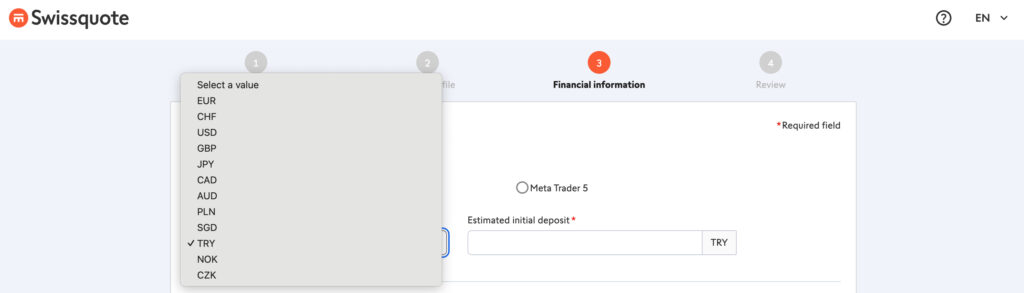
Configuring a TRY account at Swissquote
Should I Use a TRY Trading Account?
A TRY trading account may be ideal for you if the following apply:
- You Live in Turkey: A TRY account aligns with your domestic currency, making deposits, withdrawals, and tax reporting much simpler.
- You Trade Turkish Stocks and ETFs: If you invest in companies listed on Borsa İstanbul (BIST) or trade Turkish bonds and ETFs, using a TRY account reduces currency conversion fees.
- You Want to Hedge Against Currency Fluctuations: Given the lira’s historic volatility, holding a TRY-denominated account can help reduce risks associated with frequent foreign exchange transactions.
- You Use Turkish Payment Methods: Brokers that support TRY accounts may integrate local banking options such as EFT/Havale, Papara, and FastPay, potentially making transactions smoother and more cost-effective.
What Are the Limitations of a TRY Trading Account?
- Limited Broker Availability: The vast majority of international brokers do not offer TRY as a base currency from our analysis, which restricts options for Turkish traders.
- Higher Costs for Non-TRY Assets: If you trade assets denominated in USD, EUR, or GBP, you may face currency conversion fees when executing trades.
- Currency Volatility: The Turkish lira is known for its wild price fluctuations, which can impact profits when trading internationally.