
Best Brokers With KES Accounts 2026
We’ve tested brokers offering KES accounts and selected the best based on transaction fees, reduced currency conversion costs, and tailored local support, enhancing trading efficiency for Kenyan traders.
 Written By
Royston Wild
Royston is a seasoned investor and financial writer with over a decade of experience analyzing brokers and investment markets. With a background in stocks, commodities, and forex reporting - he brings a fresh perspective to broker evaluations.
Royston Wild Profile Page Fact Checked By
James Barra
James is an experienced broker analyst with a background in financial services. He has spent 2,500+ hours testing brokers, used 35+ different platforms and apps, audited 120+ broker T&Cs, and verified 300+ regulatory licenses. James has also been on US and UK TV, and been a guest on finance podcasts, discussing reports conducted by BrokerListings.com and sharing his expertise.
James Barra Profile Page Edited By
Tobias Robinson
Tobias is committed to helping traders find the right brokerage for their needs. He has tested 200+ brokers, spent 2,600+ hours using different platforms, and placed 2,100+ trades.
Tobias Robinson Profile PageJuly 11, 2026
-
1Crypto.com is a leading cryptocurrency exchange focused on advancing DeFi technologies. It provides token lending, prepaid cards, NFTs, and more. Founded in Hong Kong in 2016, it serves 150 million users.
Compare Brokers
| Broker |  |
Demo Account |
Minimum Deposit |
Minimum Trade |
Leverage |
Copy Trading |
Regulator |
Instruments |
Platforms |
Account Currencies |
Automated Trading |
AI |
Guaranteed Stop Loss |
|---|---|---|---|---|---|---|---|---|---|---|---|---|---|
 |
✓ | Varies by payment method | $1 | ✗ | ✗ | SEC, FCA, MAS, AMF, CySEC, CBI, ASIC, FINTRAC, CIMA, VARA, OAM, HCMC, CFTC, OSC, KoFIU | Crypto, Stocks, ETFs, OTC Options, Tokenized Stocks, Prediction Markets and Strike Options (US only) | Own, TradingView | USD, EUR, GBP, CAD, AUD, NZD, ZAR, TRY, SEK, NOK, DKK, CHF, HKD, PLN, CZK, AED, SAR, HUF, BRL, KES | DCA Auto-Staking | ✗ | ✗ | |
| Broker | |
Demo Account |
Minimum Deposit |
Minimum Trade |
Leverage |
Copy Trading |
Regulator |
Instruments |
Platforms |
Account Currencies |
Automated Trading |
AI |
Guaranteed Stop Loss |
Safety Comparison
Compare how safe the Best Brokers With KES Accounts 2026 are.
| Broker | Trust Rating |
Guaranteed Stop Loss |
Negative Balance Protection |
Segregated Accounts |
|---|---|---|---|---|
|
✗ | ✗ | ✓ | |
| Broker | Trust Rating |
Guaranteed Stop Loss |
Negative Balance Protection |
Segregated Accounts |
Mobile Trading Comparison
Compare the mobile trading features of the Best Brokers With KES Accounts 2026.
| Broker | Mobile Apps |
iOS Rating |
Android Rating |
Smart Watch App |
|---|---|---|---|---|
|
iOS & Android | ✗ | ||
| Broker | Mobile Apps |
iOS Rating |
Android Rating |
Smart Watch App |
Comparison for Beginners
Compare how suitable the Best Brokers With KES Accounts 2026 are for beginners.
| Broker | Demo Account |
Minimum Deposit |
Minimum Trade |
Education Rating |
Support Rating |
Fractional Shares |
Demo Competitions |
|---|---|---|---|---|---|---|---|
|
✓ | Varies by payment method | $1 | ✗ | ✗ | ||
| Broker | Demo Account |
Minimum Deposit |
Minimum Trade |
Education Rating |
Support Rating |
Fractional Shares |
Demo Competitions |
Comparison for Advanced Traders
Compare how suitable the Best Brokers With KES Accounts 2026 are for advanced or professional traders.
| Broker | Automated Trading |
VPS |
API |
AI |
Pro Account |
Leverage |
Low Latency |
Extended Hours |
|---|---|---|---|---|---|---|---|---|
|
DCA Auto-Staking | ✗ | ✗ | ✗ | ✗ | ✗ | ✗ | ✗ |
| Broker | Automated Trading |
VPS |
API |
AI |
Pro Account |
Leverage |
Low Latency |
Extended Hours |
Accounts Comparison
Compare the trading accounts offered by Best Brokers With KES Accounts 2026.
| Broker | Demo Account |
Interest on Cash |
Islamic Account |
Joint Account |
Managed Account |
PAMM |
MAM |
LAMM |
Pro Account |
|---|---|---|---|---|---|---|---|---|---|
|
✓ | USD: 5% | ✗ | ✗ | ✗ | ✗ | ✗ | ✗ | ✗ |
| Broker | Demo Account |
Interest on Cash |
Islamic Account |
Joint Account |
Managed Account |
PAMM |
MAM |
LAMM |
Pro Account |
Detailed Rating Comparison
Compare how we rated the Best Brokers With KES Accounts 2026 in key areas.
| Broker | Trust |
Platforms |
Assets |
Mobile |
Fees |
Accounts |
Research |
Education |
Support |
|---|---|---|---|---|---|---|---|---|---|
|
|||||||||
| Broker | Trust |
Platforms |
Assets |
Mobile |
Fees |
Accounts |
Research |
Education |
Support |
Fee and Cost Comparison
Compare the cost of trading with the Best Brokers With KES Accounts 2026.
| Broker | Cost Rating |
Fixed Spreads |
Inactivity Fee |
EUR/USD Spread |
Crypto Spread |
|---|---|---|---|---|---|
|
✗ | $5 | ✗ | 0.075% (spot), 0.034% (derivatives) | |
| Broker | Cost Rating |
Fixed Spreads |
Inactivity Fee |
EUR/USD Spread |
Crypto Spread |
Customer Ratings
Compare how customers of these brokers feel about them, with real user ratings from Trustpilot, the Apple App Store and Google Play.
| Broker | Customers |
Trustpilot Score |
Trustpilot Reviews |
Android App Rating |
iOS App Rating |
|---|---|---|---|---|---|
|
150,000,000 | 9,455 | |||
| Broker | Customers |
Trustpilot Score |
Trustpilot Reviews |
Android App Rating |
iOS App Rating |
Broker Popularity
See how popular the Best Brokers With KES Accounts 2026 are in terms of number of clients.
| Broker | Popularity |
|---|---|
| Crypto.com |
|
Why Trade With Crypto.com?
Crypto.com is ideal for new crypto traders looking to buy, sell, and trade over 400 digital tokens. Its strike options and prediction markets cover financial, economic, election, sport, and cultural events. As a CFTC-regulated platform, it provides a secure choice for US traders interested in binary-style contracts using an easy-to-use app.
Pros
- Crypto.com now offers over 9,000 stocks and ETFs in some regions, helping traders diversify across sectors.
- The platform tracks cryptocurrencies, stocks, ETFs, prediction markets, and tokenized Wall Street stocks in one interface, making multi-asset management and insights easier.
- Crypto.com uses a cold wallet system with multi-signature technology and geographic distribution to improve security. This method ensures strong protection of user assets with secure offline storage.
Cons
- Fees apply to crypto and fiat withdrawals, which can be significant for active traders making smaller transfers. The minimum withdrawal limits are also high, limiting flexibility in managing smaller portfolios or immediate liquidity needs.
- Customer support mainly uses chatbots and email, with limited reliable phone support from our testing. This may cause delays in solving urgent issues like account access or transaction problems, which can be frustrating for crypto traders needing quick help.
- The app has high bid-ask spreads on many coins, which can be expensive for traders using market orders. Wide spreads mean the buying price is significantly higher than the selling price, reducing profits, especially in low-volume trades.
Filters
How We Choose The Top KES Brokers
Our detailed testing process involves:
- Registering for an account with each broker in our expanding catalogue, then recording which ones allow customers to deal using Kenya’s shilling as the base currency.
- Verifying that each company has authorization to operate from a top-level regulator, as per BrokerListings.com’s regulator ranking system. Given the limited safeguards afforded by Kenya’s Capital Markets Authority (CMA), we only choose brokers that have received approval from a strict overseas regulator.
- Regularly checking that each service provider has kept their regulated status. This is because markets watchdogs are able to suspend or revoke licenses when misconduct is identified.
- Evaluating brokers on factors other than the availability of KES accounts. Trading costs, functionality of the trading software, range of financial markets, and the quality and availability of customer service are other key items we consider.
What Is A KES Account?
A KES trading account allows individuals to deal using the shilling, Kenya’s national currency. Accounts are funded, withdrawals are made, and financial securities bought and sold using the East African currency.
Retail participation in Kenya is booming, and the Nairobi Securities Exchange (NSE) has targeted 9m active retail investors by 2029. Growing interest in financial markets has been accompanied by a steady increase in the number of brokers operating in the country.
Using a KES-based trading account carries several benefits:
- These accounts can help you avoid currency conversion fees when you’re depositing and withdrawing cash from your broker.
- Forex markets can be volatile, so being able to fund your account with the same currency you use every day protects you from this. ‘Exotic’ currencies like Kenya’s shilling are especially prone to bouts of choppiness.
- Transferring money in and out of your account can be quicker and simpler. This is because service providers offering KES-denominated trading accounts usually support local payment methods, like transfers from payment service providers (such as M-PESA).
- Trading Kenyan securities – such as government bonds and shares on the NSE – becomes more straightforward.
How Do I Open A KES Account?
The number of brokers offering KES-denominated accounts is rising but remains fairly small today. This means you may need to spend some time tracking one down.
However, setting up an account can be done fairly quickly once you’ve identified a service provider. The process involves five steps:
1. Choose A Broker
This is likely to be the most time-consuming part of your journey. Consider the fees and charges you can expect to pay, the size of its bid and ask spreads on the markets you’re targeting, the functionality of the trading software, and the range of financial assets you’re allowed to trade. For instance, the transaction charges for shares listed on Kenya’s stock market can differ substantially between service providers.
Pro tip: Like most regions, Kenya is experiencing a sharp rise in the number of scammers looking to make off with your cash and/or sensitive personal data. For this reason, it’s critical to check the broker you’re thinking of using is licensed by a respected global regulator.
Kenya’s capital markets and brokers are regulated by the Capital Markets Authority (CMA). However, the supervisory and enforcement framework here is less robust than those in many other parts of the world.
Under BrokerListings.com’s Regulator Trust Rating, the CMA has received Category C classification. To receive the strongest safeguards against fraud and poor customer service, we recommend using a brokerage that’s authorized by a Category A organization.
Examples include the Financial Conduct Authority (FCA), which regulates the UK’s financial markets; the US Securities and Exchange Commission (SEC); and Japan’s Financial Services Agency (JFSA).
2. Register For An Account
Account opening requirements will differ from broker to broker. Some may only need you to submit and then verify your email address. Others may ask to see proof of identification, and require personal information like your place of residence, income and trading experience.
3. Select KES As Your Base Currency
The US dollar (USD) is the most popular currency used by traders and investors. It’s therefore possible you’ll need to manually select an account that lets you deposit, withdraw and trade with the Kenyan shilling.
4. Deposit Some Capital
With your account set up, you’ll be able to send money to your account. Brokers typically offer a range of ways you can make a deposit, including:
- Bank transfer (such as from KCB Bank).
- Debit card payment.
- Digital wallet.
- Payment service provider (such as Airtel).
Be mindful that some brokers in Kenya might restrict certain payment methods.
5. Start Trading
Once you have funds in your KES account, you’ll be able to start building your trading portfolio. The whole process – from opening an account to trading the financial markets – can typically be done in less than half an hour.
Example Of Opening A KES Trading Account
I opened an account with Crypto.com, which has been offering financial services since 2016. It isn’t regulated by Kenya’s CMA, though it has received approval from roughly a dozen other organizations. These include Category A regulators the FCA, SEC, CySEC, and AMF.
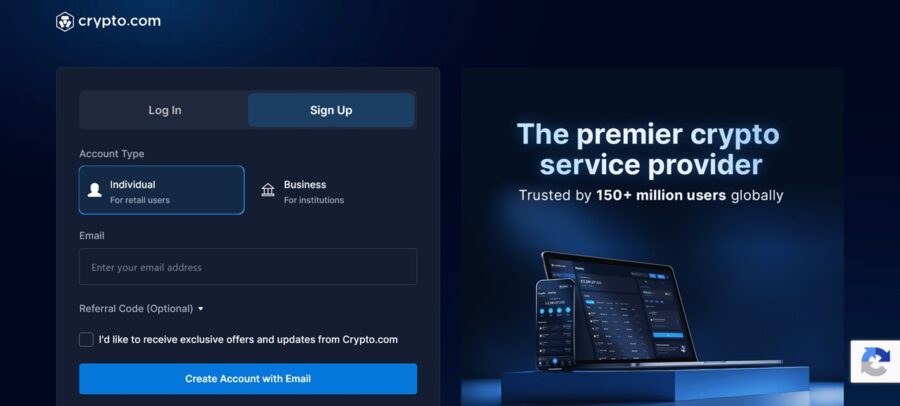
Signing up for a Crypto.com trading account
Opening a KES-denominated trading account was more complex than with some other brokers. After submitting my email address and telephone number, I was required to verify both with the use of a passcode. After this, I uploaded some personal ID documentation and verified my face using my mobile phone.
With these steps completed, I clicked on my profile icon on the top right-hand side of the screen and clicked on ‘Settings’ further down in the menu.
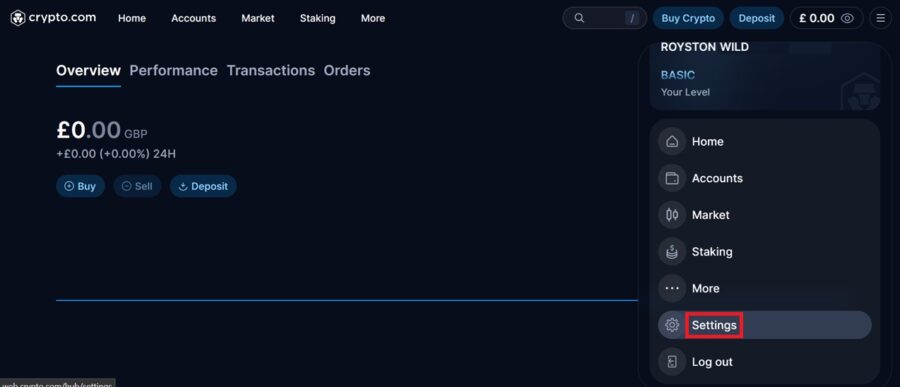
Clicking on the ‘Settings’ tab in the Crypto.com platform
On the new page, I navigated down to the ‘Display and Payment Currency’ tab and clicked. This showed me several currencies, including the Kenyan shilling. Clicking on this updated my account currency within seconds.
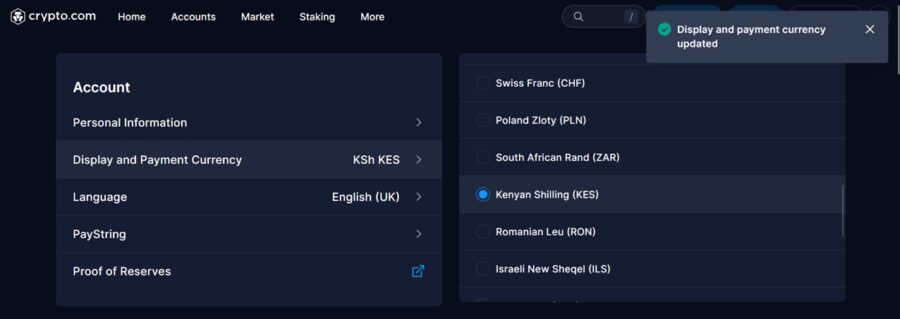
Choosing a KES account in the Crypto.com platform
Should I Use A KES Trading Account?
A KES-denominated trading account may be a great idea if:
- You reside in Kenya, and are looking to make tax reporting simpler.
- You want to remove unnecessary costs when depositing and withdrawing funds.
- You want to use local payment methods (like M-PESA, or bank transfers from Kenyan banks) to fund your account and withdraw money.
What Are the Disadvantages Of Using A KES Account?
However, there are some drawbacks you may encounter if you’re determined to use the KES as your base currency. These include:
- A far smaller pool of brokerages at your disposal. As a result, you may need to compromise in other areas, like on the selection of financial assets you’re able to trade, or the overall cost of the trading platform.
- Charges for currency conversion when you’re trading securities denominated in currencies other than the KES.