

Financial Literacy In The TikTok Era: Who Should You Trust?
A generation ago, people learned about money in predictable ways. Parents explained how credit cards worked. Schools touched on basic economics. Banks and financial advisers gave guidance on saving and investing. That’s changed, with people increasingly turning to social media, notably the video platform TikTok.
 Written By
Christian Harris
Christian is a seasoned analyst, leveraging his expertise in stocks, forex, and crypto to evaluate brokers worldwide. With hands-on trading experience and a strong focus on risk management, he helps traders find reliable platforms. Christian's work for BrokerListings.com has been cited in the Financial Times.
Christian Harris Profile Page Fact Checked By
Tobias Robinson
Tobias is committed to helping traders find the right brokerage for their needs. He has tested 200+ brokers, spent 2,600+ hours using different platforms, and placed 2,100+ trades.
Tobias Robinson Profile Page Edited By
James Barra
James is an experienced broker analyst with a background in financial services. He has spent 2,500+ hours testing brokers, used 35+ different platforms and apps, audited 120+ broker T&Cs, and verified 300+ regulatory licenses. James has also been on US and UK TV, and been a guest on finance podcasts, discussing reports conducted by BrokerListings.com and sharing his expertise.
James Barra Profile PageAugust 12, 2026
Millions of people now pick up financial knowledge through short videos on social media. Spend a few minutes on TikTok, and you’ll find clips on investing, building passive income, or turning a side hustle into something bigger.
Some of it is genuinely useful. Certain creators break down complicated topics clearly or share real experiences about paying off debt or starting a business. For many viewers, these videos offer the first real introduction to financial ideas that school never covered.
But social media also blurs the line between education and marketing. One video might offer solid budgeting advice. The next promises quick profits from the latest investment trend.
That creates an obvious problem for anyone trying to improve their finances: how do you tell the difference between useful advice and content built to go viral? To help answer this, we analyzed 150 FinTok videos, all with 100,000+ views and finance-related hashtags, assessing their accuracy, credentials, and disclosures.
Key Takeaways
- Social media is now a top source of financial advice. Many young adults use TikTok to learn about money, and more first-time investors cite social media as a key influence.
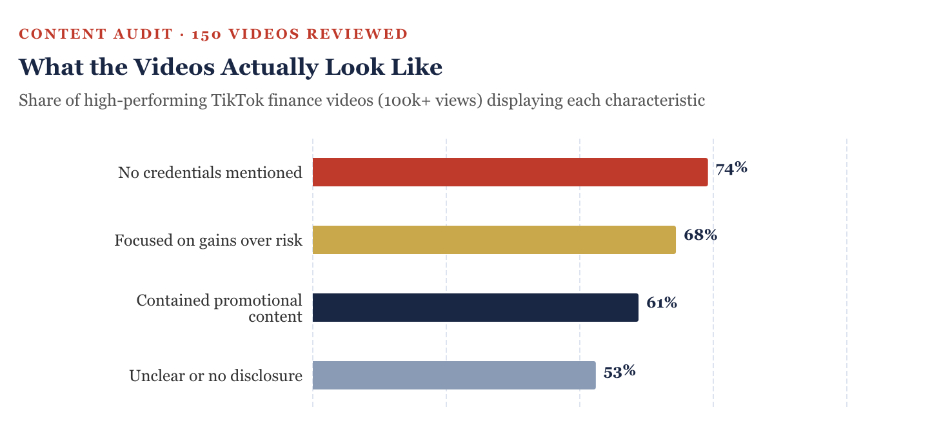
- However, most creators lacked clear credentials. In our analysis of TikTok videos, 74% did not clearly state professional financial qualifications.
- Risks were often underplayed. Videos were far more likely to highlight potential gains than explain losses, volatility, or failure rates, a problem identified in 68% of videos analyzed.
- Promotions were common. 61% of videos blended advice with broker mentions, product plugs, affiliate links, or course sales, while the creator’s renumeration route wasn’t always clearly labelled.
- Disclosures were inconsistent. 53% of promotional content did not come with clear, prominent disclosures. This is despite tougher rules from regulators on suitable disclosures.
- Low financial literacy is ultimately fuelling the rise of FinTok. Research from S&P Global shows that only about one-third of adults worldwide understand basic financial concepts. That gap helps explain why short, simple explanations of money topics spread so quickly on social media.
How Social Media Became A Finance Classroom
Finance content wasn’t always a big deal on social media. Early TikTok was mostly entertainment – dance clips, comedy, lifestyle stuff. But creators eventually figured out that practical topics could pull large audiences. Money turned out to be one of the biggest draws.
It makes sense. Young adults entering the workforce face real financial decisions right away: what to do about student debt, how to start investing, how to build savings, and how to keep up with rising costs. Many feel unprepared.
Research from the FINRA Investor Education Foundation (FINRA Foundation) has consistently found that large numbers of adults struggle with basic financial concepts – things like compound interest and inflation.
Schools rarely fill that gap. In many countries, personal finance is barely covered in the curriculum.
So people look elsewhere. And social media is right there.
A short video explaining compound interest can reach millions within hours. Budgeting tutorials spread quickly among younger viewers trying to juggle rent, student loans, and credit cards. For many, these clips are a starting point.
The Scale Of FinTok
Finance content has become one of TikTok’s biggest categories.
Hashtags around investing, budgeting, side hustles, and passive income pull billions of views. New creators join the space constantly, building audiences around financial education or entrepreneurship.
A significant slice of ByteDance’s billion-plus monthly users is under 35—more comfortable learning through social media than through textbooks or bank seminars.
Many prefer short videos that explain one concept at a time, prompting creators to cover topics like credit scores, index funds, and emergency funds.
That format can be helpful. But it has real limits.
Why Financial Advice Goes Viral
Social media platforms are built to keep people watching. TikTok’s algorithm favors videos that get views, comments, and shares – which means emotionally compelling content often spreads faster than careful, nuanced explanations.
Financial content that performs well tends to share a few common traits.
- Confidence. Creators who speak with certainty draw attention. Phrases like “this strategy works every time” or “this stock will double” trigger curiosity.
- Simple narratives. Complex financial topics don’t fit neatly into 30 seconds. Viral videos boil them down to clean storylines: invest early, build passive income, quit your job.
- Visual proof. Screenshots of profits, rising charts, lifestyle upgrades – these serve as evidence of success, or at least the appearance of it.
These elements make content engaging. They don’t necessarily make it accurate.
Behavioral economists have studied this for years. When people see others appear to be financially successful, it triggers a mix of curiosity and fear of missing out. Social media makes that feeling hit faster.
The FinTok Advice Audit
To get a clearer picture of what viewers are actually seeing, we reviewed a sample of finance videos on TikTok.
The goal wasn’t to call out individual creators – it was to spot common patterns in the advice circulating online.
The review covered 150 videos posted within the previous year. Each had at least 100,000 views, was tagged with finance-related hashtags, and focused on general financial advice or income strategies.
Videos were assessed on three things.
- Accuracy — did the claim line up with widely accepted financial knowledge? Guidance from institutions like the CFA Institute and FINRA helped set the benchmark.
- Credentials — did the creator explain their professional background or qualifications?
- Disclosure — if a product or service was being promoted, was that relationship made clear?
A few patterns stood out.
Most creators didn’t mention professional credentials. Many described themselves as self-taught investors or entrepreneurs.
The potential for financial gain – from building audiences, promoting products, or growing partnerships – drives much of the content. Risk explanations came up far less often than promises of gains. Promotional content, including affiliate links and product recommendations, was common.
None of this means all TikTok finance content is unreliable. But it shows how easily education and advertising can blend together.
The Most Common FinTok Money Myths
Certain claims keep popping up in finance videos. Some contain partial truth. Others stretch reality.
Knowing what to look for helps.
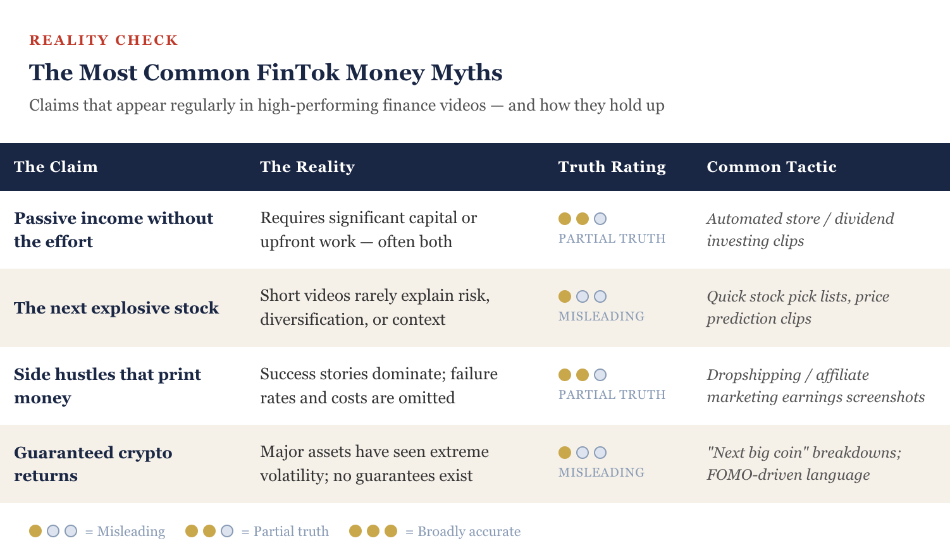
Passive income without the effort
Few ideas travel faster online than passive income. Videos promise daily earnings from automated online stores, dividend investments, or digital products.
The concept itself isn’t a myth. Passive income exists. But building it usually takes significant upfront work or capital — often both.
Dividend investing can generate income over time. But dividends depend on company profits and market conditions. The CFA Institute notes that dividend strategies support long-term investing but aren’t guaranteed sources of stable income.
Creating digital products or online businesses takes time, and many projects fail before producing consistent revenue.
“Passive income” often hides how much work the setup actually involves.
The next explosive stock
Another popular format: a creator highlights companies they believe are about to surge, presenting quick stock picks with minimal analysis.
The retail trading boom of 2021 showed what happens when social media amplifies that kind of excitement. The surge around GameStop and AMC drew later scrutiny from the U.S. Securities and Exchange Commission, which found that online discussion contributed significantly to the spike in retail trading activity.
Sharing investment ideas isn’t inherently harmful. But short videos rarely cover risk management, diversification, or long-term planning. Without that context, speculation can look a lot like reliable guidance.
Side hustles that print money
Entrepreneurship content is everywhere on TikTok — dropshipping, affiliate marketing, selling digital templates, and online tutoring. Many videos highlight impressive monthly earnings.
What they tend to skip: marketing costs, time investment, and failure rates.
Starting an online business can pay off. It also involves real risk and plenty of trial and error. What goes viral are the success stories, not the projects that quietly failed.
Crypto wealth stories
Cryptocurrency content exploded during the digital asset boom. Many videos focus on finding the next big coin before prices rise, sometimes suggesting that certain tokens are guaranteed to appreciate.
Regulators strongly dispute that framing. The UK’s Financial Conduct Authority (FCA) has warned repeatedly that cryptocurrency investments carry high risk and extreme volatility. Major digital assets have seen dramatic price swings within very short periods.
Short-form video rarely captures that complexity.
The Business Behind Financial Influencing
One reason finance content spreads so quickly is that it can be quite profitable for creators – often more profitable than the investing strategies they discuss.
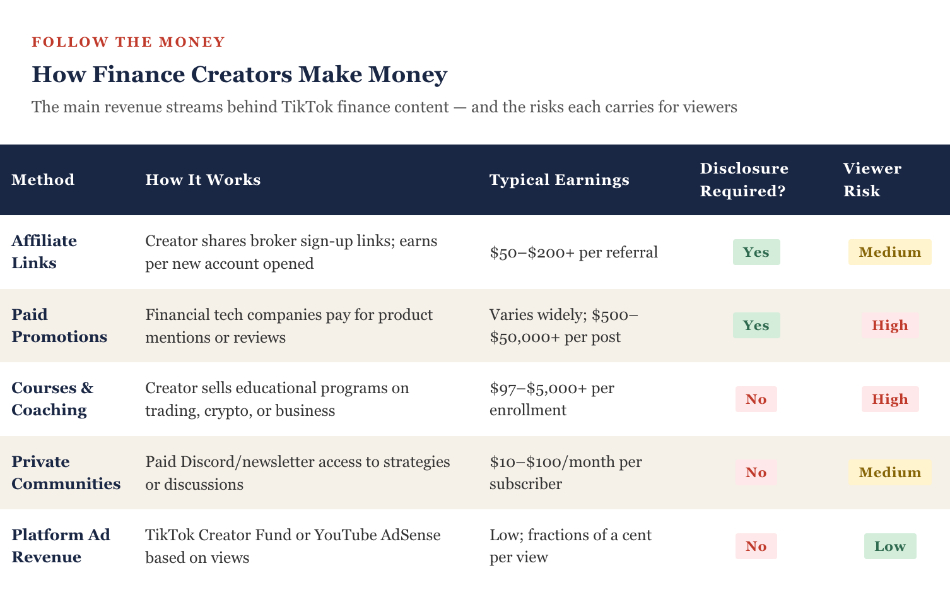
Large audiences create multiple income streams.
- Affiliate partnerships. Broker platforms run referral programs. A creator shares a sign-up link for a trading app and gets a commission when viewers open accounts. Payments can range from around $50 to more than $200 per new user. For creators with large followings, that adds up.
- Paid promotions. Financial technology companies increasingly work with influencers to promote budgeting apps, investment platforms, and savings tools. Regulators require disclosure, but enforcement gets tricky when it appears only in small print or buried in captions.
- Courses and coaching. Educational products are a major source of revenue. Creators sell courses on stock trading, cryptocurrency, and building online businesses — sometimes for thousands of dollars. Some are genuinely useful. Others lean heavily on marketing. The Federal Trade Commission (FTC) has pursued cases against companies that promised unrealistic earnings from online programs.
- Private communities. Paid Discord groups, newsletters, and trading forums give some creators recurring income. Members pay monthly fees for access to discussions and strategies. These communities can be engaging, but transparency becomes a real question when the ideas being shared don’t pan out.
Regulatory Attention Is Growing
Regulators are paying closer attention to what’s circulating online.
The United States Securities and Exchange Commission (SEC) has brought enforcement actions tied to social media promotions. A widely reported case involved Kim Kardashian, who settled charges in 2022 after promoting a cryptocurrency without disclosing she’d been paid. The settlement included a $1.26 million penalty and restrictions on future promotions.
In the UK, the FCA has warned that illegal financial promotions on social media may violate advertising rules. Australia’s securities regulator ASIC has cautioned that influencers could face fines or legal penalties for providing financial advice without a license.
The message is consistent: regulators now see social media as part of the financial system, not separate from it.
Platforms Are Trying To Respond
TikTok and other platforms have introduced tools to improve transparency. Creators can label content as paid partnerships. Certain financial ads now require approval before going live.
But moderation is hard.
Most finance content appears as organic posts, not ads. Automated systems struggle to distinguish genuine education from misleading claims. A video predicting a stock will rise might be optimistic — that doesn’t necessarily make it illegal.
In practice, enforcement tends to fall on regulators rather than the platforms themselves.
The Bigger Issue: Financial Literacy
The popularity of finance content on social media reflects something deeper. A lot of people simply don’t have access to good financial education.
The S&P Global financial literacy survey found that only around 33 percent of adults worldwide demonstrate basic financial literacy. Even in wealthy countries, many adults struggle to explain inflation, diversification, or compound interest.
When formal education doesn’t cover these things, people search for answers somewhere. Social media is easy and immediate. That’s why it fills the gap.
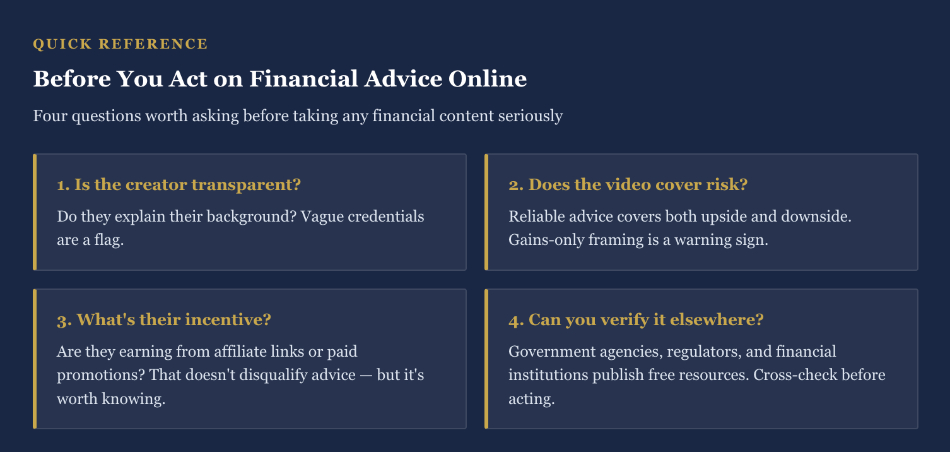
How To Evaluate Financial Advice Online
Avoiding social media entirely isn’t the answer. But a bit of healthy skepticism goes a long way.
- Look for transparency. Creators who explain their background and qualifications give you more to work with. Vague credentials are worth noting.
- Watch for balance. Good financial education covers both risk and potential reward. If a video only talks about the upside, that’s a flag.
- Check the incentives. If a creator is promoting a product or platform, think about whether they benefit financially from your sign-up. That doesn’t automatically make the advice wrong — but it’s worth knowing.
- Verify before acting. Big financial decisions deserve more than one source. Government agencies, regulators, and research organizations publish free educational material that can help you cross-check what you’re seeing online.
The Bottom Line
Social media has genuinely changed how people learn about money — and not entirely for the worse. Platforms like TikTok have brought financial conversations to a much wider audience.
Millions of people now encounter ideas about investing, budgeting, and building financial security that were once confined to textbooks or professional seminars.
That’s real progress.
But the same platforms also reward bold claims, quick success stories, and promises that sound almost too good to be true.
Understanding personal finance today means understanding something beyond money itself — it means understanding how information spreads, and why some of it spreads faster than it probably should.
A viral video can introduce an idea. But turning that idea into sound financial knowledge still takes something slower: research, credible sources, and a willingness to push back on claims that feel too clean to be real.