

Broker Complaints Report for 2026
 Written By
James Barra
James is an experienced broker analyst with a background in financial services. He has spent 2,500+ hours testing brokers, used 35+ different platforms and apps, audited 120+ broker T&Cs, and verified 300+ regulatory licenses. James has also been on US and UK TV, and been a guest on finance podcasts, discussing reports conducted by BrokerListings.com and sharing his expertise.
James Barra Profile Page Fact Checked By
Tobias Robinson
Tobias is committed to helping traders find the right brokerage for their needs. He has tested 200+ brokers, spent 2,600+ hours using different platforms, and placed 2,100+ trades.
Tobias Robinson Profile Page Edited By
William Berg
William Berg combines his expertise in law and finance to analyze trading brokers. He has checked 3,250+ regulatory licenses, investigated 2,365+ broker clones and trading scams, and placed 3,500+ trades.
William Berg Profile PageApril 23, 2026
We scoured third-party review sites like TrustPilot, Google Play, and the App Store, documenting negative user reviews for 10 large brokerages over the last six months. Our aim was to identify where some of the market’s best-known providers were failing users. We then compared the data with our 2025 Complaints Report to see which firms have improved, and crucially, which haven’t.
Key Takeaways
Why user reviews still matter:
- User reviews paint a picture of the trading experience from real clients. They provide an insight into what it’s like to trade with these brokers when you remove the marketing. And our analysis shows there are some real pain points.
- One study found 97% of consumers still lean on customer reviews to help guide their decisions about which brands to use, and which to avoid. And disgruntled customers often provide an unvarnished look under the hood.
- That said, reviews are subjective and we can’t verify every individual claim. Still, they remain a useful indicator of recurring pain points when similar complaints appear time and again.
Scope:
- We recorded and analyzed user complaints at prominent brokers between October 2025 to April 2026, primarily focusing on one and two star reviews, but also factoring in some three star reviews if they contained negative feedback.
- We manually read and documented over 500 reviews, categorising them into issue mentions across 6 categories: App Experience, Trading Conditions, Payments or Transfers, Customer Support, Account, and Registration.
- We concentrated on complaints of 10 major brokers: Trading 212, Robinhood, Fidelity, Charles Schwab, Vanguard, Capital.com, E*Trade, ThinkMarkets, Markets.com, and Admiral Markets.
Headlines:
- Despite advancements in technology, the app user experience still leaves a lot to be desired. Technical glitches, lags, and dated user interfaces (especially at legacy brokers like Fidelity), showed up in 33% of issue mentions.
- Customer support teams are not sufficiently dealing with traders’ queries, with problems cited in 33% of issue mentions, and Robinhood and Vanguard standing out with the highest proportion of support-related complaints.
- Problems with deposits, transfers, and most worryingly – withdrawals – appeared in 25% of issue mentions, representing a significant portion of frustrated users.
- Trading conditions, including slow execution speeds and price slippage, as well as trading fees and joining incentives that didn’t meet expectations, were a serious issue, featuring in 21% of the feedback analyzed.
- Traditional brokerages like Schwab are increasingly being criticised for their “archaic” processes and technology, and risk losing clients to newer, technology-focused firms and trading apps.
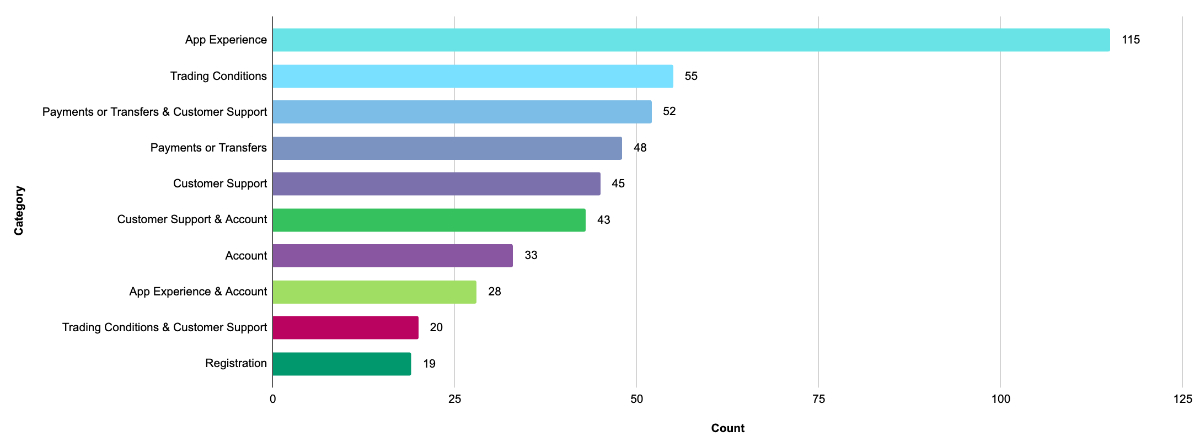
- The table below shows the number of individual issues and crossovers separately, ranked by the most common problems.
| Complaint Categories & Crossovers | Count |
|---|---|
| App Experience | 115 |
| Trading Conditions | 55 |
| Payments or Transfers & Customer Support | 52 |
| Payments or Transfers | 48 |
| Customer Support | 45 |
| Customer Support & Account | 43 |
| Account | 33 |
| App Experience & Account | 28 |
| Trading Conditions & Customer Support | 20 |
| Registration | 19 |
| App Experience & Trading Conditions | 16 |
| App Experience & Customer Support | 15 |
| Trading Conditions & Payments or Transfers | 13 |
| Payments or Transfers & Account | 12 |
| Trading Conditions & Account | 9 |
| App Experience & Payments or Transfers | 7 |
| Customer Support & Registration | 7 |
| Account & Registration | 5 |
| Payments or Transfers & Registration | 4 |
| Trading Conditions & Registration | 2 |
Pair categories only count relationships between two issues. When a review has three or more issues, it gets split across multiple pairs, but we have not counted the full number of issues in those cases. That’s why the pair totals are lower than the overall issue count.
The Change Between 2025 And 2026:
- In 2025, users complained about clunky interfaces (42%). In 2026, the focus has shifted to access to capital, with Payments and Transfer issues rising to 25% as traders struggled to withdraw funds and move balances to chase better interest rates and sign-up incentives.
- Customer Support issues climbed to 33%, fueled in part by a failure of automated bots to handle KYC/Registration and Account hurdles, exasperated at some brokers by app updates that have made biometric logins more painful.
- The critique of legacy firms like Fidelity and Schwab has evolved; users no longer just call their tech “old” – some now label it “dysfunctional,” specifically regarding mobile performance and “archaic” verification loops.
Our Methodology
We collected over 500 one, two, and three star reviews in total across 10 brokers between October 2025 and April 2026. User complaints were taken from Trustpilot, Google Play, App Store, and Google Reviews.
We focused on 10 of the biggest, well-known trading brokers:
- Trading 212
- Robinhood
- Fidelity
- Charles Schwab
- Vanguard
- Capital.com
- E*Trade
- ThinkMarkets
- Markets.com
- Admiral Markets
We manually read and recorded every review. We then categorised them by theme (often more than one theme per review). We then analyzed our dataset to pinpoint the problems that show up the most. We also compared the findings with our 2025 broker complaints data to see what brokers are (or aren’t) doing better.
Here’s a rundown of each theme:
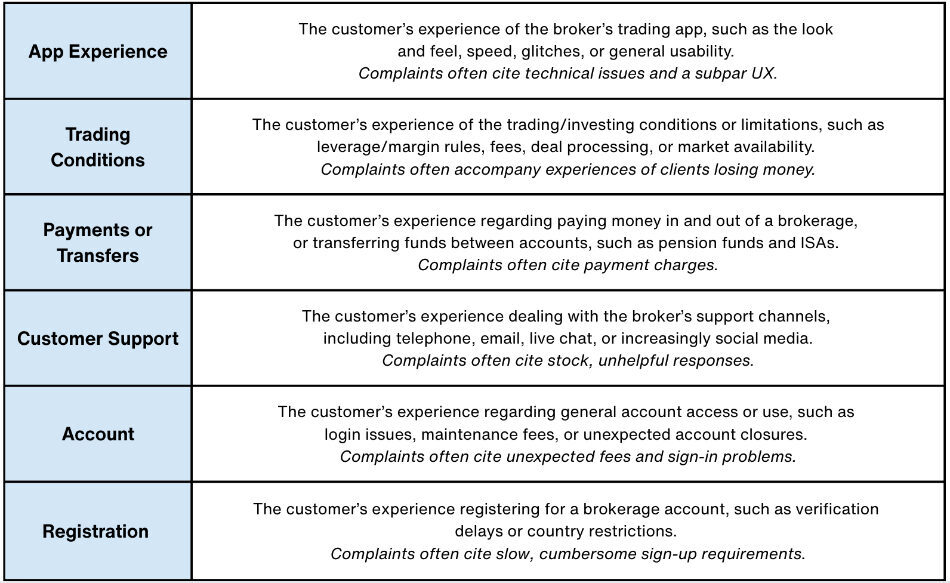
Complaint Category Rankings
The chart below summarizes the top 10 complaint categories and their frequency. It also includes the most number of crossovers – where multiple issues were flagged in the same review.
3 Key Themes
1. The Mobile Trading Experience (Still) Isn’t Good Enough
21% of the issues we analyzed cited App Experience as a standalone failure, the highest single category in our dataset. And when we factored in crossovers with other key themes like Trading Conditions and Payments, this jumped to 33%. This is despite improvements in mobile technology and brokerages pouring millions collectively into app development.
What stood out while we were reading the user reviews was how often app updates often accompanied an array of bugs that led to glitchy charts and features or painfully slow logins that ultimately left many users deeply unsatisfied. This was especially the case at Robinhood and E*Trade, who have made changes to their apps.
Legacy platforms are also clearly struggling to keep up compared to more mobile-first brokers. We read multiples reports of issues like symbols being delayed by minutes – a noteable drawback for short-term traders.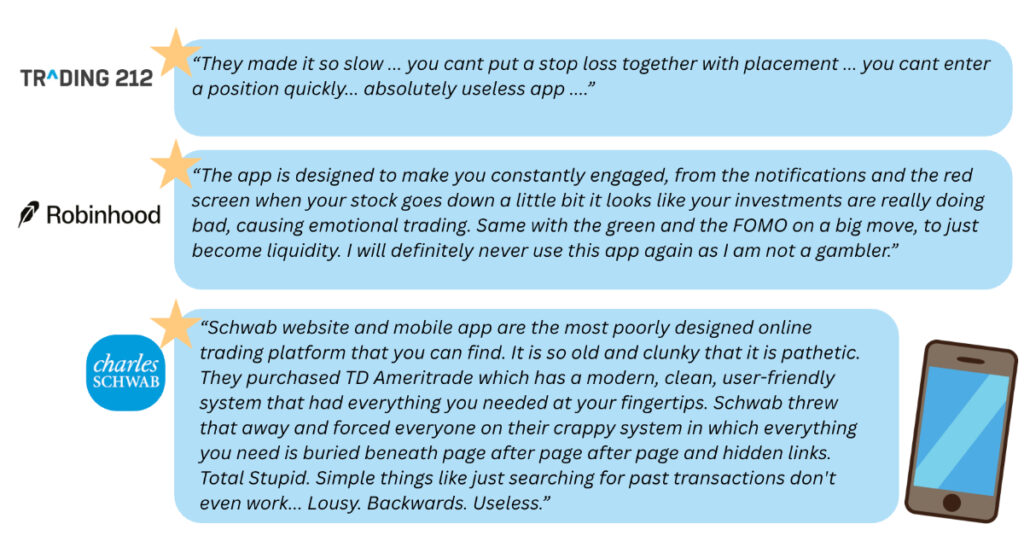
2. Payment & Support Issues Frequently Go Hand In Hand
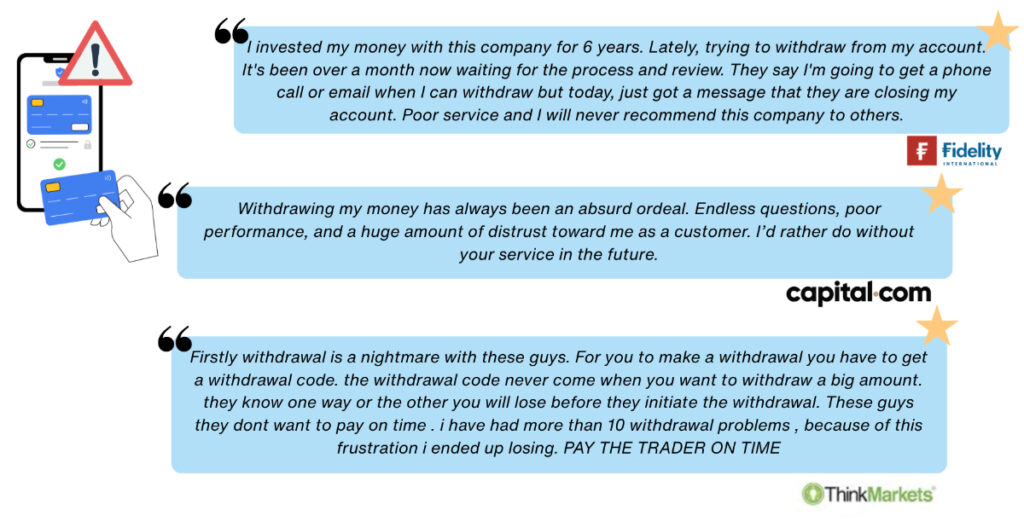
There is a clear correlation between funding investment accounts, making transfers between brokerages, withdrawing funds, and the need for human intervention.
While 9% of issue mentions cited payment issues as a standalone failure, this figure climbs to 25% when factoring in crossovers with other categories. 10% of complaints (52 separate instances) flagged a failure of both Payments and Customer Support. This was the most common compounded complaint in the data.
This suggests that when a transfer fails or a withdrawal is delayed, support is also failing to provide updates and/or greeting users with automated chatbots, leading to (understandably) high levels of anxiety. It’s also the kind of issue that could see customers flock to other brokers.
3. Execution Quality & Pricing Transparency Are Falling Short
There is a growing sentiment among investors that “commission-free” trading is being offset by poor execution and non-transparent costs. 10% of issue mentions we analyzed cited Trading Conditions as a standalone failure, but when crossovers, such as poor support during execution errors, are included, this reaches 21% of the dataset.
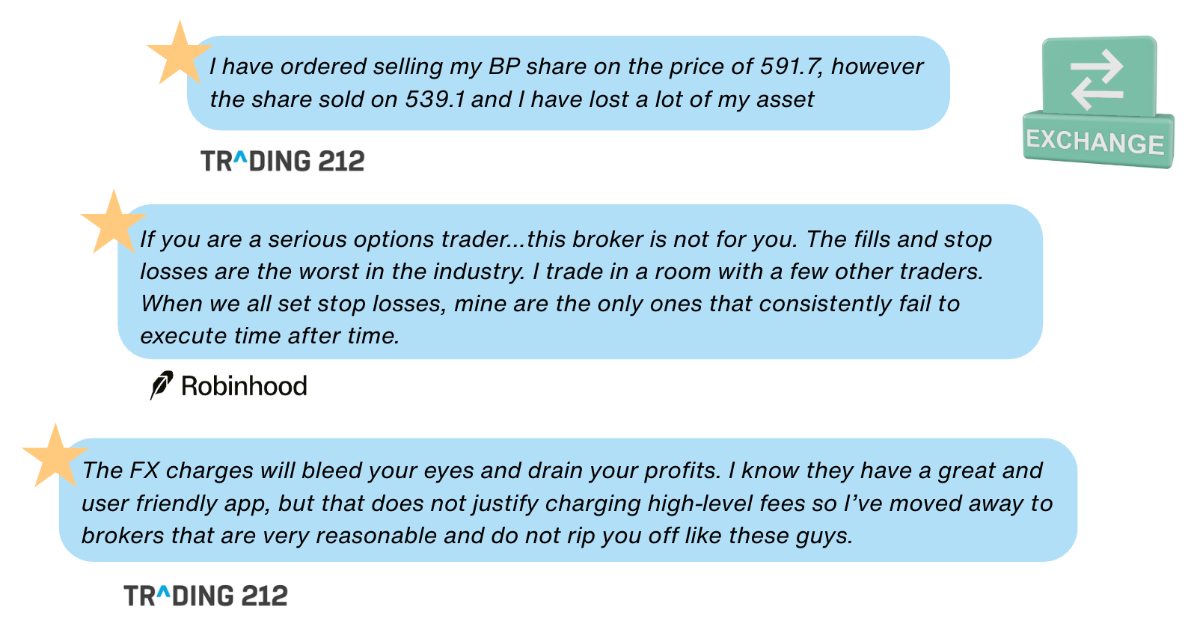
From the reviews we’ve read, users are often reporting significant discrepancies between displayed prices and actual execution prices. Furthermore, “hidden” FX fees are leaving clients worse off than they initially realised.
Some clients feel that while the front-end is user-friendly, the “back-end” processes, like execution and fee structures, are designed to quietly “drain profits”.
Category Crossovers: Where The Damage Multiplies
The most damaging user experiences are those that cross categories, indicating multiple problems with a broker’s offering – rather than a one-off glitch. The table below highlights the count of complaints where pain points compounded across themes, leading to the highest levels of user dissatisfaction.
Unsurprisingly, Customer Support regularly features across categories which is as we’d expect. If a user has a problem with say a withdrawal delay or unexpected charges, they’ll likely get in contact with customer service, and if their issue isn’t resolved, the support provided could also come under fire.
« Make Full Width »| Complaint Category Combination | Count |
|---|---|
| Payments or Transfers & Customer Support | 52 |
| Customer Support & Account | 43 |
| App Experience & Account | 28 |
| Trading Conditions & Customer Support | 20 |
| App Experience & Trading Conditions | 16 |
| App Experience & Customer Support | 15 |
The View Across Brokers
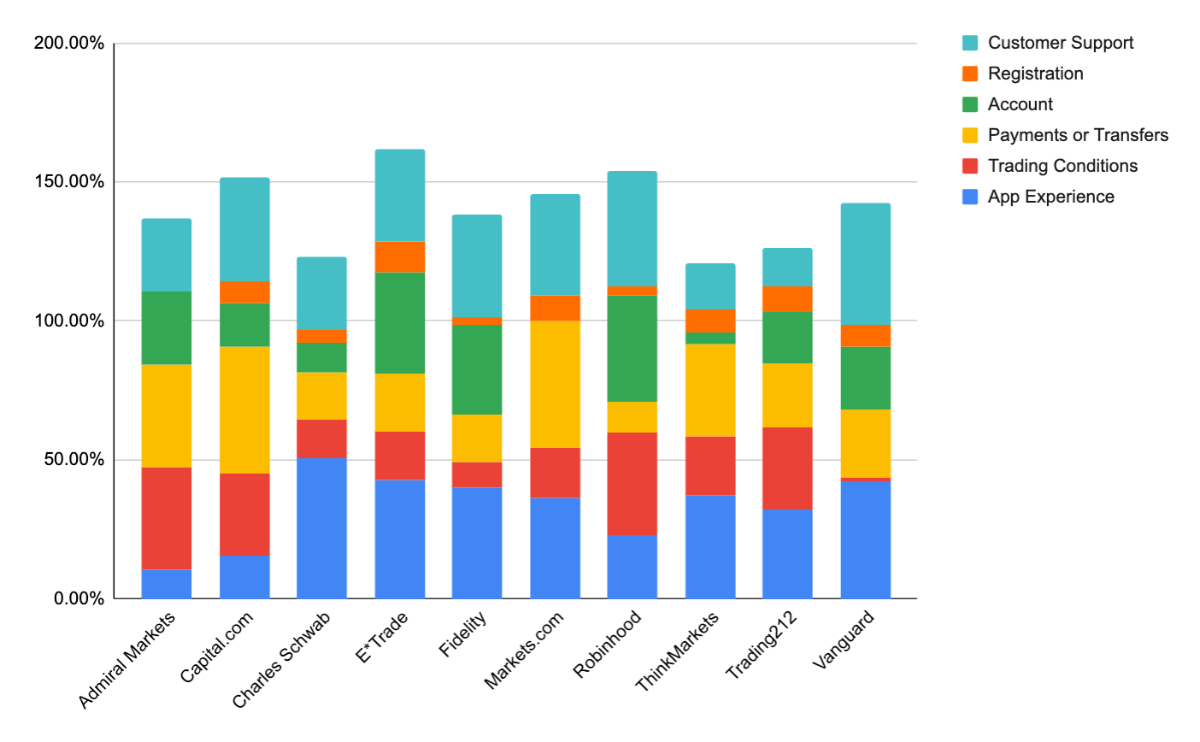
We also looked at which issues and pain points are the chief issues at each broker in our dataset. To ensure fairness, we analyzed which brokers had the highest proportion of their own reviews focused on a specific pain point (normalizing for volume, i.e. where we have more reviews for one broker compared to another). In the chart below:
- Each bar shows how often an issue appears within that broker’s reviews. A single review can have more than one issue, so the same review can be counted in multiple bars. That’s why the totals can add up to more than 100%.
- A taller bar means reviews for that broker tend to include multiple issues, not that they have more negative reviews.
- The biggest color in each bar shows the most common issue for that broker. E.g. for Schwab it’s the App Experience, while for Markets.com its Payments or Transfers.
- If the same colours appear across many brokers, those are common problems across the market – not just one company. E.g. you can see Customer Support, Payments or Transfers, Account, and App Experience issues are fairly consistent across the industry.
Which Brokers Actually Respond To Customers?
We also looked at whether brokers take the time to reply to customer complaints. Doing so points to their willingness to try and put things right.
Trading212 is very responsive on Trustpilot – actively engaging on issues like technical glitches. Fidelity also replies on Trustpilot, while ThinkMarkets is more selective about the reviews it replies to. Robinhood and Capital.com are fairly responsive on Google Play but less active on Trustpilot.
Towards the bottom of the pack are most of the legacy brokerages, notably Charles Schwab, which is seemingly radio silent on the third-party review sites we analyzed. Perhaps it feels it’s too big to fail or that a few bad reviews won’t impact its bottom line, but it could do more to quell customer complaints.
Vanguard does reply to some Trustpilot complaints, but with so many reviews citing a decline in customer service and overall quality, this somewhat cancels out the frequency in which it responds to complaints.
2025 Vs 2026
We also compared our latest dataset with our 2025 analysis, which looked at the same set of brokers. The question: what has (or hasn’t) changed? Below is a summary showing the trend amongst key complaint categories.
| Metric | 2025 Report Findings | 2026 Report Findings | Trend Direction |
|---|---|---|---|
| App Experience | 42% | 33% | Decreasing |
| Customer Support | 21% | 33% | Increasing |
| Payments/Transfers | 17% | 25% | Increasing |
| Trading Conditions | 21% | 21% | Stable |
So, what’s changed and why?
- In 2025, 42% of users complained about the App Experience, mostly focusing on “clunky” interfaces. In 2026, that has dropped to 33%. That means a clap on the back for brokers and their developers, but only a small one, as app issues still feature in a high proportion of reviews. More work still needs to be done.
- Concerns about Payments and Transfers have jumped from 17% to 25%. Users are no longer just complaining that a transfer is slow, some are worried that their money is trapped, or worse – lost for good. Now this may well be for valid reasons on the part of the broker, such as AML requirements, but a lack of status updates is clearly still frustrating users regardless.
- Customer Support complaints have jumped from 21% to 33%. We expect this is partly due to the increasing use of automated chatbots and telephone lines which we’ve experienced ourself while evaluating brokers. There’s growing frustration at the lack of human assistance, and when there is, the revolving door of agents where no single person takes ownership of a ticket/problem, leading to contradictory answers and slower resolutions.
Disclosures
- Our aim with this report is to inform traders, brokers and wider industry participants about the pain points retail investors are experiencing when dealing with brokers. Our aim is not to target or disparage any individual firm.
- Our dataset is from publicly available sources, which we documented and then analyzed to identify key themes. We reference specific brands or quotes only to illustrate a theme.
- If any broker believes our findings or descriptions are inaccurate or would like to reply to the information in this report, please contact us at outreach@brokerlistings.com.
- The appearance of brands in this study should not be considered an endorsement by BrokerListings.com. This is a neutral, independent study.
- We manually removed from our dataset reviews that we believed may have contained obvious bias or errors. This was a judgement made by the researchers.
- Quoted reviews featured in the visuals of this report are verbatim excerpts from public platforms and reflect the authors’ opinions – they are not those of the BrokerListings.com team.
- All trademarks, logos, and brand names are the property of their respective owners and are used here for identification purposes only.
- BrokerListings.com received no compensation from the brokers referenced, nor any brokers not referenced in this report.
- We analyzed publicly available reviews and did not process personal data beyond what is already public.
- Percentages are based on issue mentions (not unique reviews). This means a single review can include multiple issues or categorised themes.
- Our analysis covers a defined period between October 2025 and April 2026 and may not reflect subsequent product updates, policy changes, or remediation actions taken by brokers.
- Information presented is provided “as is,” without warranties of accuracy or completeness.
- This report is for general information only and does not constitute investment, legal, tax, or other advice.
Sources
Local Consumer Review Survey 2026: Star Ratings Keep Rising, Old Reviews Don’t Cut It – BrightLocal