

Best Brokers With THB Accounts 2026
See our top brokers offering Thai baht (THB) accounts, enabling Thai traders to mitigate currency risks and reduce conversion fees for trading efficiency.
 Written By
Royston Wild
Royston is a seasoned investor and financial writer with over a decade of experience analyzing brokers and investment markets. With a background in stocks, commodities, and forex reporting - he brings a fresh perspective to broker evaluations.
Royston Wild Profile Page Fact Checked By
James Barra
James is an experienced broker analyst with a background in financial services. He has spent 2,500+ hours testing brokers, used 35+ different platforms and apps, audited 120+ broker T&Cs, and verified 300+ regulatory licenses. James has also been on US and UK TV, and been a guest on finance podcasts, discussing reports conducted by BrokerListings.com and sharing his expertise.
James Barra Profile Page Edited By
Tobias Robinson
Tobias is committed to helping traders find the right brokerage for their needs. He has tested 200+ brokers, spent 2,600+ hours using different platforms, and placed 2,100+ trades.
Tobias Robinson Profile PageAugust 8, 2026
Filters
How We Choose The Top THB Brokers
Our detailed testing process involves:
- Opening an account with each brokerage in our growing catalogue, then recording which ones allow trading using the Thai baht as the base currency.
- Confirming that each service provider has obtained authorization from a top-level regulator, as per BrokerListings.com’s regulator ranking system. Given the limited protections afforded by Thailand’s Securities and Exchange Commission (SEC), we prioritise companies that have received approval from a top international regulator.
- Periodically re-checking that each brokerage maintains their regulated status. Financial services watchdogs are able to suspend or withdraw licenses when misconduct has occurred.
- Scoring brokers on several factors other than THB account availability. Trading costs, the quality and security of the trading software, range of tradeable assets, and the firm’s customer service are among other items we look at.
What Is A THB Account?
A THB trading account lets traders and investors deal in Thailand’s national currency, the baht. Financial assets are bought and sold – and account deposits and withdrawals carried out – using this medium of exchange.
Retail investing is rising in Thailand. This has fuelled the growth of the Stock Exchange of Thailand (SET), and it’s now South-East Asia’s second-largest stock market. Growing interest has encouraged more brokers to offer baht-denominated trading, although those offering such services remains fairly limited today.
Using a THB-based trading account can have several benefits for you:
- They are more cost-effective for depositing and withdrawing cash, as you can avoid currency conversion fees when you send money to your broker from your Thai bank account, and vice versa.
- Reduced exposure to forex market volatility, which can be especially problematic for ‘exotic’ currencies like the Thai baht.
- Quicker fund transfer in and out of your account, as brokers who support THB-based trading often support local payment methods. This can include bank transfers from Thai institutions and payments from payment service providers like TrueMoney.
How Do I Open A THB Account?
Once you’ve found a broker that offers THB-based services, the entire process from setting up an account to placing trades often takes just a few minutes.
It involves five key steps:
1. Choose A Brokerage
Important factors to think about include fees and charges, bid and ask spreads, the quality of the trading platform, and the range of financial securities you’re able to trade. For instance, are you restricted to particular shares that trade on the Thailand stock market?
Pro tip: The boom in online trading has led to a similar explosion in the number of scammers out there. This makes narrowing your search to companies that are authorized by a reputable global regulator a non-negotiable for all traders and investors.
Capital markets and brokers in Thailand are regulated by the Securities and Exchange Commission (SEC). But here’s the thing: the supervision and enforcement of local regulations are weaker than in some other parts of the world.
As a result, the SEC has been given Category C classification under BrokerListings.com’s Regulator Trust Rating. This means Thailand’s national regulator is considered “less credible and may offer little to no financial safeguards or legal protections.”
In our view, individuals should narrow their searches down to brokers that are licensed by a Category A regulator under our rankings. Examples include the US Securities and Exchange Commission (SEC), the Australian Securities and Investments Commission (ASIC) and the Cyprus Securities and Exchange Commission (CySEC).
2. Register For An Account
You may only need to submit and verify your email address to open an account. However, some brokers may require more details during the registration process, like providing documents to prove your place of residence and identification.
3. Select THB As Your Base Currency
You may be given a USD-denominated trading account by default, which uses the US dollar. In these circumstances you’ll need to navigate the broker’s website to open one with the Thai baht as the base currency.
4. Deposit Some Cash
You can’t start trading until you put some funds in your trading account. This can be done by, for instance, using a:
- Bank transfer (such as from Bangkok Bank).
- Debit card transaction.
- Digital wallet.
- Payment service provider (like PromptPay).
5. Begin Trading
You should be able to start buying securities more or less straight away. It can be a good idea to use a demo account (if available) to get up to speed with the markets and the broker’s trading software and systems.
Example Of Opening A THB Account
To illustrate how simple it can be to open a THB-based account, I registered my details with Swissquote. The broker isn’t registered with any regulatory body in Thailand, though it has been authorized by some of the world’s more respected organizations.
These include CySEC, Switzerland’s Financial Market Supervisory Authority (FINMA), and the UK’s Financial Conduct Authority (FCA). Each of these institutions has Category A status under our regulator ranking system.
The process of opening an account with Swissquote is more complicated than with some other brokers. This requires me to submit personal details, from my address and employment status to the source of my trading funds. I also have to complete some other tasks, like electronically sending proof of identification and signing ‘Know Your Customer’ (or ‘KYC’) documents.
After this stage, I could add THB as my base currency by going to ‘Profile and Settings,’ then ‘Trading Preferences’ and then ‘Currencies.’
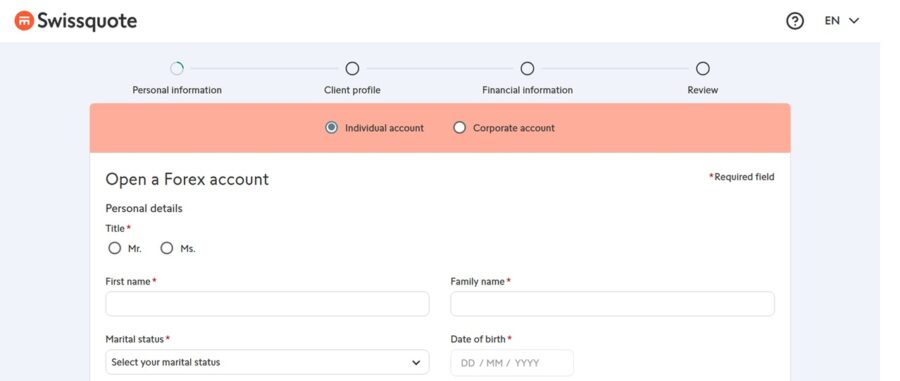
Registering with Swissquote for a THB account
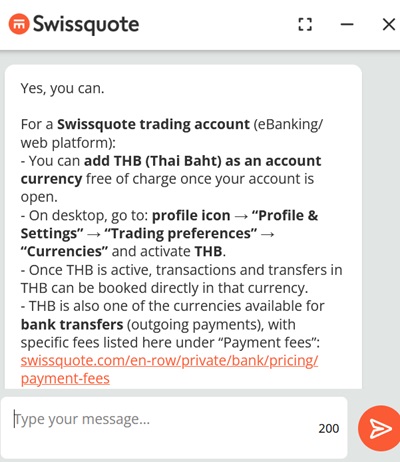
Selecting a THB account with Swissquote
Should I Use An THB Trading Account?
A THB-denominated trading account can make sense if, for instance:
- You live in Thailand, where tax reporting in accordance with local regulations may be more complicated if you trade in overseas currencies.
- You want to make the process of depositing and withdrawing cash – along with understanding how much money you have – simpler and more cost effective.
- You want to utilize local payment methods (like TrueMoney) to deposit and withdraw money.
What Are the Drawbacks Of Using THB Accounts?
However, there are some problems you may encounter if you want to trade using the Thai baht, including:
- An extremely limited range of brokers, as few service providers allow you to operate your account in Thailand’s national currency. In fact, less than 5% of our broker directory offer THB-based trading accounts.
- You’ll pay forex conversion charges when buying or selling financial assets that aren’t denominated in THB.