
Best Brokers With KWD Accounts 2026
We’ve thoroughly tested brokers offering KWD accounts, selecting ones with reliable local support, competitive spreads, and efficient withdrawals, providing traders with optimal conditions in the Kuwaiti market.
 Written By
Royston Wild
Royston is a seasoned investor and financial writer with over a decade of experience analyzing brokers and investment markets. With a background in stocks, commodities, and forex reporting - he brings a fresh perspective to broker evaluations.
Royston Wild Profile Page Fact Checked By
James Barra
James is an experienced broker analyst with a background in financial services. He has spent 2,500+ hours testing brokers, used 35+ different platforms and apps, audited 120+ broker T&Cs, and verified 300+ regulatory licenses. James has also been on US and UK TV, and been a guest on finance podcasts, discussing reports conducted by BrokerListings.com and sharing his expertise.
James Barra Profile Page Edited By
Tobias Robinson
Tobias is committed to helping traders find the right brokerage for their needs. He has tested 200+ brokers, spent 2,600+ hours using different platforms, and placed 2,100+ trades.
Tobias Robinson Profile PageOctober 9, 2026
Filters
How We Choose The Top KWD Brokers
Our detailed ranking process involves:
- Opening an account with each broker in our expanding database, then recording which of them allow traders to use Kuwait dinar (KWD) as the base currency.
- Establishing that each brokerage has authorization from an A-list regulator, as per BrokerListings.com’s regulator ranking system. Kuwait’s Capital Markets Authority (CMA) has been given Category B status, affording good (if limited) levels of protection. So we choose brokers that fall within the Category A bracket.
- Regularly checking that each broker has maintained their regulated status. This is because regulators can temporarily suspend or cancel licenses when misconduct has occurred.
- Ranking brokerages on additional factors such as trading costs, the quality and security of the trading software, and the range of financial markets on offer.
What Is A KWD Account?
Retail investing is rising rapidly in Kuwait, driven by reforms to Boursa Kuwait — the country’s national stock exchange — and the growing availability of online trading platforms.
The number of active trading accounts rocketed 111% over the course of 2025, which Boursa Kuwait said reflected “rising investor confidence and deeper market engagement.”
Individuals can open trading accounts — whether that’s to deal in stocks, currencies, contracts for difference (CFDs) or certain other financial assets — using Kuwait’s national currency. These offer advantages including:
- Safeguards from forex conversion charges when you deposit capital into your account or make withdrawals.
- Reduced exposure to volatility on currency markets, which can be especially important for those who use KWD as their everyday currency.
- Funding and withdrawing from your trading account is made simpler. Brokerages that provide KWD-denominated accounts usually support local payment methods, such as transactions from digital wallets (like AZ-eWallet) and online payment providers (such as KNET).
- Dealing in KWD-denominated securities, including stocks and currency pairs (like the KWD/USD, that pits Kuwait’s currency against the US dollar), is made simpler as individuals don’t need to keep converting across different global currencies
How Do I Open A KWD Account?
Registering for an account that permits trading with the KWD as the base currency involves these five broad steps:
1. Select A Brokerage
Though increasing in number, the number of operators offering KWD-based trading remains thin today. So if you wish to trade using Kuwait’s national currency, you may need to compromise on certain other things including trading charges, the range of financial markets on offer, the availability of leverage, and the functionality of the trading software.
Pro tip: Kuwait’s CMA is responsible for regulating the country’s financial markets and supervising brokerages there. But according to our in-house ranking system, the organization offers “good regulatory oversight” rather than excellent levels of protection.
As a result, we’d recommend using a broker afforded top-tier status under our classification system. Examples include the UK’s Financial Conduct Authority (FCA), the US Securities and Exchange Commission (SEC) and Germany’s Bundesanstalt für Finanzdienstleistungsaufsicht (BaFin).
2. Open An Account
Registering for an account may require you to submit information including your name, date of birth, place of residence, telephone number, email address, trading experience and the source of your funds.
At some stage you’ll also need to provide proof of identification and address. The precise information you’ll need to supply — and the point at which you’ll need to provide it — will differ among brokers.
3. Select KWD As Your Base Currency
The service provider will probably assign you a trading account that uses a major global currency (like USD) by default. If this is the case, you’ll be required to manually open a KWD-denominated account via the trading platform.
4. Send Over Some Cash
You won’t be able to start trading until you’ve deposited some money in your account. The brokerage should provide you with several cash transfer options, which may include:
- Bank transfer (for instance, from the National Bank of Kuwait).
- Debit card.
- Digital wallet.
- Online payment provider.
5. Begin Trading
You’ll be able to start buying and selling securities as soon as your money hits your KWD account.
Example Of Opening A KWD Trading Account
Exness has been offering financial services since the late 2000s, and has authorization from multiple global regulators like Category A bodies the Financial Conduct Authority (FCA) and the Cyprus Securities and Exchange Commission (CySEC).
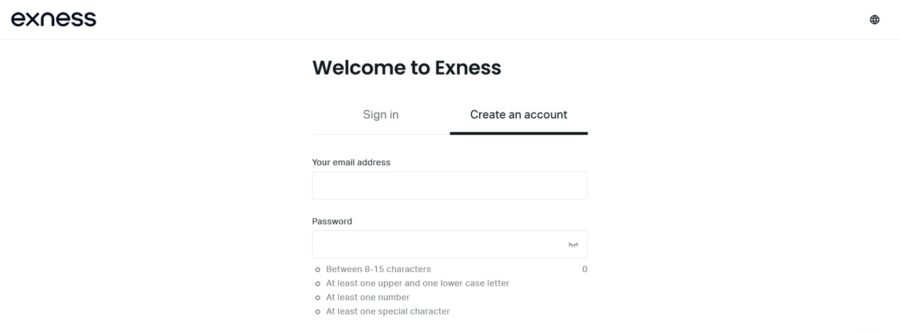
Signing up with Exness to open a KWD-based account
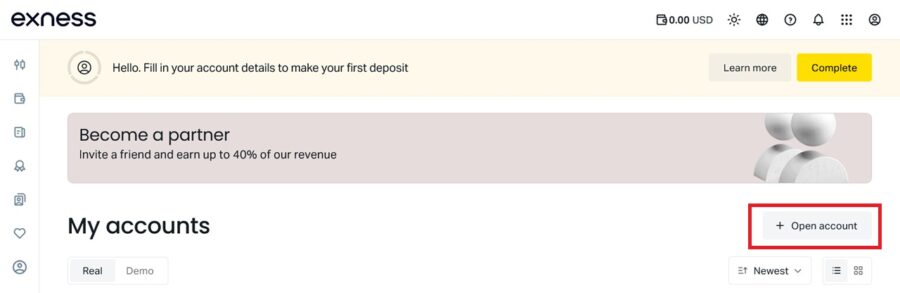
Opening an Exness account
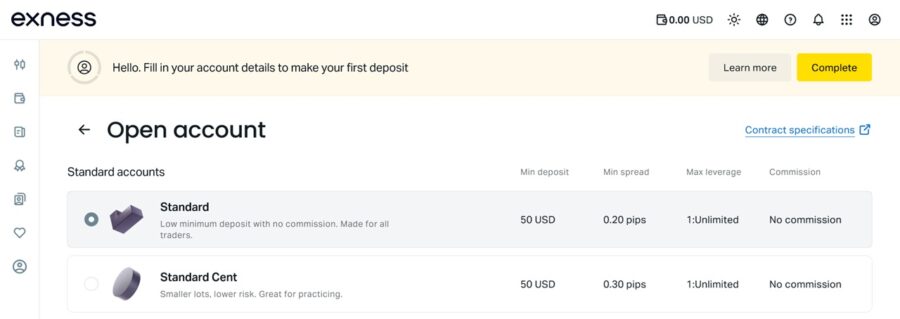
Choosing from a range of Exness trading accounts
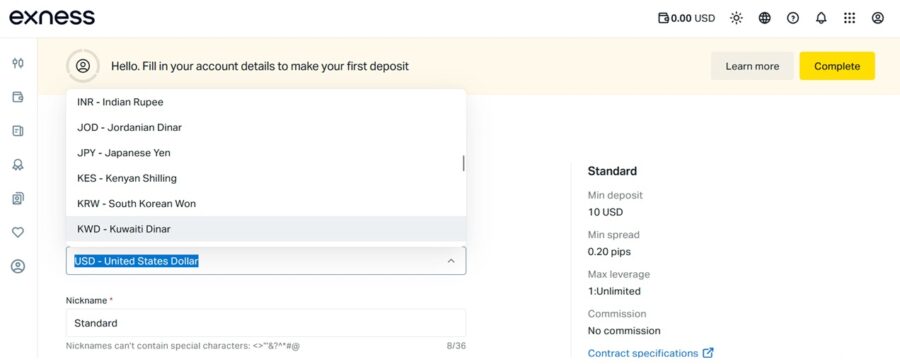
Choosing a KWD account
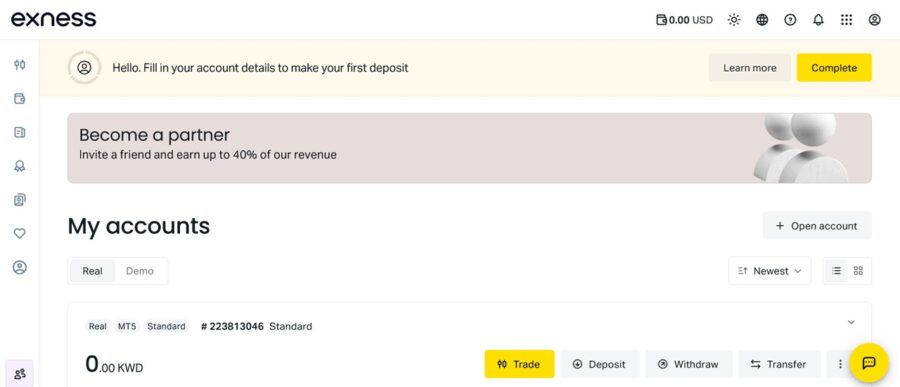
Setting up my KWD trading account with Exness
Should I Use A KWD Trading Account?
KWD-based trading accounts offer a variety of perks for traders in Kuwait. These include:
- Bank transfers from local banks (such as Gulf Bank) are typically concluded more quickly.
- Buying and selling financial assets and managing your portfolio can be more straightforward if you use the native currency.
- Currency-switching fees are excluded from the trading process. This can dramatically reduce an individual’s dealing costs, and especially for high-frequency traders.
What Are the Problems Of Using A KWD Account?
However, using a dinar-denominated brokerage account also comes with drawbacks. For instance,
- You’ll have a much smaller pool of brokers to choose from, meaning you may have to compromise on other areas of service.
- You’ll still pay forex conversion fees if you’re trading non-KWD-based securities, such as West Texas Intermediate (WTI) crude oil futures on the Chicago Mercantile Exchange (CME).