
Best S&P 500 Brokers 2026
Discover the best brokers with access to the S&P 500 following our rigorous hands-on testing.
 Written By
Royston Wild
Royston is a seasoned investor and financial writer with over a decade of experience analyzing brokers and investment markets. With a background in stocks, commodities, and forex reporting - he brings a fresh perspective to broker evaluations.
Royston Wild Profile Page Fact Checked By
James Barra
James is an experienced broker analyst with a background in financial services. He has spent 2,500+ hours testing brokers, used 35+ different platforms and apps, audited 120+ broker T&Cs, and verified 300+ regulatory licenses. James has also been on US and UK TV, and been a guest on finance podcasts, discussing reports conducted by BrokerListings.com and sharing his expertise.
James Barra Profile Page Edited By
Tobias Robinson
Tobias is committed to helping traders find the right brokerage for their needs. He has tested 200+ brokers, spent 2,600+ hours using different platforms, and placed 2,100+ trades.
Tobias Robinson Profile PageAugust 28, 2026
-
1eToro is a platform for social investing that provides options for both short and long-term trading on stocks, ETFs, options, and crypto. The platform is recognized for its easy-to-use, community-oriented interface and reasonable fees. With oversight from FINRA and SIPC, and used by millions globally, eToro is a reputed name in the industry. Trading on eToro is facilitated by eToro USA Securities, Inc.
-
2Founded in 2001, FOREX.com is part of StoneX, a global financial services firm with over a million customers. Regulated in the US, UK, EU, Australia, and other regions, it offers thousands of markets, not just forex, with competitive pricing on advanced platforms.
Compare Brokers
| Broker |  |
USD Account |
Demo Account |
Minimum Deposit |
Minimum Trade |
Leverage |
Copy Trading |
Regulator |
Instruments |
Platforms |
Account Currencies |
Automated Trading |
AI |
Guaranteed Stop Loss |
|---|---|---|---|---|---|---|---|---|---|---|---|---|---|---|
 |
✓ | ✓ | $50 | $10 | ✗ | ✓ | SEC, FINRA | Stocks, Options, ETFs, Crypto | eToro Trading Platform & CopyTrader | USD | ✗ | ✓ | ✗ | |
 |
✓ | ✓ | $100 | 0.01 Lots | 1:50 | ✗ | NFA, CFTC | Forex, Futures and Options on Metals, Energies, Commodities, Indices, Bonds Forex, CFDs, Stock CFDs, Indices, Commodities, Futures, Options, Crypto | WebTrader, Mobile, MT4, MT5, TradingView | USD, EUR, GBP, CAD, AUD, JPY, CHF, PLN | Expert Advisors (EAs) on MetaTrader | ✓ | ✗ | |
| Broker | |
USD Account |
Demo Account |
Minimum Deposit |
Minimum Trade |
Leverage |
Copy Trading |
Regulator |
Instruments |
Platforms |
Account Currencies |
Automated Trading |
AI |
Guaranteed Stop Loss |
Safety Comparison
Compare how safe the Best S&P 500 Brokers 2026 are.
| Broker | Trust Rating |
Guaranteed Stop Loss |
Negative Balance Protection |
Segregated Accounts |
|---|---|---|---|---|
|
✗ | ✗ | ✓ | |
|
✗ | ✗ | ✓ | |
| Broker | Trust Rating |
Guaranteed Stop Loss |
Negative Balance Protection |
Segregated Accounts |
Mobile Trading Comparison
Compare the mobile trading features of the Best S&P 500 Brokers 2026.
| Broker | Mobile Apps |
iOS Rating |
Android Rating |
Smart Watch App |
|---|---|---|---|---|
|
iOS & Android | ✗ | ||
|
iOS & Android | ✗ | ||
| Broker | Mobile Apps |
iOS Rating |
Android Rating |
Smart Watch App |
Comparison for Beginners
Compare how suitable the Best S&P 500 Brokers 2026 are for beginners.
| Broker | Demo Account |
Minimum Deposit |
Minimum Trade |
Education Rating |
Support Rating |
Fractional Shares |
Demo Competitions |
|---|---|---|---|---|---|---|---|
|
✓ | $50 | $10 | ✓ | ✗ | ||
|
✓ | $100 | 0.01 Lots | ✗ | ✗ | ||
| Broker | Demo Account |
Minimum Deposit |
Minimum Trade |
Education Rating |
Support Rating |
Fractional Shares |
Demo Competitions |
Comparison for Advanced Traders
Compare how suitable the Best S&P 500 Brokers 2026 are for advanced or professional traders.
| Broker | Automated Trading |
VPS |
API |
AI |
Pro Account |
Leverage |
Low Latency |
Extended Hours |
|---|---|---|---|---|---|---|---|---|
|
✗ | ✗ | ✓ | ✓ | ✗ | ✗ | ✓ | ✓ |
|
Expert Advisors (EAs) on MetaTrader | ✓ | ✓ | ✓ | ✗ | 1:50 | ✓ | ✗ |
| Broker | Automated Trading |
VPS |
API |
AI |
Pro Account |
Leverage |
Low Latency |
Extended Hours |
Accounts Comparison
Compare the trading accounts offered by Best S&P 500 Brokers 2026.
| Broker | Demo Account |
Interest on Cash |
Islamic Account |
Joint Account |
Managed Account |
PAMM |
MAM |
LAMM |
Pro Account |
|---|---|---|---|---|---|---|---|---|---|
|
✓ | USD: 4.05% | ✗ | ✗ | ✓ | ✗ | ✗ | ✗ | ✗ |
|
✓ | ✗ | ✓ | ✗ | ✗ | ✗ | ✗ | ✗ | ✗ |
| Broker | Demo Account |
Interest on Cash |
Islamic Account |
Joint Account |
Managed Account |
PAMM |
MAM |
LAMM |
Pro Account |
Detailed Rating Comparison
Compare how we rated the Best S&P 500 Brokers 2026 in key areas.
| Broker | Trust |
Platforms |
Assets |
Mobile |
Fees |
Accounts |
Research |
Education |
Support |
|---|---|---|---|---|---|---|---|---|---|
|
|||||||||
|
|||||||||
| Broker | Trust |
Platforms |
Assets |
Mobile |
Fees |
Accounts |
Research |
Education |
Support |
Fee and Cost Comparison
Compare the cost of trading with the Best S&P 500 Brokers 2026.
| Broker | Cost Rating |
Fixed Spreads |
Inactivity Fee |
EUR/USD Spread |
Crypto Spread |
|---|---|---|---|---|---|
|
✓ | $10 | ✗ | BTC 0.75% | |
|
✗ | $15 | 1.2 | BTC 1.4%, ETH 2% | |
| Broker | Cost Rating |
Fixed Spreads |
Inactivity Fee |
EUR/USD Spread |
Crypto Spread |
Customer Ratings
Compare how customers of these brokers feel about them, with real user ratings from Trustpilot, the Apple App Store and Google Play.
| Broker | Customers |
Trustpilot Score |
Trustpilot Reviews |
Android App Rating |
iOS App Rating |
|---|---|---|---|---|---|
|
3,200,000 | 32,078 | |||
|
450,000 | 2,496 | |||
| Broker | Customers |
Trustpilot Score |
Trustpilot Reviews |
Android App Rating |
iOS App Rating |
Broker Popularity
See how popular the Best S&P 500 Brokers 2026 are in terms of number of clients.
Why Trade With eToro USA?
eToro is a strong choice for traders seeking social and copy trading. Its low deposit, zero commissions, and easy-to-use platform suit new traders.
Pros
- The broker's Academy provides extensive educational resources for traders, ranging from beginners to advanced levels.
- The online broker provides a user-friendly social investment network for easy crypto trading replication.
- eToro USA Securities is a reliable broker that's regulated by the SEC, part of FINRA, and a member of SIPC.
Cons
- Traders used to third-party charting tools won't find MetaTrader 4 platform integration.
- eToro USA was fined $1.5 million by the SEC in 2024 for unregistered crypto offerings.
- Average fees may reduce active traders' profit margins.
Why Trade With FOREX.com?
FOREX.com is a top-tier brokerage suitable for forex traders of all skill levels. It offers more than 80 currency pairs, has small spreads starting from 0.0 pips, and features low fees. The platform provides powerful charting tools that include over 100 technical indicators and multiple research aids.
Pros
- FOREX.com provides top-tier forex pricing beginning at 0.0 pips. They also offer competitive cashback rebates up to 15% for dedicated traders.
- The in-house Web Trader is a top platform for new traders, featuring a sleek design and over 80 technical indicators for market analysis.
- FOREX.com has over 20 years of experience with strong regulatory oversight, and has received multiple awards, including second place in our 'Best Forex Broker' awards. As such, FOREX.com is globally reputed as a reliable trading brokerage.
Cons
- US clients do not have negative balance protection, so you can potentially owe more than your original account deposit.
- FOREX.com's MT4 platform provides around 600 instruments for trading, which is considerably less than the 5,500+ options accessible on its other platforms.
- FOREX.com, part of GAIN Capital Group LLC, paid a $700,000 fine to the NFA for mismanaging client accounts.
Filters
How We Choose The Top S&P 500 Brokers
Our comprehensive evaluation process comprises the following steps:
- Registering for a trading account with each broker in our evolving directory, then noting which ones provide customers with access to the S&P 500.
- Verifying that each broker is registered with a national regulator like the US Securities and Exchange Commission (SEC). We then consider the protections investors can expect based on the regulatory frameworks of each of these financial watchdogs. As part of this process, we also search to see if there have been any reported or investigated cases of misconduct.
- Weighing up the strengths and weaknesses of our listed brokerages. Low trading costs, the quality of their online trading software, and the range of US shares they provide exposure to are among the key things we look at.
- Regulatory re-checking each broker’s regulatory status. Organizations like the SEC can revoke a brokerage’s license when they identify cases of fraud or evidence of bad business practices.
Each broker with access to the S&P 500 in BrokerListings.com’s database was awarded an overall score following the collection of roughly 300 data points and combination with research from our hands-on evaluators, which providers were ranked by.
How Should I Choose A Broker To Trade The S&P 500?
The US stock market is the most popular share trading venue on the planet. This means the range of brokerages offering exposure to New York-listed shares – and particularly the blue-chip companies of the S&P 500 index – is vast.
However, the quality and cost of service can differ significantly the further you delve into the market. Spending time to find the best brokerage for you can yield benefits in terms of your trading and your investing experience.
The service offered may differ significantly from broker to broker. At BrokerListings.com, we have identified the four key factors every investor should check before handing over any money or personal information.
These are:
Regulatory Status
The growth in online trading has caused a boom in the number of internet-based investment scams. And as the market grows and scams become more sophisticated, the problem is becoming increasingly expensive.
According to the Federal Bureau of Investigation (FBI), investment scams were the second-most frequent example of online fraud in 2025, with 72,984 reported cases. The scale of investor losses was even more staggering, at $8,648,617,756, more than any other type of cyber-enabled fraud.
As you can see, it’s therefore critical to ensure the broker you’re considering is licensed by a reputable national regulator. This has other benefits, too, like protecting you from bad business practices and offering a route for financial redress and compensation if appropriate.
Pro tip: Consider brokers regulated by bodies with Category A status under BrokerListings.com’s comprehensive regulator ranking system. Investors can quickly and simply check the regulatory status of a broker on their websites (or in the case of CFTC-approved firms, on the National Futures Association’s (NFA) internet directory).
Using an SEC or FINRA-authorized firm, for example, has advantages, including partial or full financial protection if your broker becomes bankrupt. The Securities Investor Protection Corporation (SIPC) compensation scheme pays up to $500,000 on eligible claims for lost assets (with a ceiling of $250,000 for cash holdings).
If you’re based outside the US and plan to trade S&P 500 securities directly or indirectly, you may wish to consider a top-level regulator in your region.
Top S&P 500 broker for regulatory status: Firstrade has a long record of offering financial services dating back to the mid-1980s. Today it is authorized by both the SEC and FINRA, meaning investors enjoy excellent protections from fraud and poor customer service.
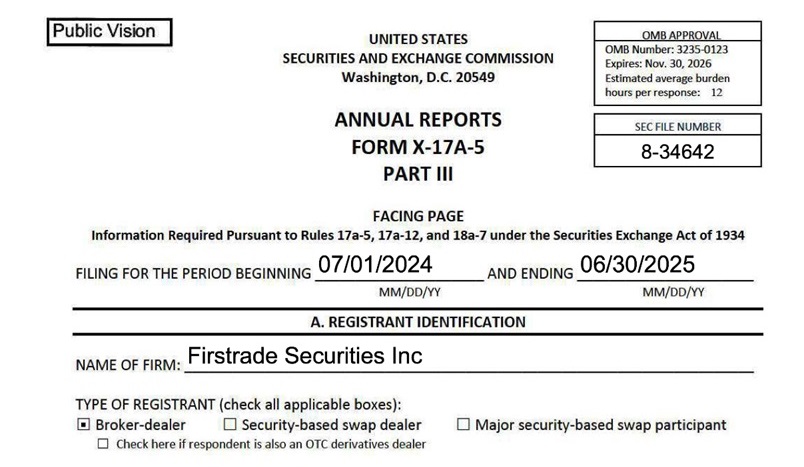
Firstrade is an SEC-authorized broker. Source: SEC
Trading Costs
Under SEC regulations, brokers are required to disclose “material fees and costs that apply to the retail customer’s transactions, holdings, and accounts.”
Publishing fees and charges in a timely, clear and comprehensive manner is a key requirement demanded by all Category A regulators. The sorts of costs we’re talking about include:
- Trading commissions.
- Charges for depositing and withdrawing money.
- Account costs (including subscription fees and charges for extras).
- Currency conversion fees.
- Account inactivity charges.
- Swap fees for derivatives.
- Account management and portfolio advice fees.
Pro tip: Foreign exchange conversion charges shouldn’t be an issue for US traders directly trading the S&P 500. This is because all S&P stocks are denominated in the US dollar (USD).
If you’re trading the S&P 500 outside the US, however, you may want to consider using a broker that offers US dollar-denominated trading accounts. This can save you a packet in currency conversion fees, and can make portfolio management simpler too.
The S&P 500 comprises blue riband shares from both the New York Stock Exchange (NYSE) and the NASDAQ exchanges.
These trading venues don’t charge retail investors directly to buy and sell shares. Instead, these fees are paid by market members like brokerages. It is then down to the discretion of the broker as to whether to pass these costs along to their customers, for example by charging higher trade commissions or employing wider bid (buy) and ask (sell) spreads.
The NYSE and NASDAQ operate different fee structures, as do exchanges that offer trading of S&P 500-related derivatives (such as futures and options contracts). The Chicago Mercantile Exchange (CME) is a popular derivatives exchange for indirectly trading US shares, and like those other venues offers its own pricing structure.
Let’s say a broker has received a trader instruction to buy 1,000 Caterpillar shares on the NYSE. They will pay a transaction fee for each share they buy, assuming the trader’s buy order matches with a sell order on the NYSE’s order book, thus removing liquidity from the exchange.
In this example, the NYSE would charge the broker $2.40 to purchase those 1,000 Caterpillar shares. Under its standard pricing plan, the exchange charges $0.0024 for each share that is bought and sold.
It’s important to take a holistic view of a broker’s fees and charges, and to consider what works best for you. For instance, if you’re a high-volume trader, you may be happy to pay a larger account management fee if the service provider also offers narrow spreads.
Top S&P 500 broker for trading costs: eToro USA doesn’t charge commissions to trade S&P 500 shares directly for those living in the US. There are no platform fees either for holding these investments, and withdrawals are free.
All this can make eToro USA a strong choice for investors who don’t trade US shares frequently.
Trading Platform
What makes the best trading platform is a highly subjective matter. It’s not just down to aesthetics like the software’s color scheme or interface layout. The most suitable platform for you will also depend on your investing style, personal circumstances and trading objectives.
For example:
- If you’re a new trader, you might want a brokerage offering stacks of educational material to help you get started.
- If you plan to trade high-risk assets like CFDs and/or make use of leverage (borrowed funds), you’ll want to know the platform provides excellent risk management tools. Note CFDs aren’t available to US residents.
- If you want to trade ‘on the go,’ a broker offering sophisticated mobile and smartwatch apps may be extremely useful.
- If you’re a short-term trader, you’ll need a platform that offers advanced charting tools.
That said, there are certain things all investors will need for a seamless trading experience. Consider things like execution speeds if you’re making short-term trades, how easy to navigate the platform’s menus are, how simple it is to build watchlists of S&P 500 shares, and the robustness of the software’s security features.
Pro tip: If you’re a novice trader, also consider a broker that offers access to demo trading accounts. That way, you can get up to speed with the market and refine your trading strategy by using virtual cash and not your own hard-earned capital.
Top S&P 500 broker for trading platform: IG is world famous for its excellent trading platform, which caters for new, intermediate and experienced traders. It’s also one of the few service providers that offer a dedicated smartphone and smartwatch app.
IG’s desktop app is fast, intuitive, and offers a range of tools (its advanced charting tools are especially strong). But if you prefer to use a third-party trading software, the broker’s trading infrastructure is compatible with various external platforms including MetaTrader 4 (MT4) and TradingView.
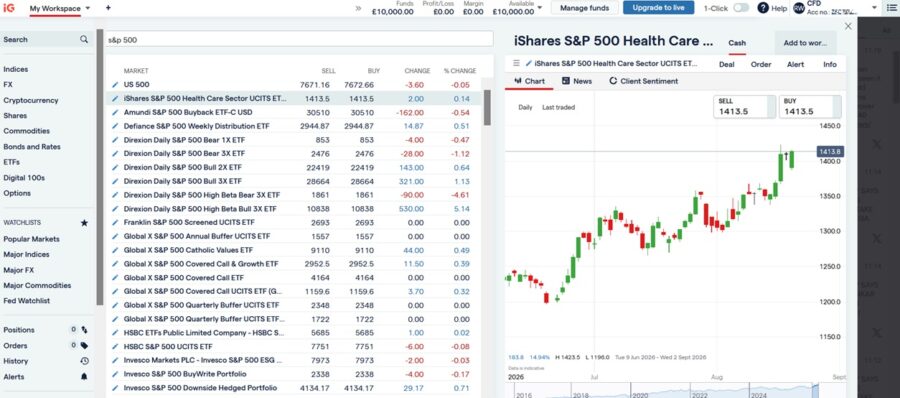
Trading the S&P 500 with IG. Source: IG
Asset Range
As I’ve mentioned, traders can deal in S&P 500 shares directly and indirectly, both of which have different advantages. As well as offering derivatives that change hands on regulated exchanges, many brokers offer index- or share-based contracts for difference (CFDs) which are dealt over-the-counter (OTC).
Certain brokers also allow traders to purchase fractional shares in S&P-listed companies. This can be a valuable tool for traders in US shares given the huge price tags of many blue-chip stocks.
Pro tip: Traders seeking exposure to S&P 500 companies don’t typically restrict their interest to this particular group of equities. This was particularly evident when SpaceX shares went public in June 2026, attracting frenzied interest from retail investors the world over.
Therefore, it may be a good idea to check that the broker you’re considering offers broad access US shares.
Top S&P 500 broker for asset range: Interactive Brokers provides wide exposure to the S&P 500 (and the broader US stock market), whether you’re looking to buy shares, exchange-traded funds (ETFs), or derivatives. Fractional shares are also on offer.
How Can I Begin Trading The S&P 500?
To begin trading S&P 500 shares, ETFs, or stock- or index-linked derivatives, I’ll need to complete the following three steps:
1. Compare brokers. It’s not just the four aforementioned factors I’ll need to think about at this stage (trustworthiness, platform, costs and asset range). They may be the most important in our view, but other features will demand attention according to my personal circumstances and investing style objectives. I’ll need to consider margin rules, for instance, if I want to use leverage, or ascertain which risk management tools are available if my strategy involves high-risk assets like CFDs (region dependent).
2. Open an account. Once I’ve selected a broker, I’ll need to provide some basic personal information to register for a live account. If my brokerage is also licensed by a reputable national regulator like the SEC, I may also be asked questions at this stage on my investing goals and experience, as well as the source of my funds to meet money laundering legislation requirements. Some service providers won’t ask this until the next stage, however…
3. Deposit money. I’ll need cash in my trading account to start buying assets. Many brokers allow their customers to make deposits in a variety of ways, including bank transfer (such as from US banks like Wells Fargo), debit card, digital wallet (like Apple Pay) and payment service providers (such as PayPal).
What Is The S&P 500?
The S&P 500 is generally regarded as the leading US stock market index. Created in 1957, the Standard & Poor’s 500 (to give the index its full title) includes hundreds of the largest listed companies in the US.
The S&P 500 comprises shares quoted on both the NYSE and NASDAQ stock exchanges. In total, the index represents 80% of the market capitalization of US-listed equities.
Pro tip: Surging investor interest in tech shares means Information Technology is the most represented sector on the S&P 500. It makes up more than a third of the index’s total market value. However, other well-represented industries include financial services, communications, consumer goods and healthcare.
Some of the S&P’s most popular stocks include:
- Consumer electronics manufacturer Apple.
- Semiconductor maker Nvidia.
- E-commerce platform Amazon.
- Banking giant JP Morgan.
- Energy producer ExxonMobil.
- Berkshire Hathaway, a conglomerate and investment company once led by legendary investor Warren Buffett.
- Pharmaceuticals manufacturer Eli Lilly.
- Software developer Microsoft.
- Tesla, which designs and manufactures cars, energy storage systems and robots.
- Google, YouTube and Gmail owner Alphabet.
- Digital payments network Visa.
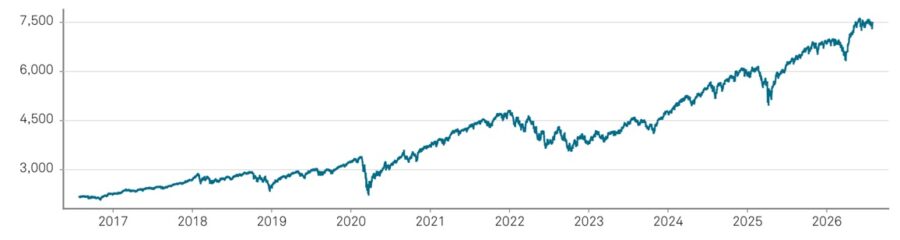
The long-term performance of the S&P 500 Source: S&P
The S&P 500 is one of several indices that come under the S&P umbrella. Others include the S&P MidCap 400 index of medium-sized companies; the S&P SmallCap 600, which tracks small cap companies; and the S&P Composite 1500, which blends all three of these indices.
How Can I Trade The S&P 500?
You’ll be hard pushed not to find a broker offering access to S&P 500 stocks. Millions of investors the world over buy and sell shares in companies that make up the index. And the range is vast, meaning investors can build diversified portfolios of robust companies, a popular strategy with long-term investors.
However, investors can also achieve this diversification with the use of an S&P-500 tracking ETF. Funds like the State Street SPDR S&P 500 ETF hold shares in every member of the index, and therefore closely follow the performance of the 500 constituent firms. Funds like these change hands on US securities exchanges as well as international trading venues.
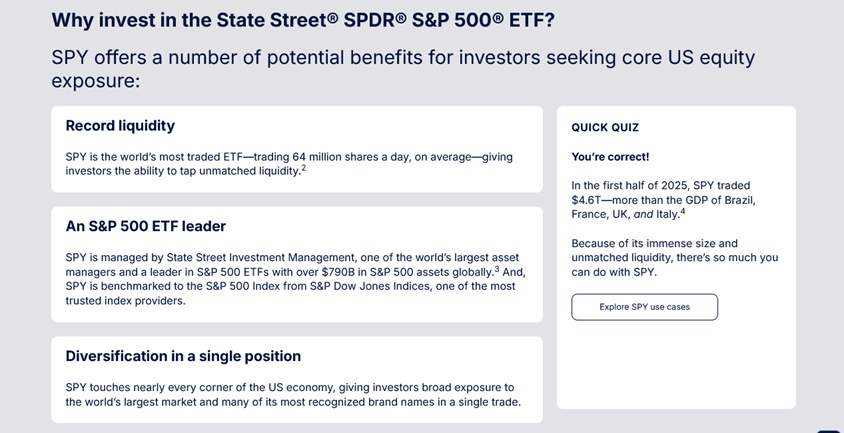
The State Street SPDR S&P 500 ETF. Source: State Street
These ETFs can cater for a range of trading strategies. Some S&P 500-linked funds distribute dividends from companies on the index, while others accumulate these cash rewards and reinvest them straight back into the fund.
Investors can also ‘go short’ on the S&P 500 with ETFs that rise in value when the index falls. Higher-risk leveraged funds are also available, which allow investors greater exposure to the index without them having to invest the full notional value themselves. The Xtrackers S&P 500 2x Inverse Daily Swap UCITS ETF is a product that combines both of these strategies.
Pro tip: State Street also offers ETFs allowing investors to cherry pick certain groups of S&P 500 companies according to the sector in which they operate.
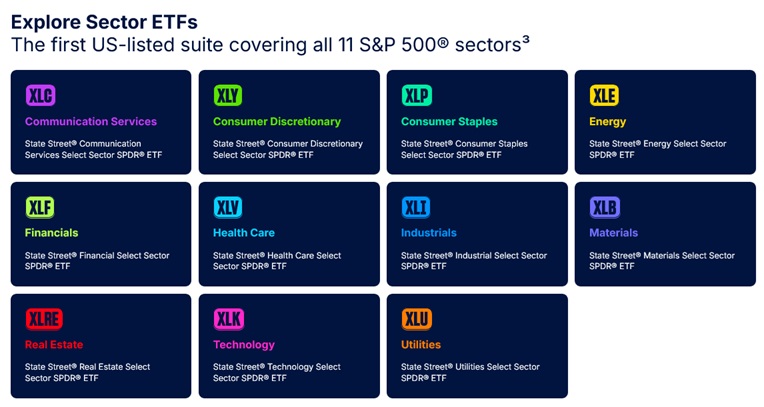
State Street’s 11 S&P 500 sector ETFs. Source: State Street
Investors can also trade S&P 500-linked derivatives, allowing them to speculate on price movements without having to own any underlying asset. This offers certain advantages, like allowing traders to go both ‘long’ and ‘short,’ providing profit opportunities when markets rise or fall.
But this strategy does have drawbacks – for instance, traders don’t receive passive income from dividend-paying US shares or S&P 500 ETFs that distribute dividends.
These derivatives include futures and options that change hands on the CME, one of many major global exchanges that offer trading of such assets. Traders can also purchase CFDs to indirectly deal in S&P 500 securities.
Pro tip: Retail investors can directly trade S&P 500 stocks and index-linked ETFs on both the NYSE and NASDAQ exchanges during regular market hours. These are 9.30am to 4pm Eastern Time (ET) Monday to Friday, excluding public holidays.
Bottom Line
The S&P 500 attracts significant investor interest and, as a result, the number of brokers offering exposure is vast. Traders can buy stocks directly as well as ETFs that track the whole index or particular sectors. Derivatives are also available that allow simple speculation on price movements.
Whichever broker you use, it’s critical to check they’re authorized by a top-level regulator like the SEC or FINRA in the US. BrokerListings.com’s regulator classification system lets you find a reputable financial watchdog simply and quickly.