

LiteFinance Review 2026
 Written By
James Barra
James is an experienced broker analyst with a background in financial services. He has spent 2,500+ hours testing brokers, used 35+ different platforms and apps, audited 120+ broker T&Cs, and verified 300+ regulatory licenses. James has also been on US and UK TV, and been a guest on finance podcasts, discussing reports conducted by BrokerListings.com and sharing his expertise.
James Barra Profile Page Fact Checked By
Tobias Robinson
Tobias is committed to helping traders find the right brokerage for their needs. He has tested 200+ brokers, spent 2,600+ hours using different platforms, and placed 2,100+ trades.
Tobias Robinson Profile Page Edited By
William Berg
William Berg combines his expertise in law and finance to analyze trading brokers. He has checked 3,250+ regulatory licenses, investigated 2,365+ broker clones and trading scams, and placed 3,500+ trades.
William Berg Profile PageAugust 24, 2026
Why Trade With LiteFinance?
"LiteFinance suits traders seeking an established broker for forex, stocks, commodities, indices, cryptocurrencies, and equity perpetuals. Its social trading system also helps investors learn from experienced traders."
 USA not accepted
 Detailed Ratings
Quick Facts
Pros
- Fast, reliable customer support based on testing
- Good set of extra tools and features, including a VPS
- Automated trading via APIs
- Good range of forex pairs
- MT4, MT5, and a unique app are supported on this excellent trading platform.
Cons
- Not supervised by any major regulator.
- The Classic account has broad trading spreads.
- There have been online complaints regarding challenges in withdrawing funds.
Regulation & Trust
On balance, LiteFinance is moderately trusted. It has been operating since 2005 and now has a Mauritius-licensed entity, but the main LiteFinance Global route is still tied to an SVG company that is not regulated; the group is not publicly listed and does not hold a banking licence.
LiteFinance’s trust case rests less on top-tier regulation and more on longevity, transparent legal disclosures, published trading rules and operational consistency. That is enough to avoid the “highly opaque offshore broker” category, but not enough to call it a top-trust venue.
The most important issue is which legal entity actually carries your account, because the protections change significantly depending on where you are onboarded.
« Make Full Width »| Entity | Verify License | Regulator Classification (A to C) | Retail Protections | Who Gets Signed Up |
|---|---|---|---|---|
| LiteFinance Global LLC (https://www.litefinance.org/) | SVG registration 931 LLC 2021 | Saint Vincent and the Grenadines Financial Services Authority (SVGFSA) / not an active prudential regulator (C – weak safeguards) | LiteFinance offers segregated funds and negative balance protection, but no compensation scheme, no complaints authority, no leverage cap mandated and no mandatory 50% margin close-out rule | Many non-EEA clients |
| LiteFinance Investment Limited (https://www.litefinance.org/) | Mauritius FSC register / Licence GB20025921 | Financial Services Commission (FSC) Mauritius (C – moderate safeguards) | Licensed investment dealer status; stronger than SVG registration alone, but still not top-tier retail protection | Some international clients depending on jurisdiction and onboarding path |
Elsewhere in the group exists LiteForex Europe – a CySEC-regulated and category A entity. This provides much stronger regulatory protections and client safeguards, such as retail leverage capped at 1:30. However, this review is focused on the LiteFinance global brands and entities, which offers up to 1:1000 leverage.
Note the regulator classification, from A to C, is based on our internal trust rating system.
Check The Entity & URL
Our investigation made one thing very clear: this is exactly the kind of broker where the footer and account agreement matter. LiteFinance itself says residents of the EEA, USA, Israel, Russia and some other countries are not served by LiteFinance Global LLC, so the onboarding route can change by geography.
Before depositing, check the legal entity shown in the footer, the client agreement in the dashboard and the payment terms attached to your account. If you expected Mauritius and land under the SVG company instead, your protection profile is materially weaker.
Watch For Clone Scams
LiteFinance has published its own fraud warnings after users received spam messages pretending to be from the broker. The firm told clients to inspect the sender address, verify the domain in any link, avoid entering credentials through emailed links, and confirm suspicious messages through official live chat first. That makes anti-clone discipline especially important here.
We’ve also seen real examples of clones of LiteFinance, with regulatory warnings against similarly spelt entities like ‘Liteforex Trades‘.
« Make Full Width »| Checkpoint | What To Look For |
|---|---|
| URL Extension | Use the official domain only: litefinance.org for the global business. Be cautious of lookalike variants, hyphenated domains and messenger links that do not resolve through the main site. |
| Sender Address | LiteFinance has specifically warned users to inspect sender email addresses and not trust brand styling alone. |
| Entity Name | The legal entity in the footer should match the protections you expect. Do not assume all LiteFinance-branded pages lead to the same regulatory route. |
| Regulator Link | Verify the Mauritius FSC entry independently where relevant. Do not rely only on footer text because clone sites can copy it. |
| Support Confirmation | If a message looks unusual, verify it through the official support page or live chat before funding or uploading documents. |
Regulation & Trust Details
- Regulator: FSC
- Guaranteed Stop Loss: No
- Negative Balance Protection: Yes
- Segregated Accounts: Yes
Accounts & Banking
LiteFinance keeps the live account structure fairly focused. Most traders will be choosing between three main account types:
- ECN: Spreads from 0.0 points, market execution, commission-based pricing, copy trading support, negative balance protection, and a $50 minimum deposit. This is the account type that makes the strongest pricing case for active traders.
- Classic: Floating spreads from 1.8 points, no separate commission, market execution, copy trading access, negative balance protection, and a $50 minimum deposit. Better suited to traders who prefer simpler all-in pricing.
- Cent: Entry from $10 to $50 depending on region, smaller contract sizing with a $1,000 contract size, and the same broad logic as a micro live environment. This is one of the more useful low-risk live-testing options in the market because it gives traders a bridge between demo and standard live trading.
A key detail is that account choice also changes the platform options. ECN supports MT4, MT5 and cTrader. Classic supports MT4, MT5 and the LiteFinance web platform. That means this is not only a spread-versus-commission choice; it also affects charting environment, order-entry style and tool access.
From our testing perspective, the account setup is cleaner than average. We opened a real account. The client area does not bury the practical controls, and key specs like margin call level, stop-out level, minimum deposit and contract size are published rather than hidden in vague marketing copy.
Deposits & Withdrawals
LiteFinance supports a broad mix of funding methods, including bank cards, bank wire, Skrill, Neteller, crypto, STICPAY and other e-payment routes depending on region. The broker has instant deposit processing and no broker-side deposit fee, and it also runs a deposit-fee compensation policy that credits payment-system charges back to the trading balance.
The more distinctive operational point is the auto-withdrawal system. Verified clients can use up to 5 automatic withdrawals every 24 hours, with a combined automatic cap of $5,000. Larger requests are then pushed into manual processing, with a processing window of up to 24 hours. Crypto withdrawals may have lower limits, often $2,000 to $3,000.
Withdrawal requests are handled on a first-come-first-served basis within 1 working day; card payouts are typically credited within 3 to 5 days after processing; international card routes can take up to 14 business days; and rejected requests often come down to AML controls, trying to withdraw to a different system than the one used to fund, or trying to send funds to a wallet that does not match the original deposit trail.
LiteFinance is better suited to traders who use straightforward funding routes and keep their withdrawal method aligned with their deposit trail. Traders moving between multiple wallets or expecting total flexibility across channels are more likely to run into avoidable problems.
Demo Account
LiteFinance offers a free demo account, but the more practical strength is the progression path. You can move from demo to a Cent account with very small real-money size, then step up to Classic or ECN. That is a better testing ladder than at many CFD brokers that jump straight from demo into standard-lot live trading.
Accounts & Banking Details
- Minimum Deposit: $10
- Account Types: ECN, DMA
- Payment Methods: Alipay, Bitcoin Payments, Ethereum Payments, M-Pesa, Mastercard, Perfect Money, Sticpay, Swift, Visa, WebMoney
- Account Currencies: USD, EUR
- Islamic Account: Yes
Assets & Markets
LiteFinance offers 600+ instruments across forex, commodities, indices, cryptocurrencies and stock CFDs, plus equity perpetual contracts, providing 24/7 access to major firms like Tesla, Intel, and Nvidia.
Forex remains a core strength, with the usual majors and minors plus a deeper long tail than many small offshore CFD brokers provide. But it is the non-forex range where LiteFinance has expanded more aggressively. The stock-CFD offering is not restricted to the US: the broker provides exposure to NYSE, NASDAQ, EURONEXT, London Stock Exchange, XETRA and HKEX. They have also added instruments such as Russell 2000, copper, nickel, orange juice, and multiple HKEX share CFDs. And they provide day-one access to some fresh IPOs, including SpaceX.
One notable addition is XAUPUSD and XAGPUSD, which is a 24/7 gold-linked and silver-linked crypto-style instruments. The broker is still actively modifying the product list rather than running a static legacy catalogue.
This is still a leveraged trading venue rather than an investing platform. But for a non-European LiteFinance account, the product range is meaningfully better than the brand’s old “mostly forex and metals” roster. And while its European counterparty stays away from crypto and stock CFDs due to tighter regulations, the global branch offers plenty of these for interested traders.
As you can see below, there’s an easy-to-use search function in the client area. Alternatively, you can look at assets by category, such as ‘Stock Indices’ or ‘EU Shares’. Like most decent brokers, you can set up a ‘Favorites’ list.
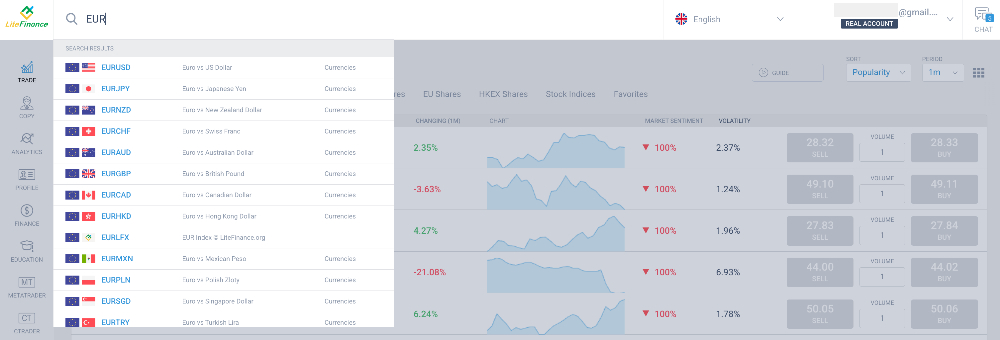
Asset Search Function
Assets & Markets Details
- Instruments: Forex, CFDs, indices, shares, commodities, cryptocurrencies
- Leverage: 1:1000 (Crypto 1:50)
- Margin Trading: Yes
- Stock Exchanges: Australian Securities Exchange (ASX), CAC 40 Index France, DAX GER 40 Index, Dow Jones, Euronext, FTSE UK Index, Hong Kong Stock Exchange, IBEX 35, Japan Exchange Group, Nasdaq, New York Stock Exchange
- Commodities: Gold, Oil, Silver
- Crypto Coins: AAV, ADA, ALG, ALI, ATO, AVX, AXS, BCH, BNB, BTC, BTG, COM, DGE, DOT, DSH, ENJ, EOS, ETH, FIL, ICP, ILV, ITA, KAV, LNK, LTC, LUN, MKR, MNA, MTC, NEA, NEO, OMG, QTM, SIA, SND, SOL, STX, THT, TRX, UNI, VET, XLM, XMR, XRP, XTZ, YFI, YGG, ZEC, ZIL, APT, AR, ARB, FTM, GRT, HBAR, IMX, INJ, JASMY, NOT, OP, RENDER, SUI, WIF, TAO, GRAM
Fees & Costs
LiteFinance is at its best on cost when used through the ECN account. The headline structure is simple enough: 0.0-point spreads on ECN versus 1.8-point floating spreads on Classic.
For major forex pairs such as EURUSD, GBPUSD and USDJPY, LiteFinance charges commission from $5 per lot on ECN. A number of common crosses also sit at $5, while several less liquid pairs rise to $6. Oil is at $0.5. Major index CFDs commonly sit around $3.5. Cryptocurrencies are charged as a percentage (approx. 0.12%).
For stock CFDs, the fee model is usually percentage-based rather than dollar-per-lot, with ECN commonly around 0.1% and Classic/Cent using a higher markup model around 0.15%. Crypto and shares are generally charged as a percentage of asset value rather than a fixed lot fee.
Another detail worth noting is how the commission is charged by platform. On cTrader, the ECN commission is split 50/50 at open and close. On MT4, MT5 and the LiteFinance platform, it is charged at open. That does not change the all-in cost, but it does change how the trade ticket and account history look in practice.
There’s also an inactivity fee that Cent users in particular should take into account, as it could erode small balances.
Fees & Costs Details
- Crypto Spread: From 0.1
Forex Spreads
- GBP/USD: 0.8
- EUR/USD: 0.2
- GBP/EUR: 0.5
CFD Spreads
- FTSE: 0.8
- GBP/USD: 0.8
- Oil: 5.5
- Stocks: Variable
Trade Execution
LiteFinance Classic and ECN use market execution, and Classic runs with no requotes. ECN has average execution running at roughly 20 to 80 milliseconds. That is plausible for a modern retail setup and good enough on for active manual trading.
The infrastructure around execution is more convincing. LiteFinance offers VPS hosting based on Microsoft Hyper-V, and its free-VPS promotion renews when a client deposits more than $200 and trades at least 2 lots during the following month. That is the sort of practical support that matters for EA users and latency-sensitive MT4/MT5 traders.
LiteFinance is capable enough for discretionary day trading, swing trading and standard retail algo use.
Platforms & Tools
LiteFinance offers four platforms: MetaTrader 4, MetaTrader 5, cTrader and the broker’s own LiteFinance Web Platform. We’ve spent hours using every one – configuring charts, analyzing markets, and placing trades to understand execution, user experience, and risk management tools.
The MetaTrader side is what you would expect: MT4 for legacy forex users, MT5 for broader market coverage and better native order controls, and cTrader for traders who want a cleaner interface and a more modern charting feel.
What makes LiteFinance slightly more interesting than a standard MetaTrader-only broker is the proprietary web platform, which is more developed than many broker-branded solutions we’ve used. It is an all-in-one no-install terminal with 75+ indicators, one-click trading, built-in market sentiment and direct integration with the client area. In practice, that matters because Classic-account users are not forced into an aging platform experience if they do not want MetaTrader.
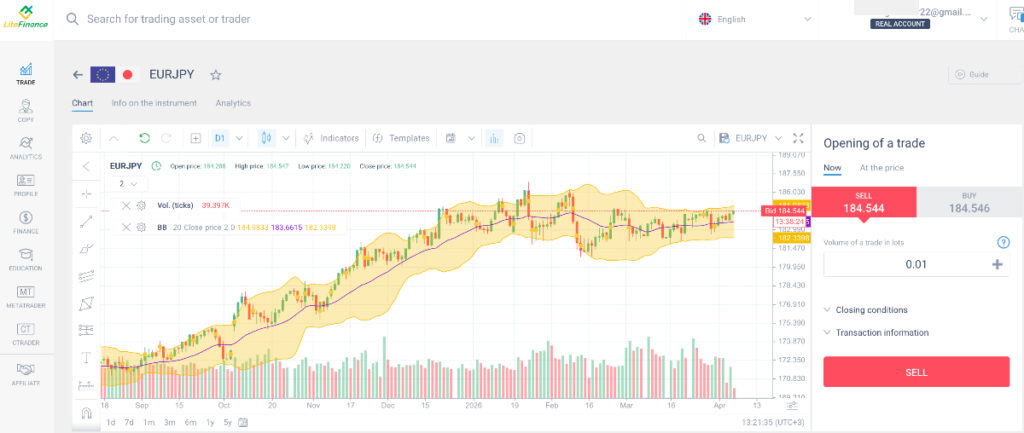
Web Platform
One major gripe that detracted from the user experience during our tests was that whenever you change tab, say to view ‘info on the instrument’, the platform has to load the page which causes a slight hiccup/delay. This is annoying when you’re trying to move from feature to feature in trading sessions.
Overall, LiteFinance is better on platform breadth than many brokers in its trust tier. It is not breaking new ground, but it gives traders enough flexibility to choose an interface that actually fits how they trade.
Mobile App
Mobile is a mixed but decent part of the package. LiteFinance has its main app on iOS and Android, and there is also a separate LiteFinance cTrader listing for users on that platform route.
From our tests, mobile platform experience differs quite a bit depending on whether you are using the proprietary app or accessing LiteFinance through MetaTrader/cTrader apps instead. In our view, LiteFinance mobile is useful and active, but not a category leader.
Copy Trading
Copy trading is far more central to LiteFinance than it is at most low-cost CFD brokers. The broker runs its own social trading environment with strategy rankings, performance statistics, account metrics and built-in copy relationships rather than treating copy trading as a minor add-on.
The entry point is from $50, but LiteFinance says a trader should think closer to $500 if they want the economics to make sense in practice. Profit-share settlement runs on a defined cycle every 24 hours at 01:00 platform time, which is the kind of operational detail we like to see because it tells you exactly when performance charges are calculated rather than hiding it behind generic copy-trading language.
LiteFinance is therefore one of the stronger options in its class for traders who specifically want broker-native copy trading without leaving the ecosystem.
One tip from our use of LiteFinance’s copy trading tool – filter for traders based on risk level. You can see below we looked for those with ‘minimal risk’ and over the longest timeframe to get a clearer view of their performance over time. Still, never expect that copy trading will guarantee results.
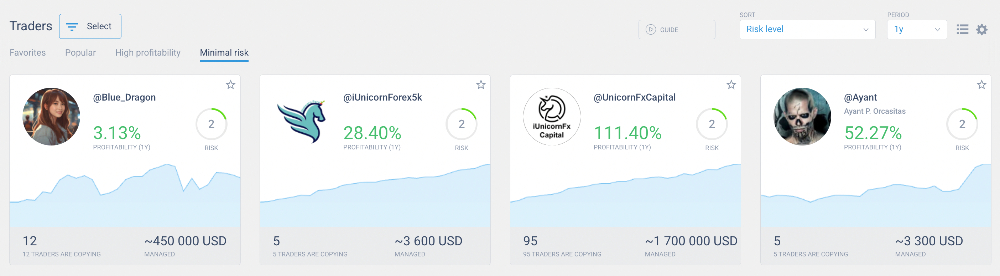
Copy Traders
Platforms & Tools Details
- Platforms: Web, MT4, MT5, cTrader
- Android App Rating:
- iOS App Rating:
- Copy Trading: Yes
- VPS: Yes
- Automated Trading: Expert Advisors (EAs) on MetaTrader
- AI Trading: No
Research
Research is one of LiteFinance’s stronger differentiators, and more substantial than many rival offshore CFD brokers. The toolset includes an economic calendar, analytics portal, Claws&Horns analytical content, a trader’s calculator, a Fibonacci calculator, live rates, macroeconomic news and a heavy stream of in-house forecasts.
Two things stood out in our hands-on use. First, the volume is high: LiteFinance publishes regular market outlooks across forex, commodities, crypto and indices rather than leaving the research section to go stale. Second, the research is specific enough to be practically usable. This is not just a generic blog feed. The broker’s macro calendars, weekly event rundowns and chart-led analysis pieces are frequent and clearly designed for active traders who want trade context, not beginner filler.
Macroeconomic news content is issued by Dow Jones & Company or its licensors, which is a useful credibility marker on the news-feed side.
The limitation is that this is still a trading-oriented research desk rather than a deep institutional one. You get plenty of event awareness, technical framing and idea generation, but not the kind of premium long-form macro analysis, data visualisation depth or institutional strategy notes you would get from a top-tier multi-asset broker.
Education
Education is broad rather than tightly structured. LiteFinance offers webinars, glossary content, beginner explainers, strategy articles, investing material and separate companion apps around areas like economic calendar use, signals, trading strategies and fundamental analysis.
There is enough here for a trader to learn from, and more content volume than many competitors at the same trust level. The webinars are not just abandoned archive pieces either; sessions run by an active trader with 5+ years’ experience, and the broader educational section is updated regularly enough to feel maintained.
The weakness is progression. The material is useful, but it still feels more like a large content library than a true end-to-end learning path. A beginner can pick up a lot here, but they will still need to impose their own structure rather than being guided through a clean curriculum from basic platform use to risk management to strategy development.
Also from a user experience perspective, LiteFinance has the most complex website and suite of materials we’ve encountered at any of the hundreds of brokers we’ve tested. It could overwhelm beginners who may get lost down various rabbit holes on the site and client area.
Customer Support
General inquiries and trading operations run 24/5. LiteFinance also has support channels through live chat, email, Telegram and a long list of local phone and WhatsApp contacts across multiple countries.
That structure matters because it suggests the support operation is built around actual issue type rather than one front-line queue trying to handle everything.
While pressure-testing this broker as a live client, the most revealing support queries were around entity assignment, withdrawal-method matching, negative balance protection terms, and swap calculations. This is because we got to see fast responses of under two minutes but a mixed bag in response quality, with agents not always fully knowing the correct entity details and trading terms.
Community Sentiment
Alongside our own hands-on tests, we examined public sentiment across major review platforms and app stores. We considered over 650 Trustpilot reviews, over 70 App Store ratings and over 2,900 Google Play reviews.
The positive themes are fairly consistent. Users regularly praise fast withdrawals, responsive support, easy account opening, good copy-trading access and a generally smooth trading environment. Those are not isolated one-off compliments; they recur often enough to line up with the stronger parts of the product we found ourselves.
The complaints are also fairly consistent. The most common concerns relate to offshore trust questions, payment-method disputes or rejected withdrawal attempts when the trail does not match, and scattered accusations around trade handling that are difficult to verify independently. Trustpilot also notes it has removed fake reviews for this company, which is important context when reading the headline rating.
Our conclusion from the community evidence is that LiteFinance is generally well regarded by the type of trader it is built for: cost-aware, platform-comfortable, interested in copy trading and not overly dependent on top-tier regulation for reassurance. It is less naturally suited to traders who place legal protections above all else.
How We Tested LiteFinance
We assessed LiteFinance by reviewing its live legal-entity disclosures, registered-office pages, account specifications. We also examined how LiteFinance actually presents critical issues that often get glossed over elsewhere: whether the SVG route is described as regulated or not, how negative balance protection is worded, what the broker says about complaints handling, how auto-withdrawals are capped, which account types get which platform access, how copy-trading profit share is timed, and how detailed the current commission schedule is across asset classes.
Alongside the broker’s own disclosures, we cross-checked wider sentiment across Trustpilot, the App Store and Google Play to see whether user complaints matched the documented pressure points in LiteFinance’s own rules and service setup.
Then we got stuck in. We opened an account, navigated every part of the client area and payment portal, fired up the platform and placed dozens of test trades across stocks, forex, and commodities to evaluate charting features, risk management tools, and order execution.

ECN Account
Who Should (And Shouldn’t) Use LiteFinance?
If you want low-cost leveraged trading, broker-native copy trading, a very low live-entry path through Cent accounts, and a broader product range than LiteFinance’s old reputation suggests, LiteFinance is a credible option.
If your priority is top-tier legal protection, this is a weaker proposition. The non-European LiteFinance route still depends heavily on whether you are onboarded under Mauritius or the SVG company, and that trust distinction is too important to ignore.
Our bottom line is that LiteFinance is stronger on pricing, platform choice, copy-trading, research and account accessibility than it is on institutional-grade trust. Traders comfortable with that trade-off may find it a genuinely usable broker. Traders who want the reassurance of strong top-tier regulation should look elsewhere.
Alternatives To LiteFinance
These similar brokers are the highest rated alternatives to LiteFinance.
-
1Founded in 2001, FOREX.com is part of StoneX, a global financial services firm with over a million customers. Regulated in the US, UK, EU, Australia, and other regions, it offers thousands of markets, not just forex, with competitive pricing on advanced platforms.
-
2Interactive Brokers (IBKR) is a leading brokerage offering access to over 170 markets in 40 countries and a range of investment services. With 40+ years in the industry, this Nasdaq-listed company follows strict regulations by the SEC, FCA, CIRO, and SFC, making it a trusted global trading broker.
-
3NinjaTrader is a US-based brokerage regulated for trading futures. It offers three different pricing plans for varied needs and budgets, along with extremely low margins on popular contracts. The company's renowned charting software and trading platform provides extensive customization options and excellent technical analysis features.



 eToro USA