

Best Brokers With MXN Accounts 2026
Dig into our top brokers offering Mexican peso (MXN) accounts, reducing conversion fees and improving the experience for traders in Mexico.
 Written By
Royston Wild
Royston is a seasoned investor and financial writer with over a decade of experience analyzing brokers and investment markets. With a background in stocks, commodities, and forex reporting - he brings a fresh perspective to broker evaluations.
Royston Wild Profile Page Fact Checked By
James Barra
James is an experienced broker analyst with a background in financial services. He has spent 2,500+ hours testing brokers, used 35+ different platforms and apps, audited 120+ broker T&Cs, and verified 300+ regulatory licenses. James has also been on US and UK TV, and been a guest on finance podcasts, discussing reports conducted by BrokerListings.com and sharing his expertise.
James Barra Profile Page Edited By
Tobias Robinson
Tobias is committed to helping traders find the right brokerage for their needs. He has tested 200+ brokers, spent 2,600+ hours using different platforms, and placed 2,100+ trades.
Tobias Robinson Profile PageAugust 8, 2026
Filters
How We Choose The Top MXN Brokers
Our exhaustive evaluation process involves:
- Opening a trading account with each brokerage in our evolving database, then recording which operators allow traders in Mexico to use the peso (MXN) as the base currency.
- Checking that each brokerage has authorization from a top-level regulator, as listed in BrokerListings.com’s regulator ranking system.
- Regularly checking that each service provider has retained their authorized status, as regulators can withdraw licenses temporarily and permanently.
- Ranking brokers on other characteristics including dealing costs, bid and ask spreads, the quality and security of the trading platform, and the range of securities on offer to retail traders.
What Is An MXN Account?
The number of active retail investors in Mexico is growing. This is thanks to rising wealth levels, a growing financial services industry, and improving capital market regulations. The number of accounts held with brokerages soared 97% over the course of 2024, according to official data.
Investors can trade a variety of securities including stocks, forex, and cryptocurrencies using an MXN account. The perks of this strategy include:
- Protection from forex conversion charges when transferring money in and out of your trading account.
- Lower exposure to choppiness on currency markets. This can be critical for individuals who get paid in Mexican pesos.
- Depositing and withdrawing account funds is made more straightforward. Brokers that provide MXN-based accounts typically support regional payment methods – this can include digital wallets (such as Mercado Pago) and online payment providers (like Openpay).
- Trading MXN-denominated securities is more straightforward, as you don’t need to bother with conversions across global currencies. Financial assets denominated in pesos include equities listed on the Bolsa Mexicana de Valores (translated as Mexican Stock Exchange in English).
How Do I Open An MXN Account?
Opening a trading account that utilizes the MXN as the base currency requires five general steps:
1. Selecting A Brokerage
Think about factors like overall trading costs – including spreads – along with the range of tradeable securities, the strength of the trading software, and the amount of leverage on offer if you plan to borrow funds from the broker.
Pro tip: Mexico’s capital markets are regulated by the Comisión Nacional Bancaria y de Valores (CNBV), which translates as the National Banking and Securities Commission in English.
The organization has been designated Category C status under BrokerListings.com’s regulator classification system. The result? As per our rankings system, the CNBV “[is] less credible and may offer little to no financial safeguards or legal protections if your broker faces financial difficulty.”
So we’d suggest traders in Mexico search the broker databases of Category A regulators to avoid scammers and companies offering poor levels of service. Examples include the US Securities and Exchange Commission (SEC), the Australian Securities and Investments Commission (ASIC), and Spain’s Comisión Nacional del Mercado de Valores (CNMV) (which translates as the National Securities Market Commission).
2. Opening An Account
You’ll need to submit a range of information before you can begin trading. This may include your:
- Name.
- Date of birth.
- Address.
- Email address.
- Trading experience.
- Salary.
- Investment objectives.
- Risk tolerance.
You’ll also need to supply digital copies of proof of identification and address.
3. Selecting MXN As Your Base Currency
The broker may automatically open a trading account that uses a major global currency (like the US dollar, or USD) for you. In these situations, you’ll need to open an MXN-based account manually through the trading platform.
However, some brokers will only allow you to trade certain markets with this strategy. With Swissquote, for instance, I asked its AI chatbot if it offers peso-based accounts. It advised I need to go into my profile and manually select a new MXN account.
But it added that such accounts are not available if I want to trade forex or contracts for difference (CFDs). I called Swissquote’s customer service line, where a representative confirmed these restrictions.
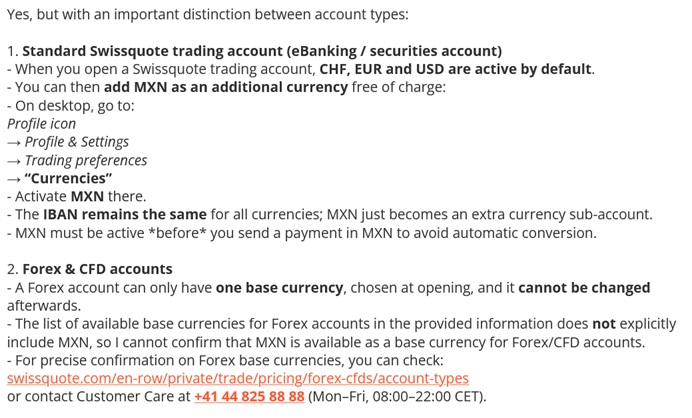
Swissquote’s policy on MXN trading accounts
4. Transferring Some Funds
To buy securities, you’ll naturally need money in your account that you can draw upon. That’s the case whether you choose to use leverage or not.
Popular methods of cash transfer include:
- Bank transfer (for instance, from BBVA Mexico).
- Debit card (such as Carnet).
- Digital wallet.
- Online payment provider.
The method of payment by which you can make deposits and withdrawals will differ among service providers.
5. Trading Financial Markets
You’ll be able to begin building your trading portfolio, for example, in Mexican stocks, as soon as your capital hits your trading account.
Example Of Opening An MXN Trading Account
Exness has been operating as a broker since 2008, and has been approved by multiple global regulators. These include the UK’s Financial Conduct Authority (FCA) and the Cyprus Securities and Exchange Commission (CySEC).
Here is how the process of opening an MXN-based trading account works:
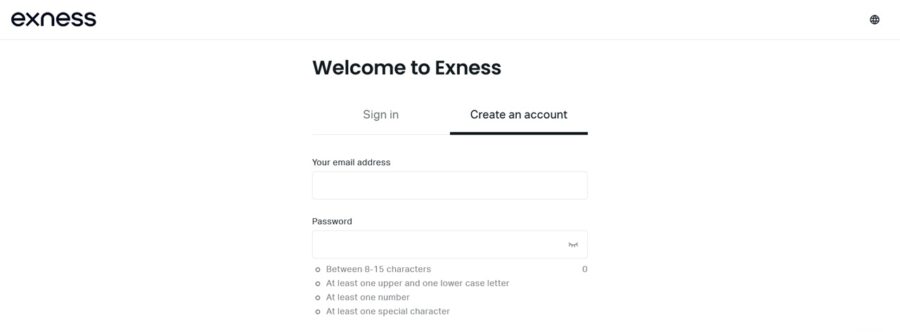
Signing up with Exness for an MXN account
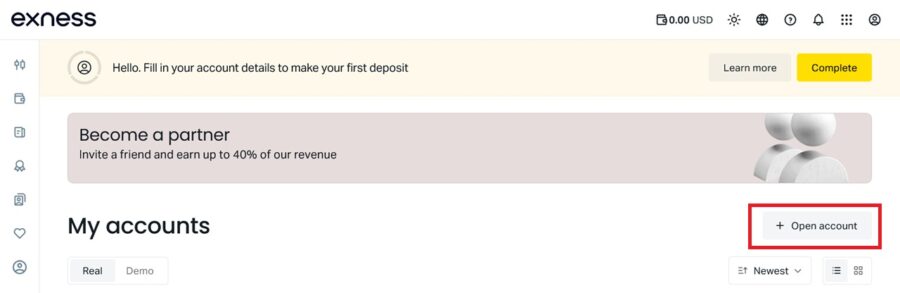
Opening a new Exness account
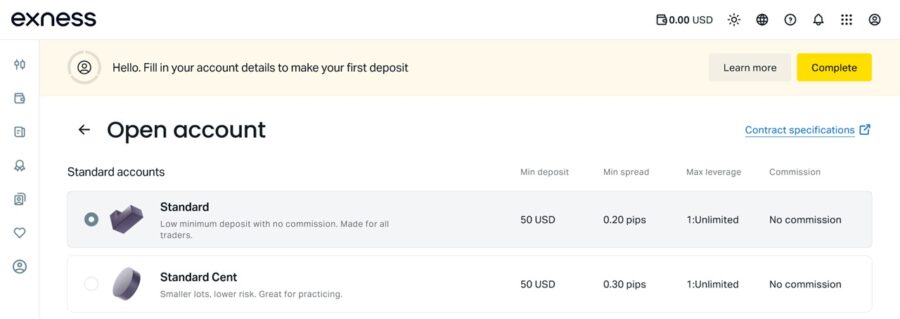
Different Exness accounts
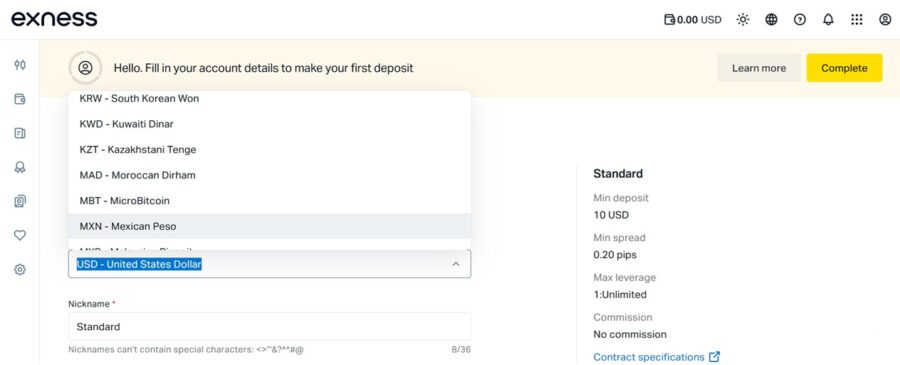
Opening an MXN-based account with Exness
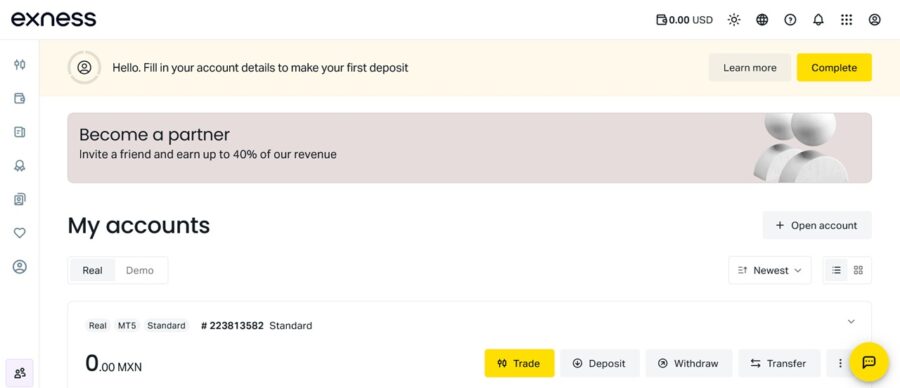
My MXN account is set up and I’m ready to trade
Should I Use An MXN Trading Account?
MXN-based trading accounts offer substantial benefits for those based in Mexico. These include:
- Bank transfers from Mexican banks (such as Banorte) may be processed more quickly. This is because funds aren’t subject to foreign currency conversions, nor do they pass through international banking channels.
- Trading securities and managing your portfolio can be more straightforward if carried out with the currency you use every day.
- Traders can avoid currency conversion fees, which can make a huge difference to trading profit margins.
What Are The Drawbacks Of Using An MXN Account?
That said, using the peso as your base currency can also come with problems. For instance:
- You’ll have a smaller choice of brokers, meaning you may have to compromise in other areas, such as on the functionality of the trading platform. Finding a service provider may also take longer. Fewer than 5% of our directory of brokers offer MXN-based trading accounts.
- You may still pay currency switching fees if you’re trading securities that are denominated in other currencies. This would be the case, for instance, if you trade euro-denominated stocks on the Euronext.