
Best SIX Swiss Exchange Brokers 2026
Discover the best brokers with access to the SIX Swiss Exchange following our rigorous hands-on testing.
 Written By
Royston Wild
Royston is a seasoned investor and financial writer with over a decade of experience analyzing brokers and investment markets. With a background in stocks, commodities, and forex reporting - he brings a fresh perspective to broker evaluations.
Royston Wild Profile Page Fact Checked By
James Barra
James is an experienced broker analyst with a background in financial services. He has spent 2,500+ hours testing brokers, used 35+ different platforms and apps, audited 120+ broker T&Cs, and verified 300+ regulatory licenses. James has also been on US and UK TV, and been a guest on finance podcasts, discussing reports conducted by BrokerListings.com and sharing his expertise.
James Barra Profile Page Edited By
Tobias Robinson
Tobias is committed to helping traders find the right brokerage for their needs. He has tested 200+ brokers, spent 2,600+ hours using different platforms, and placed 2,100+ trades.
Tobias Robinson Profile PageOctober 13, 2026
-
1Founded in 2024 and based in Saint Lucia, Plexytrade is an ECN/STP broker for active traders. It offers four account types, crypto deposits and withdrawals, and leverage up to 1:2000.
-
2Founded in 2001, FOREX.com is part of StoneX, a global financial services firm with over a million customers. Regulated in the US, UK, EU, Australia, and other regions, it offers thousands of markets, not just forex, with competitive pricing on advanced platforms.
Compare Brokers
| Broker |  |
USD Account |
Demo Account |
Minimum Deposit |
Minimum Trade |
Leverage |
Copy Trading |
Regulator |
Instruments |
Platforms |
Account Currencies |
Automated Trading |
AI |
Guaranteed Stop Loss |
|---|---|---|---|---|---|---|---|---|---|---|---|---|---|---|
 |
✓ | ✓ | $50 | 0.01 | 1:2000 | ✗ | ✗ | CFDs, Forex, Indices, Stocks, Commodities, Crypto | MT4, MT5, TradeLocker | USD, EUR | Expert Advisors (EAs) on MetaTrader | ✗ | ✗ | |
 |
✓ | ✓ | $100 | 0.01 Lots | 1:50 | ✗ | NFA, CFTC | Forex, Futures and Options on Metals, Energies, Commodities, Indices, Bonds Forex, CFDs, Stock CFDs, Indices, Commodities, Futures, Options, Crypto | WebTrader, Mobile, MT4, MT5, TradingView | USD, EUR, GBP, CAD, AUD, JPY, CHF, PLN | Expert Advisors (EAs) on MetaTrader | ✓ | ✗ | |
| Broker | |
USD Account |
Demo Account |
Minimum Deposit |
Minimum Trade |
Leverage |
Copy Trading |
Regulator |
Instruments |
Platforms |
Account Currencies |
Automated Trading |
AI |
Guaranteed Stop Loss |
Safety Comparison
Compare how safe the Best SIX Swiss Exchange Brokers 2026 are.
| Broker | Trust Rating |
Guaranteed Stop Loss |
Negative Balance Protection |
Segregated Accounts |
|---|---|---|---|---|
|
✗ | ✓ | ✓ | |
|
✗ | ✗ | ✓ | |
| Broker | Trust Rating |
Guaranteed Stop Loss |
Negative Balance Protection |
Segregated Accounts |
Mobile Trading Comparison
Compare the mobile trading features of the Best SIX Swiss Exchange Brokers 2026.
| Broker | Mobile Apps |
iOS Rating |
Android Rating |
Smart Watch App |
|---|---|---|---|---|
|
iOS & Android | ✗ | ||
|
iOS & Android | ✗ | ||
| Broker | Mobile Apps |
iOS Rating |
Android Rating |
Smart Watch App |
Comparison for Beginners
Compare how suitable the Best SIX Swiss Exchange Brokers 2026 are for beginners.
| Broker | Demo Account |
Minimum Deposit |
Minimum Trade |
Education Rating |
Support Rating |
Fractional Shares |
Demo Competitions |
|---|---|---|---|---|---|---|---|
|
✓ | $50 | 0.01 | ✗ | ✗ | ||
|
✓ | $100 | 0.01 Lots | ✗ | ✗ | ||
| Broker | Demo Account |
Minimum Deposit |
Minimum Trade |
Education Rating |
Support Rating |
Fractional Shares |
Demo Competitions |
Comparison for Advanced Traders
Compare how suitable the Best SIX Swiss Exchange Brokers 2026 are for advanced or professional traders.
| Broker | Automated Trading |
VPS |
API |
AI |
Pro Account |
Leverage |
Low Latency |
Extended Hours |
|---|---|---|---|---|---|---|---|---|
|
Expert Advisors (EAs) on MetaTrader | ✓ | ✗ | ✗ | ✗ | 1:2000 | ✓ | ✗ |
|
Expert Advisors (EAs) on MetaTrader | ✓ | ✓ | ✓ | ✗ | 1:50 | ✓ | ✗ |
| Broker | Automated Trading |
VPS |
API |
AI |
Pro Account |
Leverage |
Low Latency |
Extended Hours |
Accounts Comparison
Compare the trading accounts offered by Best SIX Swiss Exchange Brokers 2026.
| Broker | Demo Account |
Interest on Cash |
Islamic Account |
Joint Account |
Managed Account |
PAMM |
MAM |
LAMM |
Pro Account |
|---|---|---|---|---|---|---|---|---|---|
|
✓ | ✗ | ✓ | ✗ | ✗ | ✗ | ✗ | ✗ | ✗ |
|
✓ | ✗ | ✓ | ✗ | ✗ | ✗ | ✗ | ✗ | ✗ |
| Broker | Demo Account |
Interest on Cash |
Islamic Account |
Joint Account |
Managed Account |
PAMM |
MAM |
LAMM |
Pro Account |
Detailed Rating Comparison
Compare how we rated the Best SIX Swiss Exchange Brokers 2026 in key areas.
| Broker | Trust |
Platforms |
Assets |
Mobile |
Fees |
Accounts |
Research |
Education |
Support |
|---|---|---|---|---|---|---|---|---|---|
|
|||||||||
|
|||||||||
| Broker | Trust |
Platforms |
Assets |
Mobile |
Fees |
Accounts |
Research |
Education |
Support |
Fee and Cost Comparison
Compare the cost of trading with the Best SIX Swiss Exchange Brokers 2026.
| Broker | Cost Rating |
Fixed Spreads |
Inactivity Fee |
EUR/USD Spread |
Crypto Spread |
|---|---|---|---|---|---|
|
✗ | ✗ | 0.7 | 1.1 | |
|
✗ | $15 | 1.2 | BTC 1.4%, ETH 2% | |
| Broker | Cost Rating |
Fixed Spreads |
Inactivity Fee |
EUR/USD Spread |
Crypto Spread |
Customer Ratings
Compare how customers of these brokers feel about them, with real user ratings from Trustpilot, the Apple App Store and Google Play.
| Broker | Customers |
Trustpilot Score |
Trustpilot Reviews |
Android App Rating |
iOS App Rating |
|---|---|---|---|---|---|
|
✗ | 95 | |||
|
450,000 | 2,535 | |||
| Broker | Customers |
Trustpilot Score |
Trustpilot Reviews |
Android App Rating |
iOS App Rating |
Broker Popularity
See how popular the Best SIX Swiss Exchange Brokers 2026 are in terms of number of clients.
| Broker | Popularity |
|---|---|
| FOREX.com |
|
Why Trade With Plexytrade?
Plexytrade is a new trading platform offering attractive features such as a 1:2000 leverage, zero spreads on certain instruments, and quick execution speeds of less than 46 milliseconds. However, the company is not regulated which is a substantial issue, and the lack of research and educational tools puts it behind other leading platforms.
Pros
- Account options support different trading styles. Gold Raw suits traders with spreads from 0.0 pips.
- Execution speeds under 50ms are sufficient for intratrading setups.
- Different VPS packages start at $50 monthly, but they are free after reaching certain deposit amounts.
Cons
- Plexytrade isn't regulated in key regions, which raises the risk for traders who open an account or deposit money.
- The platform doesn't offer social or copy trading options. This means that novice traders cannot mirror the actions of more accomplished traders, unlike on platforms such as eToro.
- The platform lacks research and education tools, unlike IG. Also, only clients with at least $500 can view the economic calendar.
Why Trade With FOREX.com?
FOREX.com is a top-tier brokerage suitable for forex traders of all skill levels. It offers more than 80 currency pairs, has small spreads starting from 0.0 pips, and features low fees. The platform provides powerful charting tools that include over 100 technical indicators and multiple research aids.
Pros
- Educational resources include tutorials, webinars, and a YouTube channel to help you learn about financial markets.
- FOREX.com provides top-tier forex pricing beginning at 0.0 pips. They also offer competitive cashback rebates up to 15% for dedicated traders.
- FOREX.com has over 20 years of experience with strong regulatory oversight, and has received multiple awards, including second place in our 'Best Forex Broker' awards. As such, FOREX.com is globally reputed as a reliable trading brokerage.
Cons
- US clients do not have negative balance protection, so you can potentially owe more than your original account deposit.
- FOREX.com's MT4 platform provides around 600 instruments for trading, which is considerably less than the 5,500+ options accessible on its other platforms.
- FOREX.com’s group, GAIN Capital Group LLC, paid a $700,000 NFA fine for improperly managing some client accounts.
Filters
How We Choose The Top SIX Swiss Exchange Brokers
Our exhaustive testing process involves four key steps:
- Opening a trading account with each brokerage in our evolving database, then logging which ones provide customers with access to the SIX Swiss Exchange.
- Verifying that each broker is regulated by a reputable national regulator, such as Switzerland’s Financial Market Supervisory Authority (FINMA). This specific financial watchdog has earned Category A status under BrokerListings.com’s proprietary ranking system, meaning investors can have confidence in the legitimacy and service standards of registered brokers, as well as the safe functioning of Switzerland’s broader financial market ecosystem.
- Weighing up the strengths and weaknesses of each brokerage in our database. Trading costs, the range of financial markets they provide access to, and the quality of their trading software are key things we pay attention to.
- Regularly re-checking each brokerage’s regulatory status. This is because regulators can temporarily or permanently withdraw a broker’s authorisation when they identify poor business practices or fraud.
Once these processes are completed, brokers are awarded an overall score by BrokerListings.com after the combination of more than 200 data points and the findings of our hands-on testers. SIX Swiss Exchange brokers were then ranked by this.
How Should I Choose A Broker To Trade The SIX Swiss Exchange?
SIX Swiss Exchange is one of Europe’s leading stock trading venues, and is ranked among the highest on the continent by the market capitalization of all its listed companies.
But it’s not just an attractive place to trade Swiss multinational companies. Exchange-traded funds (ETFs), government and corporate bonds, investment funds and derivatives are all widely traded on the exchange.
The number of brokers offering access to Switzerland’s primary exchange is vast. However, the depth of market access they provide – along with the level of service – can differ significantly.
Here are four key things to consider before registering for an account with a brokerage:
Trustworthiness
Investment fraud is surging all over the world as online trading becomes more popular and scams become more sophisticated. In Switzerland in 2025, the National Cyber Security Centre (NCSC) recorded 848 cases of online investment fraud.
Wherever you’re based, it’s therefore essential to check the regulatory status of the broker you’re looking at before anything else. It’s important, too, to only use a service provider that’s authorized by a watchdog or watchdogs with a strong track record of regulation, supervision and enforcement behind them.
Pro tip: The BrokerListings.com regulator rating system is worth checking to find a reputable regulator. We rank organizations from Category A to Category C based on the protections they provide investors and the transparency and functioning of the financial markets in which they operate. Also make sure any brokers you’re considering aren’t on our blacklist of online trading scams.
If you’re living in Switzerland, you may wish to consider using a broker that’s authorized by FINMA, which has been awarded Category A status by BrokerListings.com. Though the body does not issue monetary fines, it has other tools at its disposal – such as license withdrawals, bans on certain activities, and disgorgement of unlawful profits – to ensure that service providers comply with local regulations.
Swiss authorities do not require brokers to register with an investment compensation scheme – such as the Securities Investor Protection Corporation (SIPC) in the US – to potentially cover investors in the event that they cease trading.
In the event of broker bankruptcy in Switzerland, client assets that are segregated from the broker’s own assets (as per regulations) do not form part of the bankruptcy estate, and should therefore be returned. If the broker fails to meet its obligations, clients may need to claim via the insolvency process with FINMA or take action through the courts.
There is a depositor protection scheme for banks and securities firms in Switzerland. However, this only covers eligible cash deposits up to CHF 100,000 if the company goes bankrupt.
If you reside outside Switzerland and plan to trade financial assets on the SIX Swiss Exchange, we suggest searching for a Category A regulator in your jurisdiction.
Top SIX Swiss Exchange broker for trustworthiness: IG has a long track record of offering financial services stretching back to 1974. As well as being authorized by FINMA, it holds licenses with multiple other Category A regulators including the UK’s Financial Conduct Authority (FCA) and the Monetary Authority of Singapore (MAS).
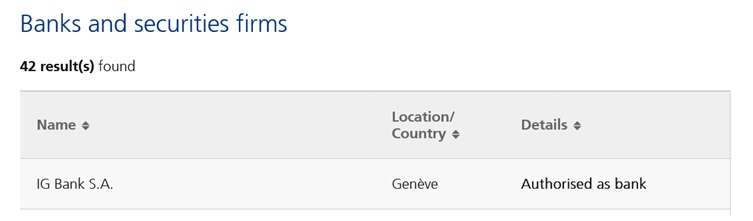
IG’s entry on FINMA’s database. Source: FINMA
Trading Costs
The next item traders tend to look at is what fees and charges they can expect to pay. Under Swiss financial services rules, brokers are required to disclose all “one-time and running costs of the financial service and the costs incurred in connection with the acquisition or disposal of the respective financial instrument.”
Costs to look out for include:
- Transaction charges.
- Deposit and withdrawal fees.
- Account management and subscription charges.
- Currency conversion costs.
- Account inactivity fees.
- Advisory and portfolio management charges.
Pro tip: It can also be critical to observe the size of the broker’s bid (buy) and ask (sell) spreads. If you’re a high-frequency trader, a wide spread can be more harmful to your eventual returns than some of the fees listed above.
It’s also a good idea to see if your broker offers CHF-based accounts. This is because – as you may expect – securities on the SIX Swiss Exchange are predominantly priced in Swiss francs. Taking this route can save you a chunk of cash in forex conversion fees.
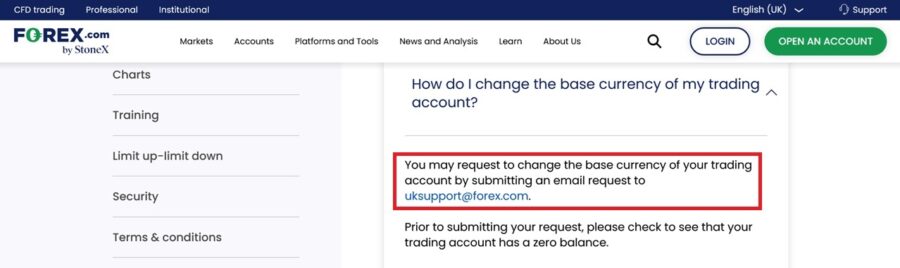
You can trade using the CHF as your base currency with Forex.com after dropping its customer service team an email. Source: Forex.com.
Pro tip: SIX Swiss Exchange doesn’t levy charges on retail or institutional investors to use its venue.
Instead, exchange members (such as brokerages, market makers and liquidity providers) have to stump up the cost based on their trading turnover and transaction volumes, as well as on the type of security being bought or sold and the way they submit the order. It is then down to the discretion of the members to pass these costs on.
Let’s say a broker has received a customer order to buy shares in Garmin, which manufactures global positioning system (GPS) and wireless technology. The brokerage executes the trade through the Swiss Trading Interface (STI), which is SIX Swiss Exchange’s electronic trading platform.
As a trading participant, the broker will pay a fixed CHF 1.00 transaction charge, plus an additional fee based on the value of the trade. This ad valorem fee will range from 0.75 basis points to 1.50 basis points, subject to a minimum of CHF 0.50.
Top SIX Swiss Exchange broker for trading costs: Traders using CMC Markets are saved from transaction fees when dealing in Swiss-based securities. There are also zero account fees on its standard account plan, while deposits and withdrawals are also free of charges.
CMC also lets customers choose from roughly 10 base currencies for their trading account, including the CHF.
Range Of Markets
The SIX Swiss Exchange is one of Europe’s largest stock markets. Yet retail investor participation is lower than other major global exchanges like the New York Stock Exchange (NYSE) and the London Stock Exchange (LSE).
This means that while some brokers will offer a wide range of Swiss-based assets to trade, others may not provide comprehensive access. Want to trade a particular small cap share from the Swiss All Share Index? You may need to hunt around to find a brokerage that’ll let you do that.
Furthermore, not all service providers will provide direct access to assets on the SIX Swiss Exchange. Instead, they’ll only let you speculate on price movements using derivatives such as:
Using derivatives carries both advantages and disadvantages for investors. Buying a futures contract that tracks shares in recruitment services specialist Adecco, for instance, allows you to gain leveraged exposure to its stock. This means you don’t have to pay the full value of the underlying shares up front.
But while you may benefit from a rise in the share price, you won’t be entitled to receive dividend income, unlike holders of actual Adecco shares.
Pro tip: Investors can trade derivative products (like futures and options) on many Swiss shares on Eurex, the European derivatives exchange operated by Deutsche Boerse. Eurex was jointly operated by SIX Group – owner and operator of the SIX Swiss Exchange – and Deutsche Boerse until the latter took full control in 2012.
Many brokers offer investors the chance to buy SIX-listed securities and Eurex derivatives. This can offer added benefits for traders, including the chance to go short on Swiss stocks.
Top SIX Swiss Exchange broker for range of markets: Interactive Brokers offers one of the best product ranges out there, whichever financial market or securities exchange you’re seeking exposure to.
It offers direct access to a variety of stocks, funds, bonds and other securities on the SIX Swiss Exchange. Traders can also purchase futures and options if they wish to take the derivatives route as well as CFDs.
Trading Platform
Generally speaking, there are certain features every investor and trader should demand from their trading software. Examples include:
- Fast trade execution speeds.
- Real-time market pricing and volume data.
- An easy-to-navigate user interface.
- Platform stability when market activity picks up (for example, when the Swiss National Bank (SNB) makes interest rate announcements).
- Access to risk management tools like stop loss orders.
- High levels of customizability (for instance, the option to create watchlists for SIX Swiss exchange securities).
- Strong security features, such as two-step verification when signing into one’s account.
This is just the tip of the iceberg, as your investing style, experience and objectives will introduce other factors that need to be considered. Short-term traders will require access to advanced charting tools, for example. New investors may want a broker who provides lots of educational material to help them get started.
Pro tip: Most major brokers offer sophisticated trading platforms that offer everything (or almost everything!) that modern investors require. Just be mindful that some service providers will charge for extras and/or better online software, and that fees for these can differ substantially.
Top SIX Swiss Exchange broker for trading platform: Vantage offers an intuitive, clear and highly customizable desktop platform. Solid charting tools are on hand, while traders have access to copy trading tools as well.
Vantage also operates a smartphone app (for both Android and iOS devices) for investors to trade when they’re out and about. Algorithmic traders may also be interested to learn that Vantage provides access to a virtual private server (VPS).
How Can I Begin Trading The SIX Swiss Exchange?
To start trading securities on Switzerland’s regulated financial markets I’ll need to complete these three tasks:
1. Comparing brokers. Costs, trading platform, range of financial markets, and regulation are the core things I’ll need to consider. But this is just the start of my journey. Depending on my investing style and personal circumstances, I may need to consider other features including:
- Whether the broker is also a market maker.
- Different ways I can fund my account.
- Compatibility with third-party trading software (such as MetaTrader 5 (MT5)).
2. Opening an account. Once I’ve found my broker, I’ll need to submit basic personal details (name, date of birth, nationality etc.) as well as more specific financial and investing-related information for regulatory purposes (for instance, source of funds and investing experience). Some service providers will also require digital copies of proof of identification and address at this stage.
3. Deposit funds. I’ll need money in my account to start building my portfolio of Swiss-listed securities. The good news is many brokers accept various payment methods, such as bank transfer from international and local banks like PostFinance; debit card; digital wallet (like Skrill); and payment service providers.
What Is The SIX Swiss Exchange?
The SIX Swiss Exchange is the primary securities exchange in Switzerland. As the name implies, it is operated by SIX Group, a complete financial market infrastructure provider whose other functions comprise securities settlement and clearing, custody, data provision and payment services.
The SIX Swiss Exchange can trace its roots back to 1850, although it didn’t take on its present guise until 1993 when the stock exchanges of Geneva, Zurich and Basel were merged. Some 99.99% of regulated securities trading takes place on the exchange, and it is home to dozens of Europe’s largest and most prestigious companies.
These include:
- Pharmaceuticals manufacturers Roche and Novartis.
- Food and beverage maker Nestlé.
- ABB, which manufactures electrification and automation technology.
- Insurance companies Zurich and Chubb.
- Banking giant UBS.
- Compagnie Financière Richemont, which makes luxury goods including Cartier jewellery and IWC Schaffhausen watches.
- Commodities producer and trader Glencore.
- Electronics manufacturer TE Connectivity.
- Swiss Re, the world’s biggest reinsurance provider.
Domestic companies make up the lion’s share of share listings on the SIX Swiss Exchange. What’s more, the market is highly concentrated, with blue chips dominating trading and the top 10 companies accounting for more than 90% of the total market capitalization of all listed shares.
The exchange’s flagship index is the Swiss Market Index (SMI), which tracks the 20 largest and most liquid equities on Switzerland’s stock market.
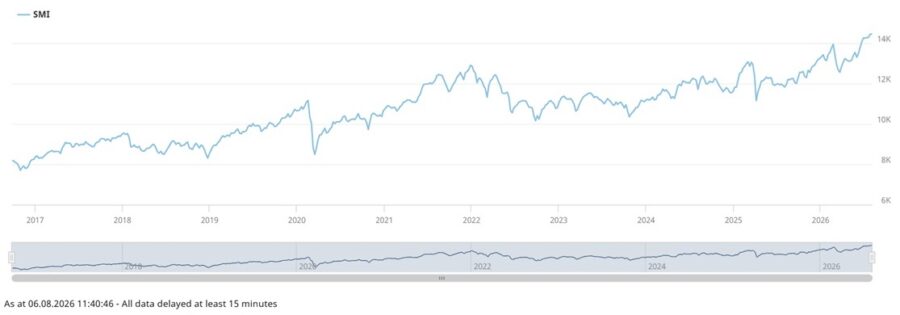
The long-term performance of the Swiss Market Index (SMI). Source: SIX Group
How Can I Trade The SIX Swiss Exchange?
There are roughly 250 companies whose shares can be traded on Switzerland’s main exchange. But the SIX Swiss Exchange isn’t just about equities – other securities that can be bought and sold include:
- Bonds.
- Exchange-traded products (ETPs) providing exposure to assets including commodities and cryptocurrencies.
- ETFs that track specific indices, sectors, themes or asset classes.
- Investment funds.
- Structured products such as warrants.
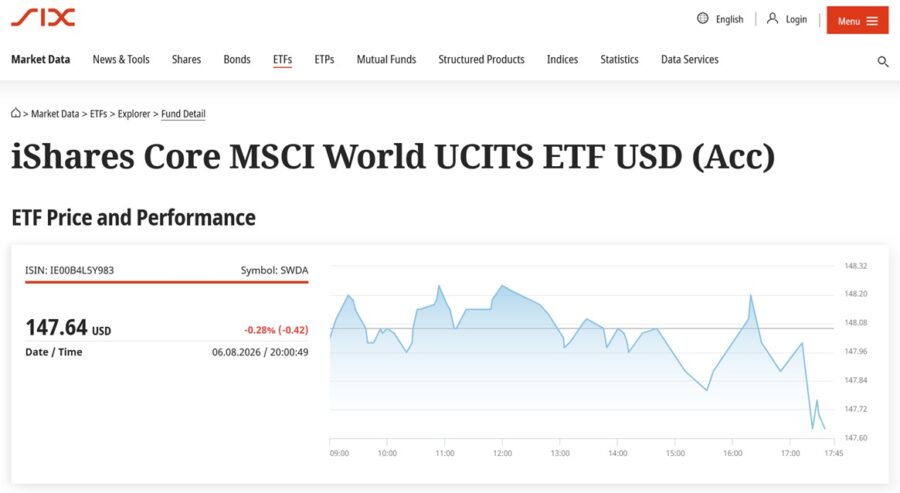
The iShares Core MSCI World UCITS ETF trading on the SIX Swiss Exchange. Source: SIX Group
Bottom Line
As home to some of Europe’s largest companies, the SIX Swiss Exchange is a popular venue with retail share traders. Investors can also buy and sell other assets like ETFs and bonds, and strict oversight from FINMA means traders can trade with confidence.
It’s important to check the broker you’re considering is authorized by FINMA or another top-level national regulator. Always check the service provider’s regulatory status before handing over any sensitive personal information or money.