Best Nasdaq Nordic & Baltics Brokers 2026
Discover the best brokers with access to the Nasdaq Nordic & Baltics following our rigorous hands-on testing.
 Written By
Royston Wild
Royston is a seasoned investor and financial writer with over a decade of experience analyzing brokers and investment markets. With a background in stocks, commodities, and forex reporting - he brings a fresh perspective to broker evaluations.
Royston Wild Profile Page Fact Checked By
Tobias Robinson
Tobias is committed to helping traders find the right brokerage for their needs. He has tested 200+ brokers, spent 2,600+ hours using different platforms, and placed 2,100+ trades.
Tobias Robinson Profile Page Edited By
James Barra
James is an experienced broker analyst with a background in financial services. He has spent 2,500+ hours testing brokers, used 35+ different platforms and apps, audited 120+ broker T&Cs, and verified 300+ regulatory licenses. James has also been on US and UK TV, and been a guest on finance podcasts, discussing reports conducted by BrokerListings.com and sharing his expertise.
James Barra Profile PageOctober 14, 2026
 Our Top Pick in USA
1
Our Top Pick in USA
1
 Interactive Brokers
-
Available in United States
Not available in United States
Rating breakdown
Interactive Brokers (IBKR) is a leading brokerage offering access to over 170 markets in 40 countries and a range of investment services. With 40+ years in the industry, this Nasdaq-listed company follows strict regulations by the SEC, FCA, CIRO, SFC, Europe and beyond, making it a trusted global trading broker.
- Demo Account
- ✓
- Minimum Deposit
- $0
- Minimum Trade
- $1
- Leverage
- 1:50 (major forex pairs), 1:2-1:4 (equities)
- Copy Trading
- ✗
- Regulator
- SEC, FINRA, CFTC, NFA, CIRO, FCA, CBI, ASIC, SFC, SEBI, JFSA, MAS
- Instruments
- Stocks, Options, Futures, Forex, Funds, Bonds, ETFs, Mutual Funds, Cryptocurrencies, CFDs Stocks, Options, Futures, Forex, Funds, Bonds, ETFs, Mutual Funds, Cryptocurrencies
- Platforms
- Trader Workstation (TWS), IBKR Desktop, GlobalTrader, Mobile, Client Portal, AlgoTrader, OmniTrader, TradingView, eSignal, TradingCentral, ProRealTime, Quantower
- Account Currencies
- USD, EUR, GBP, CAD, AUD, INR, JPY, SEK, NOK, DKK, CHF, AED, HUF
- Automated Trading
- TWS API
- AI
- ✓
- Guaranteed Stop Loss
- ✗
Compare Brokers
| Broker | |
USD Account |
Demo Account |
Minimum Deposit |
Minimum Trade |
Leverage |
Copy Trading |
Regulator |
Instruments |
Platforms |
Account Currencies |
Automated Trading |
AI |
Guaranteed Stop Loss |
|---|---|---|---|---|---|---|---|---|---|---|---|---|---|---|
|
✓ | ✓ | $0 | $1 | 1:50 (major forex pairs), 1:2-1:4 (equities) | ✗ | SEC, FINRA, CFTC, NFA, CIRO, FCA, CBI, ASIC, SFC, SEBI, JFSA, MAS | Stocks, Options, Futures, Forex, Funds, Bonds, ETFs, Mutual Funds, Cryptocurrencies, CFDs Stocks, Options, Futures, Forex, Funds, Bonds, ETFs, Mutual Funds, Cryptocurrencies | Trader Workstation (TWS), IBKR Desktop, GlobalTrader, Mobile, Client Portal, AlgoTrader, OmniTrader, TradingView, eSignal, TradingCentral, ProRealTime, Quantower | USD, EUR, GBP, CAD, AUD, INR, JPY, SEK, NOK, DKK, CHF, AED, HUF | TWS API | ✓ | ✗ | |
| Broker | |
USD Account |
Demo Account |
Minimum Deposit |
Minimum Trade |
Leverage |
Copy Trading |
Regulator |
Instruments |
Platforms |
Account Currencies |
Automated Trading |
AI |
Guaranteed Stop Loss |
Safety Comparison
Compare how safe the Best Nasdaq Nordic & Baltics Brokers 2026 are.
| Broker | Trust Rating |
Guaranteed Stop Loss |
Negative Balance Protection |
Segregated Accounts |
|---|---|---|---|---|
|
✗ | ✗ | ✓ | |
| Broker | Trust Rating |
Guaranteed Stop Loss |
Negative Balance Protection |
Segregated Accounts |
Mobile Trading Comparison
Compare the mobile trading features of the Best Nasdaq Nordic & Baltics Brokers 2026.
| Broker | Mobile Apps |
iOS Rating |
Android Rating |
Smart Watch App |
|---|---|---|---|---|
|
iOS & Android | ✓ | ||
| Broker | Mobile Apps |
iOS Rating |
Android Rating |
Smart Watch App |
Comparison for Beginners
Compare how suitable the Best Nasdaq Nordic & Baltics Brokers 2026 are for beginners.
| Broker | Demo Account |
Minimum Deposit |
Minimum Trade |
Education Rating |
Support Rating |
Fractional Shares |
Demo Competitions |
|---|---|---|---|---|---|---|---|
|
✓ | $0 | $1 | ✓ | ✗ | ||
| Broker | Demo Account |
Minimum Deposit |
Minimum Trade |
Education Rating |
Support Rating |
Fractional Shares |
Demo Competitions |
Comparison for Advanced Traders
Compare how suitable the Best Nasdaq Nordic & Baltics Brokers 2026 are for advanced or professional traders.
| Broker | Automated Trading |
VPS |
API |
AI |
Pro Account |
Leverage |
Low Latency |
Extended Hours |
|---|---|---|---|---|---|---|---|---|
|
TWS API | ✗ | ✓ | ✓ | ✗ | 1:50 (major forex pairs), 1:2-1:4 (equities) | ✓ | ✓ |
| Broker | Automated Trading |
VPS |
API |
AI |
Pro Account |
Leverage |
Low Latency |
Extended Hours |
Accounts Comparison
Compare the trading accounts offered by Best Nasdaq Nordic & Baltics Brokers 2026.
| Broker | Demo Account |
Interest on Cash |
Islamic Account |
Joint Account |
Managed Account |
PAMM |
MAM |
LAMM |
Pro Account |
|---|---|---|---|---|---|---|---|---|---|
|
✓ | USD: 3.14%, GBP: 3.24% | ✗ | ✓ | ✓ | ✗ | ✓ | ✗ | ✗ |
| Broker | Demo Account |
Interest on Cash |
Islamic Account |
Joint Account |
Managed Account |
PAMM |
MAM |
LAMM |
Pro Account |
Detailed Rating Comparison
Compare how we rated the Best Nasdaq Nordic & Baltics Brokers 2026 in key areas.
| Broker | Trust |
Platforms |
Assets |
Mobile |
Fees |
Accounts |
Research |
Education |
Support |
|---|---|---|---|---|---|---|---|---|---|
|
|||||||||
| Broker | Trust |
Platforms |
Assets |
Mobile |
Fees |
Accounts |
Research |
Education |
Support |
Fee and Cost Comparison
Compare the cost of trading with the Best Nasdaq Nordic & Baltics Brokers 2026.
| Broker | Cost Rating |
Fixed Spreads |
Inactivity Fee |
EUR/USD Spread |
Crypto Spread |
|---|---|---|---|---|---|
|
✗ | $0 | 0.08-0.20 bps x trade value | 0.12%-0.18% | |
| Broker | Cost Rating |
Fixed Spreads |
Inactivity Fee |
EUR/USD Spread |
Crypto Spread |
Customer Ratings
Compare how customers of these brokers feel about them, with real user ratings from Trustpilot, the Apple App Store and Google Play.
| Broker | Customers |
Trustpilot Score |
Trustpilot Reviews |
Android App Rating |
iOS App Rating |
|---|---|---|---|---|---|
|
4,300,000 | 5,529 | |||
| Broker | Customers |
Trustpilot Score |
Trustpilot Reviews |
Android App Rating |
iOS App Rating |
Broker Popularity
See how popular the Best Nasdaq Nordic & Baltics Brokers 2026 are in terms of number of clients.
| Broker | Popularity |
|---|---|
| Interactive Brokers |
|
Why Trade With Interactive Brokers?
Interactive Brokers is ideal for seasoned traders due to its robust charting platforms, updated data, and adaptability, especially with the IBKR Desktop application. Its exceptional pricing and advanced order features appeal to traders, and its variety of stocks remains unmatched in the market.
 Christian Harris
Review Author
Pros
- Interactive Brokers has introduced a single platform combining prediction markets from Kalshi, CME Group, and ForecastEx. Users can trade yes/no contracts on political, economic, and climate events, with a fixed $1 payout per contract, 24/6 market access, and interest on qualified positions.
- IBKR offers exceptional access to global stocks, with thousands of equities available from over 100 market centers in 24 countries, including the recent addition of the Saudi Stock Exchange.
- The TWS platform is designed for intermediate to advanced traders. It includes over 100 order types and a dependable real-time market data feed that rarely experiences downtime.
Cons
- Customer service may take time to respond, and there may be delays in fixing problems based on tests. It could be difficult to reach the customer service promptly.
- TWS is complex, and beginners might find it difficult to use and understand all its features.
- IBKR offers many research tools. However, the tools are not uniformly distributed across trading platforms and the web-based 'Account Management' page, causing confusion for the users.
Filters
How We Chose The Best Brokers For Trading On Nasdaq Baltic
We selected the top brokers for trading on Nasdaq Baltic by prioritizing firms that genuinely provide access to Baltic-listed shares and related instruments (Estonia, Latvia, Lithuania).
For every broker, we independently confirmed access to Nasdaq Baltic – either by checking the instruments available in the trading platform or by verifying details with the broker’s support team.
Only providers that passed this access check were included. From there, we ranked them by overall score, using 200+ data points plus insights from our in-house equity traders to highlight the best Nasdaq Baltic brokers.
What Is The Nasdaq Nordic and Baltics?
The Nasdaq Nordic and Baltics is an integrated network of trading exchanges in Northern Europe. It brings together the main securities exchanges of seven countries:
- Denmark (Nasdaq Copenhagen)
- Estonia (Nasdaq Tallinn)
- Finland (Nasdaq Helsinki)
- Iceland (Nasdaq Iceland)
- Latvia (Nasdaq Riga)
- Lithuania (Nasdaq Vilnius)
- Sweden (Nasdaq Stockholm)
From the early 1990s to late 2000s, a flurry of stock exchanges were created, merged and acquired in the region. This culminated in the Nasdaq OMX Group launching the INET trading platform in 2010, which integrated these seven trading venues onto one system.
The move was designed to improve efficiency, liquidity and transparency for trading assets across the countries. Today, investors can buy and sell a wide range of securities including stocks, bonds, exchange-traded funds (ETFs) and derivatives across these Nordic and Baltic nations.
Pro tip: The OMX Nordic 40 is one of the most traded share indices across the Nasdaq Nordic and Baltics.
This bellwether collection is a market-weighted stock index comprising 40 of the largest and most liquid companies in Denmark, Finland, Iceland and Sweden.
The OMX Nordic 40 is reviewed twice a year, and includes companies that also feature on other global exchanges. Major names include shipping giant Maersk, brewer Carlsberg, carmaker Volvo and energy producer Ørsted.
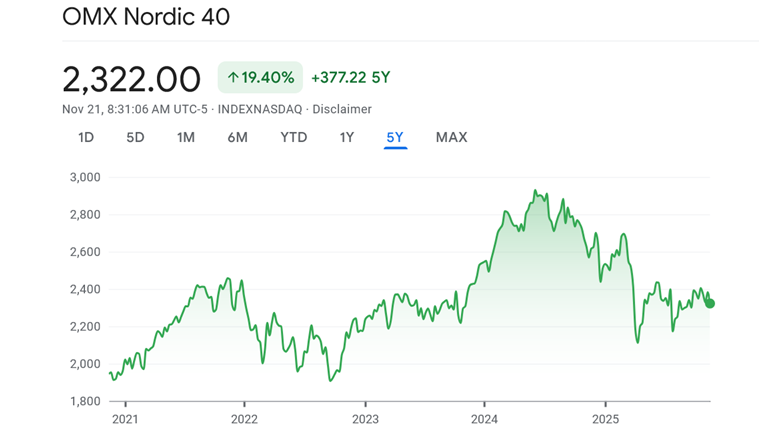
The OMX Nordic 40. Source: Google Finance
Ways To Trade The Nasdaq Nordic and Baltics
Today investors can choose from hundreds of individual shares on the Nasdaq Nordic and Baltics. These range from the blue-chip multinationals mentioned above to smaller, local businesses.
Pro tip: There are more than 1,700 companies for individuals to trade. These comprise over 650 on the main market, and over 480 at First North, the secondary market for small- and medium-sized firms.
Investors can also trade ETFs that track indices like the OMX Nordic 40, the OMX Stockholm 30 and the OMX Copenhagen 25. The latter two indices track the performance of Sweden and Denmark’s biggest and most liquid shares respectively.
It’s also possible to buy ETFs that follow particular sectors or themes. The XACT Svenska Småbolag, for instance, tracks a selection of small-cap Swedish stocks.
Traders can also deal in government and corporate bonds, and raw materials with the use of exchange-traded commodities (ETCs). In addition, derivative products like futures and options are available to trade a range of securities and indices.
Choosing A Broker To Trade On The Nasdaq Nordic and Baltics
Some of the critical factors to consider when selecting a brokerage include:
Trustworthiness
The number one rule when starting out is to ensure your money and your personal data are protected, and that your broker will execute your trading instructions without hassle.
To improve your chances of achieving this, it’s important to ascertain that the company you’re considering is authorized to trade by a respected local regulator. This provides protections against fraudulent parties and bad business practices.
For instance, the Swedish Financial Supervisory Authority (Finansinspektionen) maintains a company register investors can use to find locally licensed brokers. Companies that fail to adhere to the regulator’s strict rules and standards can be subject to penalties including monetary fines, and suspension and revocation of trading licenses.
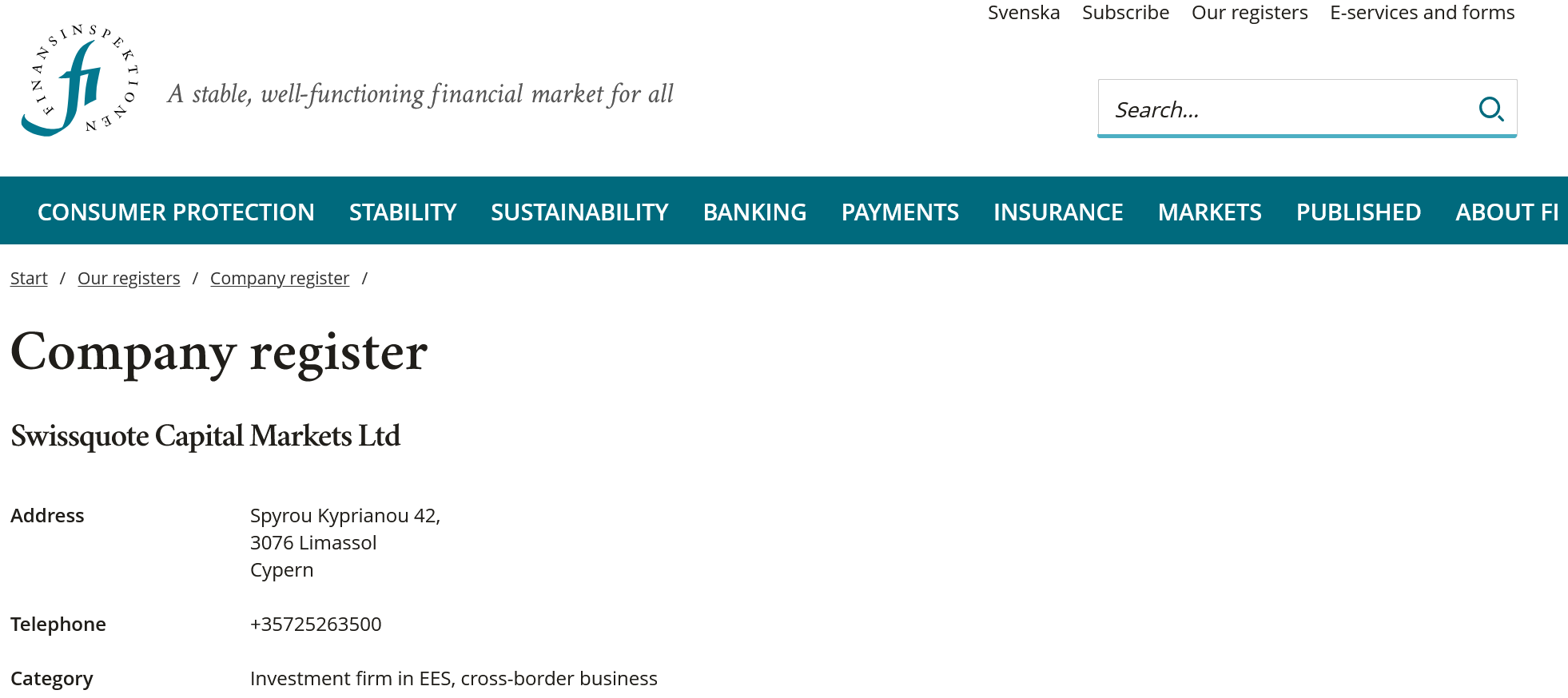
Locating Swissquote using the Finansinspektionen search facility. Source: Finansinspektionen
Pro tip: Sweden’s Finansinspektionen is classified as a Category A watchdog under BrokerListing.com’s Regulator Rating System. This register includes a wide range of global regulators for traders to consider, and includes ratings for each.
Trading Platform
If you’re spending much of your day behind a screen, you’ll want to know that the platform you’re using is both easy and enjoyable to use.
Certain things are subjective, like a platform’s color scheme, layout, and navigation. However, there are some universal non-negotiables that investors share, and it’s important to check these out when considering which brokerage to use.
Important things to look for include:
- Platform stability and transaction speeds.
- Portfolio analysis tools.
- Clear, easy-to-access data.
- Platform customizability.
- Risk management devices, including stop-loss and take-profit orders.
- Chart quality, and the provision of advanced charting tools.
- Availability of a mobile app for trading ‘on the go.’
- Backtesting tools and demo accounts for honing trading strategies.
- Real-time and Level 2 (or order book) data, along with news feeds, economic calendars and other resources.
- Support for algorithmic trading and bots.
- Compatibility with third-party trading software like MetaTrader5 (MT5), TradingView and cTrader.
- Customer service, including hours of operation and methods of contact.
Top broker for trading platform: Interactive Brokers offers a multitude of research tools, low latency, AI-powered features (like portfolio analysis) and an impressive mobile app for both iOS and Android.
It also provides customer service around the clock during the trading week, and several ways in which traders can make contact (including telephone, online chat and e-mail).
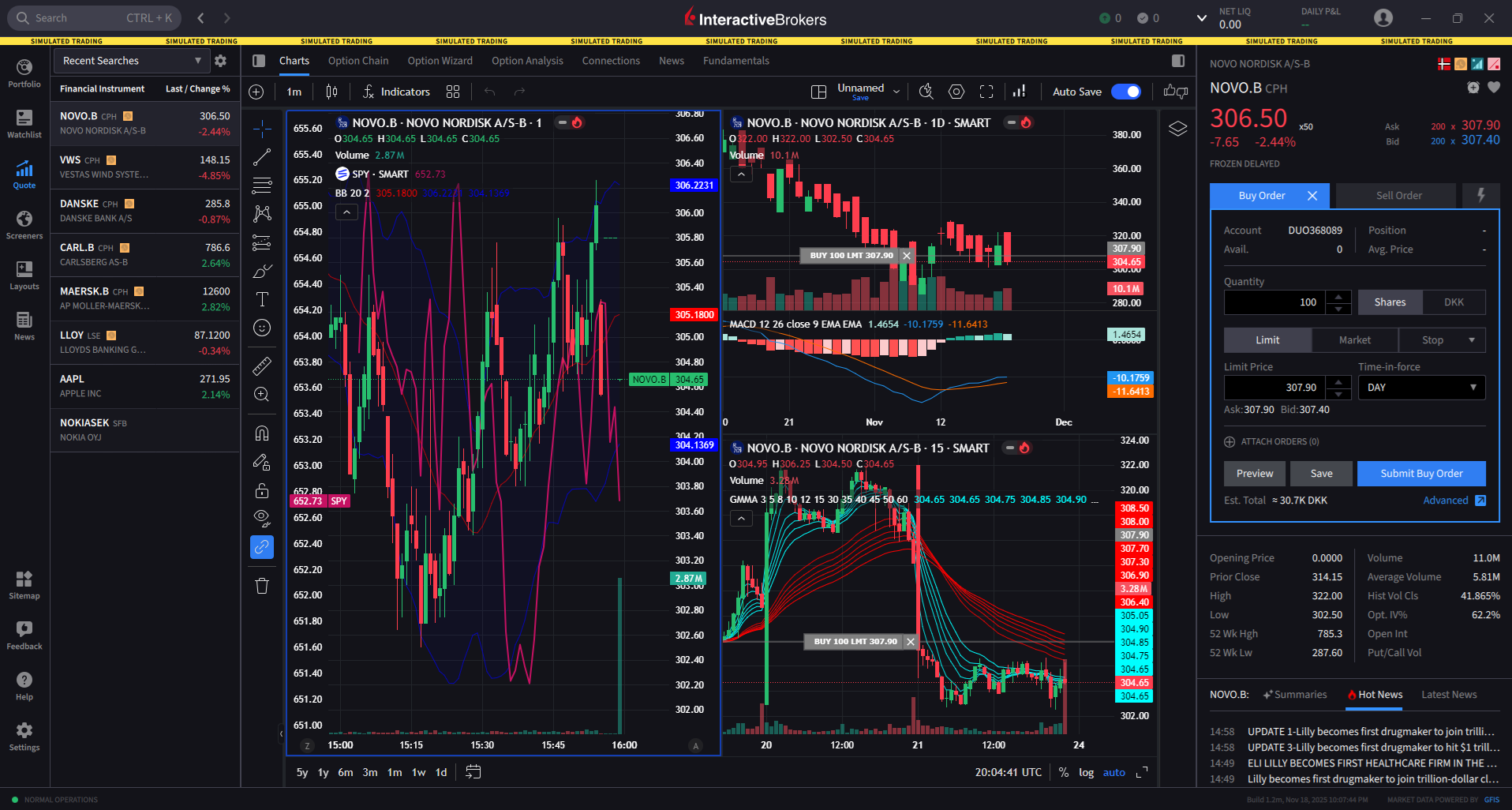
Trading Novo Nordisk shares on Interactive Brokers. Source: Interactive Brokers
Trading Costs
Keeping trading costs to a minimum is critical, and especially if you’re a high-frequency trader.
Billionaire stocks guru Warren Buffett once said “if returns are going to be 7% or 8% and you’re paying 1% for fees, that makes an enormous difference in how much money you’re going to have in retirement.” It’s a slice of wisdom that’s as valid for short-term trading as it is for long-term investing.
It’s therefore important to make sure your profits aren’t being chipped away by expenses you can avoid. Think about things like transaction fees, account charges, deposit and withdrawal fees, but also the bid-ask spreads.
Brokers with low or zero headline costs often compensate for this through wider spreads, which may work out more expensive for a trader than paying a chunky fee for each transaction.
Top pick for trading costs: Skilling doesn’t charge deposit fees, commissions on transactions, and there are no account inactivity charges. Spreads are also competitive and begin at 0.7 pips for standard accounts.
Local Currency Accounts
Tied to the trading costs theme, if you reside in a Nordic or Baltic country it may be worth checking out brokers that permit dealing in local currencies.
For instance, traders in Denmark may want to consider IG, which offers a Danish Krone (DKK) account. Meanwhile, investors in Estonia, Finland, Latvia and Lithuania, could save a packet in currency conversion fees with a top euro account provider, such as FXCC.
Asset Range
Not all brokerages will offer the exact range of securities.
If you want to trade blue-chip shares like Novo Nordisk, for instance, or an ETF tracking the OMX Nordic 40, there’s a high chance you’ll be able to find them with any broker.
However, it may be tougher to find a brokerage that offers certain other securities and financial instruments, such as small-cap Icelandic shares. So keep in mind what you plan to trade – and may wish to in the future – when choosing a broker.
Choosing a broker with a broad product range can improve an investor’s ability to capitalize on market opportunities.
Top pick for asset range: eToro has one of the broadest catalogs of tradable securities out there. These include stocks, indices, ETFs, commodities, derivatives and cryptocurrencies.
How To Begin Trading On The Nasdaq Nordic and Baltics
The account sign-up process differs among brokers. But to begin trading in Nordic and Baltic securities, expect the steps to look like this:
- Locate a broker. The market is large, so I’d spend a large amount of time choosing the best one based on the considerations discussed above. Furthermore, I’d consider choosing a brokerage with a demo trading account – this way I could ‘road test’ their platform before putting any capital down.
- Open an account. With my broker chosen, I’d need to register for an account to start trading. I’d be required to provide some personal details, and to send over digital copies of ID and proof of address.
- Deposit some money. I wouldn’t be able to trade without having money in my account. So I’d need to make a deposit. Popular payment methods include using a bank transfer, debit card transaction, a digital wallet (such as Apple Pay) or a third-party payment provider (like PayPal).
- Begin trading. After carefully researching the financial securities I plan to trade, I’d be ready to open my first position, making full use of my trading platform’s tools (like risk management and charting tools).
- Monitor the market. I’d need to closely watch the market, and be ready to trade when conditions change according to my investing objectives.
Bottom Line
Traders have a large range of brokers to choose from if they wish to deal on the Nasdaq Nordic and Baltics. It’s important to check that the company you’re looking at is authorized by a reputable regulator. After this, consider other important points like trading costs, platform quality, and the range of securities on offer.