
Best FTSE 100 Brokers 2026
Discover the best brokers with access to the UK FTSE 100 Index following our rigorous hands-on testing.
 Written By
Royston Wild
Royston is a seasoned investor and financial writer with over a decade of experience analyzing brokers and investment markets. With a background in stocks, commodities, and forex reporting - he brings a fresh perspective to broker evaluations.
Royston Wild Profile Page Fact Checked By
James Barra
James is an experienced broker analyst with a background in financial services. He has spent 2,500+ hours testing brokers, used 35+ different platforms and apps, audited 120+ broker T&Cs, and verified 300+ regulatory licenses. James has also been on US and UK TV, and been a guest on finance podcasts, discussing reports conducted by BrokerListings.com and sharing his expertise.
James Barra Profile Page Edited By
Tobias Robinson
Tobias is committed to helping traders find the right brokerage for their needs. He has tested 200+ brokers, spent 2,600+ hours using different platforms, and placed 2,100+ trades.
Tobias Robinson Profile PageAugust 15, 2026
-
1Founded in 2001, FOREX.com is part of StoneX, a global financial services firm with over a million customers. Regulated in the US, UK, EU, Australia, and other regions, it offers thousands of markets, not just forex, with competitive pricing on advanced platforms.
Compare Brokers
| Broker |  |
USD Account |
Demo Account |
Minimum Deposit |
Minimum Trade |
Leverage |
Copy Trading |
Regulator |
Instruments |
Platforms |
Account Currencies |
Automated Trading |
AI |
Guaranteed Stop Loss |
|---|---|---|---|---|---|---|---|---|---|---|---|---|---|---|
 |
✓ | ✓ | $100 | 0.01 Lots | 1:50 | ✗ | NFA, CFTC | Forex, Futures and Options on Metals, Energies, Commodities, Indices, Bonds Forex, CFDs, Stock CFDs, Indices, Commodities, Futures, Options, Crypto | WebTrader, Mobile, MT4, MT5, TradingView | USD, EUR, GBP, CAD, AUD, JPY, CHF, PLN | Expert Advisors (EAs) on MetaTrader | ✓ | ✗ | |
| Broker | |
USD Account |
Demo Account |
Minimum Deposit |
Minimum Trade |
Leverage |
Copy Trading |
Regulator |
Instruments |
Platforms |
Account Currencies |
Automated Trading |
AI |
Guaranteed Stop Loss |
Safety Comparison
Compare how safe the Best FTSE 100 Brokers 2026 are.
| Broker | Trust Rating |
Guaranteed Stop Loss |
Negative Balance Protection |
Segregated Accounts |
|---|---|---|---|---|
|
✗ | ✗ | ✓ | |
| Broker | Trust Rating |
Guaranteed Stop Loss |
Negative Balance Protection |
Segregated Accounts |
Mobile Trading Comparison
Compare the mobile trading features of the Best FTSE 100 Brokers 2026.
| Broker | Mobile Apps |
iOS Rating |
Android Rating |
Smart Watch App |
|---|---|---|---|---|
|
iOS & Android | ✗ | ||
| Broker | Mobile Apps |
iOS Rating |
Android Rating |
Smart Watch App |
Comparison for Beginners
Compare how suitable the Best FTSE 100 Brokers 2026 are for beginners.
| Broker | Demo Account |
Minimum Deposit |
Minimum Trade |
Education Rating |
Support Rating |
Fractional Shares |
Demo Competitions |
|---|---|---|---|---|---|---|---|
|
✓ | $100 | 0.01 Lots | ✗ | ✗ | ||
| Broker | Demo Account |
Minimum Deposit |
Minimum Trade |
Education Rating |
Support Rating |
Fractional Shares |
Demo Competitions |
Comparison for Advanced Traders
Compare how suitable the Best FTSE 100 Brokers 2026 are for advanced or professional traders.
| Broker | Automated Trading |
VPS |
API |
AI |
Pro Account |
Leverage |
Low Latency |
Extended Hours |
|---|---|---|---|---|---|---|---|---|
|
Expert Advisors (EAs) on MetaTrader | ✓ | ✓ | ✓ | ✗ | 1:50 | ✓ | ✗ |
| Broker | Automated Trading |
VPS |
API |
AI |
Pro Account |
Leverage |
Low Latency |
Extended Hours |
Accounts Comparison
Compare the trading accounts offered by Best FTSE 100 Brokers 2026.
| Broker | Demo Account |
Interest on Cash |
Islamic Account |
Joint Account |
Managed Account |
PAMM |
MAM |
LAMM |
Pro Account |
|---|---|---|---|---|---|---|---|---|---|
|
✓ | ✗ | ✓ | ✗ | ✗ | ✗ | ✗ | ✗ | ✗ |
| Broker | Demo Account |
Interest on Cash |
Islamic Account |
Joint Account |
Managed Account |
PAMM |
MAM |
LAMM |
Pro Account |
Detailed Rating Comparison
Compare how we rated the Best FTSE 100 Brokers 2026 in key areas.
| Broker | Trust |
Platforms |
Assets |
Mobile |
Fees |
Accounts |
Research |
Education |
Support |
|---|---|---|---|---|---|---|---|---|---|
|
|||||||||
| Broker | Trust |
Platforms |
Assets |
Mobile |
Fees |
Accounts |
Research |
Education |
Support |
Fee and Cost Comparison
Compare the cost of trading with the Best FTSE 100 Brokers 2026.
| Broker | Cost Rating |
Fixed Spreads |
Inactivity Fee |
EUR/USD Spread |
Crypto Spread |
|---|---|---|---|---|---|
|
✗ | $15 | 1.2 | BTC 1.4%, ETH 2% | |
| Broker | Cost Rating |
Fixed Spreads |
Inactivity Fee |
EUR/USD Spread |
Crypto Spread |
Customer Ratings
Compare how customers of these brokers feel about them, with real user ratings from Trustpilot, the Apple App Store and Google Play.
| Broker | Customers |
Trustpilot Score |
Trustpilot Reviews |
Android App Rating |
iOS App Rating |
|---|---|---|---|---|---|
|
450,000 | 2,496 | |||
| Broker | Customers |
Trustpilot Score |
Trustpilot Reviews |
Android App Rating |
iOS App Rating |
Broker Popularity
See how popular the Best FTSE 100 Brokers 2026 are in terms of number of clients.
| Broker | Popularity |
|---|---|
| FOREX.com |
|
Why Trade With FOREX.com?
FOREX.com is a top-tier brokerage suitable for forex traders of all skill levels. It offers more than 80 currency pairs, has small spreads starting from 0.0 pips, and features low fees. The platform provides powerful charting tools that include over 100 technical indicators and multiple research aids.
Pros
- Educational resources include tutorials, webinars, and a YouTube channel to help you learn about financial markets.
- FOREX.com has over 20 years of experience with strong regulatory oversight, and has received multiple awards, including second place in our 'Best Forex Broker' awards. As such, FOREX.com is globally reputed as a reliable trading brokerage.
- FOREX.com provides top-tier forex pricing beginning at 0.0 pips. They also offer competitive cashback rebates up to 15% for dedicated traders.
Cons
- FOREX.com's MT4 platform provides around 600 instruments for trading, which is considerably less than the 5,500+ options accessible on its other platforms.
- US clients do not have negative balance protection, so you can potentially owe more than your original account deposit.
- Demo accounts have a limited time duration of 90 days, which may not be sufficient for thoroughly testing trading strategies.
Filters
How We Choose The Top FTSE 100 Brokers
Our comprehensive evaluation process involves the following key steps:
- Opening a trading account with each broker in our growing database, then recording which ones provide customers with access to the FTSE 100.
- Establishing that each service provider is authorized by a respected national regulator, such as the UK’s Financial Conduct Authority (FCA). This way, we ensure that investors can be confident in the credibility and legitimacy of the brokerage they’re using.
- Balancing the strengths and weaknesses of every firm in our broker database. Trading costs, the functionality of their online trading platform, and the range of FTSE 100 securities and derivatives they offer access to are among the key things we consider.
- Periodically re-checking each broker’s authorization status. Regulators can suspend or revoke a broker’s license when misconduct – whether that be bad business practices or fraud – is proven. Keeping up-to-date on this is therefore essential.
Once these steps are completed, the brokers in BrokerListings.com’s database are awarded an overall score after more than 200 data points are collected, then combined with research from our hands-on testers, with providers ranked by their total ratings.
How Should I Choose A Broker To Trade The FTSE 100?
The London Stock Exchange (or LSE) is one of the most popular securities exchanges on the planet. As such, the range of brokers offering access to it – and more specifically, to blue-chip FTSE 100 shares – is vast.
However, there can be enormous differences in the quality, level and cost of service between different service providers. It therefore pays to take the time to research the market before depositing any cash and submitting personal details, especially given the sharp rise in online investment fraud.
There are many factors to consider when selecting a brokerage. Here are the four that we at BrokerListings.com believe are the most important:
Trustworthiness
As I say, the problem of investment scams is becoming increasingly widespread. In the UK in 2025, criminals stole £879.8m through investment fraud, which worked out to £2.4m every day. Wherever you’re based in the world, it’s critical to protect your money (as well as your identity) from bad actors.
The best way to do this is to use a broker that’s authorized by a top-level national regulator. This doesn’t guarantee you won’t experience problems of fraud or even bad customer service. But it significantly reduces the odds, and if you are affected you’ll have proper avenues through which to seek redress.
Pro tip: BrokerListings.com has created a proprietary ranking system which simplifies the process of finding a top-level regulator. Financial watchdogs are ranked from Category A to Category C, and include the UK’s FCA, a body which has been given the highest available grade.
Top-tier regulators typically maintain online databases of licensed brokers, like the FCA’s own ‘Financial Services Register.’ Many also include warning lists of entities – like clone firms – that investors should avoid (the FCA’s own version can be found here).
Traders residing in England, Scotland, Wales and Northern Ireland typically choose an FCA broker for ease and the robust safeguards they enjoy. On top of offering protections against fraud and poor business practices, other perks include:
- Negative balance protection on high-risk contracts for difference (CFDs) and CFD-like products. The result is that a trader’s potential losses are limited to the funds they hold in their brokerage account.
- Limits on the amount of money you can borrow from your broker to trade with (leverage). This applies to CFDs, spread bets, rolling spot forex products and certain options contracts. For example, someone wishing to trade a CFD that tracks Barclays shares will have their leverage restricted to 1:5.
- Access to the Financial Services Compensation Scheme (FSCS), which regulated brokers must be signed up to. This program pays out £85,000 per person, per broker for eligible claims if the company fails and cannot meet its financial obligations.
Pro tip: Many other national regulators offer all of or some of these added protections. The Australian Securities and Investments Commission (ASIC), and all 27 European Union states operating within the framework of the European Securities and Markets Authority (ESMA), have rules that most resemble the UK’s in this respect.
Top FTSE 100 broker for trustworthiness: Eightcap has been providing international brokerage services since 2015. In that time, it’s acquired authorization from some of the world’s top regulators including the FCA, ASIC, and the Cyprus Securities and Exchange Commission (CySEC).
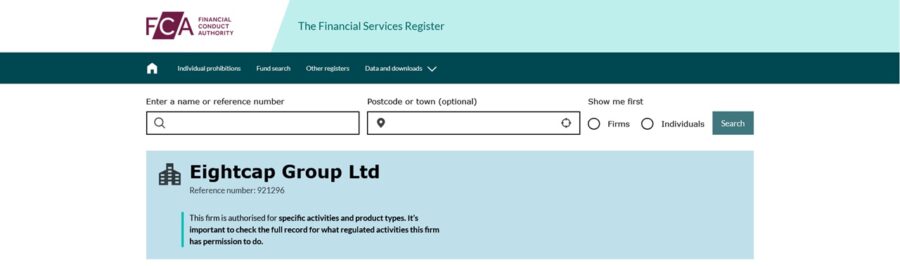
Eightcap’s entry on the FCA online register. Source: FCA
Trading Costs
Brokerages that are FCA registered are required to provide “a reasonable estimate of all costs and charges of the service and of any investment in a financial instrument which the firm has offered or sold to the client.”
Other major national regulators have the same requirements, and it’s important to pore over these details before you begin trading. Failure to do so can end up costing investors – and especially those who trade frequently – a large chunk of cash in unnecessary costs.
Key fees and charges to consider include:
- Trade commissions.
- Account and subscription costs.
- Charges on deposits and withdrawals.
- Account inactivity charges.
- Swap fees (which are overnight financing charges) for derivatives.
- Portfolio management and advisory fees.
- Currency conversion charges.
Pro tip: Carefully consider the full range of fees you could incur and not just one or two. For instance, some may charge zero commissions for trading ‘Footsie’ shares, but make up for this in other ways. Axi, for instance, doesn’t apply fees for buying and selling London-quoted shares.
However, there are charges for withdrawals below $50, while fees may also apply for both deposits and withdrawals depending on the cash transfer method. Monthly inactivity fees also become payable if your account isn’t used after a year. I’d need to weigh all this up before opening an account – Axi could still be a good choice for me if I’m a high-frequency trader.
If I’m residing in the UK, I should consider opening an account that uses the British pound (GBP) as the base currency. This is because the vast majority of FTSE 100 stocks are denominated in the nation’s currency, meaning one of these accounts could potentially save me a fortune in forex conversion charges.
That said, I need to be mindful that not all FTSE 100 shares (or Footsie-linked exchange-traded funds (ETFs)) are priced in GBP. So if I purchase shares in Compass Group, for instance, I’ll face currency charges with a sterling-based account, as the catering and hospitality provider’s stock is denominated in US dollars (USD).
Pro tip: The LSE doesn’t directly charge traders themselves when they’re trading FTSE 100 stocks or related securities. It’s the broker who, as an exchange member must settle up when assets are bought and sold. However, it is up to the decision of the brokerage whether to then reclaim these costs from the customer later on, for instance by charging trade commissions.
There are several different fee packages that LSE members can choose from. Brokers will select the best one for them based on their business activity.
For instance, under the LSE’s ‘Standard Value Traded Scheme,’ exchange members are charged the following when trading FTSE 100 stocks:
- 0.45 basis points on the first £3.5 billion of executed stock trades per month.
- 0.35 basis points for the following £5bn worth of orders.
- 0.25 basis points for all orders above these thresholds.
Top FTSE 100 broker for trading costs: CMC Markets lets investors trade with zero commissions, and doesn’t make up for this by hitting traders with wide bid (buy) and ask (sell) spreads. Other perks include no deposit and withdrawal fees, though there is a $15 inactivity fee which less-frequent traders should be mindful of.
We also like the range of base currencies CMC allows traders to use. By offering GBP, USD and euro (EUR)-based accounts, investors can reasonably expect to avoid any forex-conversion fees when directly trading FTSE 100 shares.
Trading Platform
The trading software offered to retail investors has come on leaps and bounds in recent years. Features like fast execution speeds, easy-to-reach customer service representatives, access to advanced charting tools, and the availability of highly customizable menus, charts and buttons are all commonplace nowadays.
Certain brokerages will charge a subscription fee or individual charges for access to particular features, like extra educational tools. However, many will offer a sophisticated platform and additional tools as part of their standard package for no extra cost. So shop around!
Pro tip: The answer to the question of which broker offers the best trading platform is a highly subjective one.
For example, being able to create multiple custom stock watchlists can be a valuable tool when you’re trading FTSE 100 shares. But if you’re trading high-risk products like CFDs that track Footsie stocks, knowing your broker offers a range of risk management tools can be far more important.
Some features should be absolute ‘non-negotiables’ for all traders, regardless of their trading objectives or strategies. These include rapid execution speeds; a reliable and stable platform; and access to real-time and market pricing data for FTSE 100 shares.
Pro tip: Trading of FTSE 100 stocks can be fast and furious, especially around the time when earnings statements are released; when major economic data comes out; or when the Bank of England makes its latest interest rate announcement.
For this reason, it can be a good idea for novice investors to use a broker that offers a demo trading account. That way, you can trade without risk by only putting ‘virtual’ cash — and not your real-world money — on the line.
Top FTSE 100 broker for trading platform: IG offers a demo account with $10,000 of virtual cash in some regions for investors to get up to speed and/or to try out their investing strategies.
Its live account is quick, responsive, highly customizable, and has a range of bells and whistles including trader alerts, advanced charting software and one-click trading. Furthermore, for investors who prefer using third-party platforms, IG’s trading infrastructure is compatible with MetaTrader 4 (MT4), TradingView and multiple other software systems.
There’s also an IG smartphone and smartwatch app available for investors who like to trade and manage their portfolios when they’re out and about.
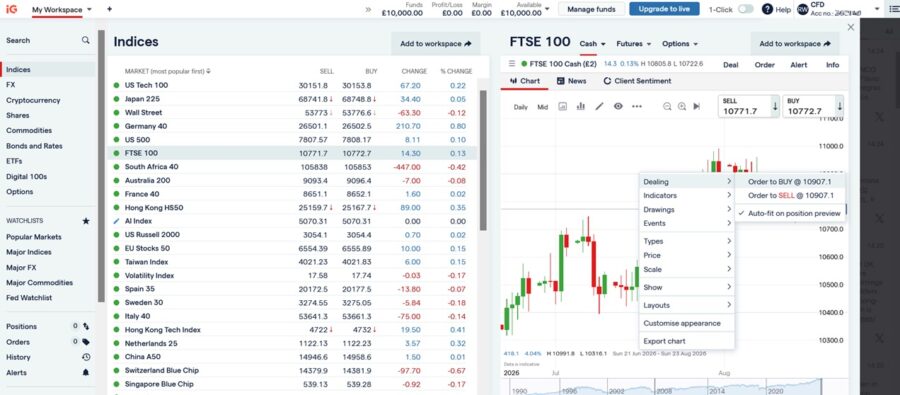
Trading a FTSE 100 CFD using IG’s platform. Source: IG
Range Of Markets
Do you want to directly trade FTSE 100 stocks or ETFs that track movements in the index? Is your plan to use leverage to boost your exposure, a strategy that’s better suited to using derivatives (like futures, options or CFD contracts)?
Perhaps you plan to use both. The path you take may significantly impact your choice of broker, as service providers don’t offer uniform access.
Pro tip: If you plan to trade the UK’s large-cap shares, think about using a broker that also provides access to the FTSE 250. This index comprises the 250 largest companies outside the FTSE 100.
This is because companies frequently move between the two indices when FTSE Russell – the London Stock Exchange Group’s global index business — carries out its quarterly reviews. That’s not all -if you’re into trading quality, market-leading companies with robust growth potential and/or strong dividend profiles, the FTSE 250 may also be a happy hunting ground for you.
Top FTSE 100 broker for range of markets: Interactive Brokers offers one of the widest product selections out there, providing exposure to hundreds of global indices and securities exchanges.
If you’re a FTSE 100 investor, you can trade stocks and ETFs directly on the LSE. What’s more, Interactive Brokers – unlike many other service providers – lets investors buy fractional shares on a host of UK companies.
Interactive Brokers also offers a broad suite of derivatives linked to the index. These include futures, options and CFDs.
How Can I Begin Trading The FTSE 100?
To begin trading FTSE 100 stocks, ETFs or derivatives, I’ll need to complete the following three steps:
1. Compare brokers. This is the most taxing stage of the process in terms of time and effort. But if I get this right, I can significantly improve my trading experience and investing returns. The four items described above (costs, trading platform, asset range and regulatory status) are essential things to check. But that’s just a taster – other popular items investors look out for include low minimum deposits, access to margin trading, and (increasingly) availability of AI tools.
2. Open an account. With my broker selected, I’ll need to submit sensitive personal information to open a live trading account (for a demo account, just an email address may suffice). Name, date of birth, and place of residence are just a few things I’ll be asked. I’ll also be required to answer questions about my investing experience and objectives if I’m in a region with strict financial regulations like the UK.
3. Deposit cash. Naturally, I’ll need money in my trading account to start trading for real. Depending on the broker, I may have a range of deposit methods available to me, including bank transfer (such as from British banks like NatWest), debit card, digital wallet (like Apple Pay) and payment service providers (such as PayPal).
What Is The FTSE 100?
The FTSE 100 is the flagship stock market index on the LSE. Established in 1984, the Footsie was founded by the Financial Times and the LSE to track the performance of the UK’s largest and most liquid listed companies.
As its name implies, the index comprises 100 blue riband companies, representing roughly 80% of the entire market capitalization of the FTSE All-Share Index. This comprises 500-plus companies spanning the FTSE 100, FTSE 250 and FTSE SmallCap indices.
The FTSE 100 contains a varied selection of companies, though it is best known for its high weighting of pharmaceutical manufacturers, oil producers, consumer goods manufacturers, banks and other financial services providers.
Some of the Footsie’s most popular shares include:
- UK retail bank Lloyds.
- Drinks manufacturer Diageo.
- Fossil fuel producer Shell.
- Legal & General, which provides asset management, life insurance and pension products.
- Drugs manufacturer AstraZeneca.
- Diversified engineer Rolls-Royce.
- Global banking services provider HSBC.
- Anglo American, a major producer of copper, iron ore and crop nutrients.
- Electricity network and grid operator National Grid.
- Consumer staples manufacturer Unilever.
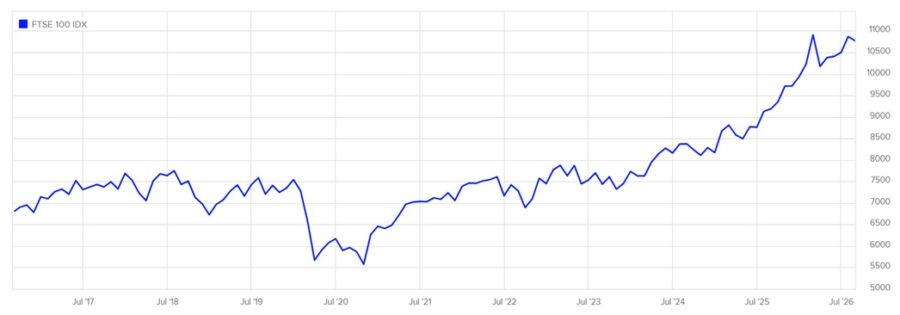
The long-term performance of the FTSE 100 index Source: LSE
How Can I Trade The FTSE 100?
The FTSE 100 is one of the world’s best-known and most widely followed stock indices. As a consequence, brokers offer a variety of ways that investors can gain exposure.
Traders can buy and sell individual stocks on the FTSE 100, or they can buy an ETF that tracks the broader index. These funds are available to trade on the LSE as well as international exchanges including the Hong Kong Stock Exchange (HKEX) and Deutsche Boerse.
Pro tip: Funds like the Vanguard FTSE 100 UCITS ETF can provide a low-cost way to get exposure to the whole index (the charge for this particular fund is below 0.1% of the total value of your holdings annually). This diversified approach helps spread risk, though returns can be lower than those achieved by successfully picking individual shares.
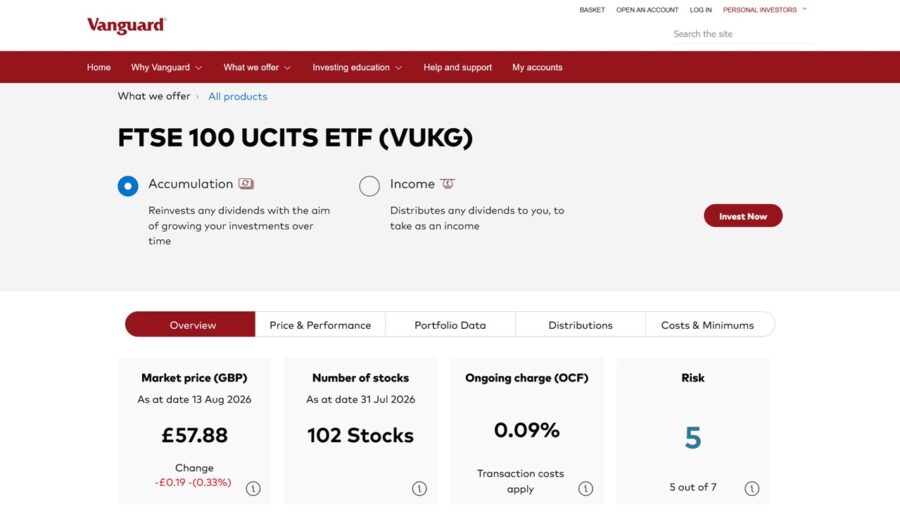
The Vanguard FTSE 100 ETF. Source: Vanguard
Some ETFs also allow investors to go ‘short,’ meaning they can profit when the FTSE 100 falls in value. Fund investors can also use a leveraged fund, a higher-risk product traders use to amplify their exposure. The WisdomTree FTSE 100 2x Daily Short is a fund that blends both of these strategies.
Pro tip: Retail investors can trade FTSE 100 shares and index-related ETFs directly on the LSE during regular stock market hours. These are 8am to 4.30pm UK time Monday to Friday (excluding public holidays).
Investors can also trade derivatives such as futures and options linked to FTSE 100 shares and the broader index. These are not available to buy and sell on the LSE, though they can be found on some overseas securities exchanges like ICE Futures Europe.
Furthermore, traders have the opportunity to use CFDs and spread bets to gain Footsie exposure. These products usually change hands over-the-counter (OTC) rather than on regulated exchanges.
These have many of the same advantages and disadvantages as exchange-traded derivatives. Investors can go both ‘long’ and ‘short,’ and don’t have to bother with holding any underlying asset. But they also lose certain benefits, like the possible receipt of dividend income and shareholder voting rights.
Bottom Line
Investors have an enormous selection of brokers to choose from when trading the FTSE 100, whether by purchasing stocks and ETFs directly on the LSE, or by dealing in derivatives that are linked to Footsie assets.
Whichever brokerage you select, it’s critical to check that they are authorized by a top-level national regulator like the UK’s FCA. This is essential to minimize the chances of you becoming a victim of fraud or poor business practices.