

Best Dubai Financial Market (DFM) Brokers 2026
Discover the best brokers for trading on the Dubai Financial Market (DFM) following our rigorous hands-on testing. Some of these platforms may offer indirect access to the DFM via derivatives. They may not be regulated by the UAE’s SCA, but by other respected regulators overseas bodies.
 Written By
Royston Wild
Royston is a seasoned investor and financial writer with over a decade of experience analyzing brokers and investment markets. With a background in stocks, commodities, and forex reporting - he brings a fresh perspective to broker evaluations.
Royston Wild Profile Page Fact Checked By
Tobias Robinson
Tobias is committed to helping traders find the right brokerage for their needs. He has tested 200+ brokers, spent 2,600+ hours using different platforms, and placed 2,100+ trades.
Tobias Robinson Profile Page Edited By
James Barra
James is an experienced broker analyst with a background in financial services. He has spent 2,500+ hours testing brokers, used 35+ different platforms and apps, audited 120+ broker T&Cs, and verified 300+ regulatory licenses. James has also been on US and UK TV, and been a guest on finance podcasts, discussing reports conducted by BrokerListings.com and sharing his expertise.
James Barra Profile PageOctober 14, 2026
Filters
How We Chose The Best Brokers For Trading On The DFM
We ranked the best brokers for access to the Dubai Financial Market by firstly confirming access via their trading platforms.
Providers were then sorted by their overall ratings, which weigh over 200 data points and the hands-on findings of our team, which includes experienced stock traders.
What Is The Dubai Financial Market?
The Dubai Financial Market (DFM) is one of the three main financial securities exchanges in the United Arab Emirates (UAE).
Founded in 2000, the DFM was the first stock exchange to be established in the seven-nation-strong Emirates region. It was followed later that year by the Abu Dhabi Securities Exchange (ADX), and then by the Dubai International Financial Exchange (now Nasdaq Dubai) in 2005.
Unlike Nasdaq Dubai, the DFM is not located within the Dubai International Financial Centre (DIFC). This reflects its focus on local and regional traders rather than international investors, and means regulations and less closely aligned with those in other global trading hubs like New York, London and Tokyo.
Ways To Trade The Dubai Financial Market
Investors can trade a wide range of financial securities on the DFM, including:
- Stocks.
- Indices.
- Exchange-traded funds (ETFs).
- Real estate investment trusts (REITs).
- Stock, index and oil derivatives (futures).
- Carbon credits.
- Bonds (including Sukuk bonds).
Pro tip: Sukuk bonds are financial securities that comply with Islamic Law. Rather than generating interest for holders like other bonds, they deliver a profit from the underlying asset, aligning them with Sharia principles.
Unlike the internationally flavored Nasdaq Dubai, the DFM specializes in the trading of shares in Dubai-based companies. As a consequence, the number of listings is modest compared with those of major stock exchanges.
The exchange’s benchmark index is the DFM General Index (DFMGI). It tracks the performance of all listed companies on the DFM, and therefore is considered an accurate barometer of Dubai’s stock market.
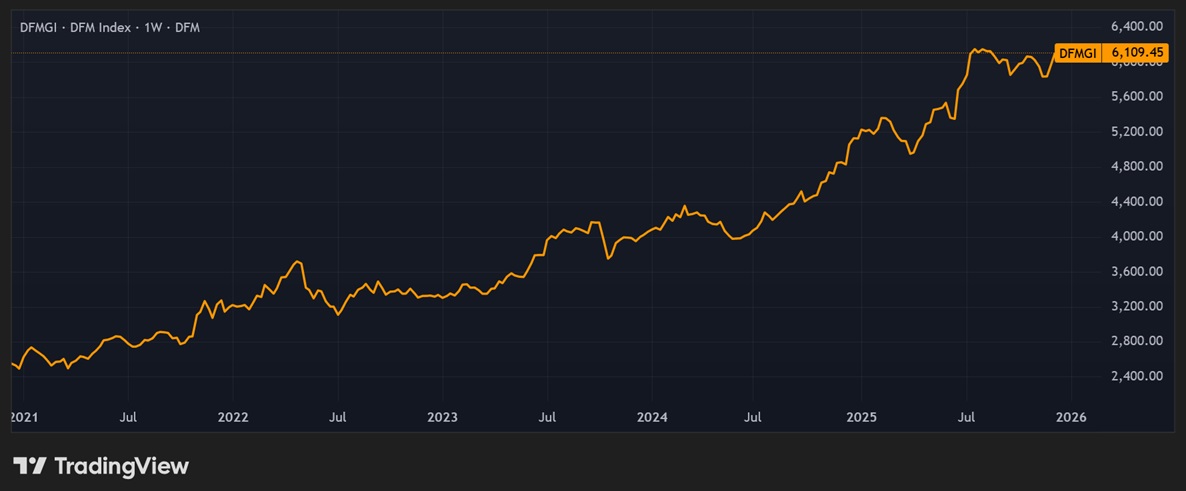
Price chart for the DFMGI. Source: TradingView
Some of its biggest names include bank Emirates NBD, the Dubai Electricity and Water Authority and real estate developer Emaar Properties.
Searching For A DFM Broker
To facilitate trading of DFM-listed securities, a brokerage must typically:
- Hold a license with the UAE’s Securities and Commodities Authority (SCA), the local regulator.
- Be registered as a member of the DFM.
Pro tip: Traders can quickly check whether the broker they’re considering can facilitate trading on the DFM using the regulator’s online Brokers Directory.
However, these rules aren’t set in stone, and some popular, internationally recognized brokers which have neither of these accreditations also offer DFM-listed securities.
eToro, for instance, allows traders to deal in around 10 large and highly liquid stocks on the exchange.
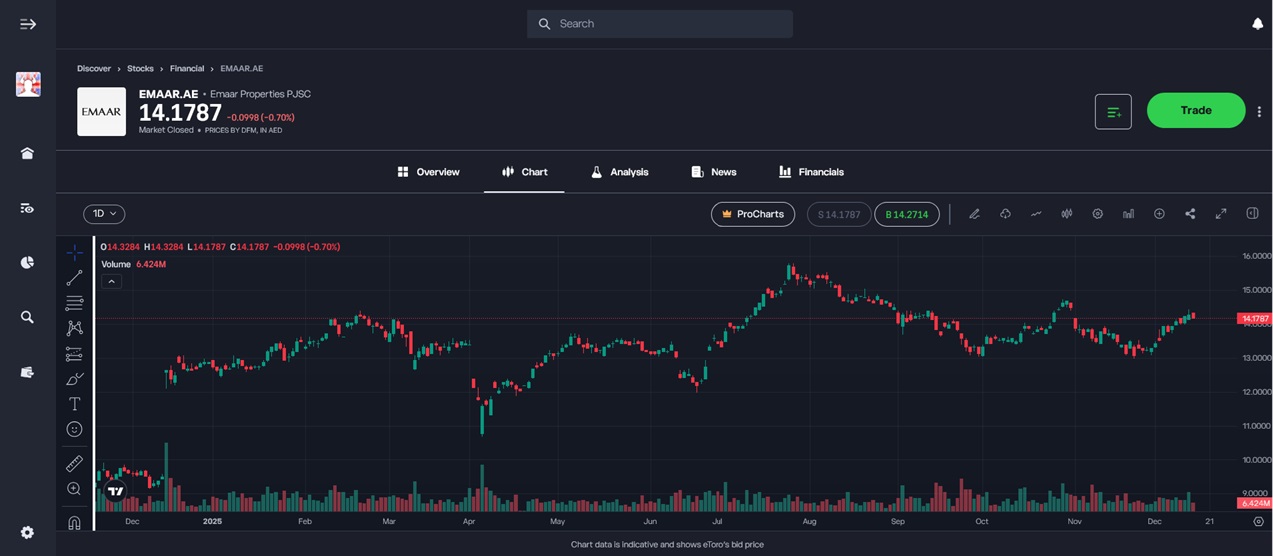
Trading Emaar Properties shares on eToro. Source: eToro
Pro tip: Though the number of brokers offering direct DFM access is limited, investors can also get indirect access to Dubai-based securities via other financial products that are widely available.
For example, a number of brokerages offer the iShares MSCI UAE ETF, a Nasdaq traded fund that provides exposure to dozens of listed shares in the Emirates. The Chimera JP Morgan UAE Bond UCITS ETF, meanwhile, is an ADX-listed fund comprising corporate, quasi-sovereign and sovereign bonds.
How To Choose A Broker To Trade The Dubai Financial Market
Once you’ve found a broker to use, there are several key things to consider before opening an account. These include:
Trustworthiness
Given the surge of fraudulent activity in the financial services arena, it’s critical to check the broker you’re considering is listed on the SCA’s directory mentioned above.
However, this is the bare minimum requirement for modern traders. This is because – under BrokerListings.com’s Regulator Ranking System – the UAE’s local regulator is classified as a Category B watchdog.
This means investors can expect a ‘good’ rather than ‘excellent’ level of protection. For this reason, it’s important to find a broker that’s also received approval from one of the world’s top-tier regulators.
As we’ve also mentioned, some top brokers don’t hold licenses from Dubai’s local regulator.
eToro is one of the most highly regulated brokers out there. While not licensed by Dubai’s SCA, it has gained approval from several of the world’s most respected regulators. These include the UK’s Financial Conduct Authority (FCA), the Australian Securities and Investments Commission (ASIC), and the Cyprus Securities and Exchange Commission (CySEC).
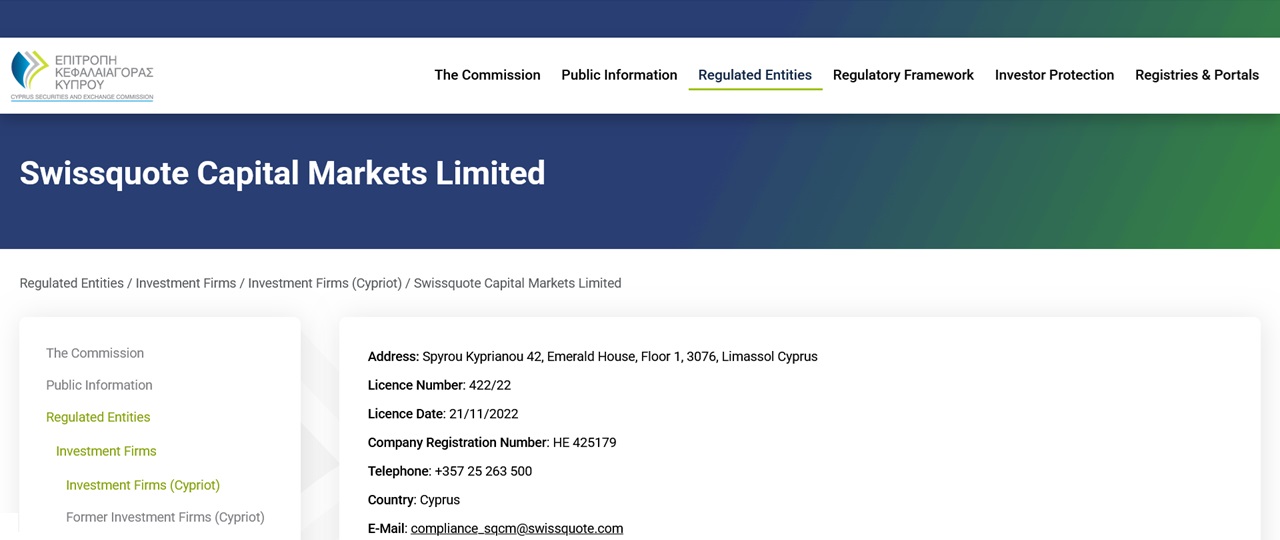
Swissquote is licensed by CySEC. Source: CySEC
Trading Platform
What constitutes the best platform can differ substantially among traders. Certain platform features are particularly important, including:
- Fast execution speeds.
- Access to real-time pricing.
- A highly customizable interface.
- Availability of advanced charting tools.
- Robust security features.
However, other factors are more subjective – one platform’s color scheme and menu structure might work for some traders but be a big turn off for others. Furthermore, other platform features like the availability of mobile apps and automated trading bots – may not be relevant for everyone.
It can therefore be a good idea to choose a broker that offers a demo account. Trading simulators allow you to road test the platform before participating in Dubai’s financial markets.
Pro tip: If you’re wishing to use a third-party platform (like MetaTrader 5 (MT5) or TradingView), you’ll need to check that the broker’s system is compatible.
Range of Assets
The main asset classes on offer tends to be broadly similar across brokerages. Stocks, ETFs, indices, forex, commodities and derivatives are offered by almost all financial services providers.
However, the range of assets on offer within these categories can differ considerably. For instance, IG offers trading on more than 15,000 markets across the globe, giving traders a wealth of opportunities to turn a profit.
Dealing Costs
In order to protect consumers, brokers who operate in highly regulated territories must publish easy-to-follow and comprehensive lists of charges traders can expect. These include transaction charges, deposit fees, withdrawal costs and inactivity fees.
As you can see, the range of things brokers charge for is extensive. And investors don’t just need to take notice of headline charges like these. Wide bid (buy) and offer (sell) prices can also eat into traders’ profits.
Some brokers who charge low (or even zero) fees may end up being more expensive for traders due to their enormous bid-offer spreads. Traders need to carefully add everything up, then, when deciding the most cost-effective trader for them.
Pro tip: UAE-based traders can try to reduce costs by using a broker that offers trading using the dirham (AED). Buying and selling with the Emirates’ local currency removes the problem of unnecessary currency conversion fees.
How To Begin Trading The Dubai Financial Market
There are five key steps an investor like me can expect when they begin trading on the DFM:
- Finding a broker. The market is huge, and so – using the tips described above – I’ll spend some time looking for the best broker for my trading needs.
- Opening an account. With my broker now chosen, I’ll need to provide some personal information, including uploading digital copies of ID documentation and proof of address. In line with industry regulations, I’ll also be asked questions on my investing goals and trading experience.
- Depositing some cash. I won’t be able to trade on the DFM without having money in my account. Different brokers don’t all offer the same way of depositing cash, but popular methods include bank transfer, debit card payment, Bitcoin transaction, digital wallet payment (such as through Apple Pay) and third-party transaction (using platforms like PayPal).
With some money on account, it’s time to begin trading. But I won’t jump straight in – I’ll first devise an investing strategy based on my tolerance of risk and objectives, then once I’m ready use risk management tools to boost my potential profits and reduce risk.
I’ll also closely monitor the market to identify the best times to open and close positions, in line with my broader strategy. Automated trading tools and bots can save me a lot of time having to watch the market myself, and will trade on my behalf according to my instructions.
Bottom Line
Whether seeking direct or indirect access to the DFM, it’s critical to ensure the brokerage you use is licensed to trade by a top-tier regulator. It’s also important to consider things like trading costs, asset ranges and broker platforms to improve your trading experience and boost your chances of making a tidy profit.