
Best Brokers With KRW Accounts 2026
Dig into our top brokers offering South Korean won (KRW) based trading accounts, cutting conversion fees and enhacing the experience for traders in South Korea.
 Written By
Royston Wild
Royston is a seasoned investor and financial writer with over a decade of experience analyzing brokers and investment markets. With a background in stocks, commodities, and forex reporting - he brings a fresh perspective to broker evaluations.
Royston Wild Profile Page Fact Checked By
James Barra
James is an experienced broker analyst with a background in financial services. He has spent 2,500+ hours testing brokers, used 35+ different platforms and apps, audited 120+ broker T&Cs, and verified 300+ regulatory licenses. James has also been on US and UK TV, and been a guest on finance podcasts, discussing reports conducted by BrokerListings.com and sharing his expertise.
James Barra Profile Page Edited By
Tobias Robinson
Tobias is committed to helping traders find the right brokerage for their needs. He has tested 200+ brokers, spent 2,600+ hours using different platforms, and placed 2,100+ trades.
Tobias Robinson Profile PageOctober 9, 2026
Filters
How We Choose The Top KRW Brokers
Our comprehensive testing process comprises four steps:
- Opening a trading account with each brokerage in our expanding database. We then record the companies that allow trading using the South Korean won (KRW) as the base currency.
- Establishing that each broker is licensed by a respected national regulator. BrokerListings.com has devised its own detailed ranking system to make locating reputable regulators easier.
- Regularly re-checking each broker’s authorized status, as regulators can suspend and withdraw licenses when they have identified misconduct.
- Scoring brokers on other factors like trading costs, the range of tradeable assets on offer, the amount of leverage traders can use, and how user-friendly and sophisticated the trading platform is.
What Is A KRW Account?
Retail investing in South Korea has taken off since the 2020 pandemic, so much so that active traders are commonly (and affectionately) known as ‘Donghak Ants.’ Their numbers surged around that time as Korean citizens rallied behind domestic stocks listed on the Korea Exchange (KRX).
Certain brokers allow traders to deposit and withdraw cash using KRW-denominated accounts. They have several benefits for individuals, including:
- Helping them avoid FX conversion costs when making deposits and withdrawals.
- Reducing their exposure to volatility on currency markets. The KRW can become choppy when, for instance, disappointing economic data from key trading partners (like China) is released.
- Transferring money into and out of your account is easier. Brokers providing won-based accounts often support local payment methods, including online payment providers (such as Kakao Pay) and digital wallets (like Toss).
- Trading KRW-priced securities doesn’t require converting your money into foreign currencies. Korean financial assets that are priced in won include shares, bonds, exchange-traded funds (ETFs), and derivatives like futures and options on the KRX.
How Do I Open A KRW Account?
Investors who wish to open a KRW account must follow these five steps:
1. Find A Broker
Only a limited number of brokers offer South Korean traders the ability to open accounts using the won. Yet characteristics including trading charges, the size of the spreads, the functionality of the trading platform and the range of tradeable securities can still differ substantially. Consider all of this when choosing a service provider.
Pro tip: South Korea’s capital markets are regulated by:
- The Financial Services Commission (FSC), which draws up financial services regulations and issues licenses to companies including brokers, banks and insurers.
- The Financial Supervisory Service (FSS), which supervises the conduct of authorized firms and carries out enforcement actions — such as financial penalties and license suspensions or revocations — when misconduct is identified.
However, both the FSC and FSS are considered Category B organizations on BrokerListings.com’s trust database. This means traders can expect good levels of protection from scams and bad business practices, though not to the same extent as under leading global regulators.
As a result, we’d suggest using a broker that’s received approval from a Category A regulator under our rankings. Examples include the US Securities and Exchange Commission (SEC), the Monetary Authority of Singapore (MAS) and Japan’s Financial Services Agency (FSA). Top-tier regulators like these typically maintain an easy-to-search database of regulated service providers.
2. Registering For An Account
You’ll need to provide basic personal details like your name, address, date of birth, and email address to open an account. Furthermore, to meet regulatory standards you’ll also be quizzed on items like your investing experience, the source of your funds, your trading objectives and your tolerance of risk.
You’ll also need to upload proof of address and identification to the broker. However, this may not be required until you’re ready to deposit money.
3. Selecting KRW As Your Base Currency
After you’ve opened your account, you may find the brokerage has automatically opened an account for you using a major currency (like the US dollar (USD), euro (EUR) or British pound (GBP)).
In these cases, you’ll need to navigate the trading platform to manually select a KRW-based account. It’s a minor inconvenience that usually takes less than a couple of minutes to complete.
4. Depositing Some Money
Brokers typically accept several methods of payment from customers. These may include:
- Bank transfer (for instance, from the KB Kookmin Bank).
- Debit card (such as BCcard).
- Online payment provider.
- Digital wallet.
5. Begin Trading
You’ll be able to start trading Korean and overseas markets as soon as the funds reach your account.
Example Of Opening A KRW Trading Account
Exness has been offering financial services since the late 2000s, and holds licenses with several global regulators including the UK’s Financial Conduct Authority (FCA) and the Cyprus Securities and Exchange Commission (CySEC).
Authorization from these particular regulators is especially important. The reason? Both are considered Category A organizations by BrokerListings.com. They have licensed Exness for the services it provides in the UK and the European Union to institutional clients.
Here is the process I followed when opening a won-based trading account with Exness:
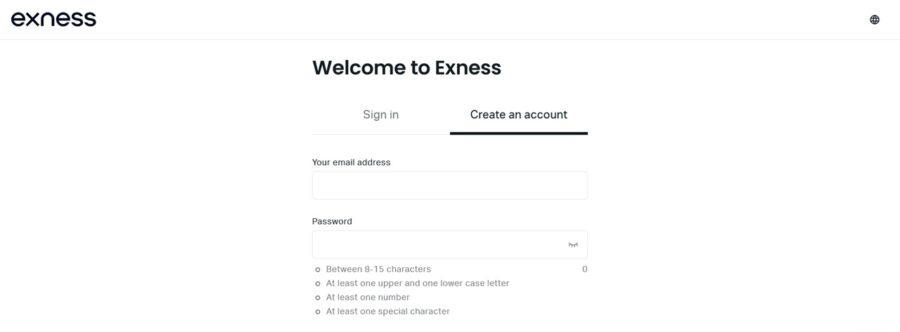
Registering with Exness to open an account
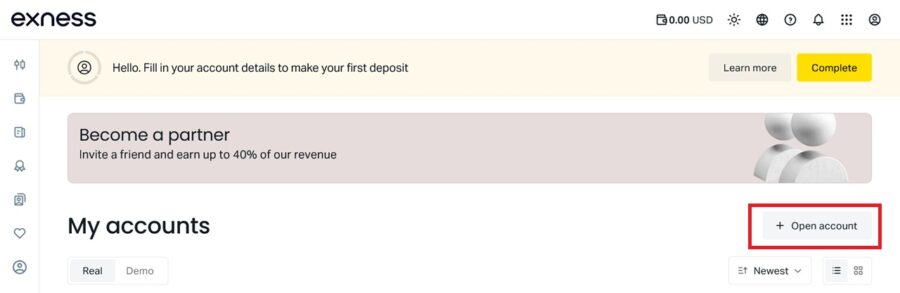
Opening a new Exness trading account
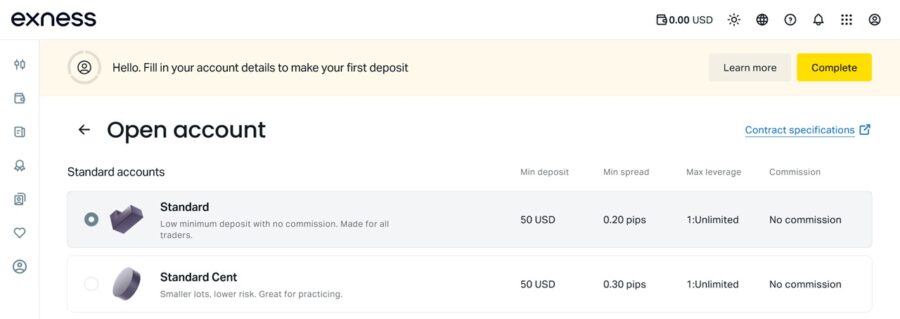
The various types of Exness trading account
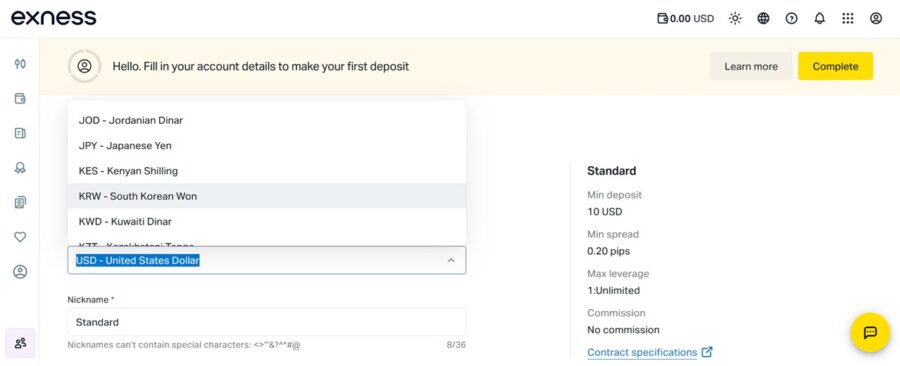
Choosing the KRW as my new account’s base currency
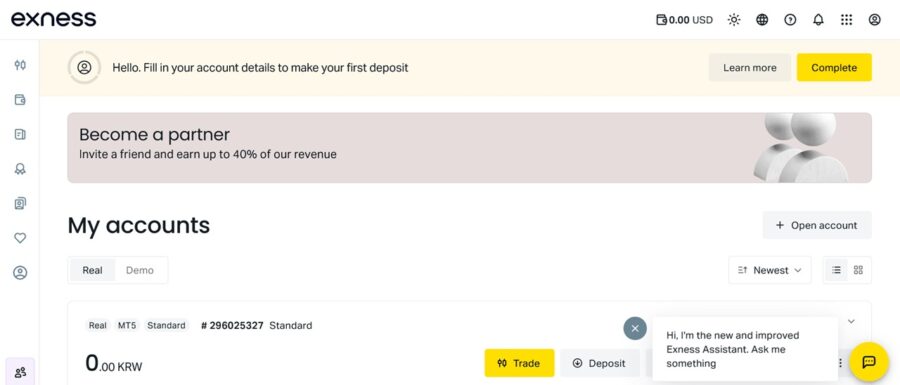
My new Exness KRW account
Should I Use A KRW Trading Account?
Some of the benefits won-based accounts offer traders in South Korea include:
- Bank transfers to and from local banks (like Shinhan Bank) can be processed more simply and quickly. This is because payments don’t pass through international banking channels and aren’t subject to conversions to and from overseas currencies.
- Trading and portfolio management are simpler when you’re using a familiar currency you use every day.
- Avoidance of FX conversion fees, which can escalate over time.
What Are The Problems Of Using A KRW Account?
That said, using the KRW can have drawbacks, including:
- You’ll have fewer brokers to choose from, meaning you may have to settle for a service provider that offers fewer benefits or higher costs than if you used a company that doesn’t offer won-based accounts.
- You’ll still face forex conversion fees if you’re trading assets that are priced in other currencies. This would happen, for instance, if you traded on the Singapore Exchange (SGX), where listed securities are denominated in the USD, EUR, Singapore dollar (SGD), Hong Kong dollar (HKD), Chinese yuan (CNY) and Australian dollar (AUD).