
Best Nairobi Securities Exchange (NSE) Brokers 2026
Discover the best brokers with direct or indirect access to the Nairobi Securities Exchange (NSE) following our rigorous hands-on testing.
 Written By
Royston Wild
Royston is a seasoned investor and financial writer with over a decade of experience analyzing brokers and investment markets. With a background in stocks, commodities, and forex reporting - he brings a fresh perspective to broker evaluations.
Royston Wild Profile Page Fact Checked By
Tobias Robinson
Tobias is committed to helping traders find the right brokerage for their needs. He has tested 200+ brokers, spent 2,600+ hours using different platforms, and placed 2,100+ trades.
Tobias Robinson Profile Page Edited By
James Barra
James is an experienced broker analyst with a background in financial services. He has spent 2,500+ hours testing brokers, used 35+ different platforms and apps, audited 120+ broker T&Cs, and verified 300+ regulatory licenses. James has also been on US and UK TV, and been a guest on finance podcasts, discussing reports conducted by BrokerListings.com and sharing his expertise.
James Barra Profile PageOctober 14, 2026
-
1Interactive Brokers (IBKR) is a leading brokerage offering access to over 170 markets in 40 countries and a range of investment services. With 40+ years in the industry, this Nasdaq-listed company follows strict regulations by the SEC, FCA, CIRO, SFC, Europe and beyond, making it a trusted global trading broker.
Compare Brokers
| Broker |  |
USD Account |
Demo Account |
Minimum Deposit |
Minimum Trade |
Leverage |
Copy Trading |
Regulator |
Instruments |
Platforms |
Account Currencies |
Automated Trading |
AI |
Guaranteed Stop Loss |
|---|---|---|---|---|---|---|---|---|---|---|---|---|---|---|
 |
✓ | ✓ | $0 | $1 | 1:50 (major forex pairs), 1:2-1:4 (equities) | ✗ | SEC, FINRA, CFTC, NFA, CIRO, FCA, CBI, ASIC, SFC, SEBI, JFSA, MAS | Stocks, Options, Futures, Forex, Funds, Bonds, ETFs, Mutual Funds, Cryptocurrencies, CFDs Stocks, Options, Futures, Forex, Funds, Bonds, ETFs, Mutual Funds, Cryptocurrencies | Trader Workstation (TWS), IBKR Desktop, GlobalTrader, Mobile, Client Portal, AlgoTrader, OmniTrader, TradingView, eSignal, TradingCentral, ProRealTime, Quantower | USD, EUR, GBP, CAD, AUD, INR, JPY, SEK, NOK, DKK, CHF, AED, HUF | TWS API | ✓ | ✗ | |
| Broker | |
USD Account |
Demo Account |
Minimum Deposit |
Minimum Trade |
Leverage |
Copy Trading |
Regulator |
Instruments |
Platforms |
Account Currencies |
Automated Trading |
AI |
Guaranteed Stop Loss |
Safety Comparison
Compare how safe the Best Nairobi Securities Exchange (NSE) Brokers 2026 are.
| Broker | Trust Rating |
Guaranteed Stop Loss |
Negative Balance Protection |
Segregated Accounts |
|---|---|---|---|---|
|
✗ | ✗ | ✓ | |
| Broker | Trust Rating |
Guaranteed Stop Loss |
Negative Balance Protection |
Segregated Accounts |
Mobile Trading Comparison
Compare the mobile trading features of the Best Nairobi Securities Exchange (NSE) Brokers 2026.
| Broker | Mobile Apps |
iOS Rating |
Android Rating |
Smart Watch App |
|---|---|---|---|---|
|
iOS & Android | ✓ | ||
| Broker | Mobile Apps |
iOS Rating |
Android Rating |
Smart Watch App |
Comparison for Beginners
Compare how suitable the Best Nairobi Securities Exchange (NSE) Brokers 2026 are for beginners.
| Broker | Demo Account |
Minimum Deposit |
Minimum Trade |
Education Rating |
Support Rating |
Fractional Shares |
Demo Competitions |
|---|---|---|---|---|---|---|---|
|
✓ | $0 | $1 | ✓ | ✗ | ||
| Broker | Demo Account |
Minimum Deposit |
Minimum Trade |
Education Rating |
Support Rating |
Fractional Shares |
Demo Competitions |
Comparison for Advanced Traders
Compare how suitable the Best Nairobi Securities Exchange (NSE) Brokers 2026 are for advanced or professional traders.
| Broker | Automated Trading |
VPS |
API |
AI |
Pro Account |
Leverage |
Low Latency |
Extended Hours |
|---|---|---|---|---|---|---|---|---|
|
TWS API | ✗ | ✓ | ✓ | ✗ | 1:50 (major forex pairs), 1:2-1:4 (equities) | ✓ | ✓ |
| Broker | Automated Trading |
VPS |
API |
AI |
Pro Account |
Leverage |
Low Latency |
Extended Hours |
Accounts Comparison
Compare the trading accounts offered by Best Nairobi Securities Exchange (NSE) Brokers 2026.
| Broker | Demo Account |
Interest on Cash |
Islamic Account |
Joint Account |
Managed Account |
PAMM |
MAM |
LAMM |
Pro Account |
|---|---|---|---|---|---|---|---|---|---|
|
✓ | USD: 3.14%, GBP: 3.24% | ✗ | ✓ | ✓ | ✗ | ✓ | ✗ | ✗ |
| Broker | Demo Account |
Interest on Cash |
Islamic Account |
Joint Account |
Managed Account |
PAMM |
MAM |
LAMM |
Pro Account |
Detailed Rating Comparison
Compare how we rated the Best Nairobi Securities Exchange (NSE) Brokers 2026 in key areas.
| Broker | Trust |
Platforms |
Assets |
Mobile |
Fees |
Accounts |
Research |
Education |
Support |
|---|---|---|---|---|---|---|---|---|---|
|
|||||||||
| Broker | Trust |
Platforms |
Assets |
Mobile |
Fees |
Accounts |
Research |
Education |
Support |
Fee and Cost Comparison
Compare the cost of trading with the Best Nairobi Securities Exchange (NSE) Brokers 2026.
| Broker | Cost Rating |
Fixed Spreads |
Inactivity Fee |
EUR/USD Spread |
Crypto Spread |
|---|---|---|---|---|---|
|
✗ | $0 | 0.08-0.20 bps x trade value | 0.12%-0.18% | |
| Broker | Cost Rating |
Fixed Spreads |
Inactivity Fee |
EUR/USD Spread |
Crypto Spread |
Customer Ratings
Compare how customers of these brokers feel about them, with real user ratings from Trustpilot, the Apple App Store and Google Play.
| Broker | Customers |
Trustpilot Score |
Trustpilot Reviews |
Android App Rating |
iOS App Rating |
|---|---|---|---|---|---|
|
4,300,000 | 5,526 | |||
| Broker | Customers |
Trustpilot Score |
Trustpilot Reviews |
Android App Rating |
iOS App Rating |
Broker Popularity
See how popular the Best Nairobi Securities Exchange (NSE) Brokers 2026 are in terms of number of clients.
| Broker | Popularity |
|---|---|
| Interactive Brokers |
|
Why Trade With Interactive Brokers?
Interactive Brokers is ideal for seasoned traders due to its robust charting platforms, updated data, and adaptability, especially with the IBKR Desktop application. Its exceptional pricing and advanced order features appeal to traders, and its variety of stocks remains unmatched in the market.
Pros
- IBKR is a highly regarded brokerage, regulated by multiple respected authorities. This speaks to its legitimacy and standing within the online trading industry, providing peace of mind.
- There's a large selection of free or paid research subscriptions available to all traders. If you subscribe to Toggle AI, you will also receive commission refunds from IBKR.
- The TWS platform is designed for intermediate to advanced traders. It includes over 100 order types and a dependable real-time market data feed that rarely experiences downtime.
Cons
- TWS is complex, and beginners might find it difficult to use and understand all its features.
- Customer service may take time to respond, and there may be delays in fixing problems based on tests. It could be difficult to reach the customer service promptly.
- In 2025, IBKR was fined $11.8 million by the US OFAC for offering services in restricted areas. It also faced a $125,000 fine from FINRA in 2025 for failing to disclose municipal bond information.
Filters
How We Chose The Best Brokers For Trading On The Nairobi Securities Exchange (NSE)
We ranked the best brokers for access to Kenyan markets, focusing on platforms that offer products linked to the Nairobi Securities Exchange (NSE), such as major Kenyan-listed companies and locally listed funds where available.
Given that not many global brokers provide direct access to the KSE, we have also included firms that offer indirect exposure through funds like the VanEck Africa Index ETF (AFK).
For each broker, we confirmed this access ourselves by checking the tradable markets inside the platform and, where needed, cross-checking details with the broker’s support team.
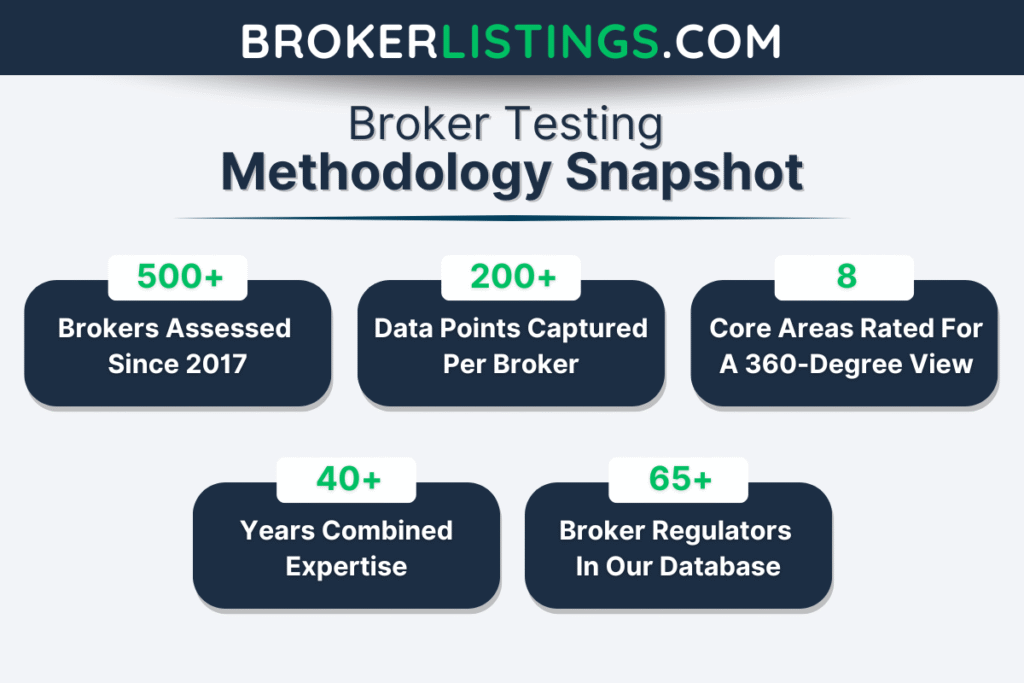
Only brokers that passed these verification steps made our shortlist. We then ordered providers by their overall ratings, drawing on 200+ review metrics and input from our experienced stock traders.
What Is The Nairobi Securities Exchange?
The Nairobi Securities Exchange (NSE) is the principal trading exchange in Kenya and is the top trading venue in East Africa. This reflects Kenya’s position as the region’s largest economy as well as its stable political landscape.
Set up in 1954, the NSE facilitates the trading of stocks, bonds, derivatives, real estate investment trusts (REITs) and exchange-traded funds (ETFs).
The NSE is home to more than 60 companies spanning a multitude of sectors. These include telecoms provider Safaricom, beer manufacturer East African Breweries, financial services specialist Equity Group and electricity producer KenGen.
The NSE 20 Index is Kenya’s benchmark share index, spanning – as the name suggests – the country’s 20 largest stocks by market cap. The NSE All-Share Index, meanwhile, tracks the performance of all listed companies on the exchange.
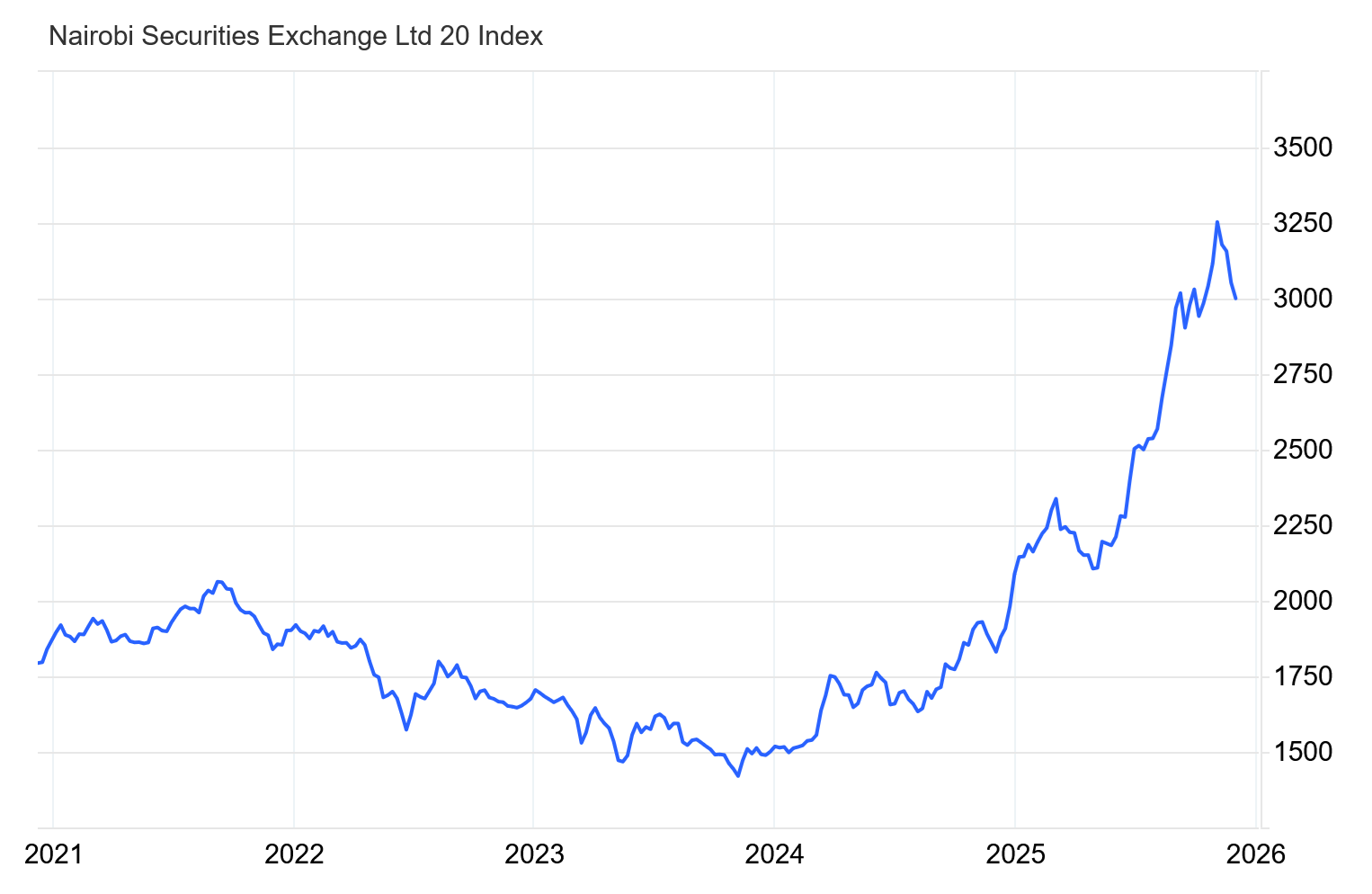
Chart showing the five-year performance of the NSE 20 Index. Source: tradingeconomics.com
Ways To Trade The Nairobi Securities Exchange
Investors can trade individual stocks on the NSE, although liquidity is much lower than that of major global exchanges as well as some continental ones (like the Johannesburg Stock Exchange). This can make it trickier to open and close positions, as well as more expensive due to wider bid and ask spreads.
Pro tip: The NSE introduced reforms in August 2025 to make it easier for retail investors to trade individual shares. Slashing the minimum transaction size of 100 shares to one share was introduced to boost participation in the local stock market by reducing barriers for lower-income investors.
Traders can also deal in ETFs, although the selection is limited to funds that track gold prices or a basket of global equities. Individuals can also buy and sell a small range of government and corporate bonds, and derivatives based on single shares or local equity indices.
The NSE also operates over-the-counter (OTC) trading of shares in private companies.
Choosing A Broker To Trade On The Nairobi Securities Exchange
Key factors to think about when choosing an NSE broker include:
Trustworthiness
Ensuring that your money is well looked after is the most important thing to consider when choosing any financial services company.
It’s critical that the broker you choose is financially robust and can be expected to provide a good level of service. Naturally, it’s also essential that the broker is who they say they are and won’t run off with your cash.
The Capital Markets Authority (CMA) is Kenya’s capital markets regulator, and maintains a list of licensed financial services companies including brokers, fund managers and investment banks.
While checking that a broker is CMA approved is an important step, it’s not a watertight way to avoid bad actors. This is because Kenya’s regulatory regime offers fewer protections than those in other parts of the world.
Under BrokerListings.com’s Regulator Rating System, the CMA has a lowly Category C ranking.
Pro tip: For this reason, investors should consider using brokers that – irrespective of whether they are licensed in Kenya – have received clearance by the highest caliber of regulator. BrokerListings.com’s trust rating provides a list of almost 100 Category A regulators.
Top broker for trustworthiness: Interactive Brokers is regulated by almost a dozen of the world’s most respected regulators. These include the UK’s Financial Conduct Authority (FCA), the Canadian Investment Regulatory Organization (CIRO), and the Financial Industry Regulatory Authority (FINRA) in the US.
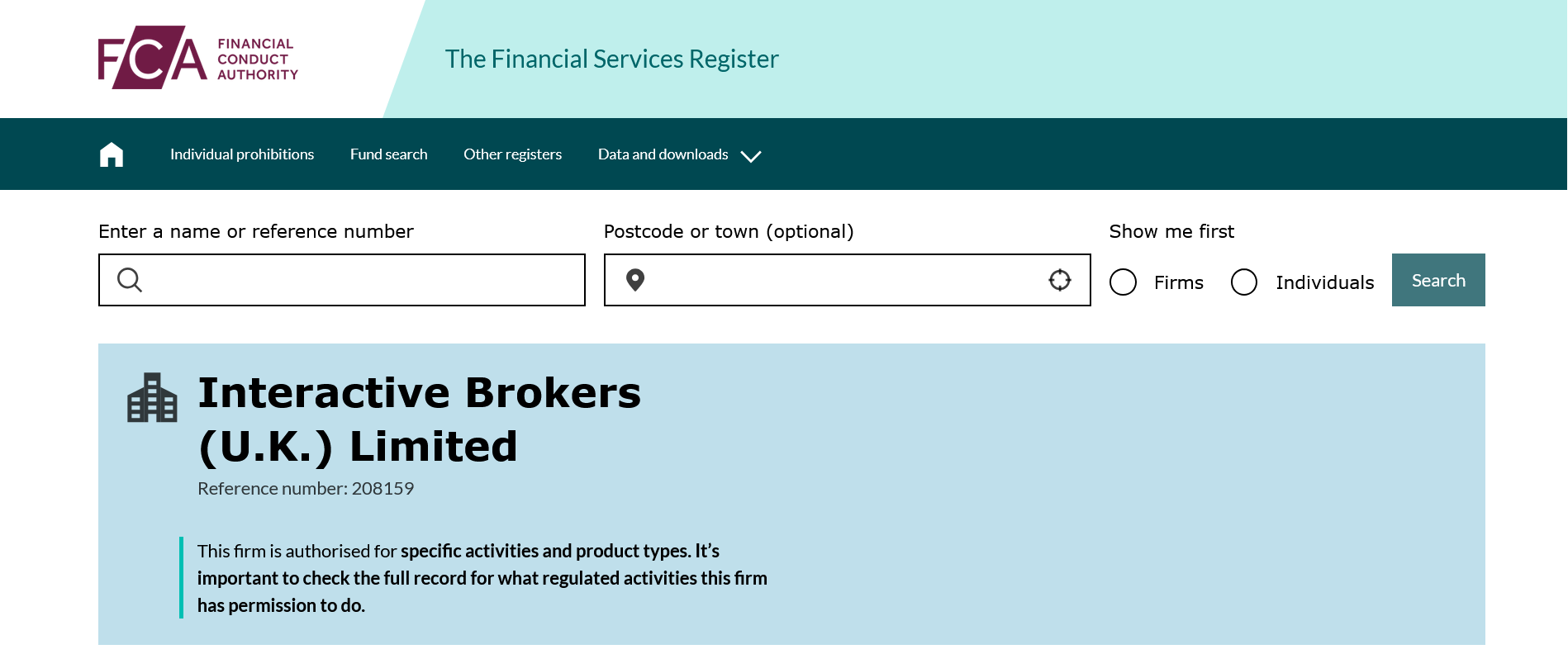
Searching for Interactive Brokers’ profile on the FCA’s register. Source: FCA
Trading Platform
Technological improvements and a high degree of market competition mean the trading experience has improved significantly in recent years.
Many brokers operate their own sophisticated proprietary trading platforms. Some also offer traders the option of plugging third-party software (like TradingView and MetaTrader 5 (MT5)) to execute trades.
Deciding which broker offers the ‘best’ trading platform is highly subjective. However, there are some non-negotiables you’ll want to check before getting on board with a services provider.
You’ll want to ensure that the company offers:
- Fast execution speeds.
- A platform that remains stable even during busy periods.
- Clear, timely data that’s simple to access.
- Extensive market information and research including order book data, news feeds, analyst reports and economic calendars.
- A highly customizable trading dashboard.
- High-quality charts and advanced charting tools.
- Risk management tools (like stop loss orders) that can limit losses and improve profit-making opportunities.
- Excellent customer service that can be easily reached.
Depending on your investing style, you may also want to consider things like whether the broker offers a mobile app; the availability of a demo account; and support for algorithmic trading.
Asset Range
The selection of securities traders can deal in can differ significantly among brokers, even on premier trading arenas like the London Stock Exchange and the Nasdaq in the US.
Asset availability may be even more variable for assets on smaller exchanges like the NSE, where liquidity issues can spring up. You might find it easy to trade Nairobi’s blue-chip companies like Standard Chartered Bank Kenya or those others described above. Trading smaller-cap stocks may be much more of a challenge.
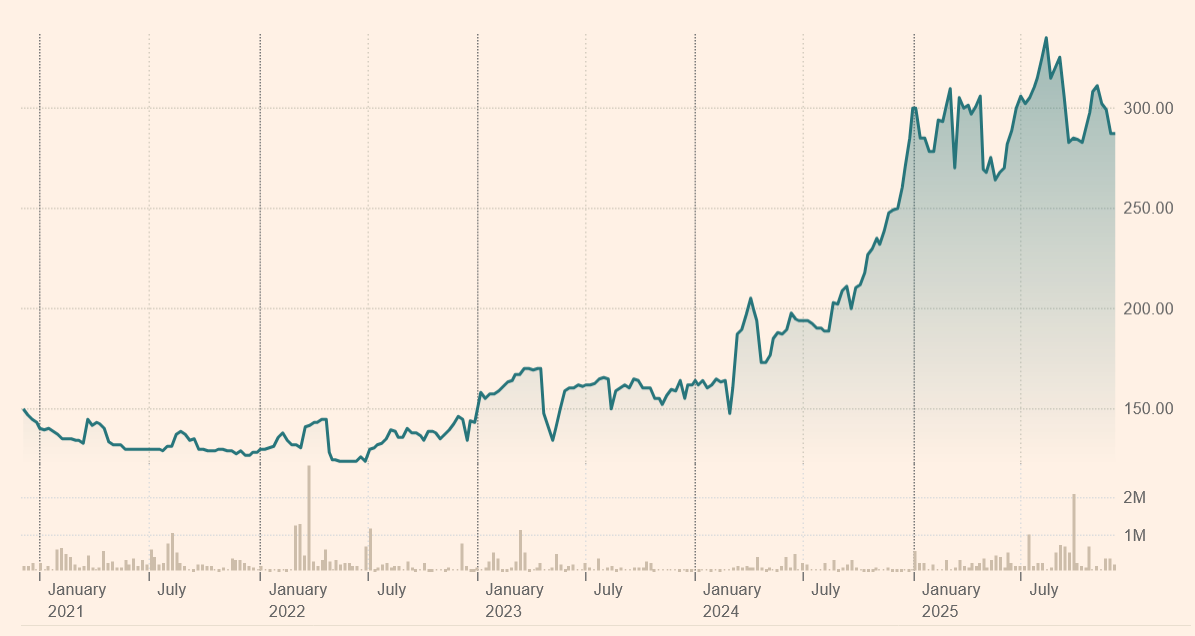
The five-year share price performance of Standard Chartered Bank Kenya. Source: Financial Times
Pro tip: Interactive Brokers has one of the broadest product ranges on the market. Individuals can deal in shares, forex, bonds, ETFs, mutual funds and cryptocurrencies. Derivatives like options, futures, and contracts for difference (CFDs) are also available.
As well as offering its own proprietary trading system, investors can do business with a wide range of third-party platforms including eSignal, TradingView and Trading Central.
Trading Costs
Keeping a cap on dealing expenses is essential. Those who don’t – and particularly those who trade at high frequency – can lose a large portion of their profits lost to their broker.
Pro tip: Reputable brokers should provide extensive information on fees, charges and minimum spreads on their websites.
Traders don’t need to just ponder obvious costs like transaction charges, overnight fees, deposit and withdrawal costs and account charges. It’s also important to consider how wide the broker’s bid and ask spreads are.
A broker that charges commission per trade could actually work out cheaper than one with no transaction fees, if the latter widens its spreads to compensate.
Pro tip: Traders in Kenya should weigh up the benefit of using brokers that offer KES accounts. This is because currency conversion costs can also add up to a pretty penny over time.
How To Begin Trading On The Nairobi Securities Exchange
Largely speaking, the process from initial sign up to live trading is fairly similar across brokerages. If I were to sign up with a local services provider I’d expect the procedure to follow the following steps:
- Find a broker. Using the checklist described above, I’d research the market to find the best services provider for my needs. Finding one that lets me road test their platform with a demo account can help me choose the right broker faster.
- Open an account. The next step involves me submitting some personal details and some ID to prove who I am and where I live. I’ll also be asked some basic questions on my investing experience and objectives as per Know Your Customer rules laid down by regulators.
- Deposit some cash. I’ll need money in my account to buy and sell securities, which will require me to transfer some cash over. This can be done with a bank transfer, a debit card payment, a digital wallet (like Google Pay), a third-party payment provider (such as PayPal), even Bitcoin.
- Start trading. With my account up and running, I’ll be ready to begin dealing on the NSE. But before buying or selling anything, I should familiarize myself with the trading platform and ensure I have risk management strategies in place.
- Watch the market. I should be ready to enter and close positions according to price action. Sticking to my pre-planned investing objectives and avoiding impulsive trades is essential.
Bottom Line
Given Kenya’s large economy and political stability, the NSE can be a great place for traders to do business in East Africa. However, limited protections for investors mean individuals may wish to consider using a broker that’s approved in a region with stricter regulatory rules.
Liquidity issues mean traders should carefully check the range of assets on offer when choosing an NSE broker, along with other factors like dealing costs and the functionality of the trading platform.